De La Soul Stakes Is High Album: The 1996 Masterpiece That Predicted Hip-Hop’s Great Divide
On July 2, 1996, De La Soul released the De La Soul Stakes Is High album into a world that wasn’t ready for it. The same day Nas dropped It Was Written. A week after Jay-Z debuted with Reasonable Doubt. Two months before OutKast’s ATLiens would reshape Southern hip-hop entirely. In the most stacked summer in hip-hop history, three guys from Amityville, Long Island — Kelvin “Posdnuos” Mercer, David “Trugoy the Dove” Jolicoeur, and Vincent “Maseo” Mason — delivered an album so far ahead of its time that the culture is still catching up thirty years later.
This wasn’t a nostalgia trip. It was a warning. And now, with Trugoy gone, the catalog finally free, and the album’s prophecies all but confirmed, Stakes Is High deserves the definitive retrospective it never received.
The De La Soul Stakes Is High Album Dropped on the Worst Possible Day
July 2, 1996 should have been a coronation. Instead, it became a case study in how timing can bury brilliance.
Stakes Is High landed in record stores at the exact same moment as Nas’s It Was Written — the most anticipated sophomore album since Ready to Die. As our deep dive into It Was Written details, Nas was expanding his audience with a glossier, more commercial sound. De La Soul was doing the opposite: stripping down, getting rawer, and openly attacking the direction hip-hop was heading.
The timing was even worse when you zoomed out. Jay-Z’s Reasonable Doubt had arrived just seven days earlier on June 25. OutKast’s ATLiens was two months away. Ghostface Killah’s Ironman would land in October. The East Coast-West Coast beef was consuming every oxygen molecule in hip-hop journalism. As AllMusic critic Vincent Thomas later wrote, the Native Tongues were “seeming nonplayers” in that feud — which meant the media treated them like irrelevant bystanders.
De La’s fourth album debuted with minimal press coverage and modest sales. But there’s a particular kind of record that only grows in stature with each passing year — the kind that sounds like prophecy once you’ve lived through what it warned about. Stakes Is High is that record.
Why De La Soul Broke Up with Prince Paul
Every De La Soul fan knows the trilogy: 3 Feet High and Rising (1989), De La Soul Is Dead (1991), Buhloone Mindstate (1993). All three were produced by Prince Paul, whose pioneering use of skits, absurdist humor, and dense sample collages didn’t just define De La’s sound — they helped invent the architecture of the modern hip-hop album.
So when De La announced they’d make their fourth album without him, it felt like a divorce.
The reality was more nuanced. By 1996, Pos, Dove, and Maseo had grown from teenagers into men in their mid-twenties. The playful daisy-age surrealism that made them famous was a costume they’d outgrown. They’d spent three albums watching Prince Paul’s production genius overshadow their own lyricism, and they needed to prove — to the industry and to themselves — that De La Soul was more than the sum of its samples.
As Albumism’s 25th anniversary retrospective documents, De La produced the majority of Stakes Is High‘s beats themselves. The sonic palette shifted dramatically: gone were Prince Paul’s playful skits and sample-dense mosaics, replaced by heavier funk, soul, and jazz-fusion loops that bore the unmistakable influence of Pete Rock, RZA, and DJ Premier — the NYC production visionaries who defined the mid-90s.
Prince Paul understood the decision. But the creative split was about more than production credits. It was about three artists choosing to grow up on wax, in real time, in front of an audience that wanted them to stay forever young. That took a kind of courage the music press didn’t recognize until years later.
J Dilla’s Breakthrough: The De La Soul Stakes Is High Album Title Track That Changed Everything

The most significant outside contribution to Stakes Is High came from a 22-year-old Detroit producer most of the world hadn’t heard yet: James Dewitt Yancey, credited as Jay Dee, known to history as J Dilla.
Dilla produced the album’s title track — and it’s not an exaggeration to say it changed everything. He sampled Ahmad Jamal’s “Swahililand” for the liquid piano loop and James Brown’s “Mind Power” for the drum foundation, then bent them into something that didn’t sound like any other hip-hop beat in 1996. The rhythm was slightly off-grid, the swing was drunk but deliberate, and the bass pocket was so deep you could lose furniture in it.
For many listeners, this was their first exposure to Dilla’s production. As our exploration of De La Soul and J Dilla’s connection chronicles, this collaboration was the spark that led to Dilla’s work with A Tribe Called Quest, Common, Erykah Badu, and D’Angelo — the constellation of artists who’d coalesce into the Soulquarians movement by the late 1990s.
But Dilla wasn’t the only producer the conventional narrative ignores. Spearhead X (from the group Y’all So Stupid) contributed tracks that blended Atlanta bass energy with Native Tongues sensibility. Skeff Anselm, who’d produced for Leaders of the New School, brought a harder-edged bounce. O.Gee added another dimension. These names appear in the liner notes but have been essentially erased from the album’s public narrative — a gap this piece corrects.
The production across all eighteen tracks is remarkably cohesive for an album with five credited producers. That’s because De La Soul handled the creative direction themselves, using outside contributions as ingredients rather than letting any single producer dominate the palette. It was the first album where they were the architects, and it sounds like it.
Future Legends on the Roster: How Stakes Is High Launched Mos Def and the Soulquarians
Pull up the guest credits on Stakes Is High and you’re looking at a roster of future legends who, in 1996, were almost entirely unknown.
Mos Def — credited as “Mos Def of Medina Green” — appears on “Big Brother Beat,” delivering one of his first prominent recorded performances. This was roughly two years before he’d team with Talib Kweli to form Black Star and three years before Black on Both Sides established him as one of hip-hop’s most gifted MCs. De La essentially put him on.
Common — then still Common Sense — contributed to the album’s creative atmosphere. The record also featured Zhane, the R&B duo whose presence connected De La to the neo-soul world that was just beginning to take shape in Philadelphia and beyond.
Here’s what the standard narrative misses: Stakes Is High wasn’t just an album that happened to feature these artists. It was the social connective tissue that prefigured the entire Soulquarians movement. J Dilla on production. Mos Def on the mic. Common in the orbit. The through-line from this 1996 album to Like Water for Chocolate, Black on Both Sides, Voodoo, and Mama’s Gun is direct and documentable.
If you want to rep the energy of that moment — when conscious hip-hop was building something bigger than any single artist — the De La Soul Stakes Is High tee carries that DNA. Three decades of culture in one design.
AllMusic called Stakes Is High “an antidote” that “ushered in a newer guard of like-minded souls.” That framing is exactly right — but it undersells the scale of what happened. This album didn’t just introduce new artists. It seeded an entire movement.
“I’m Sick of Bitches Shakin’ Asses”: De La Soul’s Warning to Hip-Hop
The title track is where Stakes Is High draws its line in the sand — and where the album earned both its most passionate defenders and its most dangerous enemies.
Trugoy the Dove’s verse is a controlled demolition of mid-90s hip-hop’s direction: “I’m sick of bitches shakin’ asses / I’m sick of talkin’ ’bout blunts, sick of Versace glasses / Sick of slang, sick of half-ass awards shows / Sick of name-brand clothes.” As Genius annotators have catalogued across 134,000+ views, every line targets a specific trend that was consuming the culture in 1996 — the materialism, the violence, the hollow spectacle.
Posdnuos follows with what amounts to a manifesto: “Man, every word I say should be a Hip-Hop Quotable.” And then, in the second verse, comes the line that reads like a political statement: “Sick of R&B bitches over bullshit tracks.” He wasn’t hedging. The Native Tongues didn’t do hedging.
The blowback was swift and real. Tupac Shakur perceived the track as a direct shot and retaliated on “Against All Odds” from his posthumous 1996 album The Don Killuminati: The 7 Day Theory. According to Wikipedia’s documentation, Treach of Naughty By Nature also took offense, creating a feud that lasted approximately fifteen years before finally cooling.
But here’s the thing about prophecy — it doesn’t require everyone to like you. De La Soul warned that commercialization would hollow out hip-hop’s creative core. Thirty years later, the debate hasn’t just continued — it’s intensified. Streaming economics, AI-generated beats, algorithm-chasing content. The stakes they identified in 1996 only got higher.
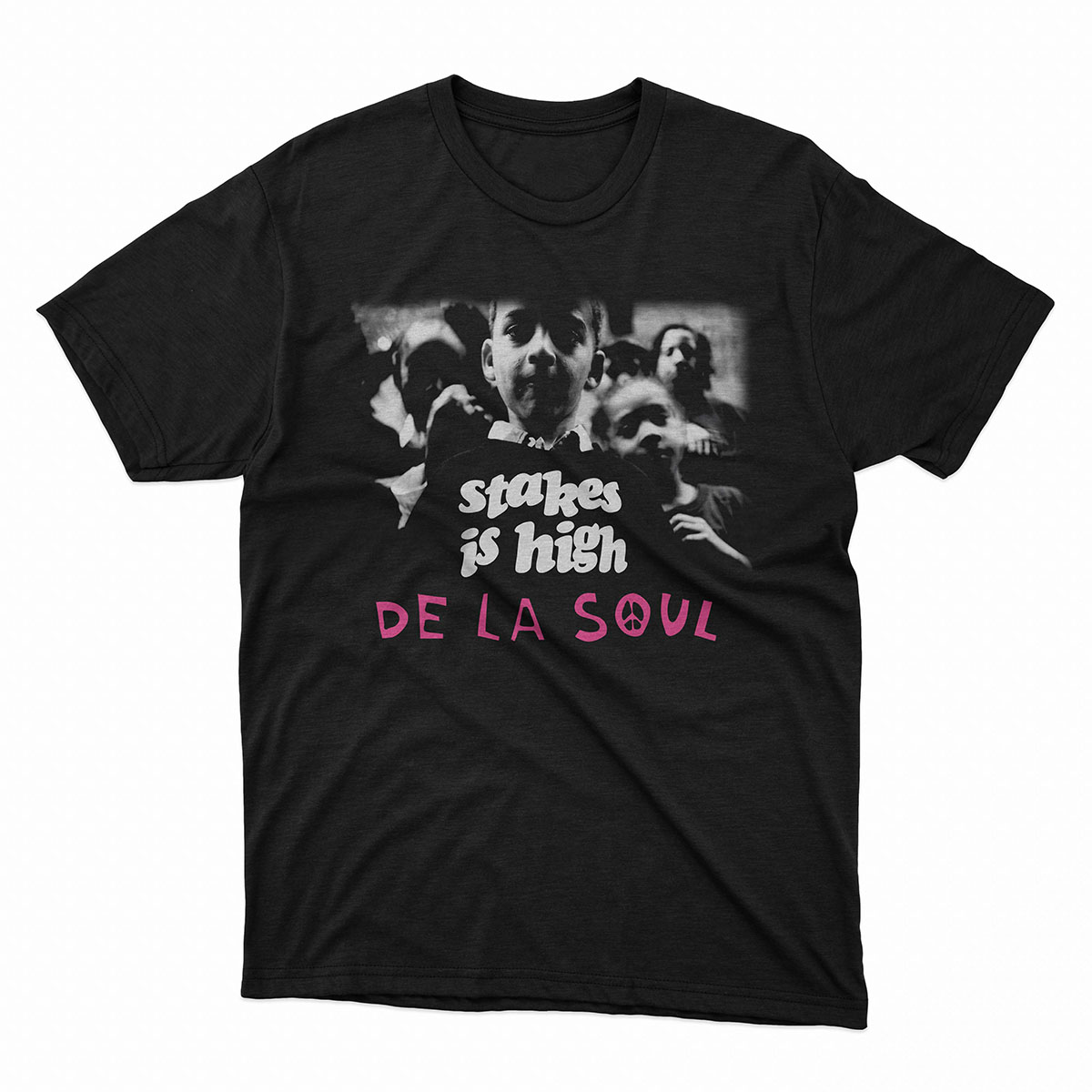
Rep the Native Tongues Legends
Thirty years of culture, one iconic design. Our Stakes Is High fan art tee keeps the prophecy alive on Bella Canvas 3001 premium cotton.
The Deep Cuts: Track-by-Track Through the Hidden Architecture
Most writing about Stakes Is High focuses on the title track and its controversy. That’s like reviewing Illmatic by only discussing “N.Y. State of Mind.” The album runs 68 minutes and 19 seconds across eighteen tracks — and its hidden architecture reveals as much as its anthems.
The Criminal Minded Bookend
The album opens with the “Intro,” a montage of people reminiscing about the first time they heard Boogie Down Productions’ Criminal Minded (1987). As Slate’s 20th anniversary essay — the most intellectually rigorous piece written about this album — argues, this creates a deliberate structural device: De La is meditating on how great music creates indelible memories. “When I first heard Criminal Minded” is the album’s opening line, six words establishing from the jump that this record is walking “the tightrope between productive uses of history and simplistic allures of nostalgia.”
The album title itself comes from the documentary Crumb (1994) about underground cartoonist Robert Crumb, where his brother Maxon Crumb describes his personal struggles: “stakes is high.” De La repurposed a loner artist’s confession into a hip-hop battle cry.
The First Solo Tracks in De La History
Stakes Is High introduced something unprecedented in the group’s catalog: dedicated solo tracks. Posdnuos got “Wonce Again Long Island,” a love letter to their home turf that showcased his technical precision and emotional range. Trugoy took “Itzsoweezee (Hot),” a track so confident and stylistically distinctive that Albumism notes it featured cameos from The Roots and Guru in its video. These weren’t filler — they were the first time each member stepped fully into his own identity on wax.
Wordplay That Rewards Replay
Slate’s essay highlights a specific example of the kind of multi-layered wordplay that rewards repeated listening: Trugoy’s line about “making bread like Wonder” — simultaneously referencing Wonder Bread and the act of kneading/needing. This is the kind of bar that flies past on first listen and detonates on the fifth. The album is full of them. “Dog Eat Dog” stacks metaphors about industry cannibalism across three verses. “Sunshine” uses weather as a framework for discussing Black joy. “Long Island Degrees” maps educational aspiration onto geographic identity.
4 More: The Stealth Hit
“4 More” was released as the album’s third single in 1997 — after the controversy had settled and the dust had cleared — and it quietly became one of De La’s most enduring tracks. The Zhane-featuring R&B crossover proved that the same group railing against commercialization could still make genuinely joyful music. That wasn’t a contradiction. That was range.
From Slept-On Classic to Streaming Salvation: The De La Soul Stakes Is High Album at 30
For more than two decades, Stakes Is High was the album you had to hunt for. Physical copies became collector’s items. Streaming? Forget it.
The reason was Tommy Boy Records. De La Soul’s entire catalog was locked in a dispute over sample clearances and royalty splits that became one of hip-hop’s most notorious business horror stories. As our coverage of the De La Soul saga details, Tommy Boy initially proposed a 90/10 split — in the label’s favor — to clear the hundreds of samples across De La’s albums for streaming. The group publicly fought this, and their fans supported them, but the catalog remained locked.
Then, in March 2023, everything changed. Chrysalis Records acquired the catalog and brought De La Soul’s entire discography to streaming platforms for the first time. A new generation could finally hear Stakes Is High without tracking down a used CD or a bootleg file. The Reddit fan post calling it “a f****** revelation” — one of our research sources — captures the genuine shock of younger listeners discovering the album cold.
Trugoy’s Death and the Posthumous Recontextualization
On February 12, 2023 — just weeks before the catalog finally went to streaming — David “Trugoy the Dove” Jolicoeur died of congestive heart failure at age 54. He never saw the streaming numbers. He never saw a new generation discover the album where he delivered some of his finest performances.
This recontextualizes everything. When you listen to Trugoy’s verse on the title track now — “I’m sick of bitches shakin’ asses” — it’s not just a critique of 1996. It’s the last truly defiant creative statement from an artist who spent his career choosing integrity over popularity. His solo turn on “Itzsoweezee” isn’t just a display of skill — it’s a document of a voice that no longer exists.
The Kennedy Center recognized Stakes Is High in its Hip Hop Culture series, performing the title track on one of America’s most prestigious stages. From Long Island to the nation’s capital. The album outlived its own commercial failure.
The 30th Anniversary in a Changed World
RapReviews gave Stakes Is High a perfect 10/10. AllMusic awarded 4 out of 5 stars. Entertainment Weekly gave it a B. But the real review came from time itself. Thirty years later, the album’s critiques of commercialization, materialism, and creative cowardice in hip-hop are more relevant than they were when Dove, Pos, and Maseo first committed them to tape.
If you grew up on this album — or if you’re discovering it for the first time on streaming — wearing the Stakes Is High fan art t-shirt is a way to signal that you understand what De La Soul was fighting for. It’s not merch. It’s a position statement.
Frequently Asked Questions About the De La Soul Stakes Is High Album
What is Stakes Is High by De La Soul about?
Stakes Is High is De La Soul’s fourth studio album, released July 2, 1996. It’s a passionate critique of hip-hop’s commercialization and the rise of gangsta rap. The group — Posdnuos, Trugoy the Dove, and Maseo — used the album to challenge the industry’s direction while showcasing that conscious, lyrically-driven hip-hop could still be innovative and relevant. The title references a line from the documentary Crumb, where artist Maxon Crumb describes his struggles: “Stakes is high.”
Who produced the Stakes Is High title track?
The title track was produced by James “J Dilla” Yancey (credited as Jay Dee), with additional production from De La Soul. Dilla sampled Ahmad Jamal’s “Swahililand” and James Brown’s “Mind Power” to create one of his most iconic beats. This was many listeners’ first introduction to J Dilla, who would go on to become one of hip-hop’s most influential producers before his death in 2006.
Why didn’t Prince Paul produce Stakes Is High?
De La Soul decided to produce Stakes Is High themselves after feeling that Prince Paul’s contributions didn’t match the album’s darker, more confrontational mood. By 1996, the group had grown from teenagers to men in their mid-twenties and wanted creative autonomy. While Prince Paul understood the decision, it marked the end of one of hip-hop’s most legendary artist-producer partnerships.
Was Mos Def on Stakes Is High?
Yes. Mos Def (now Yasiin Bey) made one of his first prominent recorded appearances on “Big Brother Beat,” credited as “Mos Def of Medina Green.” The album introduced him to a wider audience roughly two years before his breakthrough with Talib Kweli as Black Star, and three years before his classic solo debut Black on Both Sides.
What was the 2Pac and De La Soul beef about?
On the title track, De La Soul criticized the commercialization of hip-hop and the rise of gangsta rap — which 2Pac perceived as a shot at him. 2Pac retaliated on “Against All Odds” from his posthumous 1996 album The Don Killuminati: The 7 Day Theory. Treach of Naughty By Nature also took offense, creating a feud that lasted approximately fifteen years before cooling.
Was Stakes Is High a commercial success?
Despite critical acclaim from publications like RapReviews (10/10) and AllMusic (4/5), Stakes Is High achieved limited commercial success. It was overshadowed by being released on the same day as Nas’s It Was Written (July 2, 1996), in a summer dominated by Jay-Z’s Reasonable Doubt and OutKast’s ATLiens. The album is now widely regarded as one of hip-hop’s most slept-on classics.
Is Stakes Is High available on streaming services?
Yes. After decades locked in a dispute with Tommy Boy Records over sample clearances and royalty splits (the label initially proposed a 90/10 split in Tommy Boy’s favor), De La Soul’s full catalog — including Stakes Is High — came to streaming platforms in March 2023. This made the album accessible to a new generation for the first time.
Final Thoughts: The Album That Saw the Future
Stakes Is High wasn’t just De La Soul’s fourth album — it was hip-hop’s most prophetic record. It introduced J Dilla and Mos Def to wider audiences while warning about the commercialization that would define the next three decades. It proved that three Long Island MCs could produce their own album, stand on their own lyrical merit, and take shots at the entire industry without flinching.
Thirty years later, with Trugoy gone and the streaming catalog finally restored, the album reads as vindication. Every trend De La Soul identified in 1996 — the materialism, the corporate co-optation, the abandonment of substance for spectacle — has only accelerated. And every artist who emerged from this album’s orbit — Dilla, Mos Def, Common — went on to build the conscious hip-hop infrastructure that keeps the culture honest.
The stakes are still high. They always were. De La just said it first.
Never Miss a Drop
Album deep dives, artist spotlights, exclusive merch drops, and the stories behind the culture. Straight to your inbox. No filler — just the real.

🎧 Never Miss a Drop
Exclusive product releases, hip-hop deep dives, and member-only discounts. Straight to your inbox.
Free forever. No spam. Unsubscribe anytime.
Get the Culture, Delivered
Deep dives into hip-hop history, exclusive product drops, and discounts sent straight to your inbox. No spam, just culture.
Join 2,000+ hip-hop heads already in the loop. Unsubscribe anytime.