Ice-T T-Shirt Guide: The Definitive Buyer’s Map to Every Era of Tracy Marrow’s Catalog
The biggest mistake you can make shopping for an ice-t t-shirt in 2026 is treating the search results like a costume catalog. Every other listing is the same Power-album shot, the same Rhyme Pays mockup, the same “officially licensed” sticker — and almost none of them tell you which moment of Tracy Lauren Marrow’s life you’re actually putting on your body. This guide fixes that.
The story of why people wear Ice-T shirts is a four-decade arc that runs from a beauty parlor in 1982 (gold rollers, an unsigned freestyle, two record-store owners walking in mid-verse) to a $40,000 Sire Records deal, to the Power-cover shotgun pose that became the most replicated piece of West Coast iconography ever pressed onto cotton. Every era is a different shirt. Pick the right one and you’re wearing a date stamp on the birth of gangsta rap. Pick the wrong one and you might accidentally end up in a U.S. Immigration and Customs Enforcement protest photo. Below, every design, every era, every reason.
The “Ice-T T-Shirt” Search Bar Is Actually Two Different Conversations
Run a 2026 search for ice-t t-shirt and the first surprise is how much of the page has nothing to do with Tracy Marrow. The acronym ICE (U.S. Immigration and Customs Enforcement) has dominated political-merch searches since 2018, and the search engine doesn’t disambiguate. Half the results that look like rapper merch are actually anti-ICE protest tees: “FUCK ICE”, “No Ice Please”, “Anti ICE” graphics aimed at a completely different conversation.
Quick filter: if the design has no album art, no specific track reference, no Rocks-Off or Rockabilia licensing mark, and uses block-text political slogans, it’s a protest shirt. The Tracy Marrow shirts — the ones this guide is about — carry album-cover graphics, song titles, and (almost always) the “officially licensed” Rocks-Off mark in the listing description.
The second filter: Ice-T’s own website is not a merch destination. As of this writing, icet.com is a 165-word page with a “For Booking Info Contact” line and nothing to buy. If a listing claims to be “the official Ice-T store,” check the URL — and check whether the page sells anything at all, or just stages an introduction and pushes you to checkout via a generic shop template. The actual official licensed catalog runs through traditional rock-merch infrastructure (Rocks-Off Inc. / Phil Nicholls photography), distributed through retailers like Rockabilia and Amazon.
From Newark to Crenshaw: The Biography You’re Wearing
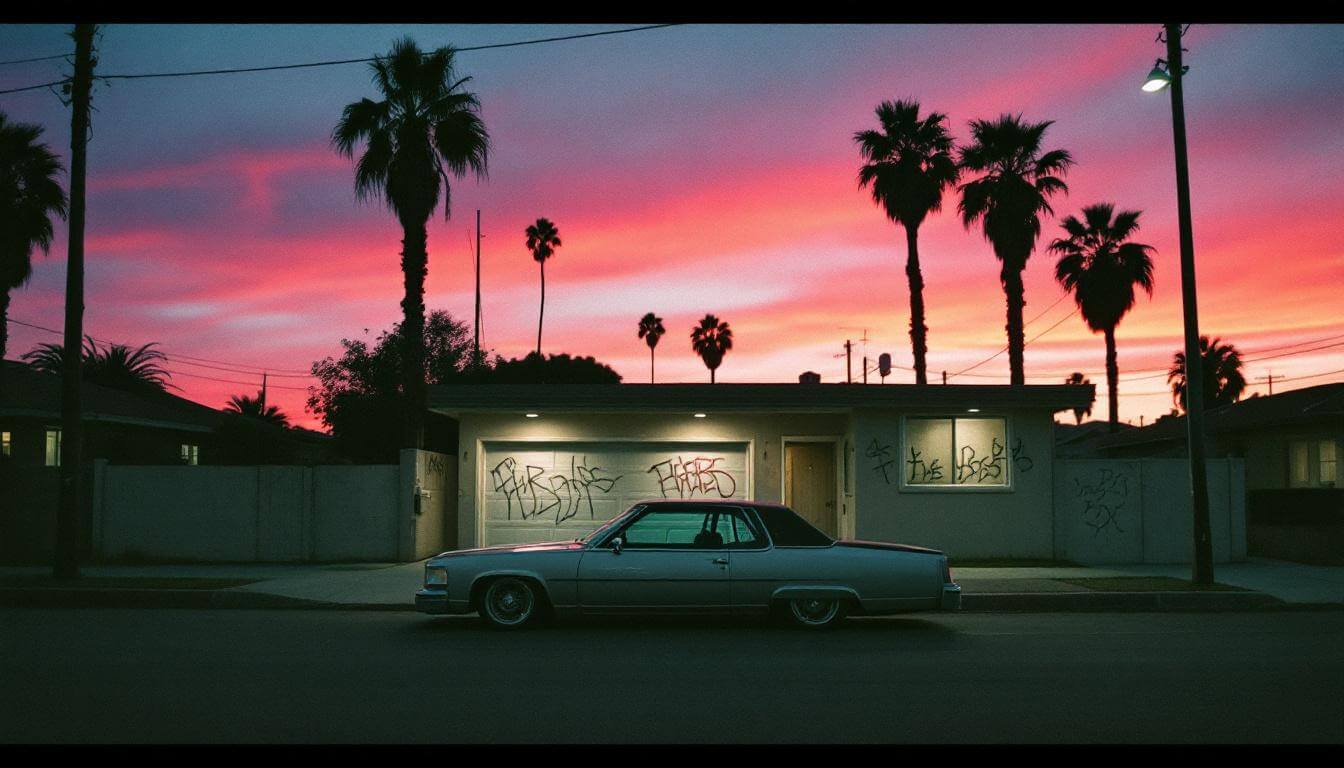
Tracy Lauren Marrow was born in Newark, New Jersey in 1958. Both his parents died of heart attacks before he hit fourteen — his mother when he was nine, his father when he was thirteen — and he moved west to live with an aunt in South Central Los Angeles. At Crenshaw High he absorbed two things in equal measure: the emerging Crip-set politics of the early-1980s neighborhoods and a stack of paperbacks by Iceberg Slim, the pimp-turned-novelist who would give him his stage name. (Ice from Iceberg, the initial of his first name as the second letter.) The biographical receipts here — Newark birth, parents’ deaths, Iceberg Slim namesake, Crenshaw — are documented across multiple sources and recapped most thoroughly in Rapospective’s 22-minute Rhyme Pays documentary.
Before he was a rapper, he was a stick-up kid. He stole and resold car stereos. He sold weed. He has discussed assisting in bank robberies in multiple on-the-record interviews. He did a stint in the army. He even tried pimping briefly. The pre-Rhyme-Pays Tracy Marrow was a 1970s/early-80s South Central survival case — and that’s the spine of why an Ice-T shirt feels different from any other rapper tee. He was telling those stories in real time, not reconstructing them years later.
The pivot happened in 1982 in a beauty parlor, with Tracy in foam rollers, freestyling for the women in attendance. Willie Strong (Saturn Records) and Cletus Anderson (VIP Records — the same VIP that Snoop Doggy Dogg would later strut through in the Who Am I (What’s My Name?) video) walked in mid-verse and asked the question that flipped the entire trajectory: “Hey, want to make a record?” The first track that came out of that conversation — “The Coldest Rap” on Saturn Records, 1983, produced over an Oberheim OB-X instrumental featuring keys by Jimmy Jam and bass by Terry Lewis — paid Ice-T roughly $200–$300. Not much. But it was a record on wax.
Between 1983 and 1986 he stacked a soundtrack appearance (Reckless on the Breakin’ soundtrack, 1984, co-produced by Chris “The Glove” Taylor before Taylor went on to work with Dr. Dre), a string of indie singles, and “6 in the Mornin'” — the 1986 B-side that everyone now treats as a founding gangster-rap document. (We’ve written about that song’s specific role in the gangsta rap origin debate separately.) By the time Sire Records’ Seymour Stein offered him the deal that produced Rhyme Pays in 1987, he was 29 years old and walking in with five years of indie receipts and a $40,000 budget.
$40,000 is the number to remember. Ice-T has stated it on the record himself — in a 2022 Unique Access Ent. interview he confirms the Sire signing came together after a planned compilation (featuring Donald D, Bronx Style Bob, Melly Mel, Grandmaster Caz) collapsed because every other rapper was already signed elsewhere. He was the only one left holding paper. Forty grand. No video. Album went gold by 1991. Every Rhyme Pays shirt in this guide is a wearable artifact of that exact moment.
The Rhyme Pays Tee (1987) — The Cover Photo That Built Gangsta Rap’s Iconography

The Rhyme Pays album cover is one of those rare hip-hop images that loaded an entire region’s iconography into a single frame. Summer 1987, Sire Records: Ice-T sitting in a convertible, his then-girlfriend Darlene riding shotgun, palm tree behind them, gold chains everywhere. That’s it. No graphic design tricks. No stylist budget on display. Just a 29-year-old recently-signed Newark-to-Crenshaw transplant photographed mid-sentence in the car of someone who had actually made it — and the entire West Coast aesthetic uncorked from that single image.
Critics on the “Great Debaters” episode hosted by hip-hop journalist Soren Baker and Amir spend several minutes on the cover specifically — Amir calls it “one of the most iconic” album covers, period. The cover is doing two things at once: it stages success (the car, the chains, the woman) while staging a documentary plainness (no makeup, no styling, no agency hand). That tension — aspiration and lived reality on the same plane — is why the image survived four decades of imitation.
When you buy a Rhyme Pays tee in 2026, you’re buying that summer. Most of the licensed designs sit at one of two endpoints: gold-foil tie-dye prints of the cover photo (Rockabilia carries this SKU in their seven-piece officially licensed Ice-T collection), or stripped-down typographic interpretations of the album title that lean into the “rhyme pays” mantra without the cover photo. The tribute approach — our route in this catalog — pulls the iconography forward without copying the photograph verbatim, treating Rhyme Pays as a cultural fact rather than a costume.
The Rhyme Pays tee also gives you the deepest catalog of song-specific designs. “Squeeze the Trigger” — the closing track Amir argues is the album’s best song on the Great Debaters episode — has its own Rocks-Off licensed print floating around resale. So does “The Girl Tried to Kill Me,” a track most retailers ignore but which Rockabilia carries as a standalone shirt. Both are signals: if a Rhyme Pays shirt references a deep cut, the buyer probably knows the album track-by-track.
The Power Tee (1988) — Why This Is The Design Everyone Sells

If you’ve ever Googled ice-t t-shirt and felt like you kept seeing the same image over and over, you were probably staring at the Power album cover. Power, Ice-T’s 1988 follow-up to Rhyme Pays, gave the West Coast its consensus iconic image: Ice-T flanked by Darlene (holding a sawed-off shotgun) and bodyguard Sean E. Sean, framed against a stark background, the entire composition pulled toward the gun and the gold. The cover did for Ice-T’s visual brand what It Takes a Nation of Millions did for Public Enemy’s: it stopped being an album cover and became a logo.
That’s why Rockabilia, Amazon, Walmart, and Night Shift Merch all carry Power-cover tees as their lead Ice-T SKU. Walmart’s “Power Album Cover Slim Fit T-Shirt” listing under brand “Ice T” is essentially the consumer-grade entry point. Rockabilia’s super-soft Power tee is the next tier. Rocks-Off photography prints — including Phil Nicholls’s Power-era shots — represent the editorial/collector tier.
Power is also where Ice-T’s range stopped being a question. As he tells it in a Unique Access Ent. interview: “Power was me realizing people are listening. You got to remember, I’m coming from no records to a $40,000 budget to half a million, 800,000 people listening to me.” The album moved gold. Songs like “I’m Your Pusher,” “High Rollers,” and “Drama” pulled the gangster-rap conversation onto cable television (MTV gave “I’m Your Pusher” rotation despite the subject matter). The cover photo’s afterlife on cotton is partially a function of that crossover: the Power shirt is the design that signals “I know hip-hop” without requiring a deep-catalog argument.
For our money, the Power shirt is the most-replicated SKU for a reason — but it’s also the most diluted. Every retailer carries it. The aesthetic conversation has moved on. If you want a Power shirt, buy the Rocks-Off licensed cut from Rockabilia; if you want a shirt that signals you know more than Power exists, buy something off Rhyme Pays.
The Deep Cuts: Girl Tried to Kill Me, Skull, Make It, and “What Ya Wanna Do?”
Beyond the two album-cover shirts, Ice-T’s officially licensed catalog runs four less-replicated designs — and these are where the real fans buy. “The Girl Tried to Kill Me” is a Rhyme Pays track-titled tee referencing one of the album’s underrated entries; if you wear it and someone reads the title at a show, you’ve found another Rhyme Pays head. The Skull tee is a Rocks-Off design that leans into the harder-edged later-period Ice-T iconography, popular with the Body Count crossover crowd. The “Make It” tee picks up an aspirational mantra from the same era. And then there’s “What Ya Wanna Do?”, an Old School Image design that Walmart of all places surfaces — it references Ice-T’s pre-Rhyme-Pays singles era, the years between The Coldest Rap (1983) and Breakin’ (1984), when his catalog was just indie 12-inches and soundtrack cuts.
The “What Ya Wanna Do?” shirt is the dark horse. Almost no other retailer carries it. If you see it in a feed, it’s a tell that someone in the licensing chain still cares about Tracy Marrow’s pre-Sire years. That’s a niche worth wearing.
For a full breakdown of where each of these tracks fits in his catalog, our complete guide to Ice-T’s greatest songs walks the discography year by year.
The Body Count Era — A Completely Different Shirt
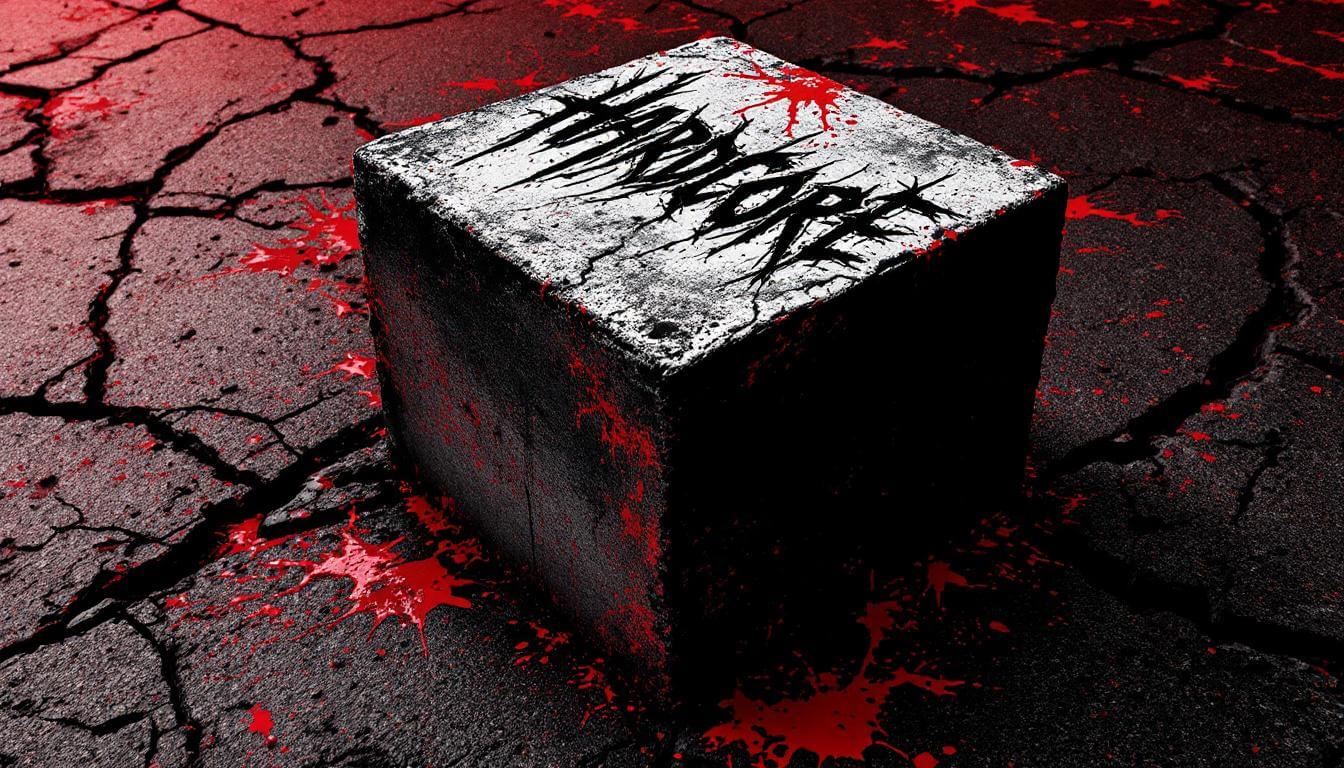
Here’s where the catalog forks. Ice-T formed Body Count in 1990 as a hardcore/metal project; the self-titled debut dropped in 1992 and detonated the year after with “Cop Killer” — a song so contested that Time Warner pulled it from the album under political pressure. Body Count’s full trajectory, including their eventual 2021 Grammy win for Best Metal Performance, lives outside the gangster-rap conversation entirely.
The Body Count tees reflect that fork. The aesthetic is metal: single-color screen prints, gothic-leaning typography, harder iconography, often built around band-logo lockups rather than album-cover photography. The fanbase overlaps with the Rhyme Pays/Power crowd at the edges but skews younger and more crossover. If you came up on Cop Killer, Bowels of the Devil, or Born Dead, the Body Count tee is the right shirt — it’s just a different shirt entirely. Don’t buy a Body Count band tee thinking you’re getting a hip-hop iconography piece. You’re not.
And don’t buy a Rhyme Pays tee thinking it’ll telegraph to a Body Count fan. It won’t. These are two different lanes that happen to share an MC. Ice-T himself frames it across multiple interviews: he refuses one-dimensionality. The shirts respect that.
The Definitive Pick — The Rhyme Pays Tribute Tee
If you’re shopping for one shirt that anchors the entire Ice-T story — the $40,000 moment, the convertible, the palm tree, the summer of 1987 — the answer is a Rhyme Pays tribute piece. The album cover is the single most under-utilized design in the licensed catalog. Every retailer sells you Power (because Power outsold Rhyme Pays); almost nobody designs around what was actually his debut.
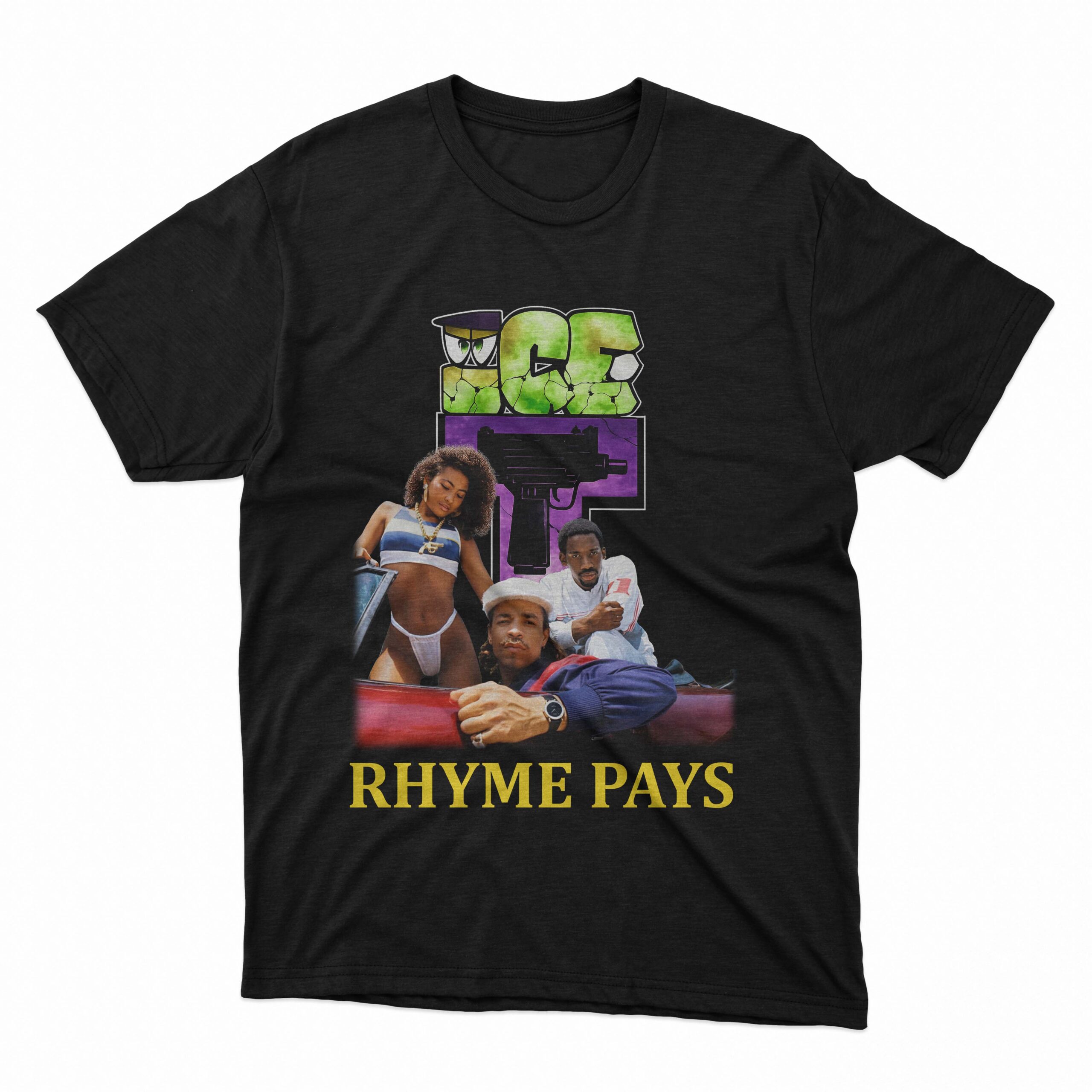
We made the tribute tee that captures that moment. The Ice-T Rhyme Pays Tribute T-Shirt is built on premium-weight cotton, pulled from a black colorway that lets the typography breathe, and designed to reference the 1987 cover without copying it photograph-for-photograph. The Rhyme Pays tribute tee is the wearable version of the argument this whole guide makes: every other ice-t t-shirt on the SERP sells you the most-replicated design; this one sells you the moment everything started.
How To Spot Authentic Ice-T Merch (And Why His Own Site Doesn’t Sell Any)

The single weirdest fact in this entire research project: Ice-T’s own website is not a merch destination. icet.com is a 165-word page with a booking-contact line and nothing to buy. That’s not laziness; it’s how the rock-merch industry works. Ice-T’s licensed catalog runs through traditional band-merch infrastructure — Rocks-Off Inc. handles licensing, Phil Nicholls’s photography appears on the editorial prints, and brick-and-mortar/online retailers (Rockabilia, Amazon, Walmart, Night Shift, Rapbay, Merchbar) sell the resulting SKUs. There’s no Jay-Z Rocawear, no 50 Cent G-Unit, no Ice-T fashion label. The shirts are merch, not a brand.
That distinction matters when you’re sorting authentic licensed product from bootlegs. Three quick filters:
- “Officially licensed by Rocks-Off Inc.” in the listing. Rocks-Off is the licensing intermediary. Their mark is the cleanest authenticity signal in the catalog.
- Photographer credit on photography prints. Phil Nicholls is the canonical Ice-T photographer; his name should appear on photographic-print tees from the editorial/collector tier.
- Album-art accuracy. The Power cover composition, the Rhyme Pays palette, the Body Count typography — these are all reproducible from album sleeves. If the design looks “off,” it usually is.
The two big categories of inauthentic listings: Amazon’s third-party fan-art racks (which are creative but unlicensed) and Etsy/Redbubble print-on-demand stores that lift album artwork without paying licensing fees. Neither funds the artist. The “officially licensed” mark does.
One more layer: Tracy Marrow’s multi-dimensional brand. Ice-T has been a Law & Order: SVU regular since 2000; his on-screen catalog from New Jack City to SVU is its own merch ecosystem (SVU shirts, mug-shot prints, etc.), but those are not Ice-T music merch — they’re Ice-T television merch. Different licensing chain, different aesthetic. Worth knowing before you click “add to cart” on something that looks like a rapper tee but is actually a TV-spin-off product.
Frequently Asked Questions
What does the original Rhyme Pays album cover show?
Ice-T in a convertible with his then-girlfriend Darlene in the passenger seat, a palm tree in the background, and gold chains throughout — the 1987 image that became one of West Coast hip-hop’s most replicated visuals (per Soren Baker’s Great Debaters analysis and confirmed across multiple sources). The Rhyme Pays tribute tee in our catalog reinterprets this image as wearable.
Why is the “Power” t-shirt the most common Ice-T design?
Power, Ice-T’s 1988 follow-up, is the album where his iconography fully crystallized. The cover image — Ice-T flanked by his then-girlfriend Darlene holding a shotgun — became the consensus “Ice-T t-shirt” design, which is why Rockabilia, Walmart, Night Shift Merch, and Amazon all carry variations of it in 2026.
Is there an officially licensed Ice-T shirt?
Yes. Rockabilia carries the official licensed line. Ice-T’s own website (icet.com) is not a merch destination — at last scrape it contains only booking-contact info. Third-party retailers (Amazon, Etsy, Redbubble) sell a mix of licensed and unlicensed designs; the “officially licensed” mark is the cleanest signal.
What’s the difference between an Ice-T shirt and an “ICE” shirt?
Ice-T = Tracy Lauren Marrow, the rapper born 1958. ICE = U.S. Immigration and Customs Enforcement. Many 2026 search results for “ice-t t-shirt” surface protest shirts about the agency (e.g., “FUCK ICE”, “No Ice Please”, “Anti ICE”). They’re unrelated — but the SERP doesn’t disambiguate, so check the listing carefully.
Is “6 in the Mornin'” the first gangster rap song?
Contested. Schoolly D’s “PSK — What Does It Mean?” (1985) predates 6 in the Mornin’ (released as a B-side in 1986 and on Rhyme Pays in 1987) and influenced Ice-T directly (per the Rapospective biographical documentary). Ice-T himself has credited Schoolly D’s drum-machine sound as the blueprint. Both are foundational.
What budget did Ice-T have to make Rhyme Pays?
$40,000. Ice-T confirmed this in a 2022 Unique Access Ent. interview — Seymour Stein at Sire Records gave him the deal after a planned compilation (with Donald D, Bronx Style Bob, Melly Mel, Grandmaster Caz) collapsed because every other rapper was already signed elsewhere.
What about a Body Count tee instead — same fanbase?
Different aesthetic, overlapping fanbase. Body Count (formed by Ice-T in 1990, debut 1992) is metal/hardcore rock with hip-hop sensibility. The shirts are darker, harder, often single-color screen prints — a different visual language than the Rhyme Pays/Power era tees. If you came up on “Cop Killer” rather than “6 in the Mornin'”, Body Count is your shirt.
Does Ice-T have a clothing line?
No — at least not in the sense that Jay-Z had Rocawear or 50 Cent had G-Unit. Ice-T’s merch is licensed through traditional rock-merch channels (Rockabilia / Rocks-Off / Phil Nicholls photography), not a standalone fashion brand.
Final Thoughts
The buying decision on an ice-t t-shirt is mostly a question of which moment of Tracy Marrow’s life you want to wear. Power if you want the consensus icon. Rhyme Pays if you want the origin story. A track-title cut if you want the deep-fan signal. Body Count if your reference point is the metal pivot. There’s no wrong answer — but there’s a reason the catalog has stayed this stable for forty years. Each shirt is a specific receipt.
Forty grand. A convertible in summer 1987. A B-side that became a foundational text. A stage name borrowed from a paperback. Iconography that wrote itself, then refused to age. Wear the moment that fits.
Wear The Moment
A $40,000 budget. A Sire Records deal nobody else wanted. A convertible in summer 1987 with Darlene riding shotgun and an album cover that wrote the West Coast’s visual rules. The Ice-T Rhyme Pays Tribute Tee is that exact moment — pulled forward, premium-weight, wearable. Skip the most-replicated Power cover. Own the origin.
Never Miss a Drop
Album deep dives, artist spotlights, exclusive merch drops, and the stories behind the culture. Straight to your inbox. No filler — just the real.

🎧 Never Miss a Drop
Exclusive product releases, hip-hop deep dives, and member-only discounts. Straight to your inbox.
Free forever. No spam. Unsubscribe anytime.

Get the Culture, Delivered
Deep dives into hip-hop history, exclusive product drops, and discounts sent straight to your inbox. No spam, just culture.
Join 2,000+ hip-hop heads already in the loop. Unsubscribe anytime.