Eighties Hip-Hop Fashion: The Block-by-Block Blueprint That Invented Streetwear
Before streetwear had a name, it had an address. Eighties hip-hop fashion didn’t drop in a press release or a Paris showroom — it grew up block by block, borough by borough, between 1980 and 1989, on the kids who invented a culture before the culture had a section in the department store. That decade is the literal blueprint every streetwear brand on earth is still cribbing from in 2026, and most listicles flatten it into “logos, gold chains, and Adidas.” That’s not a story. That’s a costume rack.
What actually happened was a tight, traceable, neighborhood-specific evolution. The Bronx invented the silhouette. Queens codified it on a record. Harlem stitched luxury into it. Brooklyn poured Africa back into it. Each move had a year, a block, and a name attached. This is the full timeline — Lee suits to shell-toes to Dapper Dan, medallions to door-knockers to the dookie rope — followed by a “wear the blueprint now” bridge into pieces you can still grab and put on without cosplaying.
The Stage: Why 1980s NYC Was the Lab
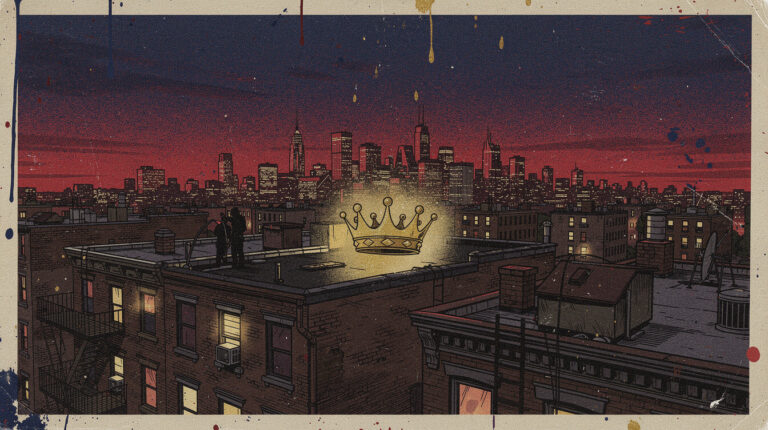
You can’t talk about eighties hip-hop fashion without talking about the city it grew out of, because the look came from constraints, not concepts. New York in 1980 was crumbling: the South Bronx had lost 40% of its housing stock to fires and abandonment over the prior decade, the city was still climbing out of its 1975 brush with bankruptcy, and the subway was tagged from end to end. Park jams ran on stolen lamp-post power. Crews carried boomboxes that ate D-batteries by the dozen. Money was tight and the temperature was hot, so the uniform had to be cheap, durable, identifiable from a block away, and built for moving.
That last point is underrated. The b-boy stance demanded clothes you could windmill, headspin, and back-spin in without ripping a seam. Lee Storm Rider denim sets and Sergio Tacchini tracksuits weren’t fashion-forward — they were physics-forward. They held up to cardboard concrete. Adidas Superstars with fat laces (or no laces at all, just the tongue out) gave you grip and an instant ID at twenty paces. By 1983, that practical kit had already become a visual language: you didn’t tell people what crew you were in, you wore it.
The other thing the city gave the look was geography. Hip-hop’s neighborhoods built a built-in style segregation that’s almost impossible to imagine in a 2026 algorithm-flat world. The Bronx had b-boy gear. Queens had Adidas. Harlem had Dapper Dan. Brooklyn had Native Tongues medallions. You could read a borough off a person, and that hyper-local logic is why what came in the ’90s only makes sense if you understand the block-by-block grid the ’80s drew first.
Early ’80s: The Park-Jam B-Boy Era (Lee Suits, Shell-Toes, Kangols)
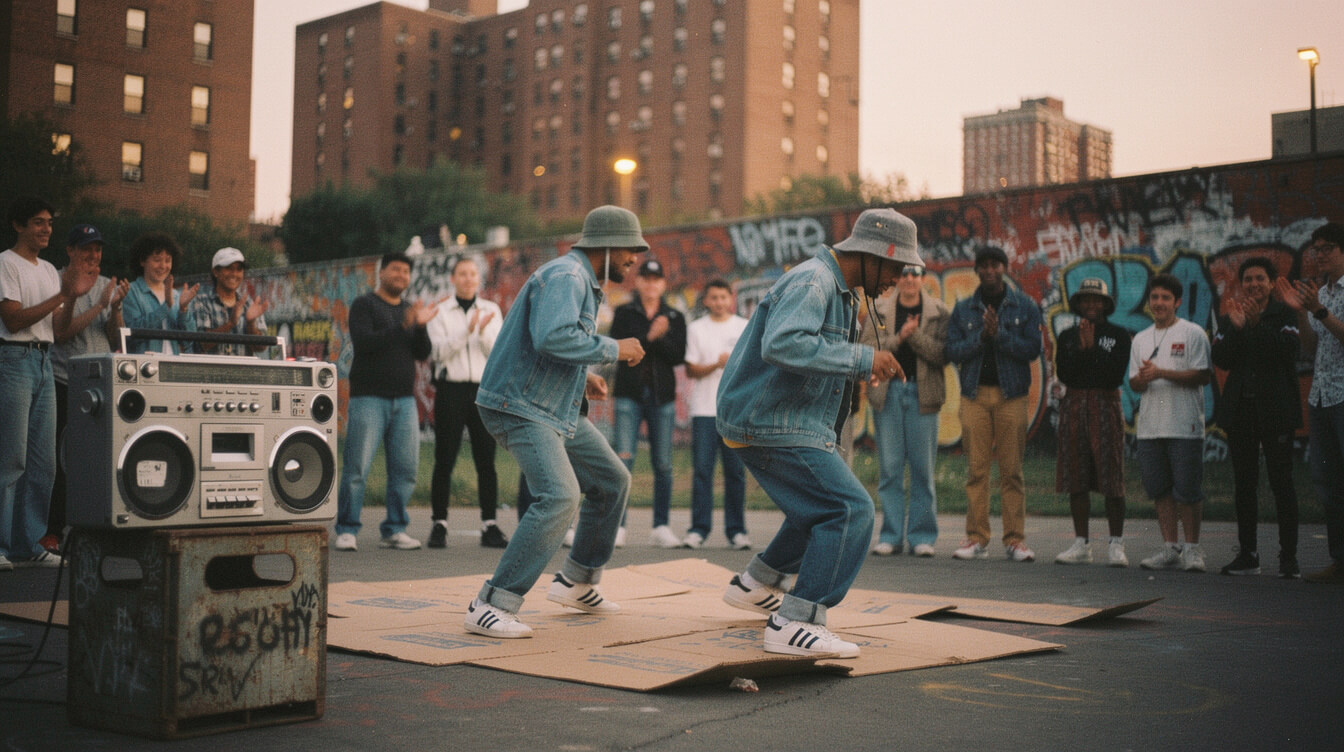
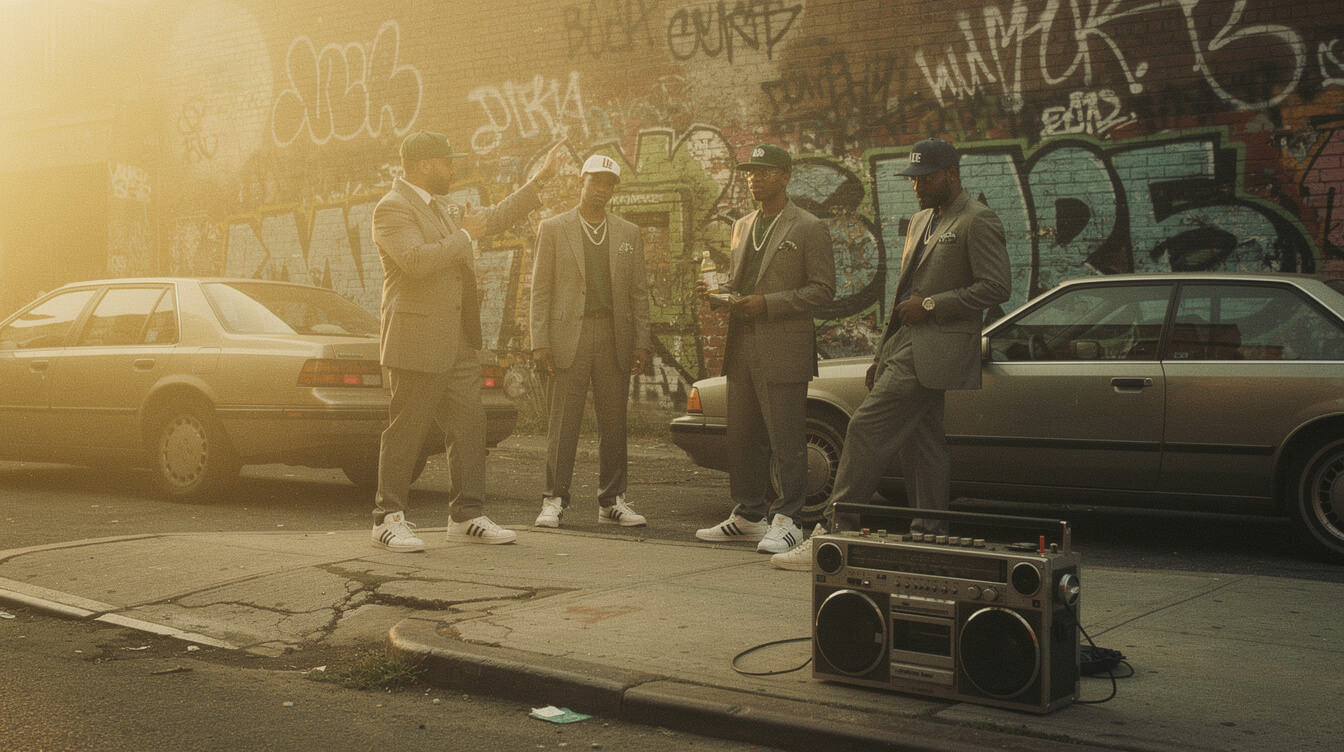
The opening movement of eighties hip-hop fashion runs roughly 1980 to 1984, and its center of gravity is the South Bronx — Sedgwick Avenue, Bronx River, Soundview, Crotona Park. The uniform of the first wave was built on three pillars: Lee denim, shell-toes, and a Kangol. Each piece had a real reason to be there.
Lee Storm Rider jackets and matching denim pants were the b-boy “suit” — clean, structured, and tough enough to survive a power-move on raw asphalt. Crews ironed creases sharper than a Marine recruit’s dress blues. The crease itself was the flex; it said your gear was new or kept right. Beneath the denim you wore a fresh white T-shirt — never anything else — and around your neck went a thin gold rope that hadn’t yet inflated into the dookie chain that defined the back half of the decade.
The feet were Adidas Superstars, the shell-toes Adi Dassler’s company first cut for basketball in 1969 and that New York repurposed as a streetwear cornerstone. The move was to pull the standard laces and replace them with “fat laces” — usually nylon, often dyed to match a crew color — and lace them flat with the tongue pushed out and up. Half the crews ran them laceless entirely, just the tongue popped, the shoe held on by stance and attitude alone. This wasn’t a styling tip from a magazine. It was a Queensbridge, Bronx, and Harlem street code that pre-dated Run-DMC‘s “My Adidas” by years.
On the head went a Kangol. The British knit-cap brand, founded in 1938, had been Frank Sinatra’s golf-course hat — but in New York the bucket shape (“the 504”) got rotated backwards or turned reverse-cocked and became hip-hop’s first identifiable accessory. LL Cool J, Big Daddy Kane, and Slick Rick all wore Kangols early; Cool J would later make the bucket synonymous with his face. The “Spitfire” floppy version became the alternative for crews who wanted softer geometry. By 1984, every kid south of 145th Street had at least one Kangol or knew somebody who’d lifted one. Layer in Cazal 607 glasses — heavy German optical frames originally aimed at fashion buyers but adopted by Run-DMC and the entire Queensbridge contingent — and the b-boy silhouette was complete.
Two more pieces locked in the early-’80s look. Sheepskin and shearling coats — first popularized by Big Daddy Kane and later canonized by every East Coast rapper who could afford one — became winter armor; a real sheepskin from 7th Avenue cost more than a kid’s monthly rent in 1983 and signaled you had grown-up money. And Sergio Tacchini, Fila, and Le Coq Sportif tracksuits — imported European tennis-and-soccer warm-ups in candy-colored two-tone — became summer armor, especially for park-jam DJs who needed something visible in a crowd and durable enough to crouch behind crates for six hours.
Mid ’80s: Run-DMC, “My Adidas,” and the All-Black Queens Uniform
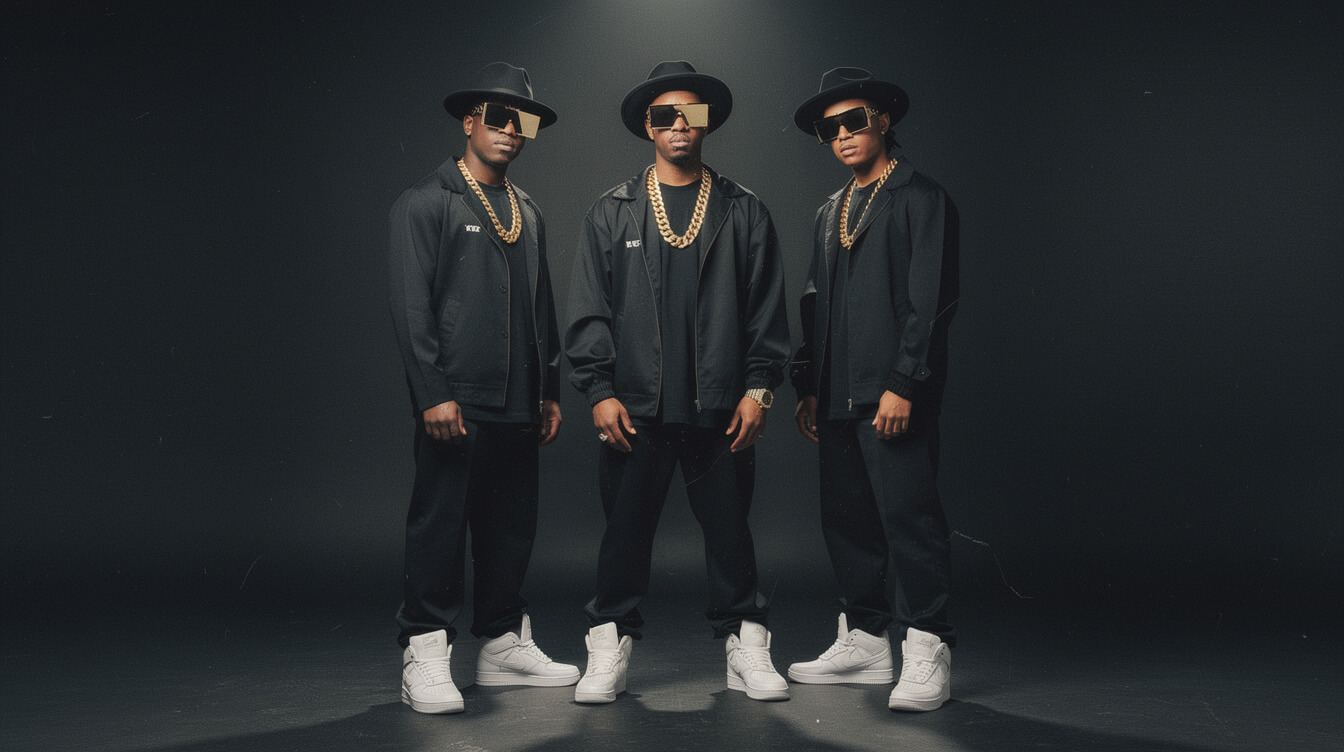
Mid-decade, hip-hop fashion had its first codification moment — the moment something that had been intuitive crew code turned into a national, then global, visual brief. That moment is Run-DMC’s Raising Hell, May 1986, and the track that did the heavy lifting was “My Adidas.” The group — Joseph “Run” Simmons, Darryl “DMC” McDaniels, and Jason “Jam Master Jay” Mizell, all out of Hollis, Queens — had been wearing the laceless-Superstar-with-black-tracksuit uniform on stage since 1984. But the Adidas record made the uniform the message.
The full Hollis kit was: black Adidas tracksuit, white Superstars (laceless or with thick laces pulled flat), Cazal frames, a black fedora, gold dookie rope chain, and a Run-DMC sweatshirt. Cosmetically, it was minimalist. Functionally, it was a uniform. Every member wore the same fit, the way a sports team does, which collapsed the audience’s read of who was the “frontman” — Run-DMC functioned as a group visually before they functioned that way verbally.
The Adidas endorsement that followed Madison Square Garden in July 1986 — when Run held a shell-toe in the air and 20,000 fans held theirs back up — was the first major sneaker-and-music brand alignment in pop history. Adidas signed Run-DMC to a reported $1.6 million deal, which sounds quaint now but in 1986 changed how every athletic brand thought about cultural endorsement forever. Every “sneaker drop” in your Instagram feed in 2026 traces its lineage directly to that Garden show.
The Run-DMC silhouette didn’t just sell Adidas. It put a stake in the ground for an entire aesthetic philosophy that still rules streetwear: minimal, monochrome, unforced, and pulled from the closet of a kid who actually lives in the neighborhood. You can wear it now. Our Raising Hell Run-DMC T-Shirt sits right in the lineage — a clean reissue of the 1986 cover energy that doesn’t try to outsmart the original.
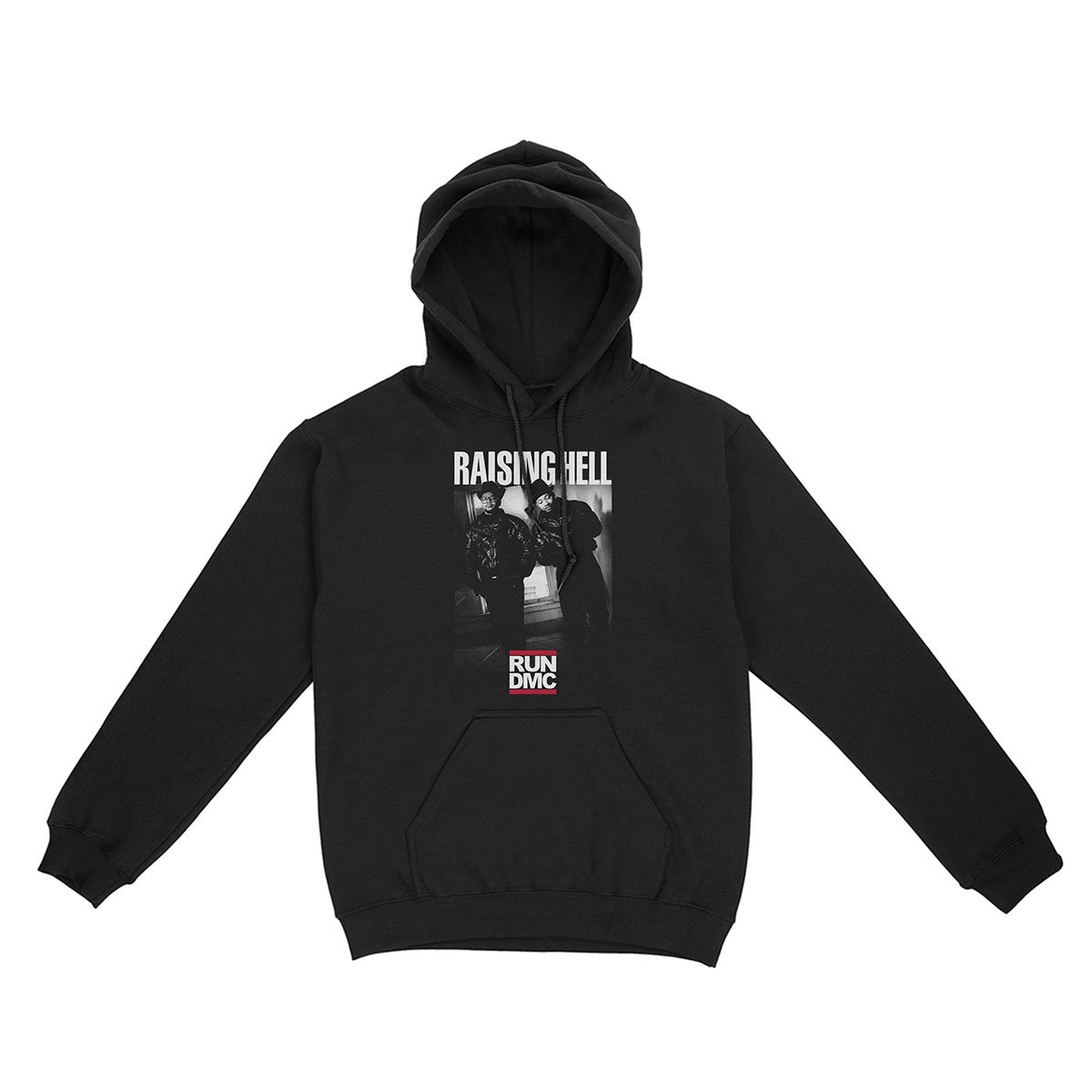
Wear the 1986 Blueprint
Our Raising Hell Run-DMC Hoodie is built off the moment that turned a Queens uniform into the global streetwear playbook. Heavyweight, all-black, no try-hard.
Late ’80s Uptown: Dapper Dan and the Invention of Logomania
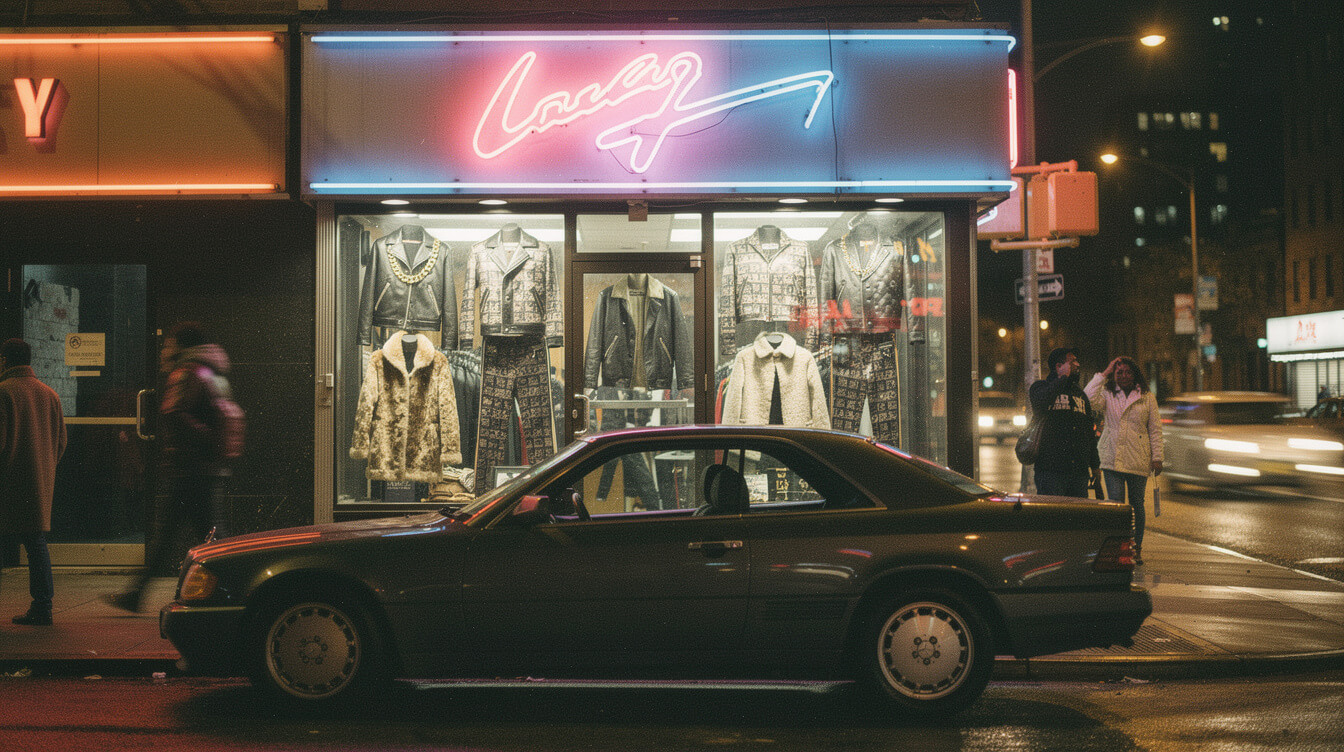
If Queens codified the b-boy silhouette, Harlem invented luxury streetwear. In 1982, Daniel R. Day — known forever after as Dapper Dan — opened a 24-hour boutique at 43 East 125th Street that would, for the next ten years, quietly rewrite what high fashion meant. Dap had a problem and a solution. The problem: every Black entrepreneur, hustler, athlete, and rapper in Harlem with money to spend wanted Gucci, Louis Vuitton, MCM, and Fendi, but the actual European houses refused to sell them garments cut for their bodies (or, in some cases, sell to them at all). The solution: Dap learned how to silkscreen luxury monogram patterns onto leather and fabric himself, and then tailor them into custom pieces that the houses had never made and would never legally authorize.
What came out of 43 East 125th Street between 1982 and 1992 is the entire DNA of modern luxury-meets-street: a Louis Vuitton-monogrammed leather jacket cut into a baseball silhouette, an MCM-printed full bomber for Salt-N-Pepa, a Fendi full-zag set for Rakim, a Gucci suit for Mike Tyson, the legendary Olympic-print jacket LL Cool J wore in the “I Need Love” video. Dap was inventing logomania in real time, fifteen years before Marc Jacobs at Louis Vuitton or Tom Ford at Gucci would do the same thing in Paris and Milan and get credit for it.
The Harlem aesthetic that grew around Dap’s shop wasn’t just clothes. It was gold — heavy fourteen- and eighteen-karat rope chains that came to be called “dookie” chains because of the resemblance to the links of an actual rope, sometimes worn three-deep. Truck jewelry — pendants the size of belt buckles. Customized leather goods: hats, jackets, even car interiors. And it was a different relationship to luxury than what was happening in the rest of fashion: in Harlem, you weren’t asking permission, you were rewriting the code yourself.
Dap’s shop was raided and forced to close in 1992 after Fendi sent investigators — a closure that was, in retrospect, a temporary defeat. In 2017, Gucci’s creative director Alessandro Michele was forced to credit Dap after copying a 1989 piece nearly identical, and that confrontation led to a formal Gucci-Dapper Dan atelier partnership in Harlem the following year. The houses that wouldn’t sell to him in 1982 are now bringing his name back into the brand. The blueprint won.
Late ’80s Bronx & Brooklyn: Conscious Era, BDP, and Native Tongues
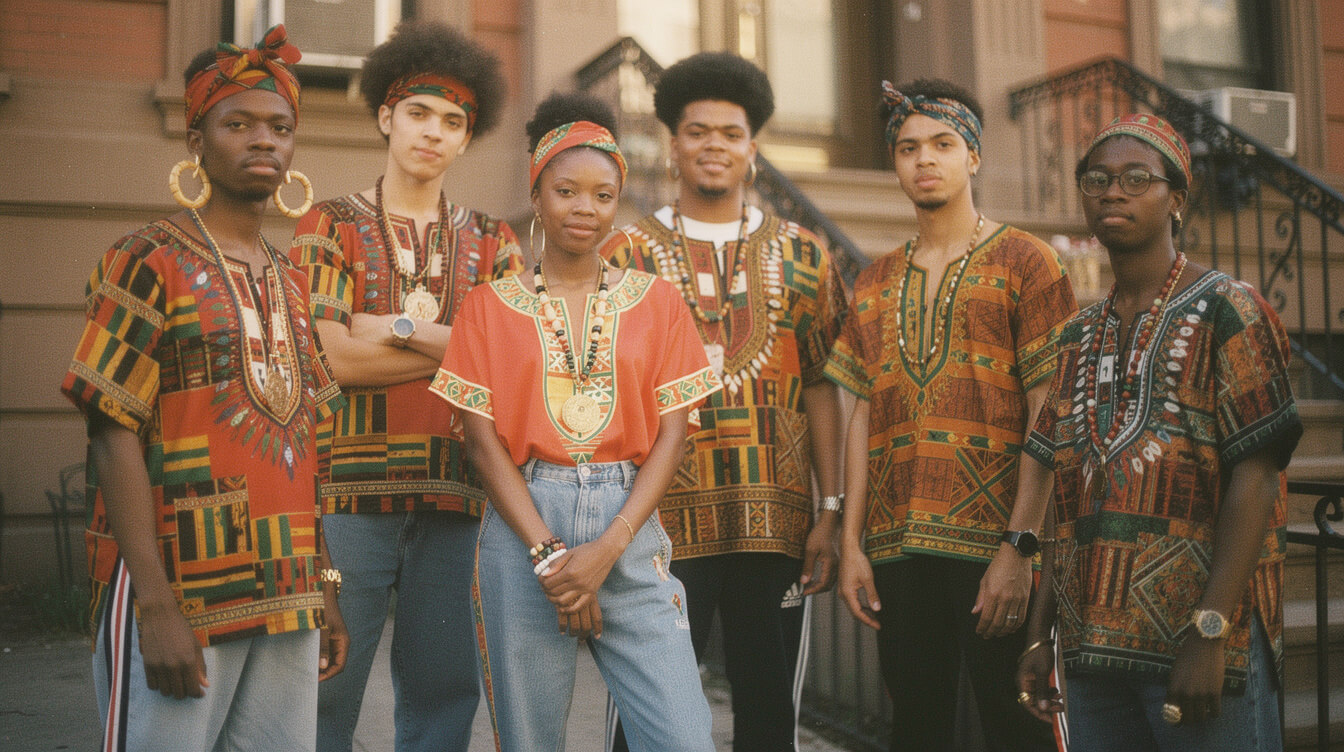
The other half of late-’80s hip-hop fashion ran in the opposite direction from Dap’s logo-emblazoned luxury — toward the continent of Africa. Between 1987 and 1989, a coalition of conscious rap collectives — Boogie Down Productions out of the South Bronx, X Clan and Public Enemy out of Long Island, and the Native Tongues family (De La Soul, A Tribe Called Quest, the Jungle Brothers) out of Long Island and Brooklyn — pulled hip-hop’s wardrobe in a sharply political direction. The look became part of the message.
The defining piece was the red-black-and-green Africa medallion — a leather-roped pendant cast in the colors of the Pan-African flag, sometimes shaped as the African continent itself, sometimes with the Egyptian ankh, sometimes with a clenched fist. It said we know who we are and where we come from in a way the gold rope chain didn’t. KRS-One wore the Africa medallion on the cover of By All Means Necessary (1988). The Jungle Brothers wore stacked medallions on the cover of Straight Out the Jungle (1988). De La Soul’s 3 Feet High and Rising (1989) was an entire aesthetic departure — bright florals, paisley, the “D.A.I.S.Y. Age” — that pushed hip-hop into psychedelic, Afrocentric, post-gangsta territory.
The Native Tongues look pulled from several sources. Kente cloth and mudcloth patterns showed up on hats, vests, and dashiki-influenced tops. African prints — wax-print fabrics from Côte d’Ivoire and Ghana — became a way of styling that explicitly rejected European logos in favor of continental geometry. Door-knocker and bamboo hoop earrings, often the size of softballs, became the women’s signature — Roxanne Shanté, MC Lyte, and Salt-N-Pepa all repped them — and would later get name-checked in songs from LL Cool J to LL’s grand-students. Locked, braided, and natural hair replaced relaxers and high-top fades; the high-top itself, popularized earlier in the decade by Big Daddy Kane and Kid ‘n Play, became sculpted into geometric works of art with fades and shaved patterns.
Sneakers in the conscious-era half of ’88-’89 split: PRO-Keds Royal Master 69ers came back in the Bronx as a deliberate rejection of the corporate Adidas-Reebok-Nike triangle, while Pumas, British Knights, and Travel Fox Cosmos got rotated through the Queens-Brooklyn-Bronx grid. If you want the late-’80s Bronx-conscious era in one garment, look at the Boogie Down Productions Tee — KRS-One and Scott La Rock represented exactly the bridge between street-savvy and message-forward that the era ran on.
The Status Hardware Doctrine: Gold, Sneakers, Frames
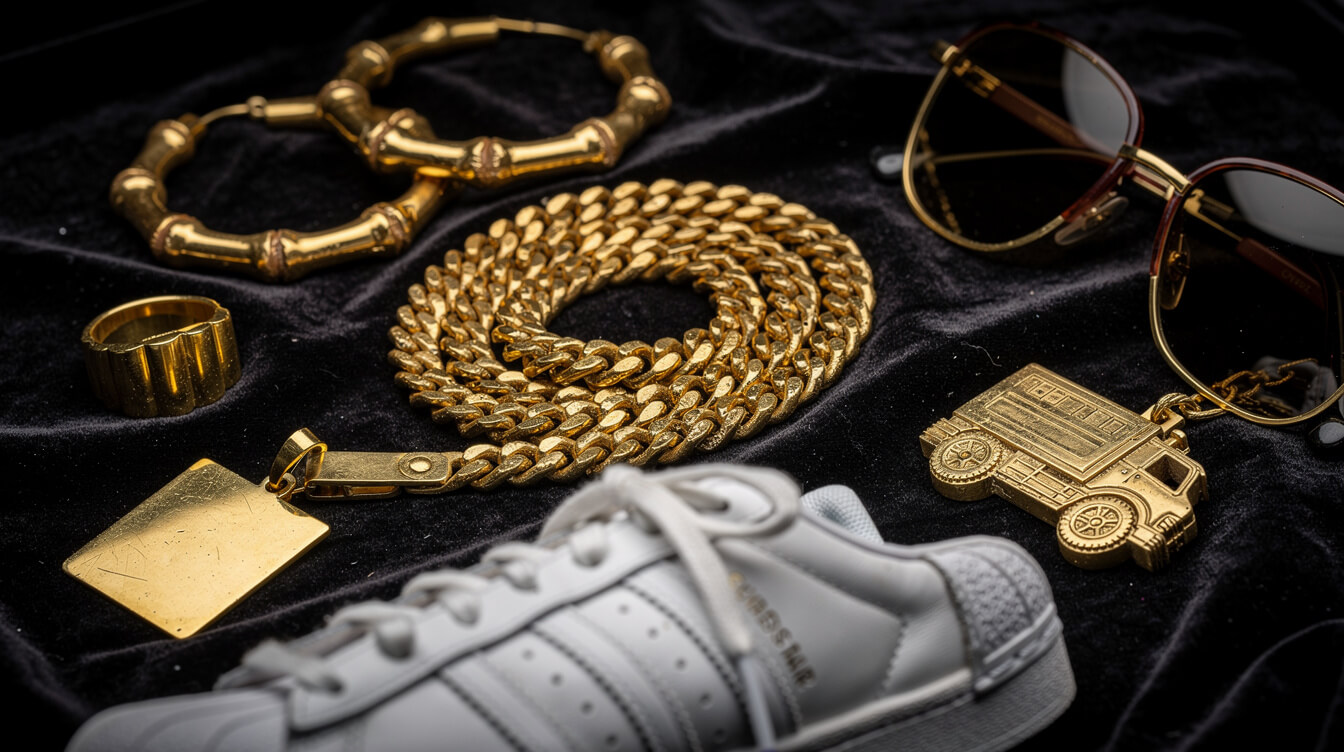
Across all four neighborhoods and all three movements of the decade, one rule held: hip-hop fashion in the 1980s was a hardware economy. Soft pieces — denim, sweatshirts, tracksuits — were the canvas. The story was told in metal, leather, plastic, and rubber. Status was something you could weigh.
The dookie rope chain was the most visible. Worn in fourteen-karat, eighteen-karat, sometimes plated, the chain ran in weights from 50 grams (entry-level) to 500-plus grams (Slick Rick, Eric B., LL). The chain wasn’t subtle, and it wasn’t supposed to be: in a city where the systems had failed your community, wearing your wealth around your neck was both insurance and broadcast. The Cuban link variant — invented in Cuba and adopted in Miami — wouldn’t fully take over hip-hop until the early ’90s; the ’80s belonged to the rope. Nameplate jewelry — your name or your block in custom gold script — became a Brooklyn and the Bronx specialty. Truck jewelry — outsized pendants — became the late-’80s flex, with the Mercedes hood ornament becoming a literal pendant on hundreds of necks before the manufacturer started cracking down.
The Cazal frames — model 607 in gold, model 951, model 858 — became hip-hop’s first true fashion glasses. They weren’t prescription, weren’t sunglasses, weren’t even particularly practical; they were heavy German plastic-and-metal craft cut for adult European optical buyers, and hip-hop colonized them. By 1986, the East Coast burglary rate on Cazals had gotten so high that several Brooklyn opticians stopped stocking them.
The sneakers were the closing argument. The Adidas Superstar was the King Tut piece, but the supporting cast was deep: Puma Clyde and Puma Suede (named for Walt “Clyde” Frazier, the Knicks legend), Nike Air Force 1 (introduced 1982, slow to catch on but locked in by ’85), Reebok Classic Leather (worn by every female rapper from MC Lyte to Salt-N-Pepa), Travel Fox Cosmos (a late-’80s Brooklyn favorite), British Knights (the lower-priced challenger), and PRO-Keds (the throwback indie pick). The sneaker rotation was tribal information — you could tell what borough and what crew somebody ran with by what was on their feet.
The closing piece of the hardware kit was the boombox. Not technically apparel, but worn — slung over the shoulder, gripped by the handle, set on a milk crate. The JVC RC-M90, the Sharp GF-777, the Conion C-100F. They were rolling stereos and signal flares: we are here, this is our music, you cannot turn it down.
How to Wear the Eighties Blueprint Now (Without Looking Like a Costume)
The hardest part of building a 2026 fit out of ’80s hip-hop fashion is the same problem people had translating ’70s rock fashion in 1995: if you cosplay the silhouette, you look like you’re at a theme party. If you isolate the structural moves and let the rest of your wardrobe stay 2026, you look like you actually know the lineage. Here’s how to think about it.
Start with the artist tee, not the tracksuit. A vintage-cut, screen-printed artist tee — Run-DMC, LL Cool J, BDP, Eric B. & Rakim, Public Enemy — does 80% of the cultural work without forcing the fit. Pair with raw or selvedge denim and a clean white sneaker (a current Superstar reissue still works) and you’ve got the silhouette without the costume. This is the move every editor in our rap merchandise guide uses when they want the look without the bit.
One piece of hardware, not five. The ’80s rope-chain-stacked-three-deep moment is iconic in photographs, costume in real life. Pick one — a single gold chain (rope or Cuban), a bamboo hoop earring set, a Cazal-shape frame — and stop. The original wearers were broadcasting wealth in a world without Instagram; you don’t have to compete with that.
Layer the era into modern silhouettes. A late-’80s leather bomber over a 2026-cut tee and slim trouser hits harder than head-to-toe ’88. A Kangol-shape bucket hat with current cargo pants reads cool, not throwback. The job is to translate, not to copy. Our Ice-T tee deep-dive walks through the same translation logic for the West Coast late-’80s aesthetic.
Keep the white tee sacred. The one thing that hasn’t moved an inch since 1982 is the foundation of the kit — a heavyweight, slightly cropped, perfectly fitted white T-shirt. Every ’80s look in this article had one underneath. It is the most underrated and most expensive-feeling piece in the entire vocabulary.
Frequently Asked Questions
What did people wear in 1980s hip-hop?
It changed across the decade in three identifiable movements. Early-’80s b-boy gear (Lee denim suits, shell-toe Adidas, Kangol bucket hats, sheepskin coats). Mid-’80s Run-DMC codification (all-black tracksuits with white laceless Adidas, Cazal frames, fedoras, dookie rope chains). Late-’80s split between Afrocentric medallions, kente prints, and door-knocker earrings on one side, and Dapper Dan’s Harlem luxury-logo customs on the other.
Why did Run-DMC wear Adidas?
Adidas Superstars with fat laces — or no laces at all — were already the unofficial Queens uniform in the early ’80s when Run-DMC formed. The 1986 single “My Adidas” turned that street code into a global anthem, which led directly to the first major sneaker-and-music endorsement deal in history: a reported $1.6 million contract between Adidas and Run-DMC, sealed after Run famously raised a shell-toe at Madison Square Garden in July 1986.
Who was Dapper Dan and why does he matter to ’80s hip-hop fashion?
Daniel R. Day ran a 24-hour boutique at 43 East 125th Street in Harlem from 1982 to 1992. Because European luxury houses refused to sell to (or for) his Black clientele, he learned to silkscreen Gucci, Louis Vuitton, Fendi, and MCM monogram patterns onto leather and fabric and then tailor custom pieces no house had ever made. He effectively invented luxury-meets-street logomania a decade and a half before Paris and Milan got there — and was vindicated when Gucci entered a formal partnership with him in 2018.
What jewelry defined ’80s hip-hop style?
Heavy gold “dookie” rope chains (fourteen- and eighteen-karat, often stacked three-deep), nameplate pendants in custom script, oversized truck jewelry pendants (often the Mercedes hood ornament repurposed), and — on women — big gold door-knocker pendants and bamboo hoop earrings the size of softballs. The unifying rule: status was meant to be worn in plain sight.
Is ’80s hip-hop fashion the origin of modern streetwear?
Yes — every structural pillar of contemporary streetwear traces directly back to choices made block-by-block in 1980s New York. Logo culture comes from Dapper Dan. Sneaker hype comes from “My Adidas.” Athleisure as identity comes from the Hollis tracksuit. Luxury-street fusion comes from 125th Street. Even the artist tee, our favorite gateway garment, is a direct descendant of the iron-on screen-prints crews wore at park jams in 1983.
Final Thoughts: The Blueprint Is Still in the Walls
Eighties hip-hop fashion gets flattened in most retellings because the people retelling it didn’t live it block-by-block. They list trends; they don’t draw the map. But the map matters. Without the Bronx, there is no b-boy silhouette. Without Queens, there is no Run-DMC moment. Without Harlem, there is no logomania. Without Brooklyn and Long Island, there is no conscious aesthetic. And without all four working in parallel between 1980 and 1989, there is no streetwear industry as we know it in 2026 — no Off-White, no Supreme, no Fear of God, no Yeezy, no Telfar.
The blueprint is still in the walls. Every drop you queue up for in 2026 is a remix of a move some kid made in a park on Sedgwick Avenue or on a stoop on 125th Street or on a corner in Bed-Stuy four decades ago. Custom Creative builds for that lineage. Our catalog isn’t a costume rack — it’s a way to wear the receipts. Keep the white tee sacred, pick one piece of hardware, layer the era into modern silhouettes, and let the work do the talking. The ’80s already did.
Get the Culture in Your Inbox
Album anniversaries, hip-hop history deep-dives, and first looks at every Custom Creative drop. No filler — just receipts and gear.

🎧 Never Miss a Drop
Exclusive product releases, hip-hop deep dives, and member-only discounts. Straight to your inbox.
Free forever. No spam. Unsubscribe anytime.
Get the Culture, Delivered
Deep dives into hip-hop history, exclusive product drops, and discounts sent straight to your inbox. No spam, just culture.
Join 2,000+ hip-hop heads already in the loop. Unsubscribe anytime.