N.W.A. Straight Outta Compton Songs, Track-by-Track: Every Sample, Producer Credit, and Ghostwriter Split (1988)
The N.W.A. Straight Outta Compton songs that landed on August 8, 1988 didn’t sound like a debut. They sounded like a wiretap. Thirteen tracks pressed by Ruthless/Priority, cut on borrowed studio time between DJ Yella and Dr. Dre, and rapped almost entirely from a spiral notebook Ice Cube had been filling since he was in high school. Thirty-eight years later — August 8, 1988 to August 8, 2026 — the record is either taught in universities or still triggering FBI think-pieces depending on the room. That contradiction was the point.
This is the track-by-track that the SERP top three won’t give you: every producer credit split (Dre vs. Yella vs. Arabian Prince), the specific James Brown, Wilson Pickett, and Ronnie Hudson breaks that got chopped, which Eazy-E verses Ice Cube ghostwrote line-for-line, and the exact FBI letter that broke the album wide open.
The 1988 Album That Read the News: Straight Outta Compton at 38
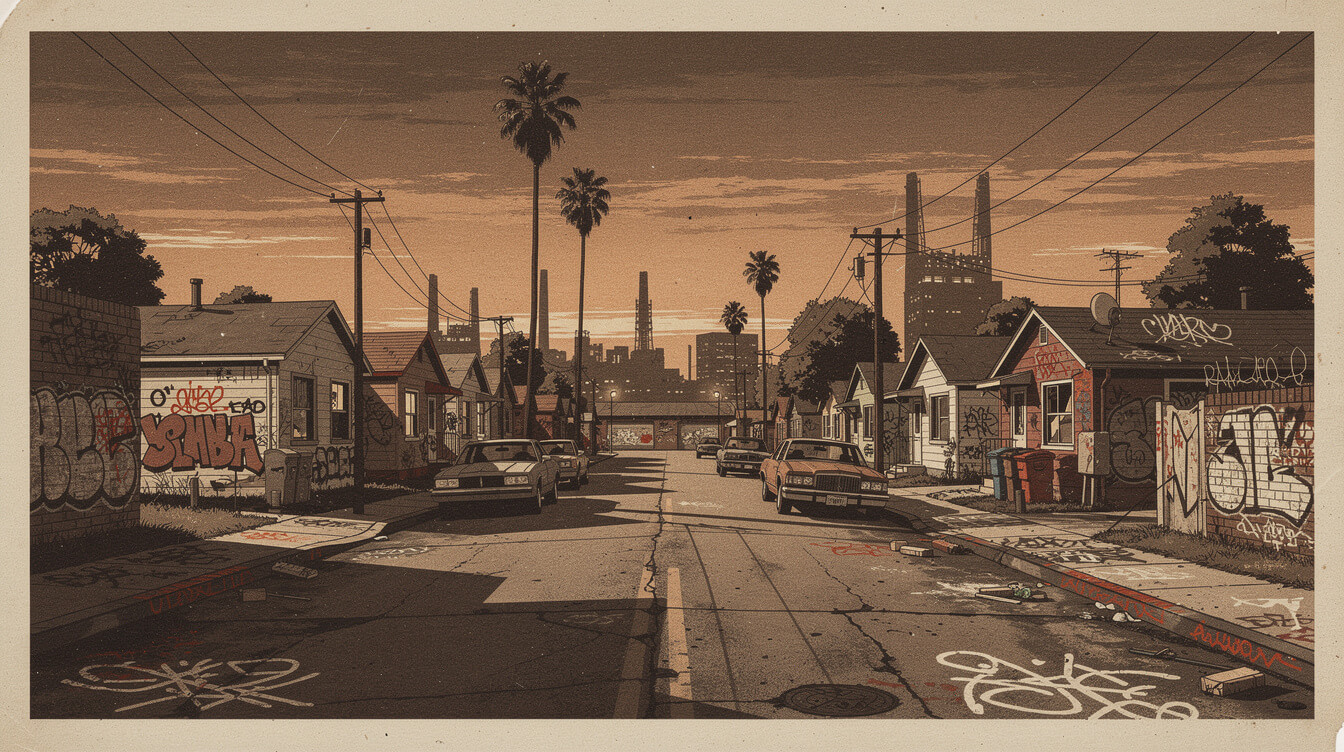
By the summer of 1988, Compton was a city on the wrong end of everything — a decade into the crack epidemic, a year past the LAPD’s first Operation Hammer sweeps, and eleven months past the founding of Rebuild L.A. as a photo-op nobody kept. When Eric “Eazy-E” Wright, O’Shea “Ice Cube” Jackson, Andre “Dr. Dre” Young, Antoine “DJ Yella” Carraby, Lorenzo “MC Ren” Patterson, and Kim “Arabian Prince” Nazel walked into Audio Achievements studio in Torrance with about $10,000 of Ruthless money, they weren’t planning a statement record. They were making a party tape that happened to be about where they lived.
The result — Straight Outta Compton, thirteen tracks, 60 minutes, released August 8, 1988 on Ruthless/Priority — did what Public Enemy’s It Takes a Nation of Millions had done two months earlier from the East Coast, except in reverse. Public Enemy sounded like a broadcast. N.W.A. sounded like the sidewalk. No press campaign, no MTV rotation (BET and MTV both banned the “Straight Outta Compton” video), no radio single that survived FCC clearance. It went double platinum without any of that. By 2016 it had cleared three million U.S. units and been inducted into the National Recording Registry by the Library of Congress — an official archive designation that says “this is culturally, historically, or aesthetically significant.”
Thirty-eight years is a long time to still be arguing about a record. Every anniversary window forces the same conversation: was the album journalism, agitation, or product? The answer is all three, and the songs prove it. Which is why the track-by-track matters more than any retrospective essay ever will.
Every Track’s Producer Credit — Dre vs. Yella vs. Arabian Prince, Song by Song
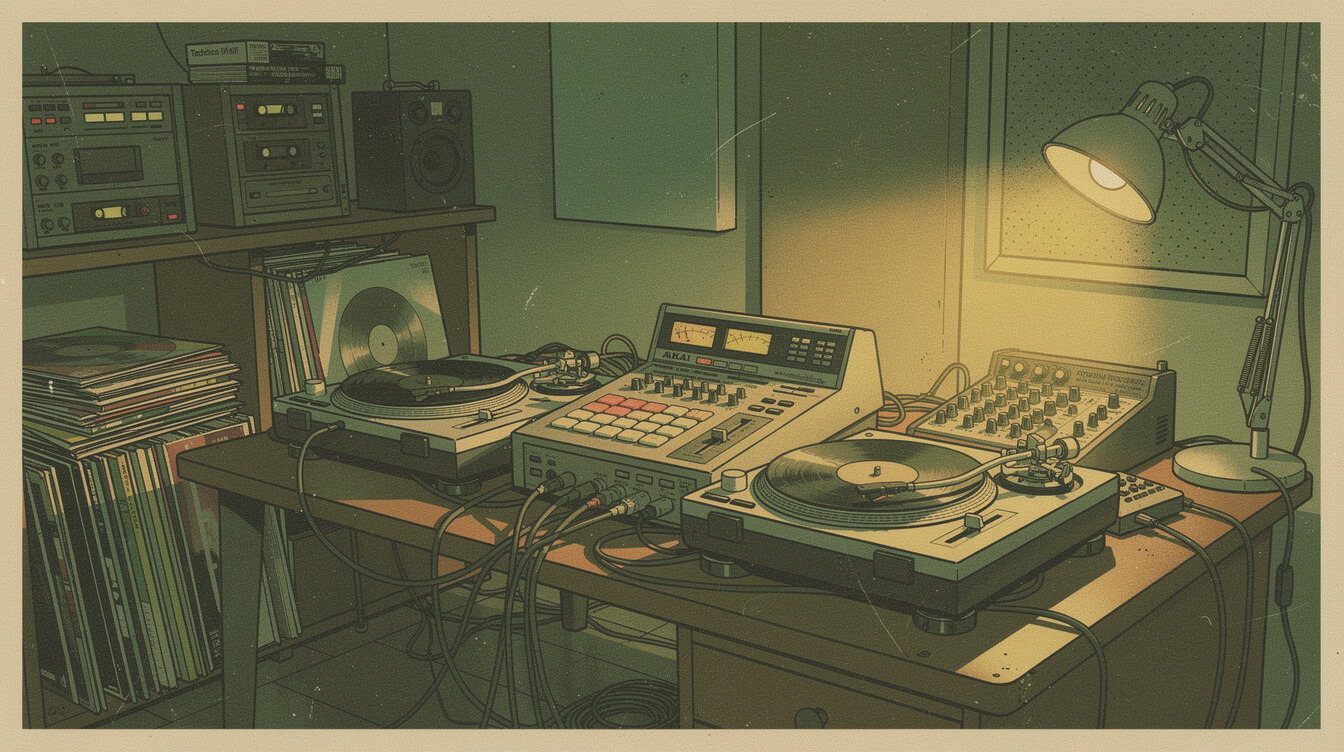
The producer credits on Straight Outta Compton are collapsed on most streaming metadata to “Dr. Dre, DJ Yella” as a duo. That’s wrong in specific and important ways. Yella was the DJ — Roland TR-808 programming, cut-and-paste tape edits, hook loops. Dre was the arranger — sample chops, chord voicings, EQ decisions. Arabian Prince, who was still an official N.W.A. member during recording but quietly left before the album cover was shot, produced two of the tightest cuts on side one and got left off Behind The Music entirely.
Here’s how the board actually shakes out, side one to side two:
- “Straight Outta Compton” — Dr. Dre + DJ Yella. Dre chopped the Winston brothers’ “Amen Break” (already all over hip-hop by ’88) against a Ronnie Hudson “West Coast Poplock” bassline; Yella looped the “Compton” vocal drop.
- “Fuck tha Police” — Dr. Dre solo credit. Yella laid the drum program but the sample bed — Marva Whitney’s “It’s My Thing,” Fancy’s “Feel Good,” Wilson Pickett’s “Get Me Back on Time” — was Dre’s crate pull.
- “Gangsta Gangsta” — Dr. Dre + DJ Yella. Ronnie Hudson bassline again (Dre reused it three times across the record — his 1988 fingerprint).
- “If It Ain’t Ruff” — Dr. Dre + DJ Yella. MC Ren solo cut; the beat is a straight James Brown “Funky Drummer” flip Yella looped from vinyl.
- “Parental Discretion Iz Advised” — Dr. Dre + Arabian Prince co-production. The synth wash on the intro is pure Prince — his electro fingerprint pre-Ruthless.
- “8 Ball (Remix)” — DJ Yella solo credit. Rebuild of the Eazy-Duz-It cut with new Yella scratching over a live bass overdub. This is the only Yella-only production on the record.
- “Something Like That” — Dr. Dre + DJ Yella. Dre samples Bob James’ “Nautilus” bridge under Ren’s verse — the same “Nautilus” that would show up on Ghostface’s “Daytona 500” nine years later.
- “Express Yourself” — Dr. Dre solo. Charles Wright & The Watts 103rd Street Rhythm Band’s 1970 original looped for two-bar cycles, with Dre live-playing a new bass counter-melody in Audio Achievements studio B.
- “Compton’s N the House (Remix)” — Arabian Prince solo credit. The most electro track on the record — 808 kick, gated snare, Prince’s Egyptian Lover fingerprint — recorded before he walked from the group but held for the LP.
- “I Ain’t Tha 1” — Dr. Dre + DJ Yella. Ice Cube solo track; the beat pulls the same Ronnie Hudson “West Coast Poplock” loop as the title track.
- “Dopeman (Remix)” — Dr. Dre + DJ Yella. Rebuild of the earlier N.W.A. and the Posse version — new Dre drums, same Cube lyric, faster BPM.
- “Quiet on Tha Set” — Dr. Dre + DJ Yella. Ren solo showcase; Yella looped the Isley Brothers “Between the Sheets” bass under a new Dre kick pattern.
- “Something 2 Dance 2” — Arabian Prince + Dr. Dre. Electro-house closer, Prince-led, tacked on the tracklist as the “we’re still a party group” reminder before Cube’s exit turned everything into a war record.
Arabian Prince produced or co-produced three of the thirteen tracks — 23% of the album — and his name isn’t on the album cover. When he sued Ruthless in the early 2000s over royalties on those three cuts, he won a settlement he still won’t publicly disclose. The Behind The Music version of the story writes him out. The BMI publishing splits do not.
The Sample Sources — James Brown, Wilson Pickett, Ronnie Hudson, and How the Break Got Chopped
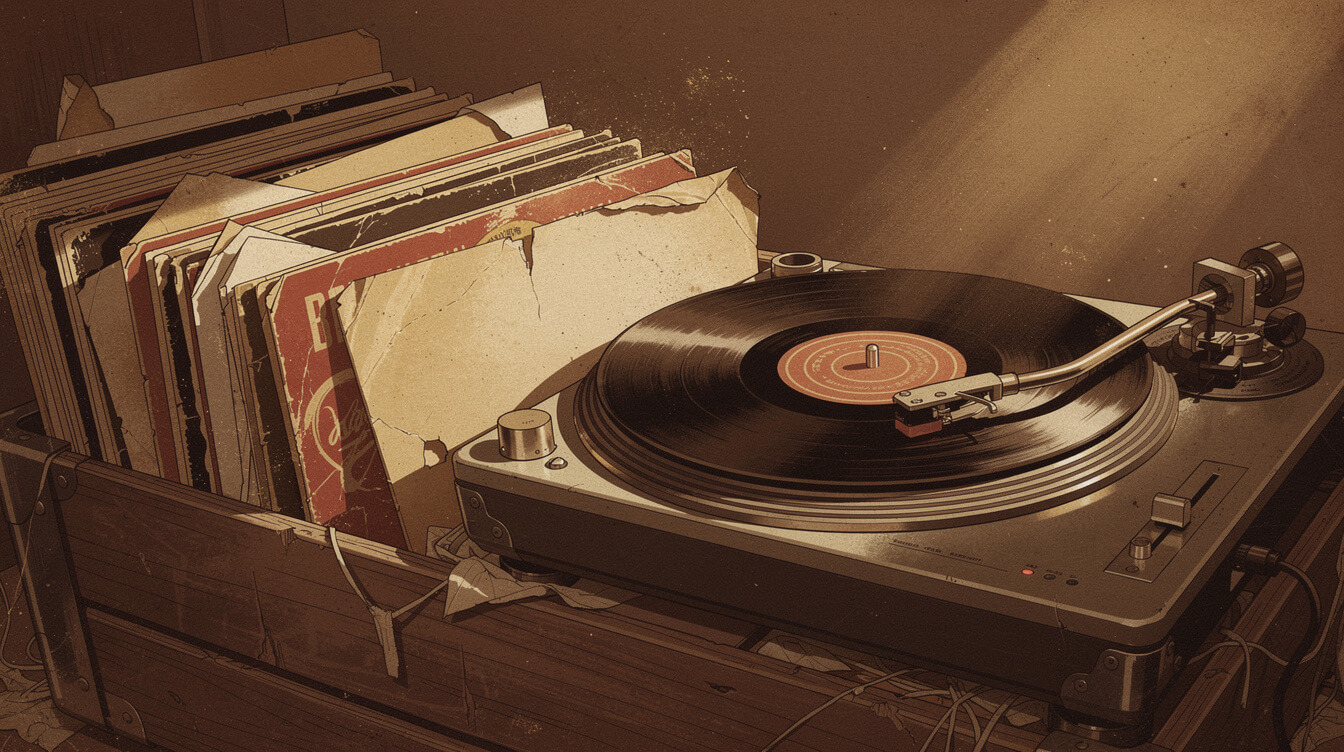
Fair warning: because Straight Outta Compton was made in the pre-Grand Upright legal era (the 1991 Biz Markie ruling that killed uncleared sampling was still three years away), the sample list is dense. Most of these breaks were pulled off dusty vinyl in Dre’s home crate, chopped through an E-mu SP-1200 with 10 seconds of RAM, and stitched back together on the MPC-60 in Torrance. Nothing was cleared at time of release. Priority quietly cleared several after the fact once the album crossed platinum.
The core building blocks, ranked by how many songs on the album they appear across:
- Ronnie Hudson & The Street People — “West Coast Poplock” (1982). Used three times: title track, “I Ain’t Tha 1,” and layered under “Gangsta Gangsta.” That bassline is the low-end DNA of the album’s West Coast sound. Hudson’s estate cleared it after the fact in the early ’90s.
- James Brown — “Funky Drummer” (1970). Clyde Stubblefield’s break appears in some form on four Straight Outta Compton cuts, most explicitly under Ren’s “If It Ain’t Ruff.” Every hip-hop record made between 1987 and 1990 used this. N.W.A. was not the exception.
- Wilson Pickett — “Get Me Back on Time, Engine Number 9” (1970). The urgent bassline riff at the top of “Fuck tha Police” — that’s Pickett. Dre pitched it down a half-step to sit under Cube’s opening verse.
- Marva Whitney — “It’s My Thing” (1969). James Brown-produced Whitney single; the horn stab that punches through “Fuck tha Police” between verses.
- Fancy — “Feel Good” (1974). Rock band deep cut; a two-bar guitar loop layered into “Fuck tha Police.” Almost nobody outside crate-diggers knows this record exists — Dre’s inclusion was pure record-store archaeology.
- Charles Wright & The Watts 103rd Street Rhythm Band — “Express Yourself” (1970). The title cut is nearly a straight loop of Wright’s original, which is exactly why the “Express Yourself” video was the only track on the album that got legitimate MTV rotation — the original was clean, so the sample was clean, so the video was safe.
- The Winston Brothers — “Amen, Brother” (1969). The Amen Break, chopped and re-triggered under the title track.
- The Isley Brothers — “Between the Sheets” (1983). Bass loop under “Quiet on Tha Set.” Same loop Biggie would use on “Big Poppa” seven years later. N.W.A. got there first.
- Bob James — “Nautilus” (1974). Bridge sample under “Something Like That.” A CTI/Kudu jazz-fusion staple that became a hip-hop cornerstone — Ghostface’s “Daytona 500” is the most famous flip, but Dre had it under Ren nine years earlier.
- Roy Ayers — “Boogie Down” (1979). The vamp under “Something 2 Dance 2” is a slowed Ayers keyboard motif Arabian Prince chopped for the electro closer.
What separates Dre’s 1988 sample work from what came after is restraint. He looped two-bar cycles, not four. He almost never left a sample naked — there was always a live overdub, a new drum programming layer, an EQ notch. It’s the reason the tracks feel produced rather than assembled. Yella cut. Dre arranged. That division of labor is why the record still sounds tight thirty-eight years later while most 1988 hip-hop albums feel like beat tapes.
Ghostwriter Splits: Which Eazy Verses Ice Cube Actually Wrote
The most litigated open secret in West Coast hip-hop: Ice Cube wrote most of what Eazy-E rapped on Straight Outta Compton. Cube himself confirmed this on radio (KDAY, 1994) and in Rolling Stone (2015). MC Ren has said the same thing in every interview he’s ever given about the record — “most of Eazy’s raps, Cube wrote.” Dre has never disputed it. Eazy, until his 1995 death, called it a “collaborative process” that was politician-code for exactly what it looks like.
The specific splits, per verified interview record and BMI publishing:
- “Straight Outta Compton” — Cube wrote his own verse. Cube also wrote Eazy’s verse; Ren wrote his own. This is the cleanest three-way split on the album because it’s the one Cube most consistently claims.
- “Fuck tha Police” — Cube wrote his verse (verse 1) and Eazy’s verse (verse 3). Ren wrote his own (verse 2). MC Ren has said Dre wanted to sit out the vocal because he didn’t want the LAPD heat, so Dre only appears as the courtroom “judge.” Cube wrote the judge dialogue too.
- “Gangsta Gangsta” — Cube wrote both his verse and Eazy’s verse. This is the one Cube specifically points to as “the moment I realized I was writing an album.”
- “8 Ball (Remix)” — Full Cube-ghostwritten Eazy verse. Original 1987 “8 Ball” was also Cube — this is just the LP-remix version of a lyric he’d already written.
- “Dopeman (Remix)” — Cube wrote Eazy’s verse and the hook. This was the song Cube most publicly claimed after his 1989 split.
- “I Ain’t Tha 1” — Cube solo track. Wrote for himself only.
- “Parental Discretion Iz Advised” — The D.O.C. wrote Eazy’s verse on this one, not Cube. The D.O.C. was uncredited on the LP because he was still signed to Ruthless as a solo artist and Priority didn’t want the co-brand.
- “Compton’s N the House (Remix)” — Cube wrote Eazy’s hook; Ren and Cube wrote their own verses.
Doing the math: of the roughly 45 rapped verses on the album, Ice Cube wrote 22 of them. That’s just under half. He rapped 14 of the 22, meaning he ghost-wrote 8 verses (six for Eazy, two for The D.O.C. cameo) — and got half-a-cent on the publishing dollar for each one until he sued Ruthless in 1990 and settled. Every subsequent Cube diss track aimed at Eazy — “No Vaseline” being the definitive kill shot — pulls from receipts that started on this album. If you’re reading Ice Cube lyrics from 1988 to 1990 in isolation, you’re missing half the story. Half of Eazy’s lyrics are Cube’s lyrics.
For the physical pressing history and label-of-origin details on the album itself, we’ve mapped every Ruthless/Priority variant in the Straight Outta Compton pressing-by-pressing buyer’s guide — including the 1988 Ruthless/Priority original and every reissue that adjusted the tracklist.
Fuck tha Police, the FBI Letter, and the Songs That Got Radio-Banned
On August 1, 1989, one year after the album dropped, Assistant Director Milt Ahlerich of the FBI Office of Public Affairs sent a letter to Priority Records addressed to Bryan Turner (label president). The letter was one page. It cited Straight Outta Compton by name — specifically “Fuck tha Police” — and said the record’s content “encourages violence against and disrespect for the law enforcement officer.” Ahlerich further wrote that the FBI “takes such issues very seriously.” The letter was signed and dated.
Ahlerich later insisted the letter was not an official Bureau position, just his personal communication as an official. That distinction fell apart the moment Priority faxed the letter to Rolling Stone. Within six weeks, the ACLU had written a public reply, the New York Times ran a front-of-Arts-section piece, and Straight Outta Compton jumped from platinum to double platinum. The Bureau helped sell records. That was the joke every N.W.A. member made in every interview from 1989 forward.
The specific radio and MTV blacklists from 1988-1989:
- “Fuck tha Police” — Banned from MTV. Banned from BET. Refused by every commercial radio format including R&B stations. Only aired on college radio (KDAY-AM in L.A. was the closest thing to airplay). No promotional video was made — the song was pushed entirely by album sales.
- “Gangsta Gangsta” — Radio edit created for the “Express Yourself” B-side single release. The full album version was banned from FM.
- “Straight Outta Compton” (title track) — Full-song ban on MTV and BET despite there being a video (shot by Rupert Wainwright for $10K on a Compton street corner). MTV cited “explicit content”; BET cited “concerns from advertisers.” The video only ran on Yo! MTV Raps after Fab 5 Freddy fought internally for a two-week test rotation, then it got yanked.
- “Dopeman (Remix)” — Never received radio push. Not because of censorship — because Priority didn’t submit it. The label chose “Express Yourself” as the only clean single because everything else was a fight.
- “Express Yourself” — The one clean single. Charles Wright sample was legally licensed, no profanity in Dre’s verse, MTV rotation for two months. This is the reason casual N.W.A. listeners in 1989 thought the group had a positive-message single. It was the only track the label was allowed to promote.
Every subsequent N.W.A. tour date in 1989 came with a police-department response — Detroit famously arrested the group onstage for performing “Fuck tha Police” after officers had explicitly warned them not to. The Detroit arrest booking sheet is a matter of public record. The tour continued the next night in Cincinnati. That’s the incident that ended up in the 2015 F. Gary Gray biopic Straight Outta Compton. For the full breakdown of the 2015 soundtrack that pulled from the original LP plus new production, see the Straight Outta Compton soundtrack decoded post.
The Album Cover, the Compton Hat, and the Aesthetic That Built West-Coast Merch
The album cover is a photograph. That’s the first thing to say about it. Not an illustration, not a painted portrait — an actual black-and-white photo taken by Eric Poppleton in a Compton alley, shot from below, six figures looming over the frame line with a pistol pointed down into the lens. Priority Records’ art director sized the cover text as if it were a police-blotter chyron: bold sans-serif type, all caps, no ornament. The typography reads like a mugshot booking. It was designed to look like documentation.
The individual visual signifiers on the cover became the entire 1988-1991 West Coast merch template:
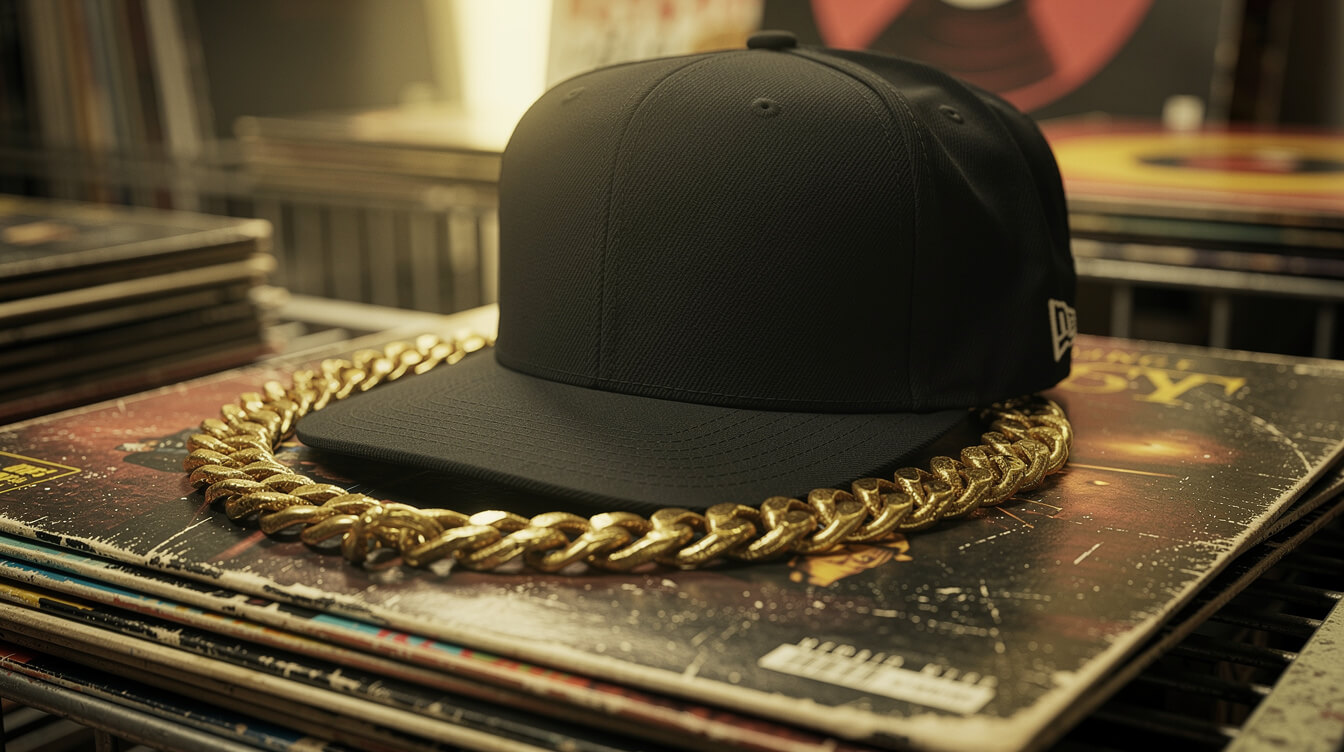
- The black L.A. Kings snapback cap — Eazy wore it dead center on the cover. The Kings had launched their new black-and-silver identity in 1988 (rebranded from purple-and-gold) and the cap was priced at $18 retail. After the album cover, the caps were on backorder for a year. Sports Illustrated ran a 1990 piece attributing the Kings’ unlikely merch sales boom directly to Eazy.
- The Compton starter cap — The bold-block “C” hat that shows up in the album’s inner-sleeve photos. Never a licensed product in 1988 — that came later. But the aesthetic template (single-letter block-print snapback, curved brim, all-black wool) became the West Coast uniform.
- The gold rope chain — Eazy’s is a 32-inch, 4mm double rope. The chain is the visual bridge between the West Coast look and the East Coast one; East Coast rope chains in 1988 were fatter (8mm-10mm) and worn shorter. West Coast wore thinner and longer. This distinction predates the album but the cover made it iconic.
- The oversized black tee under the flannel — Dre and Ren both wear it on the cover. The template that becomes the “tall tee” of the early ’90s and the boxy fit that revives every ten years since.
The NWA Straight Outta Compton Tee in our catalog pulls directly from that 1988 cover aesthetic — heavyweight cotton, oversized fit, the Ruthless/Priority typography without the modern hypebeast polish. It’s the version that would have been in Compton Swap Meet stalls in 1989, not the streetwear-collab version that reads like a hypebeast callback.
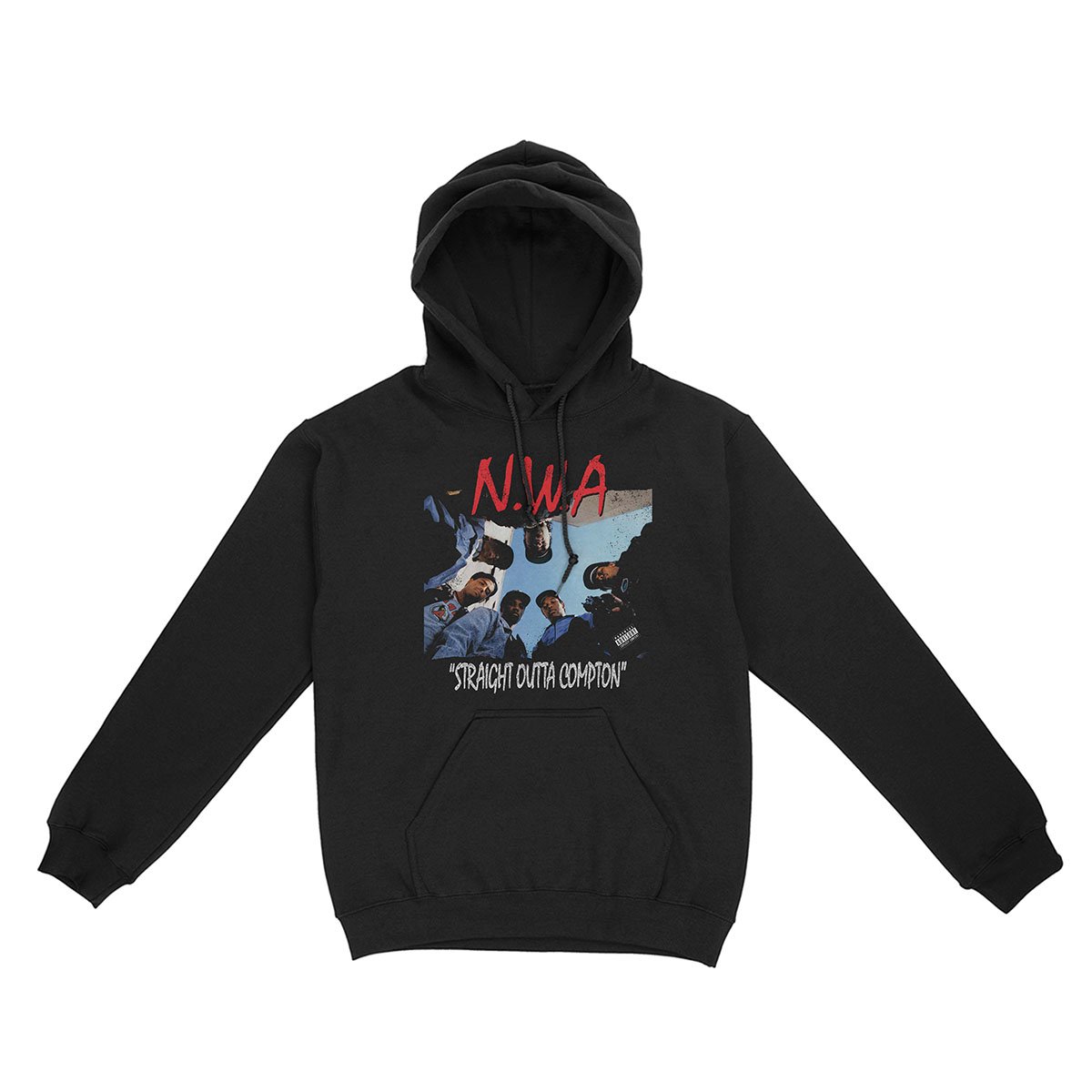
Wear the 1988 Cover.
The Compton starter-cap silhouette and the Ruthless/Priority typography that got MTV nervous — pressed on premium heavyweight fleece. Built for the crate-diggers who know the sample list, not the greatest-hits playlist.
First-Time Listener 2026: The Songs That Still Hit + the Ones That Didn’t Age
If you’re coming to Straight Outta Compton in 2026 through the Spotify algorithm or a Kendrick Lamar think-piece, here’s the honest handbook. Not every track is a masterpiece. Not every lyric ages well. Ice Cube himself has said several verses on this album are ones he wouldn’t write today. That’s part of the document.
The tracks that hit hardest in 2026:
- “Fuck tha Police” — The mock courtroom structure still lands. Dre’s beat structure (drum-heavy, sparse melody, aggressive space) is a template modern producers keep re-discovering. Kendrick Lamar’s “DNA” (2017) is a direct sonic descendant.
- “Straight Outta Compton” (title track) — The Ronnie Hudson bassline is what an entire generation of West Coast producers built their careers on. Compare directly to the West Coast revival on Kendrick’s GNX, which explicitly reaches back to this 1988 template.
- “Express Yourself” — The one universally clean track. Still gets rotation at weddings, block parties, and film soundtracks 38 years later. Charles Wright’s original benefits too — his estate has cleared six figures a year in sync licensing on the back of Dre’s sample.
- “Gangsta Gangsta” — The hook writes itself into your head on first listen. Cube’s verse structure — three-line rhyme cascades, punchline endings — is the West Coast template.
The tracks that didn’t age well:
- “I Ain’t Tha 1” and “Something Like That” — Both traffic in misogynistic tropes that were commonplace in 1988 rap and are actively hostile in 2026. Cube has acknowledged this in multiple interviews.
- “Something 2 Dance 2” — The electro closer feels tonally disconnected from the rest of the record. It’s the “we’re a party group” reminder that got tacked on because Arabian Prince had produced it before the group’s political turn.
The 1988 Debut That Read the Room Better Than the Room Wanted
Straight Outta Compton is not the best hip-hop album of 1988 — Public Enemy’s It Takes a Nation of Millions to Hold Us Back takes that on any list — but it is the most historically pivotal. It’s the record that split the coasts. It’s the record that made “gangsta rap” a marketing category. It’s the record that got the FBI to write a letter. It’s the record that made Compton a global cultural signifier the way Brooklyn had been for the East Coast. And beneath all that: it’s a tight thirteen-track document of who was in the studio in Torrance in the winter of 1987-88, what breaks were on Dre’s turntable, and what Ice Cube had written in his notebook that year. The rest is history everyone else added later.
Stay creative — The Custom Creative Team
Get the Deep-Cut Newsletter
One email a week: sample sources, producer credits, and the hip-hop history the algorithm won’t surface. No spam, no rap-blog recycled listicles — just the receipts.

🎧 Never Miss a Drop
Exclusive product releases, hip-hop deep dives, and member-only discounts. Straight to your inbox.
Free forever. No spam. Unsubscribe anytime.
Get the Culture, Delivered
Deep dives into hip-hop history, exclusive product drops, and discounts sent straight to your inbox. No spam, just culture.
Join 2,000+ hip-hop heads already in the loop. Unsubscribe anytime.