Hip-Hop Fashion Explained: The Artist-Designer Lineage That Built a $60 Billion Industry (From Karl Kani to Yeezy)
The hip hop fashion story most style blogs tell is a decade-by-decade recap: baggy in the 90s, throwbacks in the 2000s, skinny jeans in the 2010s. Wikipedia does that in 11,600 words. HeSpokeStyle does it in 4,000. That’s not the story.
The real story is a business lineage. It’s one continuous 50-year arc of Black artists who saw the money the fashion industry was making off the culture, took the pen back, and built brands. Karl Kani in 1989. Cross Colours the same year. FUBU in 1992. Rocawear, Sean John, Phat Farm at the turn of the century. Kanye’s Yeezy. Off-White. PURPLE brand right now. Business of Fashion pegs the streetwear economy hip-hop generated at over $60 billion a year. That number didn’t happen by accident — it was engineered by a specific list of founders, most of them Black, most of them uncredited by the mainstream fashion press until decades later. This is that list, in order, with receipts.
Before the Brand: The 1970s Bronx and Dapper Dan’s Harlem Boutique
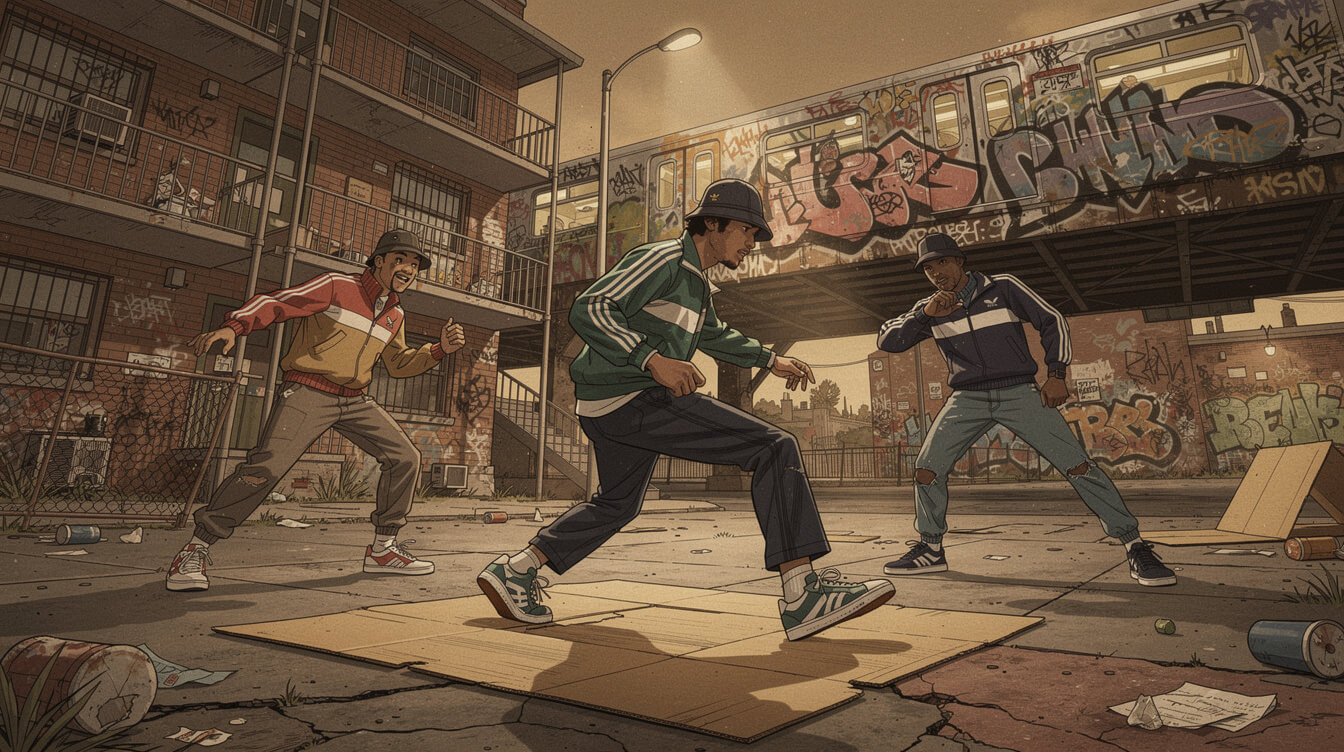
Before hip-hop had labels, it had a uniform. August 11, 1973. Kool Herc throws the back-to-school party at 1520 Sedgwick Avenue in the West Bronx and pulls what’s usually called the founding block party of the culture. The b-boys and b-girls in that room weren’t wearing anything a designer had labelled "hip-hop." They were wearing Puma Suedes and Adidas Superstar shell-toes because they were the shoes that gripped the flattened cardboard on a linoleum floor. They wore Kangol bucket hats because LL Cool J would later canonize them, but originally because they kept the sun off during park jams. They wore Le Coq Sportif tracksuits and Cazal frames not as an ironic throwback but because that’s what looked sharp in 1978.
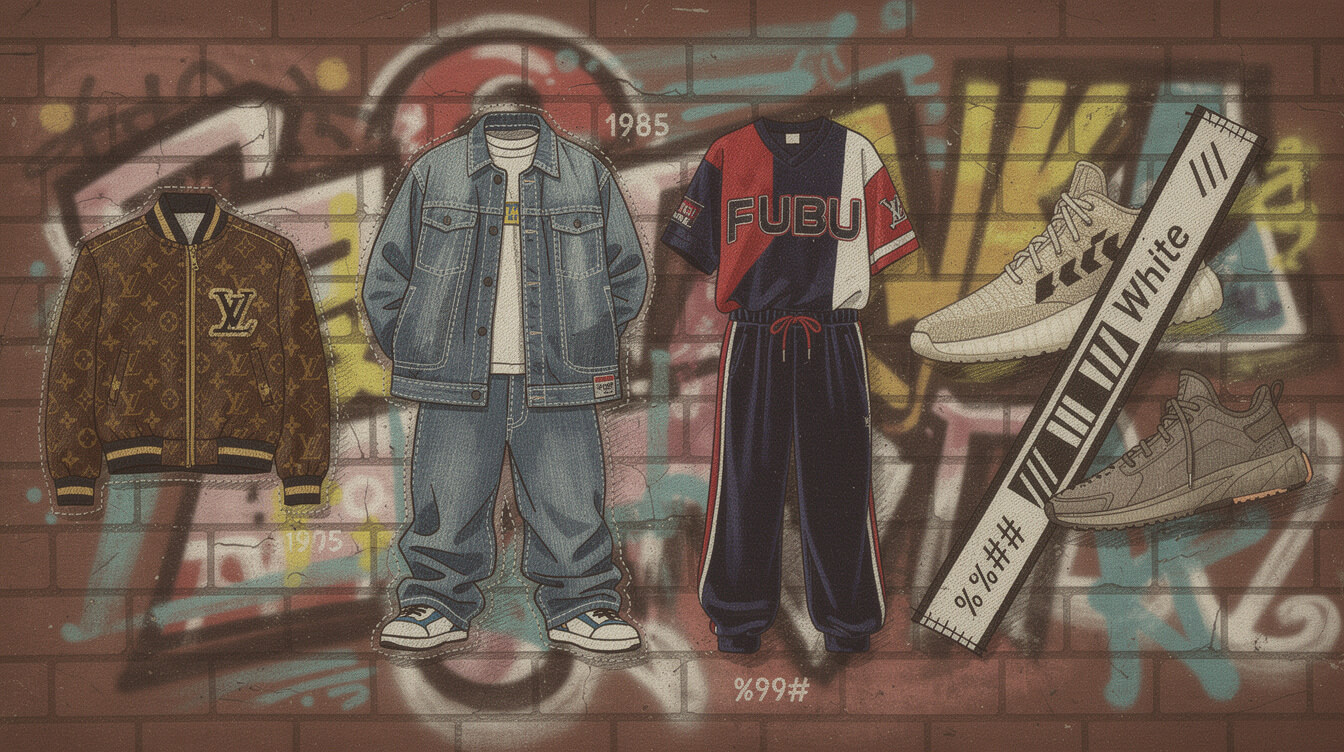
The pipeline from park jam to fashion — with a capital F — ran through one address: 43 East 125th Street, Harlem. That was Dapper Dan’s Boutique, open from 1982 to 1992, and it changed everything. Dapper Dan Day was a bootlegger in the most beautiful sense of the word. He photographed Louis Vuitton, Gucci, MCM, and Fendi monogram prints, screen-printed his own version onto leather and mink, and cut them into custom fur-trimmed bomber jackets, matching parkas, and duffel bags for anyone who could pay. His customer list is the who’s-who of 80s hip-hop: LL Cool J, Salt-N-Pepa, Eric B. & Rakim (who wore the head-to-toe MCM look on the Paid in Full cover), Big Daddy Kane. Mike Tyson wore a Dapper Dan bomber to the fight where he lost his belt to Buster Douglas.
The luxury houses did not appreciate this. In 1992, after years of cease-and-desists, Fendi’s lawyers led a joint raid on the Boutique that put Dapper Dan out of business overnight. It took 25 years for the fashion establishment to admit it had been wrong. In 2017, Gucci’s creative director Alessandro Michele sent a Cruise 2018 look down the runway in Florence that was an almost identical remake of a Louis Vuitton-print bomber Dapper Dan had made for Diane Dixon in 1989. The internet noticed. Gucci partnered with Dan and reopened his Harlem atelier the following year. We’ll come back to that story in the last section — it’s the closing loop of everything else in this article.
The Artist-Designer Lineage: Karl Kani, Cross Colours, and FUBU
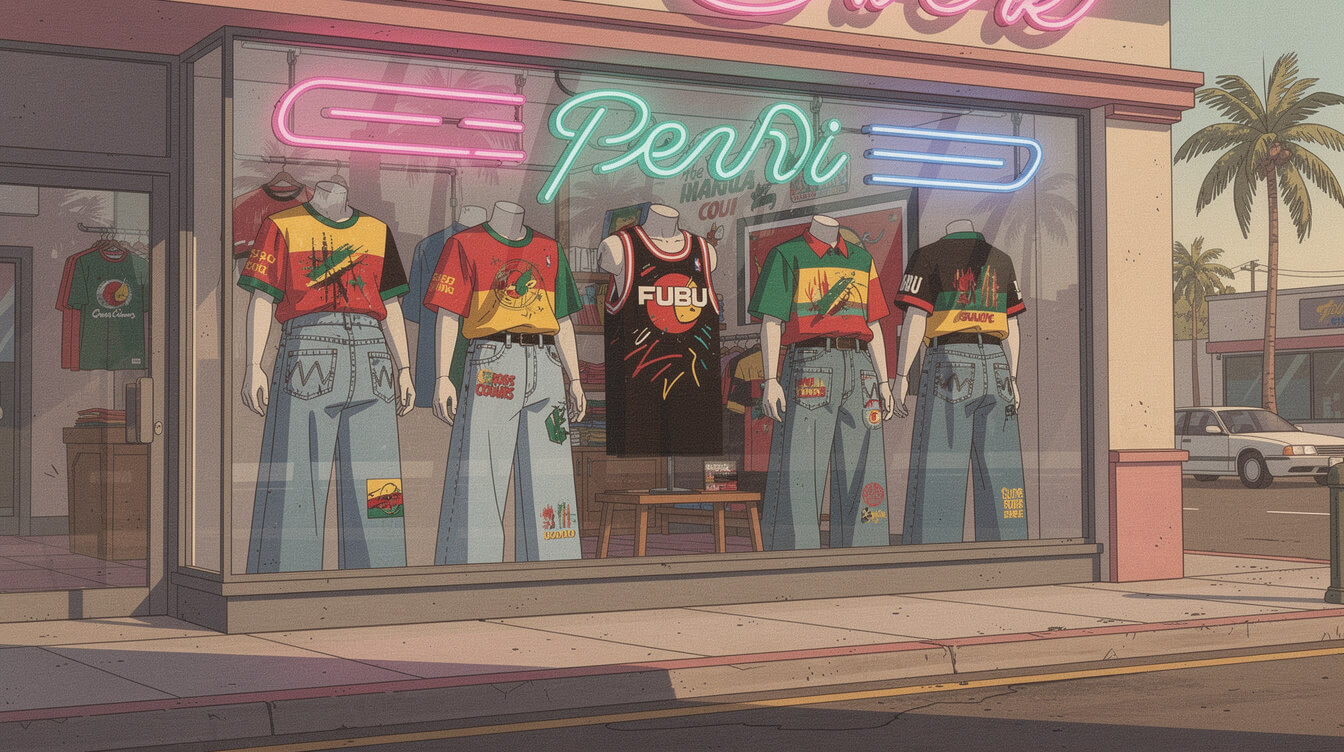
1989 is the year hip-hop fashion becomes an industry. Two brands launch that year. Neither of their founders got a business school degree; both hit nine figures in revenue inside five years.
Karl Kani — real name Carl Williams — was a Brooklyn-born, Costa Rica-raised kid who moved to LA at 20 with a duffel bag full of oversized denim samples his father had helped him sew. He named his brand "Karl" because he wanted it to sound like European luxury, then bolted "Kani" on the end as a play on "Can I" — as in can I really do this? He could. By 1994, Karl Kani was doing over $100 million a year in wholesale. Every rapper in the golden age wore his jeans: Tupac in the "I Get Around" video, Biggie in the "Juicy" visual, Aaliyah on stage. He was the first Black-owned hip-hop apparel brand to break out of the culture and into department stores.
Cross Colours — founded the same year in Los Angeles by Carl Jones and TJ Walker — took a different angle. Their tagline was "Clothing without prejudice," and every piece was drenched in pan-African red, yellow, green, and black. Cross Colours became the uniform of The Fresh Prince of Bel-Air; Will Smith wore it, DJ Jazzy Jeff wore it, the show costumed almost every guest star in it. In 1992 they hit $89 million in revenue in a single year. A financial dispute with their manufacturer nearly killed the brand mid-decade, but they’re back now, reissuing archive pieces to a generation that grew up watching the reruns.
FUBU — For Us, By Us — launched in 1992 out of Daymond John’s mother’s basement in Hollis, Queens (the same neighborhood Run-DMC put on the map). John sewed the first tie-top hats himself. The turning point was 1996: LL Cool J agreed to wear a FUBU hat and jersey in a GAP commercial and mumbled "For Us, By Us" on-camera as a stealth ad-within-an-ad. GAP didn’t notice until the spot had already run. FUBU orders spiked overnight. By 1998 they were doing $350 million a year and had a licensing deal with Samsung Electronics that pushed them into over 5,000 doors globally.
These three brands — Karl Kani, Cross Colours, FUBU — did something the luxury houses had spent 40 years refusing to do. They put Black founders, Black designers, Black manufacturing partners, and Black models at every level of the pipeline. That’s the artist-designer lineage. Every brand that follows in this article is a direct descendant of what those three built.
The Rap-Mogul Fashion Wave: Sean John, Rocawear, Phat Farm, G-Unit
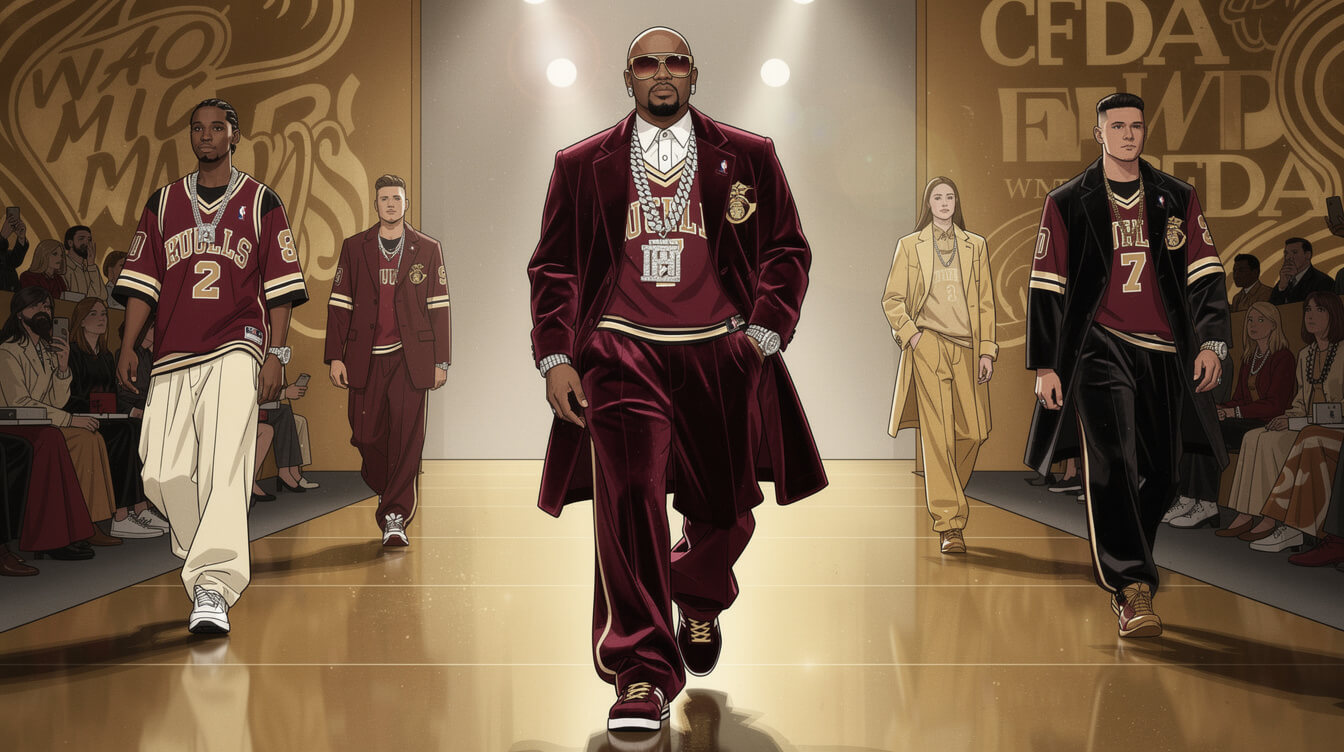
If the 90s was the era of the founder-designer, the 2000s was the era of the artist-CEO. The rappers themselves became the labels. Same industry, ten-times the marketing budget, and — for the first time — real board-of-directors-level equity in the fashion business.
Phat Farm came first, actually. Russell Simmons launched it in 1992 as a hip-hop take on preppy Ivy League — cable-knit sweaters, rugby shirts, oversized polos — because he wanted to prove hip-hop wasn’t stuck in the tracksuit aisle. Kellwood Company bought Phat Farm and its sister line Baby Phat (run by Kimora Lee Simmons) in 2004 for a reported $140 million.
Sean John launched in 1998, and Sean "Diddy" Combs did what no hip-hop label had done: he took the brand to the Council of Fashion Designers of America runway. In 2004, he was named CFDA Menswear Designer of the Year — the first Black designer to win the award. Sean John was one of the top-selling menswear brands in America through the mid-2000s.
Rocawear is the biggest exit on this list. Founded in 1999 by Jay-Z and Damon Dash as the apparel arm of Roc-A-Fella Records, Rocawear was the throwback-jersey, oversized-denim, gold-chain codex of the late 90s and early 2000s. In 2007 they sold the brand to Iconix Brand Group for $204 million while retaining creative control. That’s a nine-figure exit for a rap-owned fashion label, in cash, at a time when the fashion press was still calling hip-hop apparel a "fad."
G-Unit Clothing Company, 50 Cent’s line, launched in 2003 in partnership with Marc Ecko’s Ecko Unlimited. It rode the Get Rich or Die Tryin’ wave and did over $50 million a year at its peak.
Together, this generation of artist-CEOs proved that a rapper could sit on the same fashion week seating chart as Karl Lagerfeld and be there as an owner, not a guest. Everything Kanye West and Pharrell would do a decade later was made structurally possible by the Sean John and Rocawear deals.
One Email a Week. Real Culture.
Join thousands of hip-hop heads on the Custom Creative newsletter. Deep-dive stories, drop alerts, and receipts — no hype filler.
Regional Style DNA: How Geography Wrote the Aesthetic Code
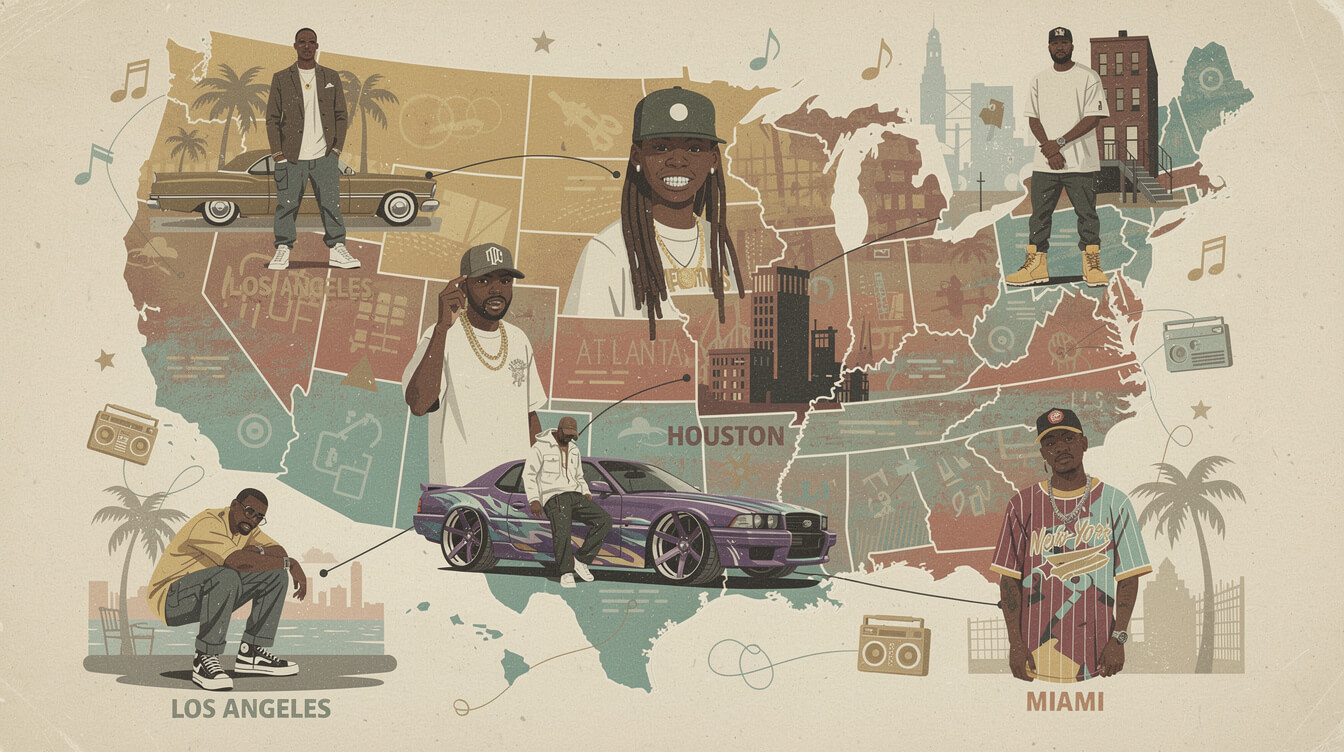
Hip-hop fashion never had a single national uniform. The genre grew regionally, and so did the style. If you know what a rapper is wearing, you can usually guess where they’re from within 200 miles. That’s not a stereotype — it’s a working style algorithm.
West Coast (LA, Long Beach, Compton, Vallejo): Dickies work pants — the industrial khaki 874 — hit LA g-funk in the early 90s and never left. Ben Davis short-sleeve button-downs. Chuck Taylor 70s. Cortez sneakers. Locs sunglasses. White tee. Snoop Dogg wore it. Kendrick Lamar wears a version of it now on nearly every album cover; if you’re building an LA outfit around a favorite rapper right now, you could do a lot worse than a Kendrick Lamar fan-art tee layered under a flannel shirt. The West Coast aesthetic is functional, working-class, and stubbornly consistent — the same silhouette in 1993 and 2023.
Atlanta: Gold. Fitted caps pulled low. Braids and dreads. Trap-era Atlanta made grillz mainstream (Nelly’s "Grillz" hit #1 in 2005 but the aesthetic is older than that — Goodie Mob and Outkast were already wearing them in 1994). Migos brought the designer-belt-with-tee look into the mainstream. Future codified the layered gold chain over the black hoodie. Atlanta style is about signaling wealth without breaking a sweat — the flex is the outfit.
Houston: The Screwed and Chopped aesthetic is a whole visual language of its own. Candy paint cars. Screwed-tape iridescent print. Grillz — Houston had them before Atlanta did, courtesy of Paul Wall and TV Johnny. Slim Thug’s tall-tee-and-fitted-cap uniform. UGK’s country-rap-tune fits. Houston taught the whole South how to layer a fitted, a chain, and a screwed-up voice into one visual identity.
New York (Bronx, Brooklyn, Queens, Harlem, Staten Island): Hoodies. Timberland construction boots. Tall tees. Puffer jackets in the winter. Fitted New Era caps with the sticker still on the brim (a Brooklyn tradition). The Wu-Tang Clan built an entire visual identity out of black hoodies and Clarks Wallabees. Nas made the North Face puffer a New York icon. Cam’ron made pink a hard-rap color in 2003. New York fashion is layered, weather-adaptive, and unapologetically expensive-looking.
Miami: Cuban link chains. Throwback baseball jerseys. Linen shirts open two buttons. Rick Ross’s whole aesthetic. Trick Daddy, Trina, Pitbull — Miami hip-hop leans into the party-city sunshine and the Cuban-American style codes that predate the genre. The chain is the piece.
Read a photo of a rapper. Read the shoes, the pants, the outerwear, the jewelry. You’ll know the zip code before you know the name.
The Streetwear Pivot: Supreme, BAPE, and Kanye’s Genesis
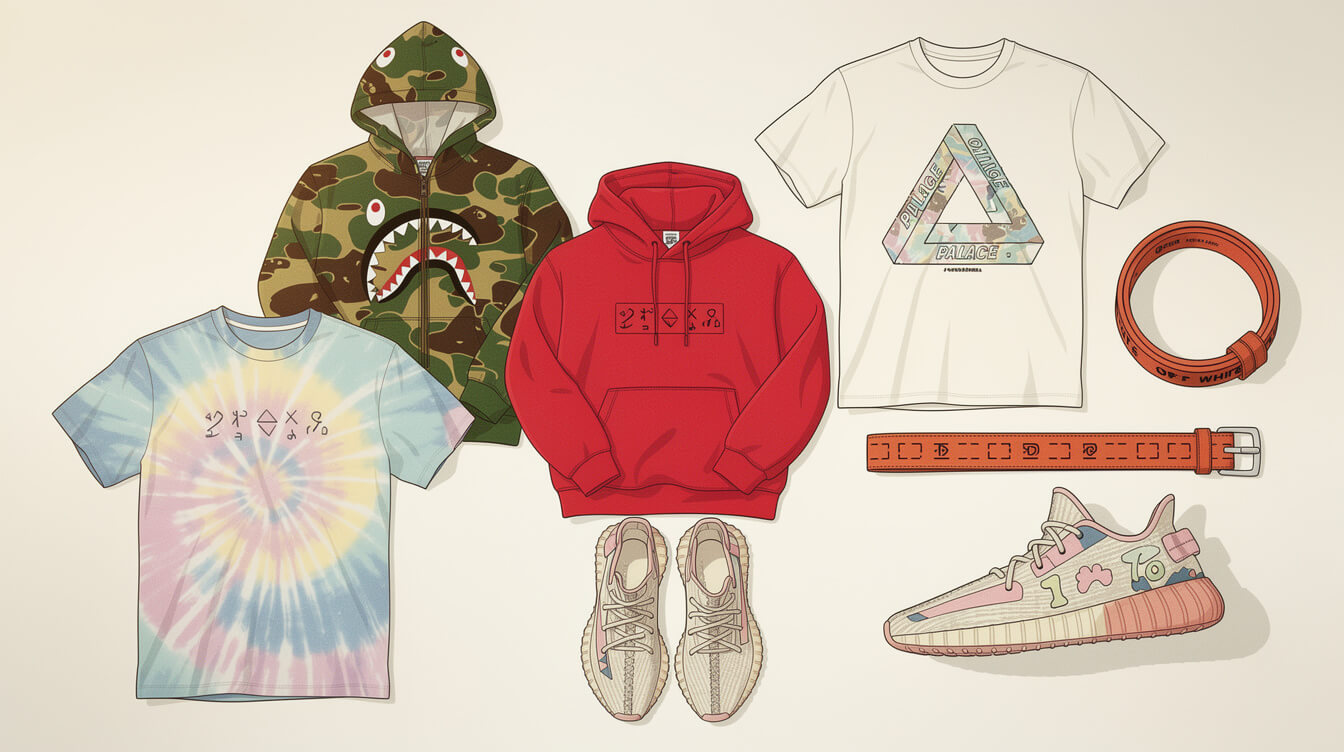
Around 2005 something shifts. Hip-hop fashion stops being only apparel labels run by rappers and starts absorbing an adjacent movement: streetwear. The two scenes had been separate — streetwear was skateboarding, Japanese hip-hop, and downtown NYC art culture; rap fashion was rap fashion. Between 2005 and 2015, they merged.
Supreme — founded by James Jebbia in 1994 as a skate shop on Lafayette Street in Manhattan — spent its first decade as a NYC skate brand with a hip-hop customer base. Then the collabs started: Nike SB Dunks, then North Face parkas, then a legendary 2007 collaboration with the Wu-Tang Clan (which sits in the archive at insane resale prices to this day). By the 2010s, Supreme box-logo hoodies were the currency of hip-hop status. In 2020, VF Corporation bought Supreme for $2.1 billion. The little skate shop was suddenly one of the most valuable single-brand exits in fashion history.
BAPE — A Bathing Ape, founded in 1993 by Nigo in Harajuku, Tokyo — was Supreme’s spiritual twin on the Pacific side. Nigo befriended Pharrell Williams around 2000. Pharrell put the shark hoodie on N.E.R.D. tours and in music videos. Kanye West followed. Lupe Fiasco followed. By 2007, BAPE was on every rap-culture magazine cover in the US. Nigo became Kenzo’s artistic director for Louis Vuitton menswear in 2021 — a former streetwear founder running a Louis line, a career trajectory that would have been unimaginable in 1998.
Kanye West is the pivot inside the pivot. His Nike Air Yeezy 1, launched in 2009, is arguably the moment streetwear-as-collectible became hip-hop-as-collectible. His move to Adidas in 2013, resulting in the Yeezy Boost 350 in 2015, generated an estimated $1.7 billion a year in revenue for Adidas at peak. Kanye’s cultural collapse in 2022 ended the Adidas partnership abruptly, but the Yeezy Gap chapter (2020-2023) had already proven you could put a rapper in the room where mass-market retail decisions get made and give him the pen. The whole modern fashion week guest list — Tyler, The Creator (Golf Wang, 2011), A$AP Rocky (VLONE, 2013), Travis Scott (Cactus Jack collabs), the Compton-born Tupac visual lineage now cited in nearly every runway show — flows from doors Kanye kicked open.
By 2018, the distinction between "streetwear" and "luxury" had effectively collapsed. Louis Vuitton hired Virgil Abloh, Off-White’s founder and Kanye’s longtime creative director, as menswear artistic director. Abloh was the first Black artistic director of a Louis Vuitton menswear line in the house’s 164-year history. When Abloh passed in 2021 at age 41, the whole fashion industry paused. His four-year run at LV — from 2018 to 2021 — is the single fastest fusion of hip-hop culture and old-guard luxury the industry has ever seen.
The 2017 Reset: Dapper Dan × Gucci and the Luxury Handshake
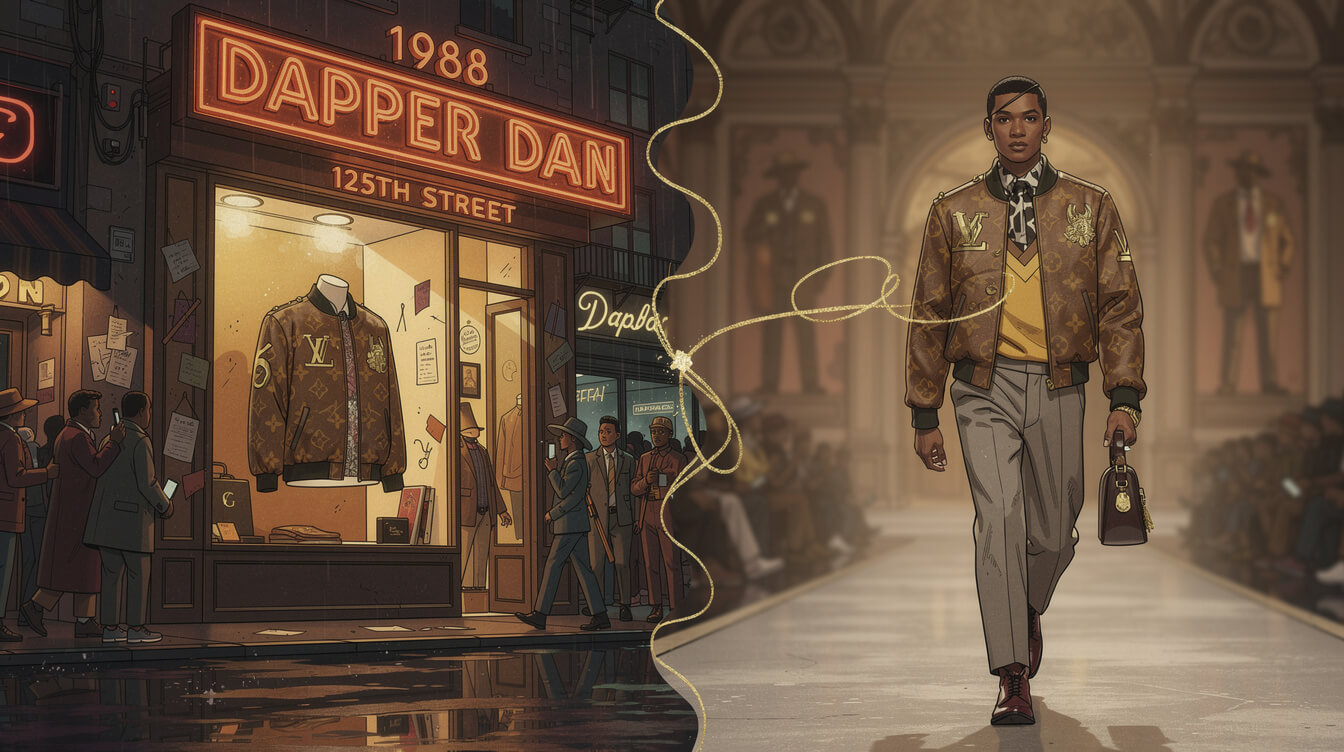
Every thread in this article ties into the same knot, and the knot is Florence, May 29, 2017. Alessandro Michele sends the Gucci Cruise 2018 collection down the runway inside the Palazzo Pitti. Look 30 is a puff-sleeve, mink-trimmed bomber jacket in Louis Vuitton monogram print. It is, top to bottom, a Dapper Dan design. Dixon-1989 archives immediately called it out on Instagram: this is Dapper Dan’s jacket. Not influenced by Dapper Dan. Verbatim.
Any other year, in any other decade, that story would have ended with a lawyer letter and a corporate silence. In 2017 it ended differently. Marco Bizzarri, Gucci’s CEO, flew to New York. Sat down with Dan Day at his kitchen table in Harlem. Apologized. Gucci partnered with Dan to reopen his atelier at 43 East 125th Street — the exact address that had been raided in 1992. Every piece from the Gucci-Dapper Dan collaboration is one-of-one, hand-cut in the atelier, and comes with the Gucci & Dapper Dan of Harlem co-branding on the label.
Read that timeline as one sentence: The luxury industry spent 25 years raiding, suing, and erasing hip-hop’s most influential tailor — then hired him. That’s the 30-year arc from the FBI raid to the Cruise runway. That’s when hip-hop fashion won.
What Michele and Bizzarri understood in 2017 — and what Louis Vuitton confirmed a year later by hiring Virgil Abloh — is that the culture had built the industry, and the industry could either acknowledge it and share the money or keep pretending, at which point the culture would build a parallel industry that made everyone else look old. Hip-hop had already done that. The parallel industry — Supreme, Yeezy, Off-White, Fear of God, PURPLE brand, Chrome Hearts x rap culture, KidSuper, Denim Tears — was doing $60 billion a year while the old guard was still trying to remember whether it was okay to hire Black designers.
That’s the story. It’s not decades; it’s people. Karl Kani. Carl Jones and TJ Walker. Daymond John. Russell Simmons. Diddy. Jay-Z and Damon Dash. Kanye West. Virgil Abloh. Nigo. Tyler. Rocky. Travis. Dapper Dan. Every one of them a link in a lineage that no fashion school teaches yet, but that every single global fashion week now moves to the tempo of.
Wear the Lineage
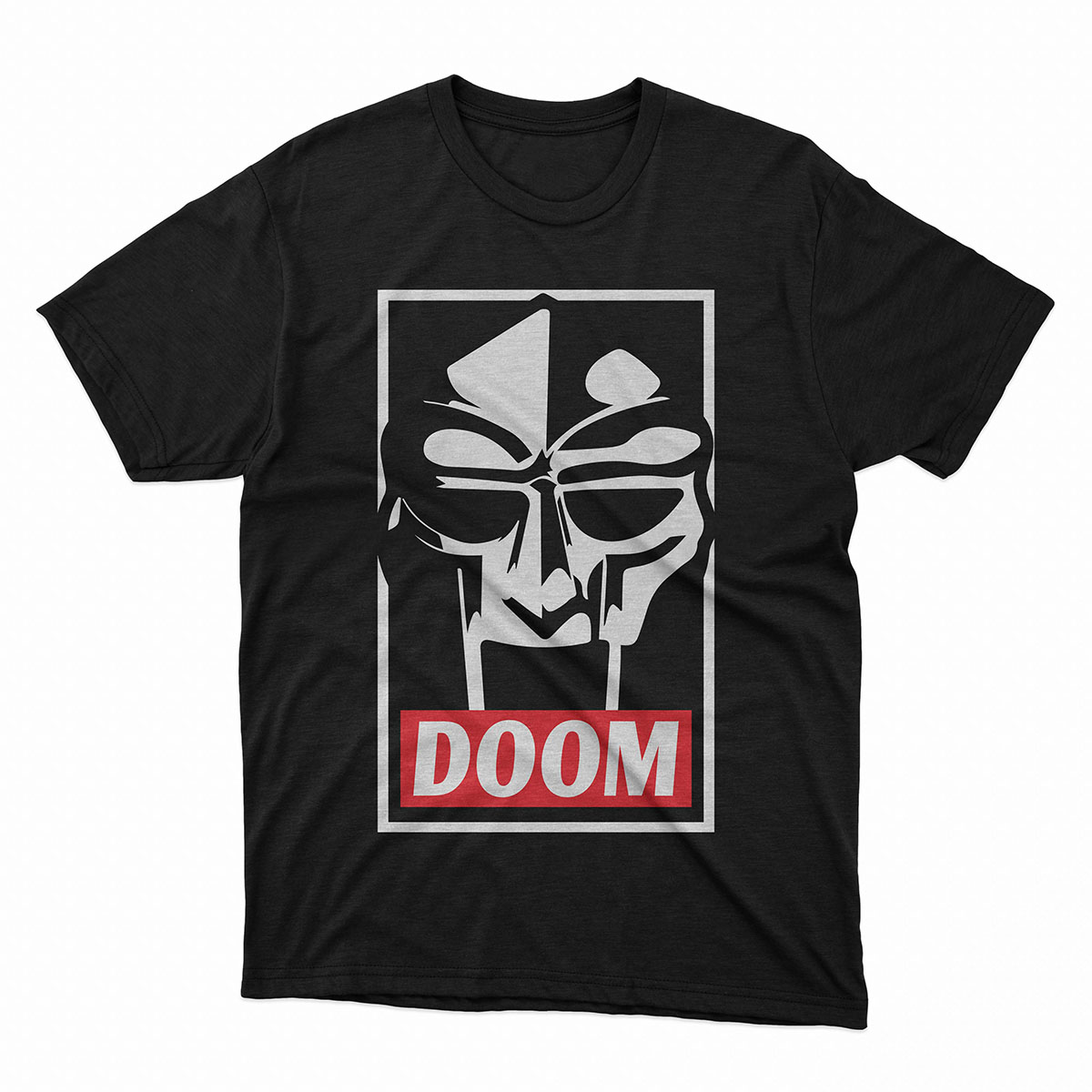
Every piece in our hip-hop apparel collection is the current-decade continuation of the Karl Kani, Cross Colours, FUBU lineage — fan-art tributes to the artists who wrote the culture. Start with a legend: the MF DOOM tribute tee, hand-illustrated, printed on heavyweight Bella+Canvas.
Frequently Asked Questions About Hip-Hop Fashion
What is hip hop fashion?
Hip-hop fashion is the apparel, footwear, jewelry, and styling codes that developed alongside hip-hop culture from the 1970s Bronx forward. It’s not one look — it’s a rolling set of regional and generational aesthetics (b-boy, golden age, jiggy, mogul, streetwear, luxury-crossover) that share one thing: they were driven by Black artist-founders and independent brand-builders, not by traditional fashion houses.
Who founded the first hip-hop fashion brand?
Karl Kani (Carl Williams) launched his eponymous brand in 1989 in Brooklyn and is widely credited as the first Black-owned hip-hop apparel brand. Cross Colours (Carl Jones and TJ Walker) launched the same year in Los Angeles. FUBU (Daymond John and partners) followed in 1992 in Hollis, Queens. Dapper Dan’s custom boutique in Harlem predates all three but operated as a boutique atelier rather than a wholesale brand.
How big is the hip-hop fashion industry?
Business of Fashion estimates the broader streetwear economy — which hip-hop culture built the customer base for — at over $60 billion a year globally. That figure includes Supreme, Nike SB, Yeezy at its peak, Off-White, BAPE, and the wholesale apparel arms of the rap-mogul labels. Individual exits have topped $2 billion (Supreme to VF Corp, 2020).
Why did Dapper Dan’s boutique get shut down in 1992?
Luxury houses — primarily Fendi, but Gucci and Louis Vuitton were involved — sued Dapper Dan for using their monogram prints on custom pieces. A joint raid on his 125th Street boutique ended his 1980s run. The story reversed in 2017 when Gucci partnered with him after Alessandro Michele’s Cruise 2018 collection was called out for copying a Dapper Dan design.
Which regions have the most distinct hip-hop style?
Every hip-hop metro developed its own visual code: New York (hoodies, Timbs, tall tees, fitted caps), West Coast (Dickies, Chucks, white tees), Atlanta (grillz, gold chains, fitted caps), Houston (candy paint aesthetic, Screwed-tape print, oversized jerseys), and Miami (Cuban links, throwback jerseys, linen). You can usually identify a rapper’s home region by the outfit before the accent.
Final Thoughts: Fashion’s Longest Delayed Credit
Every runway show that’s happened in the last 15 years — from LV Men’s under Virgil Abloh to Kenzo under Nigo to Louis Vuitton under Pharrell — is a note being finally paid on a decades-old debt. Karl Kani, Dapper Dan, Cross Colours, FUBU, Sean John, Rocawear, Kanye, Virgil — they didn’t wait for the fashion industry to acknowledge them. They built a parallel one. Now the two industries have merged, and the culture is finally getting the pen credit for the ink it laid down 50 years ago.
The clothes we wear are receipts. Every hoodie, every fitted cap, every jersey, every tee is a footnote in a business lineage that Business of Fashion could not have priced at $60 billion without those founders having done the work first. So the next time somebody frames hip-hop fashion as a "trend", you can tell them exactly which trend, and which founder, and which year, and how much the sale went for.
The producers who built the sound and the founders who built the fashion were doing the same job on different frequencies. That’s the story. That’s why we make what we make.
Get the Culture in Your Inbox
Join the Custom Creative newsletter — one email a week covering hip-hop history, drop alerts, and stories that don’t make it to the mainstream press. No filler. No hypebeast noise. Real culture.

🎧 Never Miss a Drop
Exclusive product releases, hip-hop deep dives, and member-only discounts. Straight to your inbox.
Free forever. No spam. Unsubscribe anytime.
Get the Culture, Delivered
Deep dives into hip-hop history, exclusive product drops, and discounts sent straight to your inbox. No spam, just culture.
Join 2,000+ hip-hop heads already in the loop. Unsubscribe anytime.