Today in Hip-Hop — August 11: The Culture Turns 53 (Kool Herc, 1520 Sedgwick, 1973)
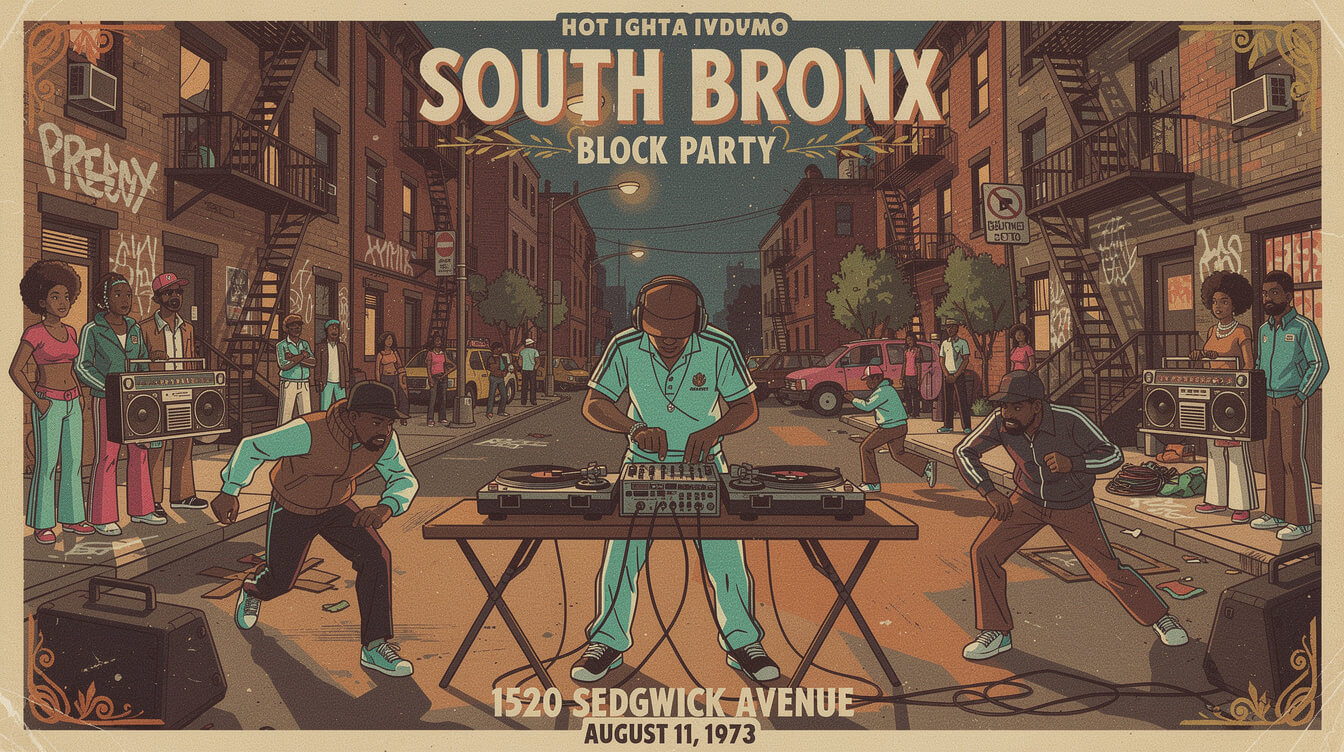
August 11, 1973. A back-to-school jam in the rec room at 1520 Sedgwick Avenue, West Bronx. Cindy Campbell charges a quarter for the girls, fifty cents for the fellas, and hands her little brother the turntables. That brother — Clive Campbell, a Kingston-born teenager who called himself DJ Kool Herc — does something no one had done before: he takes two copies of the same funk record, drops the needle on the drum break, and rides that break back-to-back until the room loses its mind. Fifty-three years ago tonight, that was hip-hop being born.
The Merry-Go-Round, and Why It Changed Everything
Herc’s move had a name: the Merry-Go-Round. Two copies of James Brown’s Give It Up or Turnit a Loose, two copies of the Incredible Bongo Band’s Apache, two copies of Babe Ruth’s The Mexican. When the break came — that stripped-down eight bars where the vocals dropped out and the drums took over — he’d cut back to the second turntable and play it again. And again. He turned a fifteen-second break into a five-minute canvas. Everything that followed — sampling, remixing, beatmaking, the entire producer-as-auteur mythology — traces back to that trick.
The dancers noticed first. When Herc extended the break, the kids who’d been waiting for that eight-bar window to go off would suddenly have room to work. Herc named them B-boys — break boys — and the whole vocabulary of what we now call breakdance was invented in that rec room on Sedgwick over the next few months. On the mic that night was Coke La Rock, giving shout-outs to the crowd between records — the first documented MC in what became a whole art form. Herc DJ’d. Coke rhymed. B-boys spun. The four elements were already there, all in one August night.
Cindy Campbell: The Sister Who Threw the Party
Give the credit where it’s due. Cindy Campbell is the reason August 11, 1973 exists. She wanted new clothes for the back-to-school season, needed to raise money, and cooked up the plan: rent the rec room, print up a handwritten flyer (“a DJ Kool Herc PARTY”), let her brother spin. She promoted it, worked the door, and made hip-hop’s first business decision. In every serious account of that night — including her own oral histories with the Bronx Historical Society and the 2007 Cornell Hip Hop Collection — Cindy is the executive producer. Hip-hop was born the night a Bronx teenager needed school clothes.
What Grew Out of That Rec Room
Within eighteen months, Afrika Bambaataa was doing his own Bronx River Community Center parties and building the Universal Zulu Nation. Grandmaster Flash took Herc’s Merry-Go-Round, added the quick mix, invented the crossfader technique, and turned DJing into a precision instrument. The three of them — Herc, Flash, Bambaataa — are the Holy Trinity everyone from KRS-One to Nas to Jay-Z name-checks. 1520 Sedgwick Avenue was added to the National Register of Historic Places in 2007, officially recognized as the birthplace of hip-hop. There’s a plaque on the building now. Most tourists walking Highbridge Park have no idea what happened three blocks up.
The line runs straight from that party to everything that came after. Boogie Down Productions — KRS-One and Scott La Rock — named themselves after the borough Herc built up. Criminal Minded, their 1987 debut, is the first blueprint for street-level Bronx hip-hop after the founders — raw, political, uncompromising, and directly downstream of the block-party tradition Herc, Bambaataa, and Flash created a decade earlier.
Wear the Lineage — BDP Criminal Minded Hoodie
We made the Boogie Down Productions Criminal Minded Hoodie for the heads who understand the through-line — Kool Herc at 1520 Sedgwick, KRS-One and Scott La Rock at 1407 Franklin, the same Bronx that built the whole thing. Heavyweight Gildan 18500. The album that carried Herc’s block-party DNA into the golden age.
Also This Month in Hip-Hop
- August 25, 1998 — Lauryn Hill drops The Miseducation of Lauryn Hill. In two weeks it turns 28 — the album that made a solo female-lead artist the biggest name in hip-hop that year.
- August 8, 1988 — N.W.A’s Straight Outta Compton was released 38 years ago last week, moving the culture’s center of gravity from the Bronx to South Central.
- September 11, 2001 — Jay-Z’s The Blueprint, produced largely by a then-unknown Kanye West and Just Blaze, turns 25 in exactly one month. Soul samples, Bronx-rooted DNA, Manhattan studio.
Fifty-three years from a rec room to a billion-dollar culture that shaped fashion, film, politics, and language on every continent. All of it because Cindy needed school clothes and Clive knew what to do when the break dropped.
Stay creative — The Custom Creative Team

🎧 Never Miss a Drop
Exclusive product releases, hip-hop deep dives, and member-only discounts. Straight to your inbox.
Free forever. No spam. Unsubscribe anytime.
Get the Culture, Delivered
Deep dives into hip-hop history, exclusive product drops, and discounts sent straight to your inbox. No spam, just culture.
Join 2,000+ hip-hop heads already in the loop. Unsubscribe anytime.