Jay-Z The Blueprint 2: Inside Hip-Hop’s Most Infamous Double-Album Regret
Jay-Z the Blueprint 2 is the album he made after being crowned Best Rapper Alive — and the one he’d later rank near the bottom of his own catalog. Released November 12, 2002, The Blueprint² The Gift & the Curse debuted at #1, sold 545,000 copies in its first week, and went triple platinum. It also became the album Jay-Z himself couldn’t defend a decade later. This is the real story behind hip-hop’s most instructive double-album gamble — the guests, the samples, the mistake, and why it still matters twenty-plus years later.
A Sequel Written From the Top of the Mountain
To understand why Blueprint 2 exists the way it does, you have to understand where Jay-Z was standing in 2002. The Blueprint — released the same morning as September 11, 2001 — had just landed as his fourth consecutive #1 album and was being called a masterpiece almost immediately. It reframed him from “one of the best rappers alive” to the Best Rapper Alive, a title that sticks to this day. If you haven’t run the numbers on that run yet, our Blueprint 25th anniversary breakdown covers exactly how that record rewired his career.
So when Jay went back into the booth for a follow-up, he wasn’t chasing a hit — he was trying to cement a legacy. Recording stretched from December 2001 through September 2002 across seven different studios, from Baseline in New York to Master Sounds in Richmond, Virginia, an unusually sprawling process for an artist who’d built his reputation on knocking albums out fast. That’s a different problem to solve than making a hit single, and it’s the problem that shapes everything about Blueprint 2: the ambition, the sprawl, and eventually, the regret.
It’s also worth remembering what Jay-Z was up against culturally in late 2002. Hip-hop had just lost both 2Pac and The Notorious B.I.G. within the previous six years, and the genre was actively searching for who would carry that torch of “album artist” status into the new decade. Jay had the sales and the radio dominance, but Blueprint proved he could also have the critical respect. Blueprint 2 was where he tried to prove he could have both again — on a bigger canvas, with a bigger budget, and a bigger cast.
The Gift and the Curse — Two Albums Duct-Taped Together
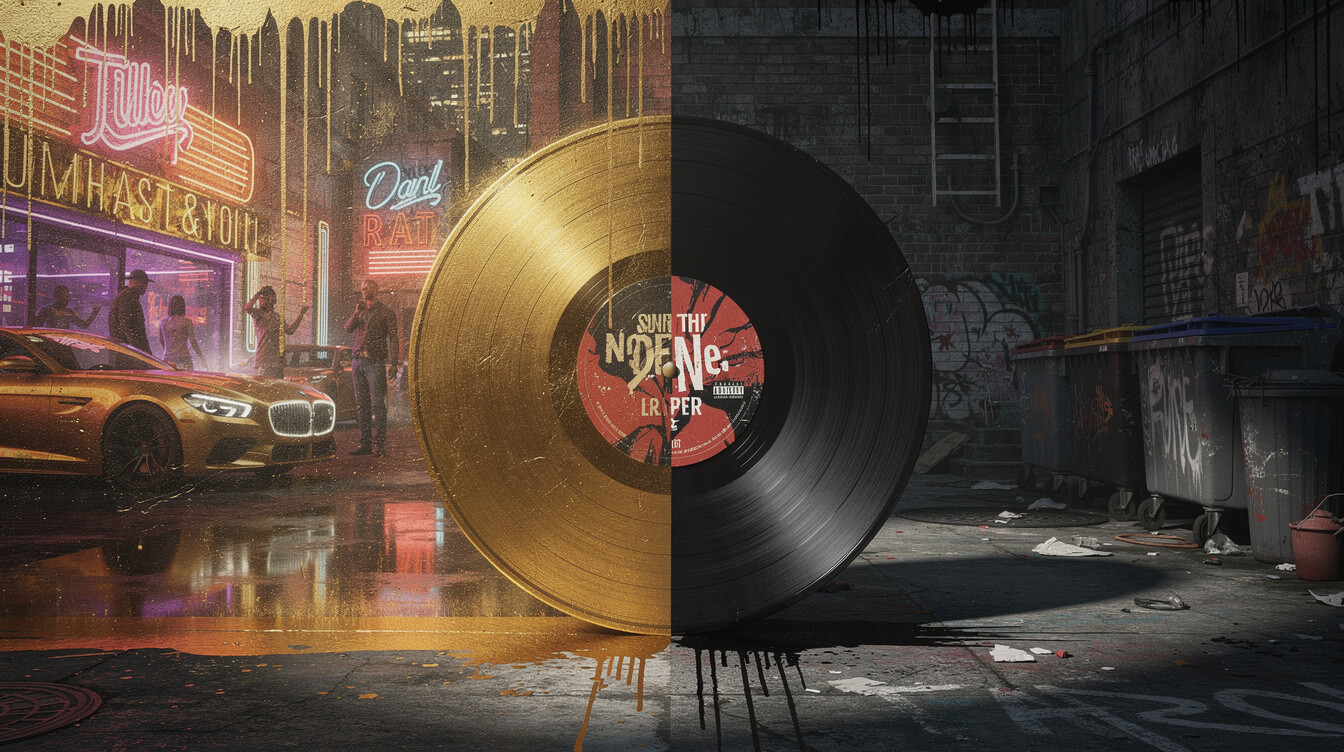
The Blueprint² The Gift & the Curse isn’t one album — it’s two, stapled together at 108 minutes and 25 tracks deep. The Gift disc is the pop-rap half: glossy, radio-ready, built for the Neptunes and Timbaland’s biggest hooks. The Curse is the hardcore half — the disc that opens with a posthumous Notorious B.I.G. verse on “A Dream” and closes out with street records built for car speakers, not clubs.
The concept made sense on paper. In practice, it meant Jay-Z was competing with himself for attention across two discs, and the record’s biggest criticism — then and now — is the same one you’d give any double album that didn’t need to be one: there’s a genuinely great single disc buried inside two decent ones. Rolling Stone called it “long on both bouncy funk and forgettable R&B samples.” AllMusic’s John Bush put it plainly: Jay-Z had the songs, but couldn’t sustain 110 minutes at the level his best work demands.
The Gift leans into Heavy D-produced “Guns & Roses” with Lenny Kravitz on guitar and hook duty, a Just Blaze remix of “U Don’t Know” featuring Brooklyn’s M.O.P. shouting over the beat, and No I.D.’s George Clinton-sampling “All Around the World.” It’s built for maximum reach — the kind of disc you’d hand someone who only half-follows rap and expect them to find at least three songs they love. The Curse, by contrast, opens with the posthumous Biggie/Faith Evans collaboration “A Dream” and stays in that mood: Dr. Dre and Rakim trading verses, Sean Paul dancehall-flexing on “What They Gonna Do,” and Big Boi, Killer Mike, and Twista all crowding onto “Poppin’ Tags” for a posse cut that has no business being this deep into a 25-track record and still slapping. Two discs, two entirely different nights out — and that’s exactly the problem critics and Jay-Z himself would eventually land on.
The Guest List No One Else Could Book
Where The Blueprint was almost guest-free, Blueprint 2 swings hard the other way, and the roster is genuinely wild by any era’s standard: Dr. Dre and Rakim reunite on “The Watcher 2” (a direct sequel to Dre’s own “The Watcher”), Beyoncé shows up before the world knew to care, Faith Evans and a posthumous Notorious B.I.G. verse open the record, and Lenny Kravitz and Sean Paul pull the tracklist out-of-genre entirely.
Then there’s “Some How Some Way,” where Beanie Sigel and Houston legend Scarface trade verses over a Just Blaze beat — one of the record’s most purely hardcore moments and a reminder that Jay-Z was still willing to hand the mic to a Geto Boy at his commercial peak. If that Southern-meets-Roc-A-Fella chemistry is your speed, our Scarface “The Fix” Tee is built for exactly that lineage — Houston street rap that never needed a co-sign to earn its respect.
What makes the guest list interesting isn’t just the names — it’s the range. Truth Hurts adds the hook to “The Watcher 2,” a straight sequel to a Dr. Dre solo cut, which itself only exists because Dre wanted a proper answer record after years of subliminal shots in the press. Elsewhere, Memphis Bleek, Freeway, Young Gunz, Peedi Crakk, and Omillio Sparks all pile onto “As One,” turning it into a full Roc-A-Fella roll call — the label flexing its bench depth on Jay-Z’s own record. Few artists before or since have assembled a guest list spanning a West Coast production legend, a Motown-era funk sample flip, a Jamaican dancehall star, and an entire in-house roster on a single project. That’s the kind of reach only a Best Rapper Alive budget buys.
’03 Bonnie & Clyde — Hip-Hop’s First Power-Couple Anthem
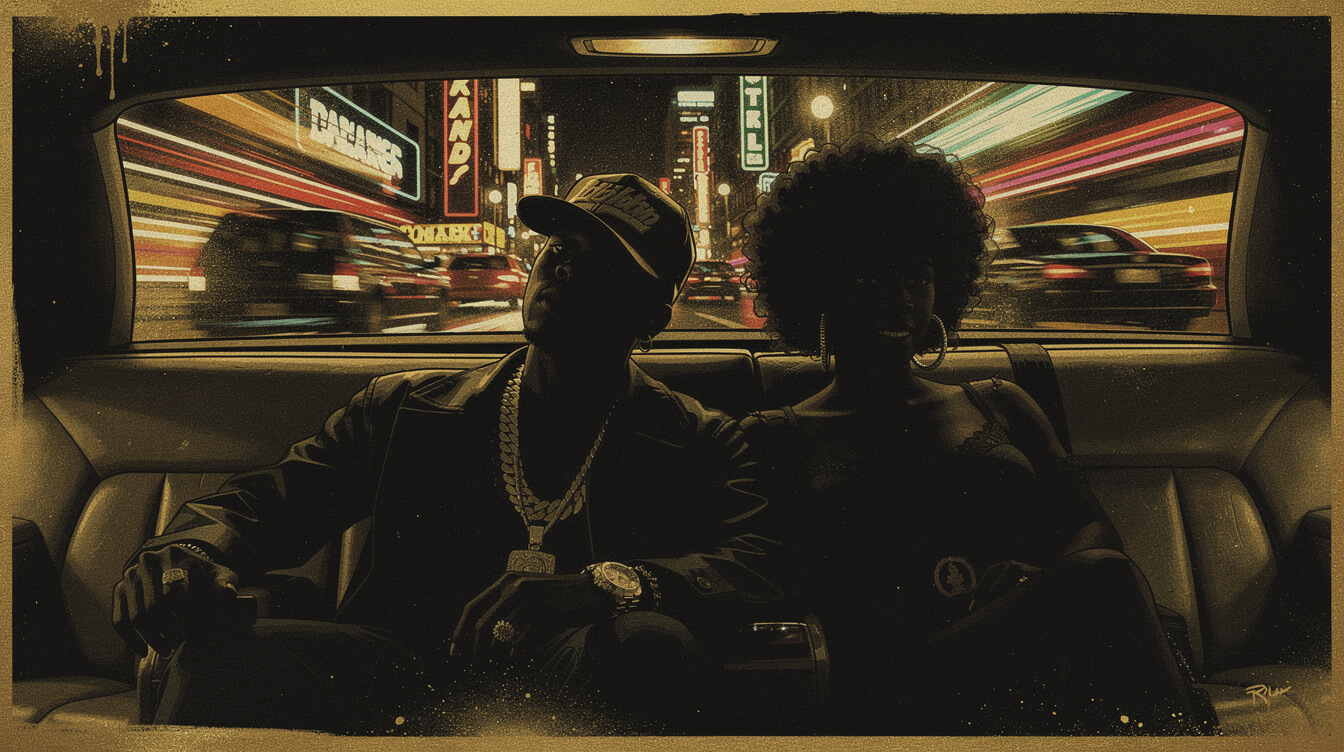
If Blueprint 2 is remembered for one song, it’s this one. “’03 Bonnie & Clyde” flips 2Pac’s “Me and My Girlfriend” — itself already a metaphor about a gun — into a real-life duet with Beyoncé, produced by Kanye West at the exact moment Jay and Bey’s relationship was becoming public. It’s the song that effectively announced hip-hop’s biggest power couple to the world, three years before the two would go public in any formal way.
The record peaked in the Hot 100’s top ten and became one of two singles from Blueprint 2 to do so (the other being “Excuse Me Miss,” built on a Neptunes beat with Pharrell handling the hook). Twenty-plus years later, it’s still the song from this album most likely to show up on a Jay-Z or Beyoncé retrospective — proof that even an inconsistent album can produce a genuinely canonical moment.
The Charts Never Blinked, Even When the Critics Did
Whatever the reviews said, the commercial numbers on Blueprint 2 weren’t up for debate. It debuted at #1 on the Billboard 200 with 545,000 units sold in its first week — Jay-Z’s fifth consecutive chart-topper — and went on to earn triple platinum certification from the RIAA. It charted at #23 in the UK, hit #4 on the UK R&B Albums chart, and landed inside the top 40 in Germany, Scotland, and beyond. By the end of 2002, it ranked among the year’s top-selling albums overall, and it repeated the feat on Billboard’s R&B/Hip-Hop year-end chart again in 2003.
That gap between commercial reception and critical reception is exactly why Blueprint 2 is worth studying: an album can be a legitimate hit by every chart metric available and still be the one its own creator wishes he could take back. Sales don’t lie, but they also don’t always tell you whether an album needed to be 108 minutes long.
It’s also worth noting that 2002 was a very different commercial landscape than the one we live in now. Double albums were a genuine flex in the pre-streaming era — physical CDs, real shelf presence, a statement of scale you could hold in your hands. Nas had done it with Stillmatic-era sprawl in spirit if not format, and Wu-Tang had proven a sprawling group record could work on Wu-Tang Forever. Jay-Z’s version of that flex just happened to arrive at the exact moment his songwriting was tightest — which made the extra padding sting more, not less, by comparison to what he’d just proven he could do on a single disc a year earlier.
The Mistake Even Jay-Z Won’t Defend
Here’s the part that makes this album’s story worth telling: Jay-Z agrees with the critics. On his 44th birthday, he sat down and ranked his own solo catalog. He put Blueprint 2 at No. 11 out of 12 — ahead of only Kingdom Come, the album most fans consider his worst outright. His quote on it doesn’t leave much room for interpretation: “Too many songs. Fucking Guru and Hip Hop, ha.”
That’s a shot at Young Guru, his longtime engineer, who admitted a year earlier that he’d personally pushed Jay to make Blueprint 2 a double album — arguing that an artist at Jay’s level needed a sprawling, career-defining double LP to stand next to what 2Pac and Biggie left behind. “It was a mistake,” Guru said in 2012. “You learn from your mistakes.” Metacritic’s aggregate score of 64 backs up the “generally favorable, not great” read: critics liked plenty of individual songs and agreed almost universally that the record needed an editor, not more tracks.
The reviews at the time read almost like a chorus repeating the same note in different keys. Chicago Tribune critic Soren Baker singled out “A Dream,” “’03 Bonnie & Clyde,” and “The Watcher 2” as unimaginative reworkings of other artists’ music rather than original statements. Entertainment Weekly’s David Browne was blunter still: “It reminds me of nearly every other double CD. It could have been a good single disc.” Even Village Voice critic Robert Christgau, who found highlights in “U Don’t Know (Remix)” and “Poppin’ Tags,” couldn’t resist noting his disappointment that Jay-Z sampled a Paul Anka vocal on “I Did It My Way” rather than the Frank Sinatra original he clearly wanted — a rights issue, not an artistic choice, but one more example of the record’s compromises piling up.
It’s a useful lesson that predates streaming-era album bloat by over a decade — more tracks doesn’t mean more album, and even the best rapper alive can talk himself into padding a tracklist when the goal shifts from making a great record to making a big one. If you want to hear what Jay-Z sounds like when he trusts restraint instead, our Reasonable Doubt listening guide is the exact opposite approach — 14 tracks, zero filler.
Deep Cuts That Deserve a Second Spin
Skip the singles for a minute and there’s real crate-digger material on this record. “The Bounce,” produced by Timbaland and Kanye West, layers a sample of Audio Two’s 1987 “Top Billin'” underneath vocals lifted from Alka Yagnik and Ila Arun’s 1993 Bollywood cut “Choli Ke Peeche Kya Hai” — an East-meets-East-Coast sample choice that was genuinely ahead of its time, years before Bollywood interpolations became a hip-hop trend. Kanye also drops an uncredited verse on the track, a small detail most casual listeners miss entirely.
Then there’s “I Did It My Way,” which wanted to sample Frank Sinatra’s “My Way” and couldn’t clear it — so Jay-Z rapped over a Paul Anka vocal instead, since Anka co-wrote the original French composition (“Comme d’habitude,” written by Claude François and Jacques Revaux) that “My Way” was itself adapted from. It’s a workaround born entirely out of clearance politics, and it’s the kind of behind-the-scenes production trivia that never makes the Wikipedia summary but explains exactly why the song sounds the way it does.
Add “The Watcher 2” — a legitimate Dre/Rakim reunion buried on disc two, produced by Dre himself and built around Scott Storch keys — and the title track “Blueprint2,” a Charlemagne-produced cut that flips an Ennio Morricone score into something that sounds nothing like anything else on the record. Stack those three next to each other and you’ve got a stronger album than the “too long, too messy” reputation suggests, if you’re willing to dig for it instead of judging the record by its singles alone.

Repping the Verse That Stole “Some How Some Way”
Scarface didn’t need Roc-A-Fella’s platform to earn respect on Blueprint 2 — he brought Houston with him. The Fix Tee is for anyone who knows the guest verse hit harder than the hook.
Frequently Asked Questions
When did Jay-Z’s Blueprint 2 come out?
The Blueprint² The Gift & the Curse released November 12, 2002, on Roc-A-Fella Records and Island Def Jam — just over a year after the original Blueprint.
Is Blueprint 2 a double album?
Yes. It splits into two discs: The Gift (pop-rap leaning, 14 tracks) and The Curse (hardcore hip-hop leaning, 11 tracks), running 108 minutes combined.
Why does Jay-Z consider Blueprint 2 a mistake?
Jay-Z has said publicly he considers it one of his weakest albums, largely due to length — he ranked it 11th out of his 12 solo albums as of 2013, blaming the double-album format his engineer Young Guru pushed him toward.
What are the biggest songs on Blueprint 2?
“’03 Bonnie & Clyde” featuring Beyoncé and “Excuse Me Miss” were the two Hot 100 top-ten singles. “The Watcher 2” (with Dr. Dre and Rakim) and “A Dream” (featuring a posthumous Notorious B.I.G. verse) are the album’s most-discussed deep cuts.
Is there a shorter version of Blueprint 2?
Yes — Blueprint 2.1, released April 2003, is a single-disc reissue with half the original tracklist plus five bonus cuts, including the single “La-La-La.” It was certified gold by the RIAA on its own.
Who produced most of Blueprint 2?
Just Blaze and Kanye West handled the bulk of production, continuing the partnership that defined the original Blueprint. The Neptunes, Timbaland, Dr. Dre, No I.D., and Heavy D each contributed additional tracks, making it one of the most producer-diverse albums in Jay-Z’s catalog.
How does Blueprint 2 compare to the original Blueprint?
Critically, it doesn’t — The Blueprint (2001) is widely considered a genre-defining classic, while Blueprint 2 is viewed as an ambitious but bloated follow-up. Commercially, both were #1 albums, but only the original carries the “masterpiece” consensus among critics and fans alike.
Twenty-plus years on, Blueprint 2 is a genuinely useful case study in restraint — or the lack of it — from an artist who rarely made that mistake twice. Stream it disc by disc, not front to back, and you’ll find the great single album Jay-Z and Young Guru both admit is buried in there.
The Culture, Delivered Weekly
Deep-catalog breakdowns, new drops, and the stories behind the merch — straight to your inbox, no filler tracks included.

🎧 Never Miss a Drop
Exclusive product releases, hip-hop deep dives, and member-only discounts. Straight to your inbox.
Free forever. No spam. Unsubscribe anytime.
Get the Culture, Delivered
Deep dives into hip-hop history, exclusive product drops, and discounts sent straight to your inbox. No spam, just culture.
Join 2,000+ hip-hop heads already in the loop. Unsubscribe anytime.