Rapper Sweatshirt: The 46-Year History From the Bronx to the Boutique
A rapper sweatshirt isn’t a garment. It’s a receipt. It’s a way to put on the city, the era, the catalog, the crew — without saying a word. From the South Bronx in 1979, when MCs first wore matching crewnecks at park-jam DJ sets, through the Cross Colours / Karl Kani / FUBU explosion of the early 90s, through Wu-Wear’s $20M run, through Odd Future’s washed black era, through today’s heavyweight 380-gram boutique drops — the rapper sweatshirt has been hip-hop’s most quietly load-bearing piece of clothing. It’s been on more album covers than most producers, and it’s outlasted more record labels than most artists.
This is the long-form, era-by-era story of how that happened — and how to actually pick one that earns the culture instead of cosplaying it. We’ll cover what makes a rapper sweatshirt different from a regular hoodie, why the Wu-Wear blueprint still dictates what modern brands do in 2026, what Earl Sweatshirt’s name accidentally proved about cultural gravity, and how to read a sweatshirt’s graphic well enough to know whether the wearer actually listened to the album.
Before the Brand: South Bronx, Subway Cars, and the First Rapper Sweatshirts (1979–1986)
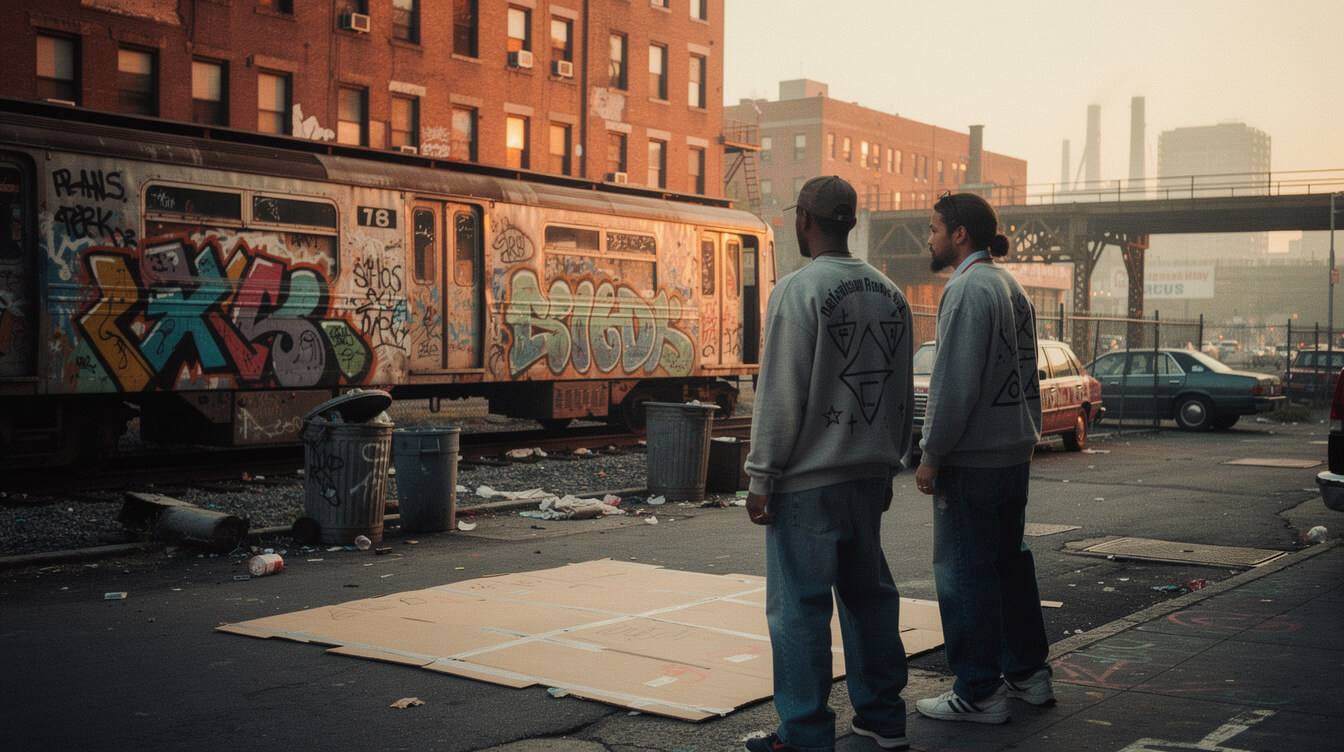
Before there was a brand, there was the crewneck. The earliest rapper sweatshirts didn’t say anything because they didn’t have to — the wearer’s name was tagged in marker on the chest, or his crew’s name was scrawled across the back in fabric paint. Kool Herc, Afrika Bambaataa, Grandmaster Flash and the Furious Five wore what was on the block: heavy cotton crewnecks from Champion, Russell, and the no-name garment-district mills along Seventh Avenue. The sweatshirt did three jobs at once. It moved when you DJed. It absorbed sweat in 1520 Sedgwick rec rooms with no ventilation. And it gave you a flat surface to paint your name on.
The graphic-tee economy didn’t exist yet in any organized way. The first rapper sweatshirts were hand-customized — paint-marker tags, iron-on letter sets you’d buy at a luggage store, the occasional bootleg silkscreen pressed in a Bronx basement. By 1982, Grandmaster Flash and the Furious Five were photographed in matching custom crewnecks for their The Message press run, a stylistic choice that quietly built the entire crew-merch playbook everyone copied for the next forty years. Run-DMC made the leap from custom paint to actual brand identity in 1983 when they started running their own block letters; by the time Raising Hell dropped in 1986 the sweatshirt had become inseparable from the act of identifying as a rapper. You didn’t buy one to look like a rapper. You wore one because you were one.
What got lost in the 90s nostalgia rewrite is how DIY this all was. Nothing was for sale. There was no eighties hip-hop fashion industry yet — there was a culture making its own clothes because the existing apparel market refused to make anything that looked like the culture. The rapper sweatshirt was the first official garment of that refusal.
The Crew Era: Cross Colours, Karl Kani, FUBU, and Wu-Wear Built the Modern Rapper Sweatshirt
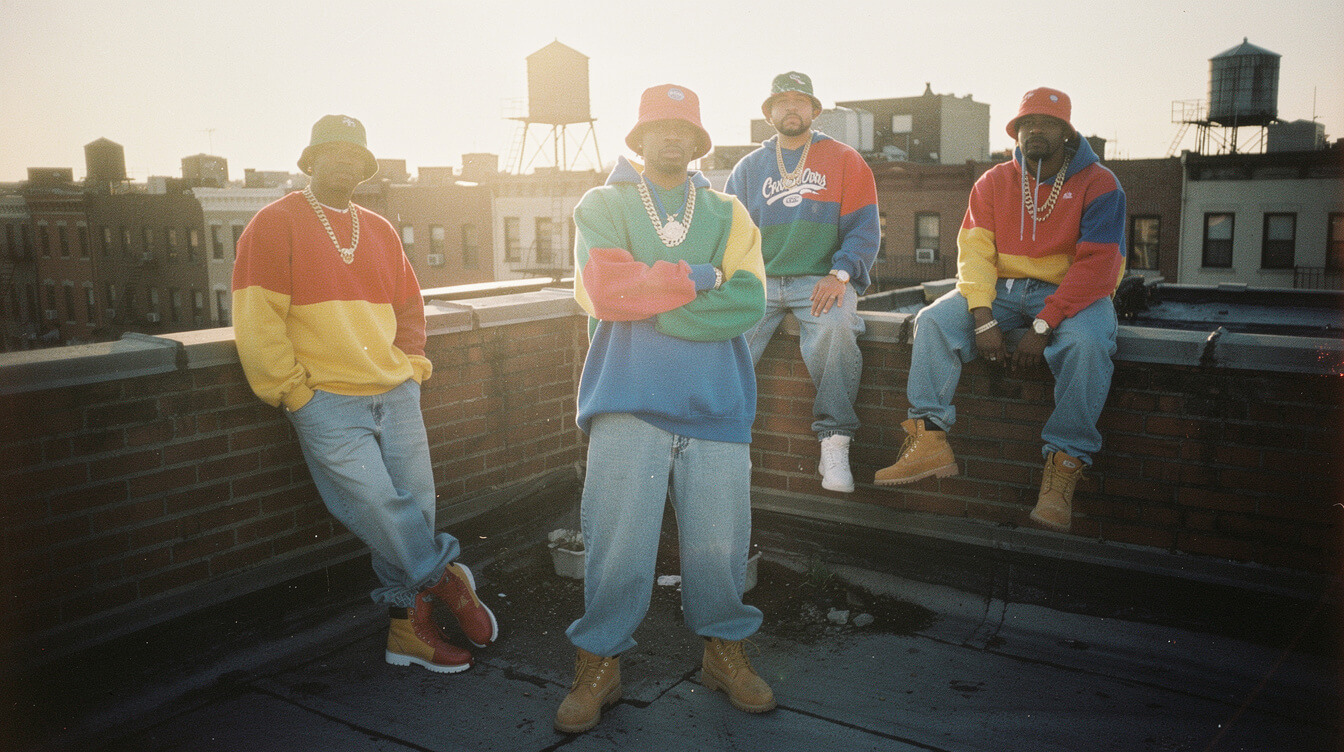
Between 1990 and 1997 the rapper sweatshirt became an industry. Cross Colours launched in 1989 in LA, designed by Carl Jones and TJ Walker on the explicit thesis that Black culture needed its own fashion vocabulary — bold primary color blocking, Pan-African red-gold-green palettes, oversized fits made for breakdance-derived body language. By 1992 Cross Colours was a $97M-a-year company. The crewneck sweatshirt was their hero silhouette because it carried the most ink and the most attitude.
Karl Kani, founded by Carl Williams in 1989 as well, pushed in the opposite direction — embroidered chenille script, premium fleece weights, the first true premium-priced rapper sweatshirts. By 1994 Kani was outfitting Tupac, Snoop, and the entire Death Row roster. Tupac wore the Kani crewneck in the “California Love” video. That single styling decision is responsible for more 2020s nostalgia drops than almost any other piece of 90s footage.
FUBU (For Us, By Us) launched in 1992 out of Daymond John’s mother’s basement in Hollis, Queens — the same Hollis that gave us Run-DMC. By 1998 FUBU was a $350M revenue brand. LL Cool J famously slipped a FUBU hat into a GAP commercial in 1997, broke the GAP shoot from inside, and effectively used a competitor’s $4M ad spend to launch a Black-owned challenger brand. That kind of cultural jiu-jitsu only happens once. The sweatshirt was the vehicle.
And then Wu-Wear opened on Victory Boulevard in Staten Island in October 1995, the first rap-group-owned standalone retail store. RZA insisted on owning the supply chain from day one because he’d watched every other crew lose merchandising rights to labels. At its peak Wu-Wear cleared $20M in annual revenue — a number that quietly proved a rap-group apparel brand could move serious volume without a single corporate licensing deal. Every artist-owned merch line that followed — from Yeezy to The Hundreds to Supreme x Wu-Tang to MF DOOM’s Metal Face Records line to the modern Bandcamp drop economy — descends from that one Staten Island storefront.
If you’re tracing the visual DNA of how the silhouette evolved across that decade, our 90s hip-hop fashion blueprint walks through the era-by-era timeline from Cross Colours to Wu-Wear to Sean John in granular detail.
The Album-Cover Sweatshirt: Why Rappers Turn Liner Notes Into Garments
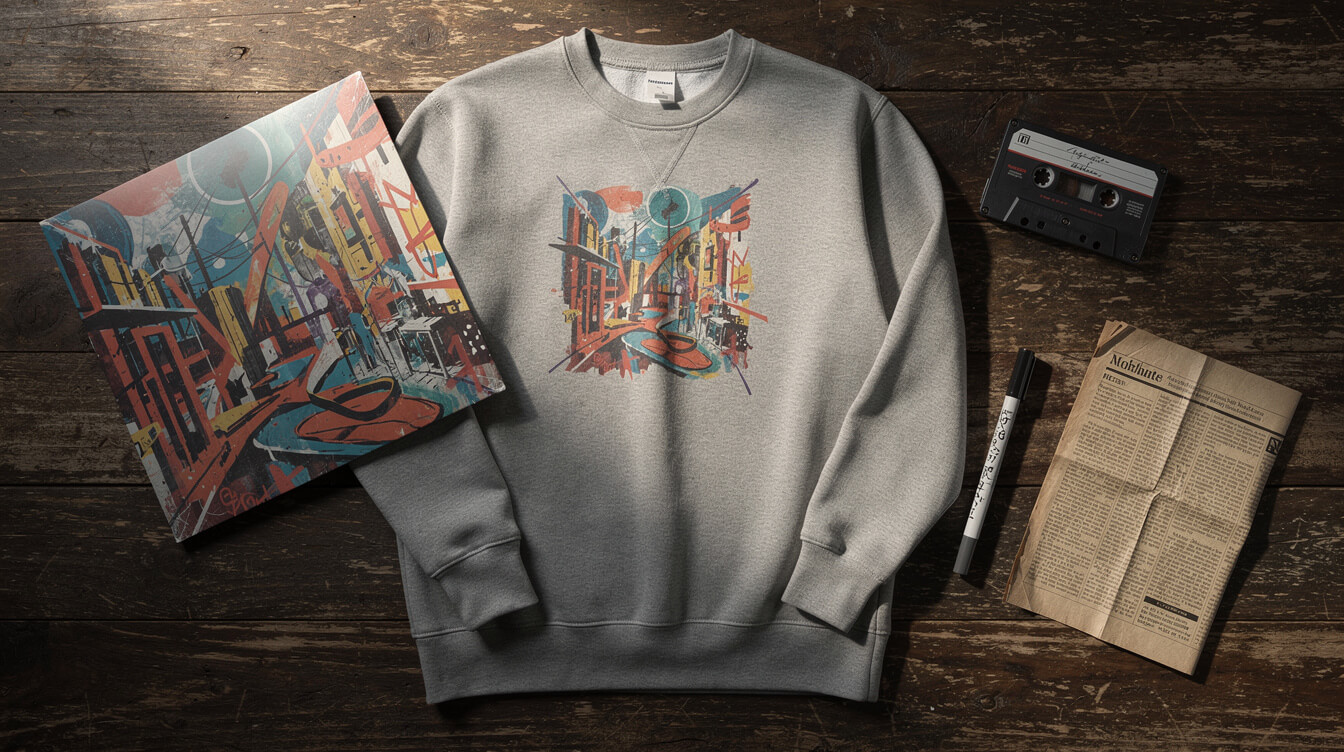
The single most under-discussed format in hip-hop apparel is the album-cover sweatshirt — a garment whose chest graphic is a 1:1 transposition of an existing record’s cover art. It is, in literal terms, the wearer wearing the catalog. The format works because hip-hop is a discography-driven culture. We argue about tracklists. We rank albums. We memorize liner notes and producer credits. Wearing the cover is wearing the argument.
The blueprint goes back to the Mobb Deep The Infamous bootleg crewnecks that flooded Brooklyn flea markets in 1995, the unofficial Wu-Tang Enter the 36 Chambers sweatshirts hawked outside Lyricist Lounge nights, and the legendary OG Illmatic sweatshirt that traded for $400+ on early eBay in 2003. None of these were officially licensed. All of them were beloved. The lesson the industry took twenty years to internalize: fans want the receipt. They want to wear the artifact, not just the brand.
By the late 2000s licensed album-cover apparel had become a full economy. Stüssy partnered with the Wu. Supreme dropped the famous 2018 Wu-Tang collab. Bravado started licensing classic boom-bap covers wholesale. The smart current play, in 2026, is to make album-cover sweatshirts for the records the algorithm forgot — the Hard to Earns, the Liquid Swordses, the Madvillainys, the Hell Hath No Furys. Bigger catalogs, deeper credibility, less Bravado licensing friction.
Earl Sweatshirt: How One Rapper Made the Name Inevitable
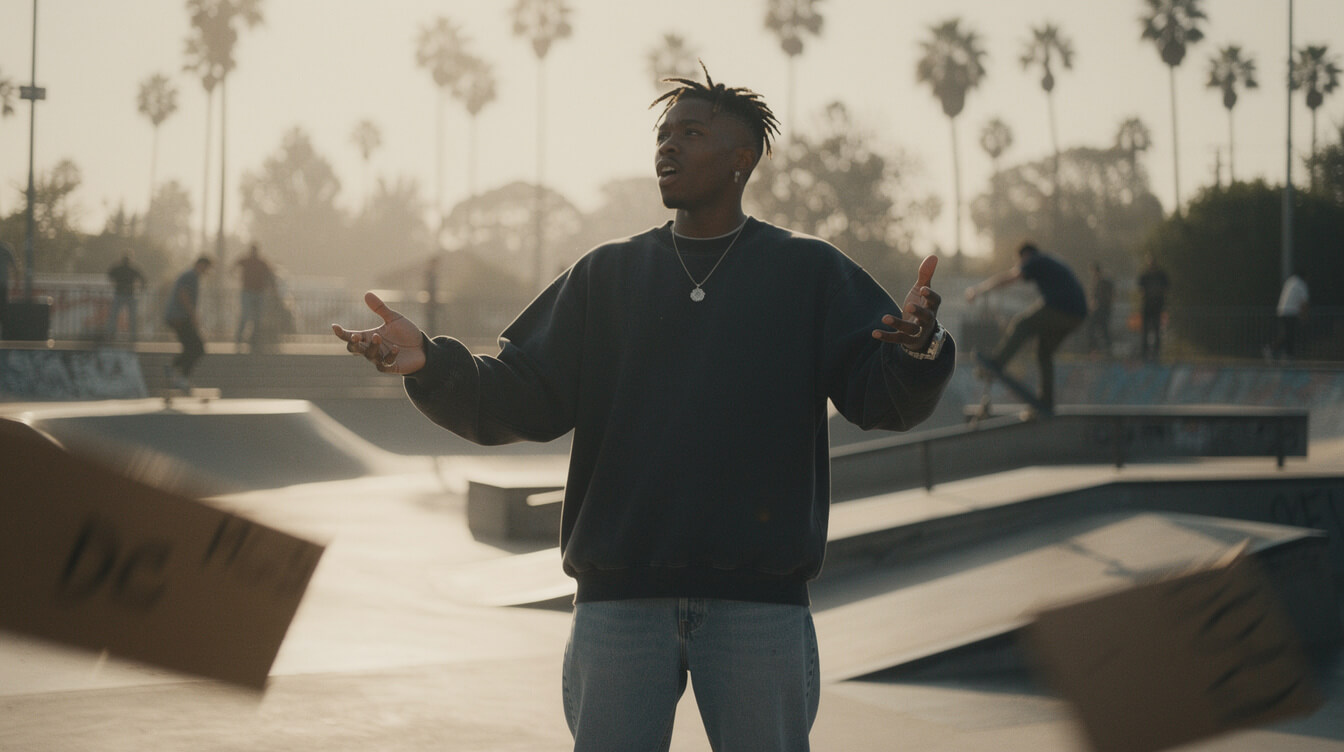
You cannot write about rapper sweatshirts in 2026 without writing about Earl Sweatshirt. Thebe Neruda Kgositsile — born February 24, 1994 in Chicago, son of South African poet laureate Keorapetse Kgositsile — joined Odd Future in 2009 as the youngest member of the LA collective at fifteen. He picked the stage name “Earl Sweatshirt” partly as a deliberate refusal of conventional rap nomenclature and partly because the crewneck sweatshirt was already the off-duty uniform of the Odd Future generation: oversized, washed-out, scraped raw of any sheen.
The name turned out to be culturally prophetic. As Earl’s discography deepened — Doris (2013), I Don’t Like Shit, I Don’t Go Outside (2015), Some Rap Songs (2018), Sick! (2022), VOIR DIRE (2023) — the sweatshirt became the visual language of an entire alternative-hip-hop subgenre. Mach-Hommy in his masked sweats. MIKE in oversized washed crewnecks. Earl-adjacent producers like Alchemist, the Standing on the Corner collective, Navy Blue, Liv.e. The sweatshirt got coded as the garment of serious hip-hop, the opposite of the merch-rack hoodie and the opposite of the Gucci-branded designer flex. It became the uniform of the lyrical underground.
That cultural code is exactly why our Wu-Tang Clan From the Slums of Shaolin Hoodie sits in the same shopping cart as a vintage tour sweat for two completely different reasons: one is the foundational album-cover receipt; the other is the lineage that descended from it. They’re the same conversation in two different decades.
The Modern Rapper Sweatshirt: Heavyweight Fits, Loud Graphics, and What’s Different Now
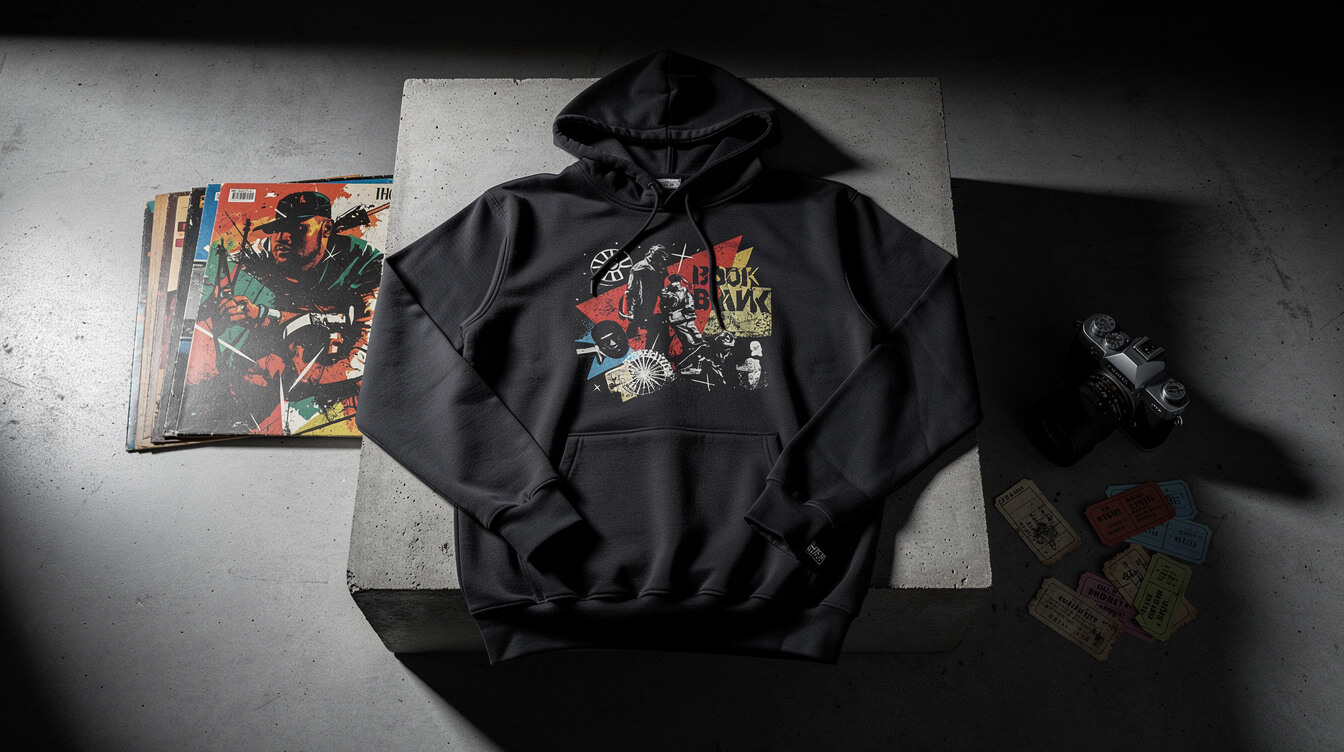
The 2026 rapper sweatshirt looks materially different from the 1996 version, and the differences are worth getting right.
- Weight has gone up. The boutique-grade rapper sweatshirt is now 380–450 GSM (grams per square meter) — almost twice the weight of a standard Gildan 18000. Heavyweight cotton fleece, ringspun, garment-dyed. The garment is closer to a workwear piece than a gym layer.
- Fits have re-collapsed back to oversized. The slim-fit American Apparel era of 2008–2014 is over. The modern rapper sweatshirt sits in a deliberately dropped shoulder, runs roomy through the chest, and tapers slightly through the hem. Read it as the silhouette of mid-90s Wu-Wear, re-released with modern pattern blocking.
- Graphics have re-centered on cultural specificity. Generic “RAP” wordmark sweatshirts feel embarrassing in 2026. The graphic now has to say something — an album cover, a tour date, a label crest, a producer tag, a lyric pulled from a specific verse. The wearer is expected to be able to defend the reference.
- Premium pricing has stabilized $49–$120. Below $40 reads like POD. Above $200 reads like a Demna joke. The boutique sweet spot — heavyweight cotton, screen-printed or embroidered chest graphic, made in small runs — lives between $50 and $100. That’s where the actual market is.
- Distribution has decentralized. The mall-anchor 90s era is fully gone. The rapper sweatshirt now sells through artist Bandcamp stores, independent culture-shops, Shopify storefronts run by serious heads, and a small handful of boutique imprints (Custom Creative included) that license or design specifically for the lyricist class.

“Rap Is Something You Do. Hip-Hop Is Something You Live.”
Our KRS-One Hoodie Tribute carries the line that defined the difference between a passenger and a participant. Premium fleece, screen-printed in small runs.
How to Pick a Rapper Sweatshirt That Actually Earns the Culture
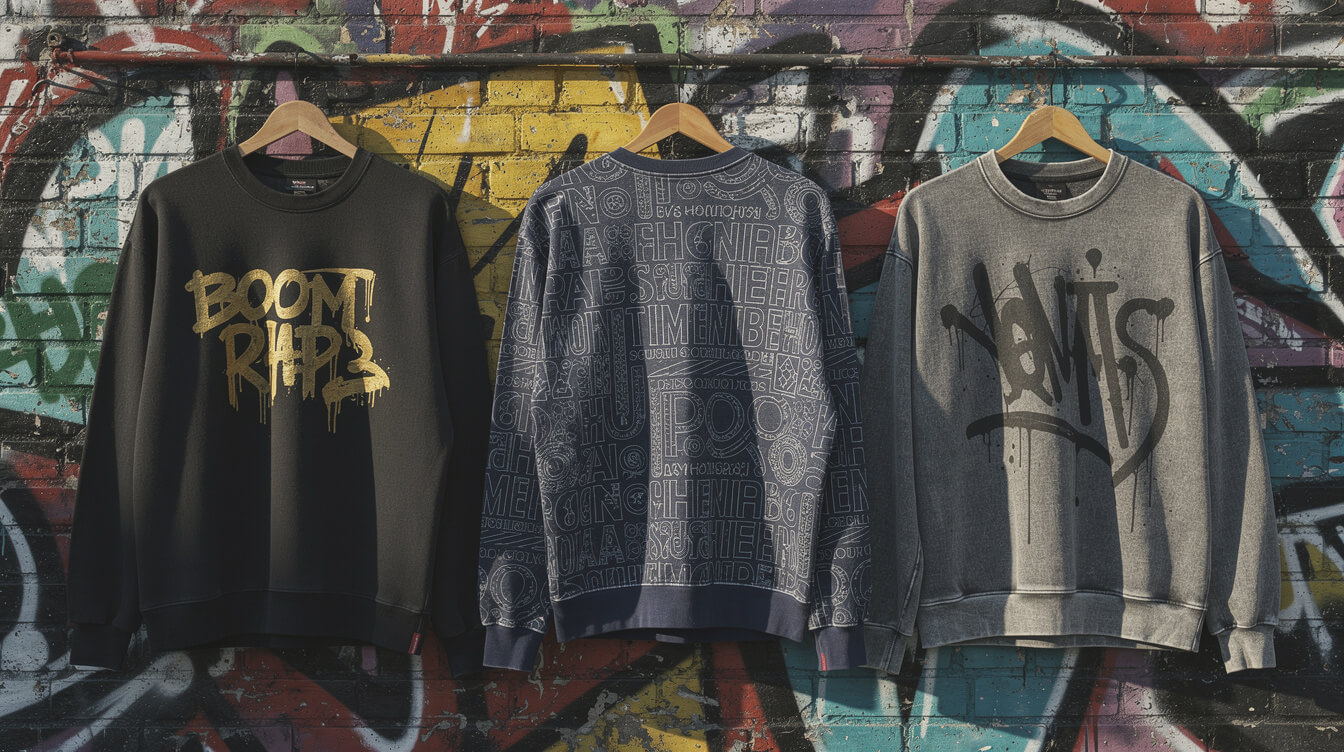
A buyer’s framework, in order:
- The graphic has to be defendable. If somebody at a bar asks you about the chest, you should have a one-sentence answer ready. “It’s the cover of Hard to Earn, the Premier-produced Gang Starr LP from 1994 where ‘Mass Appeal’ lives.” That’s a defendable graphic. A wordmark that just says “RAP” or “HIP HOP” in block letters is not.
- The weight has to be honest. Read the GSM. Anything under 320 GSM is a layering tee in disguise. The real rapper sweatshirt sits 380 GSM and up. You feel it when you pick it up.
- The print has to age well. Heat-transfer prints crack in 6–18 months. Screen-printed plastisol ink on heavyweight cotton lasts decades — same construction as the OG 90s pieces in collector closets. Embroidered chenille and tackle-twill are the premium tier above that.
- The fit has to mean something. Oversized works because it matches the silhouette of the era you’re referencing. A slim-fit Wu-Wear cosplay reads off. If the graphic is from 1994 the cut should be too.
- The source has to be legible. Buy from a brand that can tell you the story of the graphic — who made the album, who produced it, why the cover looked the way it did. A brand that’s just printing what trends on TikTok cannot defend the reference, and neither can the wearer.
Frequently Asked Questions About Rapper Sweatshirts
Are rapper sweatshirts the same as hip-hop hoodies?
Functionally close, but the rapper sweatshirt is the older silhouette. The crewneck pullover dominated the late 70s through the mid-90s; the hooded version overtook it commercially around 1996 (Wu-Wear’s Method Man hoodie drops were the inflection point). Most “hip-hop hoodies” today are actually rapper sweatshirts with a hood added — same body, same graphics culture, same weight class. The hood is a styling preference, not a separate category.
What’s the most expensive rapper sweatshirt ever sold?
An original 1994 Cross Colours sweatshirt worn by Tupac in a Death Row press shoot reportedly sold at auction for $46,000 in 2021. Tupac-provenance pieces command the highest premiums; Wu-Tang Wu-Wear OG runs from the Staten Island store typically clear $1,200–$3,500 on Grailed. Wear-tested OG Karl Kani crewnecks from 1993–1996 trade in the $400–$900 range.
Are Earl Sweatshirt hoodies an actual product line?
There’s no official “Earl Sweatshirt” branded sweatshirt line in the way FUBU or Wu-Wear is. Earl drops limited-run tour merch through Tan Cressida and his record labels, and the occasional album-cycle hoodie tied to Sick!, VOIR DIRE, and the recent collaborations. Most “Earl Sweatshirt sweatshirt” Google traffic is fans looking for either his tour merch or alternative-hip-hop-coded heavyweight crewnecks in the visual lineage his name accidentally christened.
What’s the difference between a POD rapper sweatshirt and a boutique one?
POD (print-on-demand) sweatshirts are typically heat-transfer printed on Gildan 18000 blanks (270 GSM). They sell for $25–$35. Boutique rapper sweatshirts are screen-printed or embroidered on heavyweight 380+ GSM cotton fleece, made in small runs of 50–500 pieces. They sell for $49–$120. The boutique piece will last 10+ years; the POD piece will crack in 12 months.
Final Thoughts: A Rapper Sweatshirt Is Always a Receipt
The reason this garment refuses to die — through Cross Colours, through Wu-Wear, through the Earl era, through the modern boutique resurgence — is that it does something no other piece of clothing in hip-hop does. It carries the catalog. It lets the wearer publish a one-line opinion about hip-hop without saying anything. It works in 1986 and it works in 2026 because the underlying culture has never stopped being discography-driven, crew-driven, and receipt-driven.
Pick the graphic you’d defend. Pick the weight you’d keep for a decade. Pick the album you actually played. The rapper sweatshirt has been hip-hop’s quietest billboard for forty-six years, and the only rule that has ever mattered is the one Run-DMC taught everyone first: wear what you’d say on a record.
Get the Drop Before Everyone Else
New hoodie drops, deep cultural reads, and small-batch releases — straight to your inbox, no filler.
Stay creative — The Custom Creative Team

🎧 Never Miss a Drop
Exclusive product releases, hip-hop deep dives, and member-only discounts. Straight to your inbox.
Free forever. No spam. Unsubscribe anytime.
Get the Culture, Delivered
Deep dives into hip-hop history, exclusive product drops, and discounts sent straight to your inbox. No spam, just culture.
Join 2,000+ hip-hop heads already in the loop. Unsubscribe anytime.