OutKast Aquemini: The 1998 Masterpiece That Saved Hip-Hop From Itself
September 29, 1998. The week OutKast Aquemini dropped, hip-hop was at war with itself. Tupac was two years dead. Biggie was sixteen months gone. The East-versus-West autopsy was still warm, and the conversation about what came next had hardened into a binary — coasts, beefs, body counts. Then two kids from East Point, Georgia, walked into the room with seventy-five minutes of live bass, cosmic funk, and storytelling that didn’t ask permission. Aquemini didn’t pick a side. It built a third one.
This is the album that broke hip-hop’s coastal monopoly. Not Stankonia, not Speakerboxxx/The Love Below — Aquemini. The South had been knocking. After this LP, the door was kicked off the hinges. Below, we unpack the OutKast Aquemini story end to end: how André Benjamin and Antwan Patton built it, why the title is a thesis statement, what the Source Awards aftermath had to do with the lead single, and why a 1998 record still hits like it was cut last week. If you came for a tracklist, you’ll get that too — but only after we set the table.
OutKast Aquemini: The Album That Broke Hip-Hop’s Coastal Monopoly

To understand what OutKast Aquemini accomplished, you have to remember what the SoundScan reports looked like in 1998. The Wu had splintered into solo albums. Bad Boy was post-Biggie limping. Death Row was a smoking crater. The South was selling, but to the editorial gatekeepers at The Source and the MTV booking machine, it was still novelty — a regional curiosity riding bass-heavy programming and Cadillac muzik. Master P had cracked the door open with No Limit’s vertical empire. Goodie Mob’s Soul Food had earned critical respect. But nobody from below the Mason-Dixon had cut an album that demanded canonization.
Aquemini demanded it. Released by LaFace Records on September 29, 1998, the album debuted at No. 2 on the Billboard 200, certified platinum in November of the same year — two months out — and double platinum by July 1999. Critics didn’t just praise it; they reorganized their lists. Rolling Stone eventually moved it to No. 49 on the 500 Greatest Albums of All Time. The Source gave it five mics, the rarest rating the magazine handed out. That five-mic call was bigger than the chart numbers. It was the establishment saying, in print, that two twenty-three-year-olds from East Point had cut something canonical.
What made the album impossible to dismiss wasn’t only the rapping. It was the architecture. Aquemini ran 74 minutes and 47 seconds — long even by 1998 standards — and it earned every second by abandoning the verse-hook-verse-hook factory pattern that Bad Boy and Death Row had standardized. Live horns. A Hammond B-3 that you can hear breathing through its rotary speaker. George Clinton credited as a co-writer. Erykah Badu floating through “Liberation” like a sermon. Raekwon — a Wu-Tang Clan emissary from Staten Island, the heart of the East — flown south to trade bars with André on “Skew It on the Bar-B.” That last move was almost diplomatic. The South wasn’t asking permission anymore. It was inviting the coasts to the cookout.
Two Signs, One Sound: Why the Aquemini Title Tells You Everything
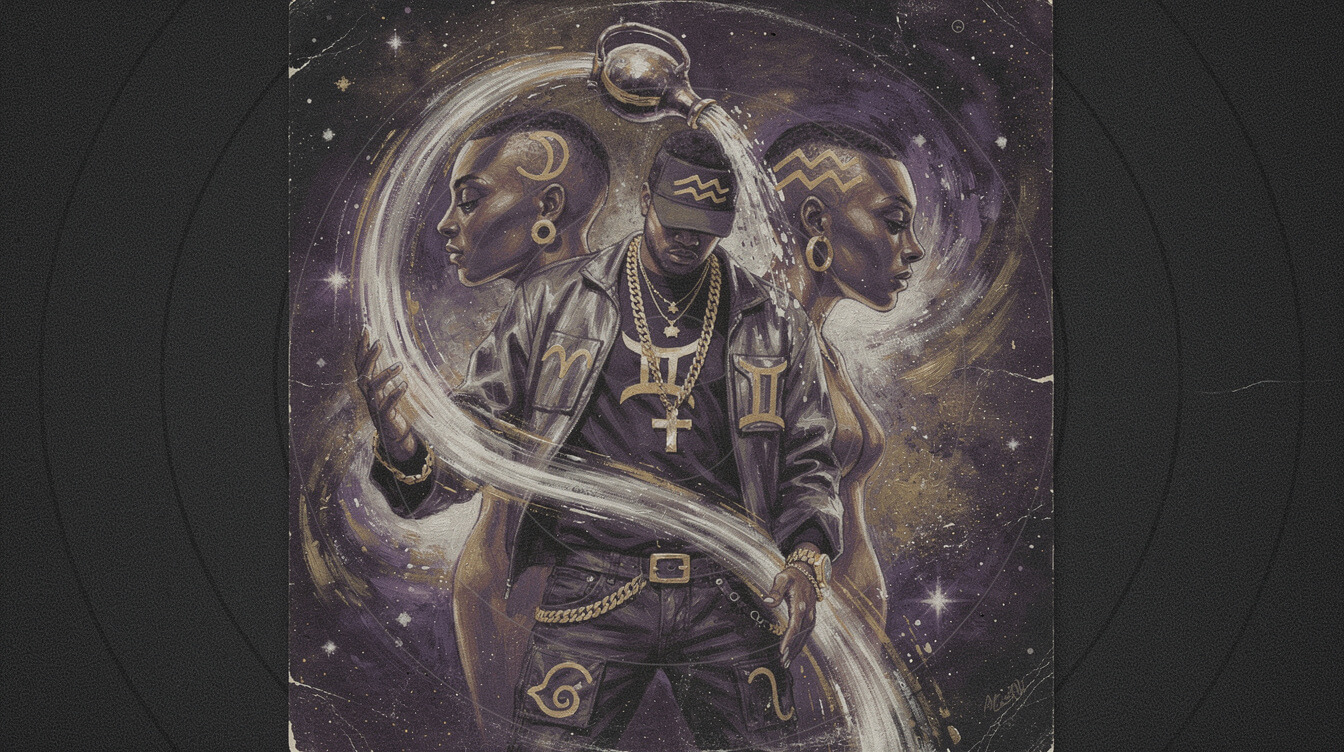
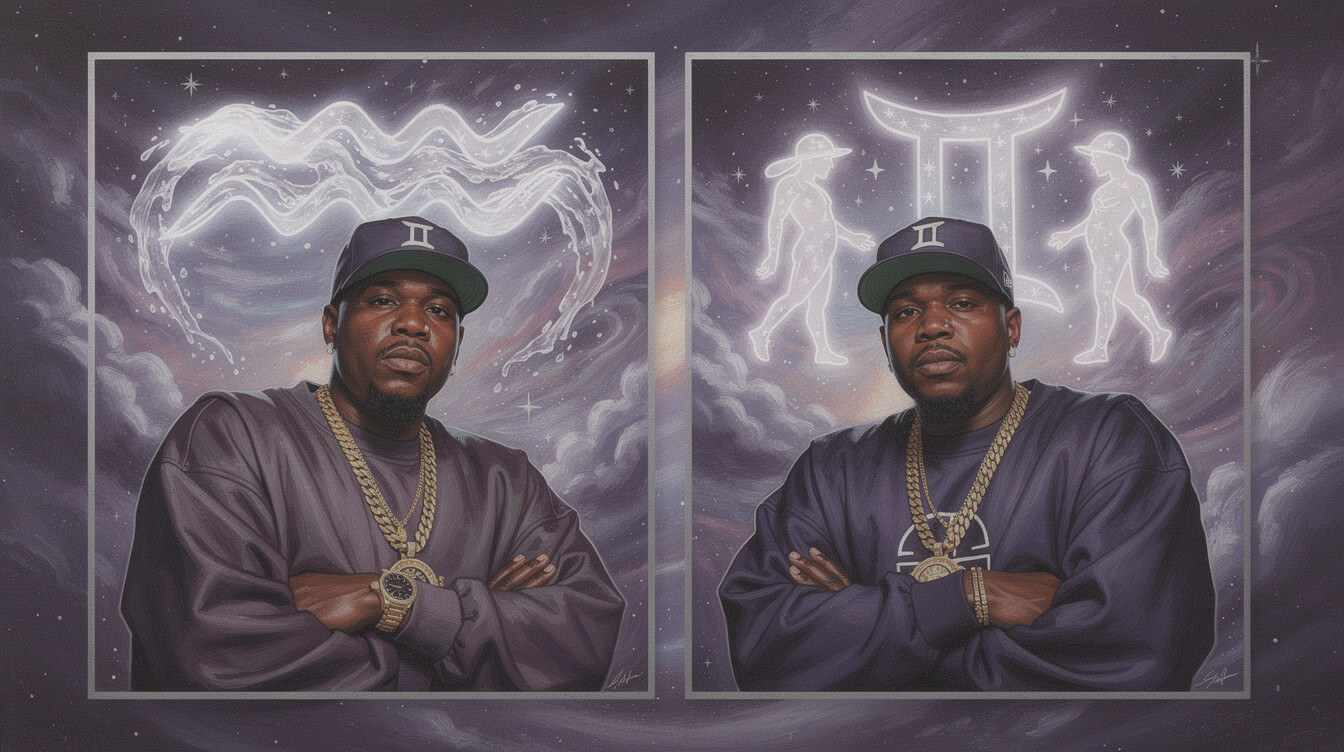
The title is a portmanteau: Aqua from Aquarius (Big Boi, born February 1, 1975) and mini from Gemini (André 3000, born May 27, 1975). On the surface it’s an astrological wink. Read closer and it’s the album’s entire thesis. Aquemini is the sound of two opposing creative temperaments — one rooted, one airborne — refusing to compromise and instead pulling so hard in opposite directions that the rope holds.
Big Boi is the player. The Cadillac driver. The Aquarius pragmatist who keeps the rhyme schemes tight, the cadences clipped, and the references local. Listen to his verse on the title track and you hear East Point neighborhood detail — corner stories, family code, the discipline of someone who has thought hard about how to win the game without losing his teeth. André is the Gemini twin: shape-shifting, restless, mid-flight between identities. By 1998 he had already begun the metamorphosis that would later produce The Love Below — vegetarianism, turbans, abstract clothing choices. On Aquemini, he is rapping like a man trying to think his way out of a box he didn’t realize he was in.
The miracle of the album is that these two registers don’t fragment it. They braid. On every track, you can feel the friction between Big’s grounded craftsman and André’s celestial improviser, and that friction is the engine. Most rap duos make stylistic peace by drifting toward the same voice. OutKast made peace by amplifying the difference and letting the contrast do the work. That’s why the title isn’t decorative. It’s instructions for how to hear the LP.
It’s also a clue to where commerce later went. The Aquemini iconography — the dual-symbol logo, the album cover’s split-personality portrait — has been one of the most enduring fan-art motifs in rap merchandise for almost three decades. The reason is simple: it’s a visual that already carries the album’s idea. When a culture can shorthand a record’s meaning into a logo, that record gets eternal life on a t-shirt rack. Aquemini earned that, and it earned it before the marketing department invented the deliverable.
From ATLiens to Aquemini: How OutKast Built Their Third Act
You can’t understand Aquemini without understanding the runway. Southernplayalisticadillacmuzik in 1994 was a teenager’s introduction — Big Boi and André were eighteen — recorded under Organized Noize’s tight Dungeon Family supervision. It went platinum, but the album lived inside Organized Noize’s aesthetic: rooted, Cadillac-cushioned, Atlanta-specific. Two years later, ATLiens opened the airlock. The cosmic theme arrived. OutKast started producing themselves. The Dungeon Family was still the village, but the village was now sending its kids to space camp.
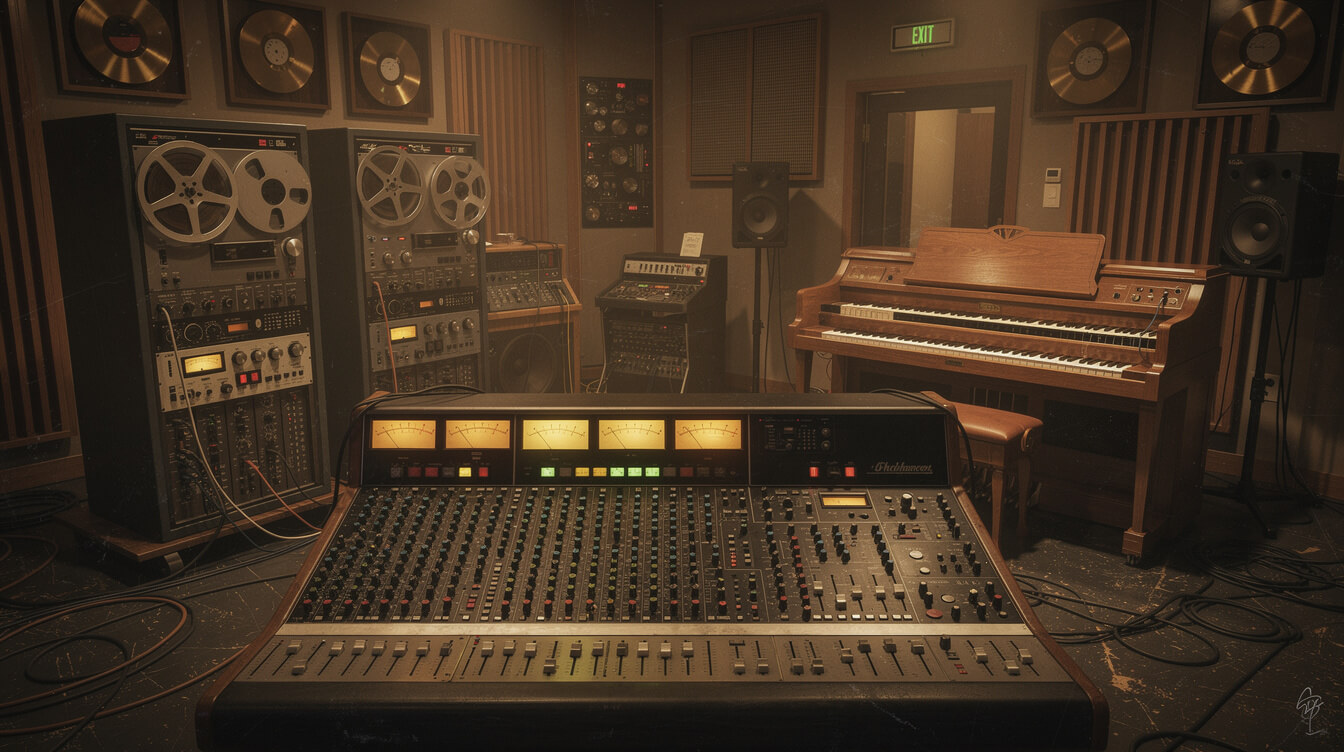
By the time Aquemini was being cut in 1996 through 1998 at Bobby Brown’s Bosstown Recording Studios and Doppler Studios in Atlanta, the runway had become a launchpad. LaFace gave the duo near-total creative control. They handled the majority of production themselves under the OutKast credit, with Organized Noize and Mr. DJ filling in. Session musicians filtered in and out throughout. The new wrinkle: live instrumentation. Not loops — players. Bass guitar, electric guitar, real horns, real keys. That texture is the reason the album doesn’t date. Sampled loops freeze. Live takes breathe. We covered the same architectural shift in our read on ATLiens and its Afrofuturist pivot, and Aquemini is what happens when that experiment grows past prototype.
The recording process matters here because it explains the album’s most polarizing tic: the seventy-five-minute runtime. Aquemini isn’t long because OutKast couldn’t edit. It’s long because the live ensemble approach generated more usable material than a sample-flip session ever could, and because the duo had earned the right to keep the cuts that didn’t fit a single’s format. “SpottieOttieDopaliscious” runs 7:07. “Synthesizer” with George Clinton runs 5:11. “Mamacita” goes 5:52. Singles-radio logic would have trimmed all three. Aquemini kept them because the LP isn’t competing on radio-edit terms. It’s a complete-listen record, designed for the one-sitting album experience that most 2026 listeners have forgotten how to give.
This is also where you start to see the splits between Big and André. Big’s tracks (his showcase verses on the title cut, “West Savannah,” “Y’all Scared”) sit closer to the Organized Noize Atlanta tradition — funk-driven, percussion-heavy, southern in cadence. André’s tracks (“Liberation,” “Aquemini,” the closing minutes of “Da Art of Storytellin’ Pt. 2”) drift toward extended structure, abstract lyric content, and outside-of-rap musical references. The two never split the album cleanly into his-and-his sides. They alternate, overlap, and tag-team within tracks. That instinct — to braid rather than divide — would become the design principle for every OutKast album that followed.
The Tracklist: A Track-by-Track Read of OutKast Aquemini’s Best Cuts
Sixteen tracks. Seventy-five minutes. Three skits (“Hold On, Be Strong,” “Liberation,” interludes) that aren’t skips. Here are the cuts that explain why Aquemini sits in the top ten of any honest hip-hop greats list — and what to listen for on each.
“Rosa Parks” (Track 3)
The lead single. André’s harmonica break in the bridge is one of the most-known six seconds in 90s rap. The civil rights icon’s family later sued over the title — we’ll get to that — but the song itself is a defiant invitation to “move to the back of the bus,” using the metaphor as a brag about who actually has the seat at the front of the culture. Listen for the way the beat drops out for the harmonica run. It’s a structural risk that pays off because the song earns the pause.
“SpottieOttieDopaliscious” (Track 12)
If you only play one track to convince a skeptic, play this one. Seven minutes of horn-led spoken-word storytelling — not rapped, told — over a Sleepy Brown-anchored groove that has been sampled, interpolated, and quoted by every Atlanta artist who came after, from Future to Killer Mike to JID. It is the prototype for the modern Atlanta sound’s debt to live soul music.
“Aquemini” (Track 5)
The title track. Both rappers at the peak of their early-career power. The hook (“even the sun goes down, heroes eventually die”) is one of the great writing moments on the album, and the verses lay out the dual-personality thesis the title promises. If the album has a center of gravity, it sits here.
“Da Art of Storytellin’ (Pt. 1 & 2)”
A two-part suite produced by Mr. DJ. Part 1 is the storytelling exhibition — narrative rap at the level that Reasonable Doubt and Illmatic set the bar for. Part 2 changes the production palette entirely and lets André close the suite with one of his most surreal late-album verses. Together they make the case that OutKast can do narrative density better than anyone working in 1998.
“Skew It on the Bar-B” (Track 4)
The Raekwon feature. The diplomatic handshake. Wu-Tang’s Chef trades bars with Big Boi and André in a way that doesn’t sound like a stunt feature — it sounds like respect. Important historical artifact: this is one of the first East-South marquee collaborations of the post-Biggie era that the culture treated as legitimate rather than commercial.
“Synthesizer” (featuring George Clinton)
Funk royalty co-signs the next generation. Clinton’s writing credit isn’t symbolic. His DNA is all over the record’s bass-and-keys philosophy. “Synthesizer” is where that lineage gets stated explicitly.
If “SpottieOttieDopaliscious” hooked you and you want the artwork on your back, our OutKast Aquemini T-Shirt is the fan-art tee for it — printed on Bella Canvas 3001 in Black, Navy, and Chocolate. It’s the kind of tee that does the talking for you in a record-store conversation. No further explanation needed.
Rosa Parks, the Source Awards, and the Politics of Aquemini’s Sound
You don’t read Aquemini right without rewinding to August 3, 1995 — the second annual Source Awards, held at Madison Square Garden. OutKast wins Best New Rap Group. The room boos. New York hip-hop is not yet ready to hand its trophies to a duo from East Point. André walks to the mic and delivers the line that ends up tattooed on Southern hip-hop history: “The South got something to say.” Then he walks off.
Three years later, Aquemini is the album that finally makes the receipt unignorable. Every choice on the record reads as a long answer to that boo. The harmonica break on “Rosa Parks” — instrumental territory that the New York rule book in 1998 said you do not enter on a rap single — is a deliberate provocation. The Raekwon feature is a statement that the South will share the stage but on its own terrain. The live-band approach is an aesthetic argument that Southern rap is not just regional pattern but musicianship at scale.
The Rosa Parks lawsuit, filed by the civil rights legend’s family in 1999, complicated the song’s legacy on its way to a 2005 settlement that funded a Rosa Parks tribute album. But the controversy didn’t dent the cultural meaning of the track. If anything, it cemented it. “Rosa Parks” was already a metaphor about who owns the front of the bus, and a lawsuit about the title only proved how much weight that metaphor still carried.
Behind all of this is a political point that 2026 audiences sometimes miss. The South of 1998 was not a marketing demographic for the major-label coastal apparatus. Atlanta was a place that the coasts treated as a sales territory, not a creative origin. OutKast Aquemini changed who got to define what counts as the center of rap. Within two years, the South would be producing the dominant commercial output of the genre — Cash Money, No Limit, Three 6 Mafia, the Dungeon Family graduates all about to inherit the next decade. Aquemini is the document that marks the handoff. We placed it in context in our broader OutKast Albums Ranked discography guide, but on its own terms it stands as the inflection point.
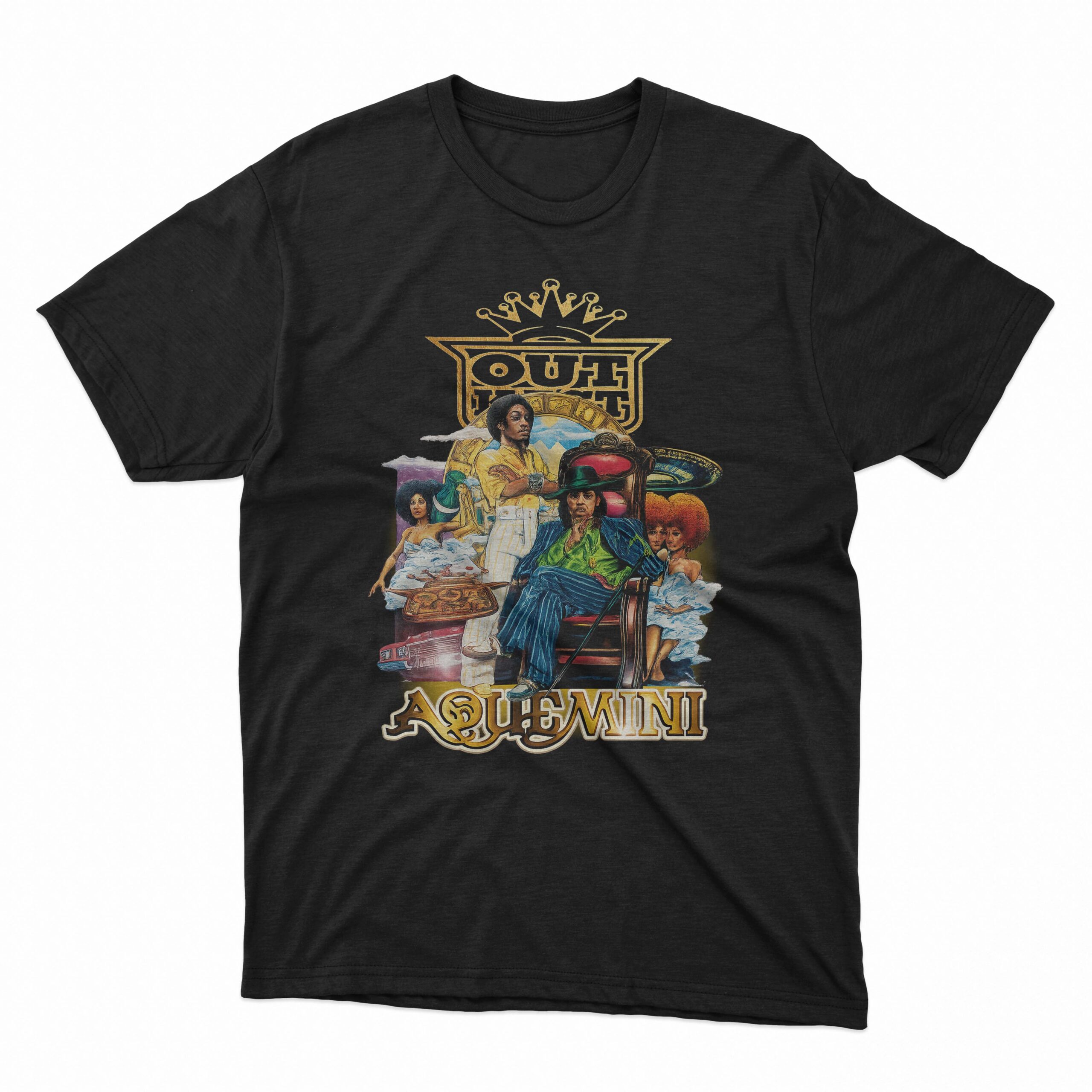
Wear the Record That Changed the Map
Fan-art homage to OutKast’s 1998 masterpiece. Premium Bella Canvas 3001 — Black, Navy, Chocolate. The tee that the record-store conversation starts itself.
Aquemini’s Legacy: Why It Still Sounds 28 Years Ahead in 2026
Pull up Aquemini on streaming in 2026 and the first thing you notice is how little has aged. Most 1998 hip-hop records have a vintage signature — a snare crack, a 12-bit drum machine, a sample-clearance shortcut that screams its era. Aquemini doesn’t. The reason is craft choices that nobody else was making in 1998 and almost everyone makes now.
Three of them. First: live instrumentation over loops. Anderson .Paak, JID, Jordan Ward, Smino, the whole post-2015 rap-with-real-instruments wave — every one of them owes the playbook to what OutKast and the Dungeon Family proved on this record. Second: long-form album structure. The seventy-five-minute LP, with skits that earn their runtime and tracks that go seven minutes when the music wants seven minutes — Kendrick Lamar’s To Pimp a Butterfly, Tyler the Creator’s IGOR, Solange’s A Seat at the Table all use the Aquemini blueprint. Third: regional pride as universal aesthetic. The album sells Atlanta to the rest of the country and the world without sanding off Atlanta. That move — be specifically local, be globally legible — is the post-1998 commercial template, full stop.
The album’s chart life supports the read. Double platinum by July 1999. Still streaming in serious numbers in 2026. Still moving vinyl reissues — the colored variants OutKast.com cycles regularly sell through within hours. And the LP still works as an entry point. Play “Rosa Parks” for a fifteen-year-old in 2026 and they don’t ask for context. They hear the harmonica break, the verses, the snap of the percussion, and they get it. That’s the durability test. Aquemini passes it every time.
If you want a broader visual lineage on rap album art that has done what the Aquemini cover did — turn the LP into a logo — check our 50-year history of hip-hop album covers. The Aquemini cover (the painted duo portrait, the silver-purple cosmic palette) sits in that conversation with Illmatic, Ready to Die, and Reasonable Doubt as one of the rare covers that became its own piece of cultural shorthand.
Frequently Asked Questions About OutKast Aquemini
When was OutKast Aquemini released?
Aquemini was released on September 29, 1998, by LaFace Records and Arista Records. It was OutKast’s third studio album, following Southernplayalisticadillacmuzik (1994) and ATLiens (1996), and preceding Stankonia (2000).
What does the word Aquemini mean?
It’s a portmanteau of two zodiac signs: Aquarius (Big Boi, born February 1) and Gemini (André 3000, born May 27). The title is shorthand for the album’s central theme — two opposing creative personalities producing one cohesive record.
Who produced OutKast Aquemini?
Primarily OutKast themselves (André 3000 and Big Boi), with significant contributions from Organized Noize (Rico Wade, Sleepy Brown, Ray Murray) and Mr. DJ (David Sheats). It was the first OutKast album where the duo handled the majority of production duties in-house.
What singles came from Aquemini?
Three: “Skew It on the Bar-B” featuring Raekwon (released August 23, 1998), “Rosa Parks” (March 23, 1999), and “Da Art of Storytellin’ (Pt. 1)” (May 25, 1999). “Rosa Parks” was the commercial breakthrough and the song most associated with the album in the mainstream.
Why did Rosa Parks sue OutKast?
The civil rights icon’s family filed a lawsuit in 1999 alleging the unauthorized use of her name on a commercial recording. The case was settled in 2005. The settlement included financial terms and a commitment from OutKast and LaFace to support the Rosa and Raymond Parks Institute, including a tribute album in her honor.
Did OutKast Aquemini win any Grammy Awards?
The album earned a Grammy nomination for Best Rap Album at the 41st Annual Grammy Awards in 1999 but lost to Jay-Z’s Vol. 2… Hard Knock Life. “Rosa Parks” was also nominated for Best Rap Performance by a Duo or Group. The historical consensus is that Aquemini‘s critical legacy has outlasted the trophies handed out that night.
Where does Aquemini rank in the greatest hip-hop albums of all time?
Rolling Stone ranks it No. 49 on its 500 Greatest Albums of All Time list (2020 update). The Source awarded it five mics — the magazine’s highest rating. Most modern editorial polls place it in the top ten of all-time hip-hop albums, alongside Illmatic, Ready to Die, Reasonable Doubt, and The Chronic.
What’s the best song on Aquemini?
“SpottieOttieDopaliscious” and the title track “Aquemini” are the most-cited critical picks, with “Rosa Parks” the popular consensus single. “Da Art of Storytellin’ (Pt. 1)” is the heads’ pick for the best pure rap exhibition on the LP. The honest answer is the album rewards listening as a complete sequence — picking one cut misses the point.
Final Thoughts: Aquemini As a Document of a Crossroads Moment
Hip-hop in 1998 was looking for a way forward that wasn’t another body bag. OutKast Aquemini answered the question without being asked. It made the case that the future of the genre was Southern, live-instrumented, long-form, and unapologetically itself — that you could honor Funkadelic and Sly Stone and Donny Hathaway and still sound like 1998, that you could be a duo from East Point and the most important act in rap that year, that you didn’t have to pick a coast because there was a third one and it was open.
Twenty-eight years later, the album is still doing the work. Every Atlanta rapper who has cut a record since owes it a debt. Every long-form concept LP in modern rap is sitting in a chair that Aquemini built. And the title still does the trick it was designed to do — a portmanteau that explains a partnership and an aesthetic in nine letters. Aquarius and Gemini, water and air, grounded and airborne, Big and André. The two signs braided into one sound. That sound changed everything.
Put it on this week. Listen to the full seventy-five minutes in one sitting, like 1998. Then come back and tell us we’re wrong about it being the album that saved hip-hop from itself.
Get the Culture in Your Inbox
Album breakdowns, anniversary reads, first dibs on new drops. No corporate filler — just the culture, weekly. Join the Custom Creative crew.
Stay creative — The Custom Creative Team

🎧 Never Miss a Drop
Exclusive product releases, hip-hop deep dives, and member-only discounts. Straight to your inbox.
Free forever. No spam. Unsubscribe anytime.
Get the Culture, Delivered
Deep dives into hip-hop history, exclusive product drops, and discounts sent straight to your inbox. No spam, just culture.
Join 2,000+ hip-hop heads already in the loop. Unsubscribe anytime.