The Blueprint at 25: How Jay-Z’s Soul-Sample Masterclass Launched Kanye West
On September 11, 2001, Jay Z‘s Blueprint — his sixth studio album and the record that would quietly rewire hip-hop production for the next fifteen years — landed in stores in a country about to forget it existed. Radio stations across America pulled hip-hop rotation to run news feeds; the towers came down at 8:46 that morning and Jay Z Blueprint copies hit shelves at 9:00. It sold 427,000 units in its first week anyway. Twenty-five years later, that opening-week number is beside the point. The Blueprint is the most quietly influential rap LP of the 2000s — the record that gave Kanye West his career, resurrected the soul sample as the dominant East Coast production template, and buried Nas so hard that “Ether” had to exist as a survival response.
This is the 25th-anniversary breakdown that Wikipedia won’t give you — the producer credit splits, the beef receipts, and the reason a chopped Bunny Sigler loop mattered more than a platinum plaque. If you came up on Roc-A-Fella era Jay, this is the record that ended the debate.
September 11, 2001: The Release Date That History Overshadowed
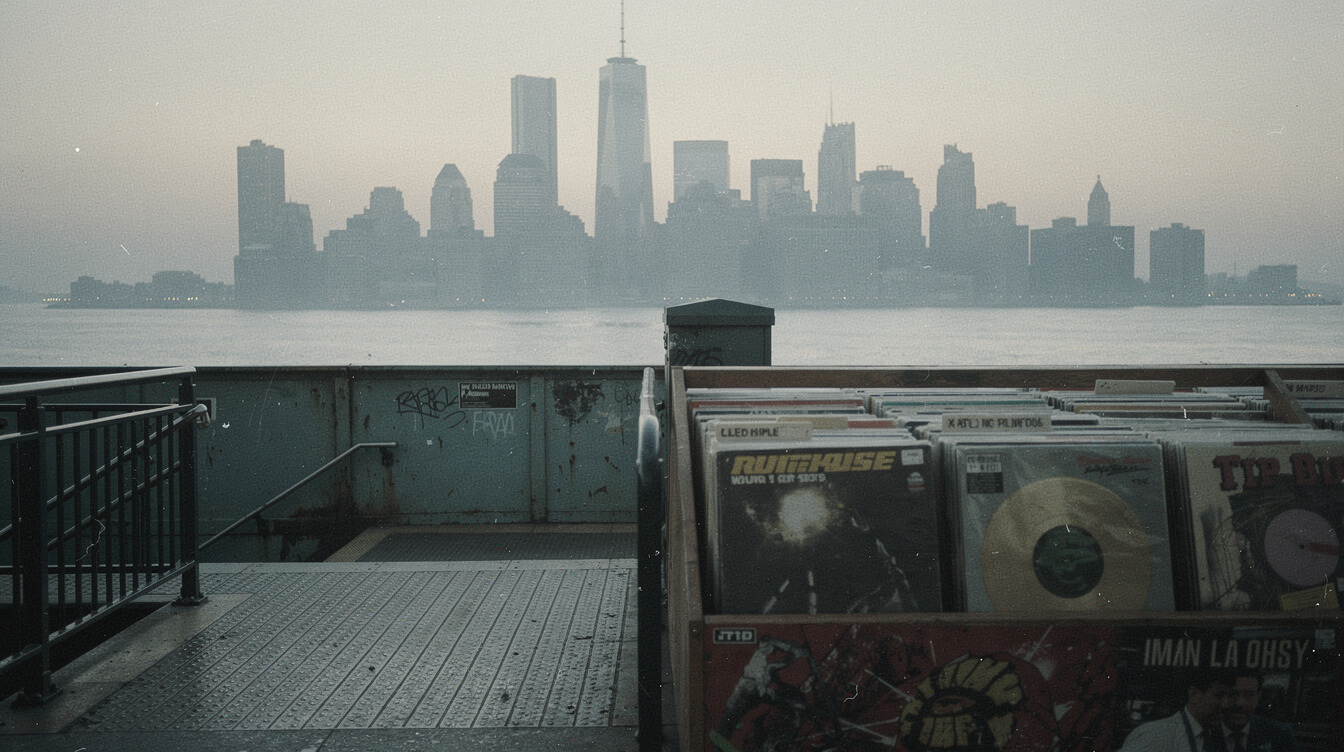
The Blueprint was scheduled for September 18, 2001. Roc-A-Fella pushed it up a week to combat bootlegging — a bootleg version had leaked in late August and Jay’s team wanted the retail SKU on shelves before the internet devoured the physical sales window. The final release date, chosen strictly for commercial reasons in July, was Tuesday, September 11.
By 9:03 AM Eastern, the second tower had been struck. Every rap station on the New York dial went to breaking news feeds. Hot 97 didn’t play a Blueprint track in full until September 14. MTV pulled the “Izzo (H.O.V.A.)” video from rotation for two weeks. Retail stores in lower Manhattan didn’t open. Best Buy locations nationwide reported customers walking in for the LP and walking out empty-handed because they’d forgotten it was Tuesday.
And yet the album sold 427,000 copies in that opening week — enough to debut at #1 on the Billboard 200, ahead of both the Bones soundtrack and Aaliyah’s posthumous surge. RIAA certified it platinum inside a month. Double platinum by the following spring. The album’s release date became a footnote in most retrospective coverage; the Wikipedia article for The Blueprint treats it as trivia. It’s not trivia. It’s the reason The Blueprint spent its first month underdiscussed by mainstream music press and had to wait until 2002 to receive the year-end critical framing it deserved — Rolling Stone eventually named it the second-best album of 2001, Village Voice put it in Pazz & Jop’s top ten, and every hip-hop publication with a pulse retroactively bumped it up the rankings once the country could breathe again.
The Kanye West Launchpad: How Four Beats Made a Career
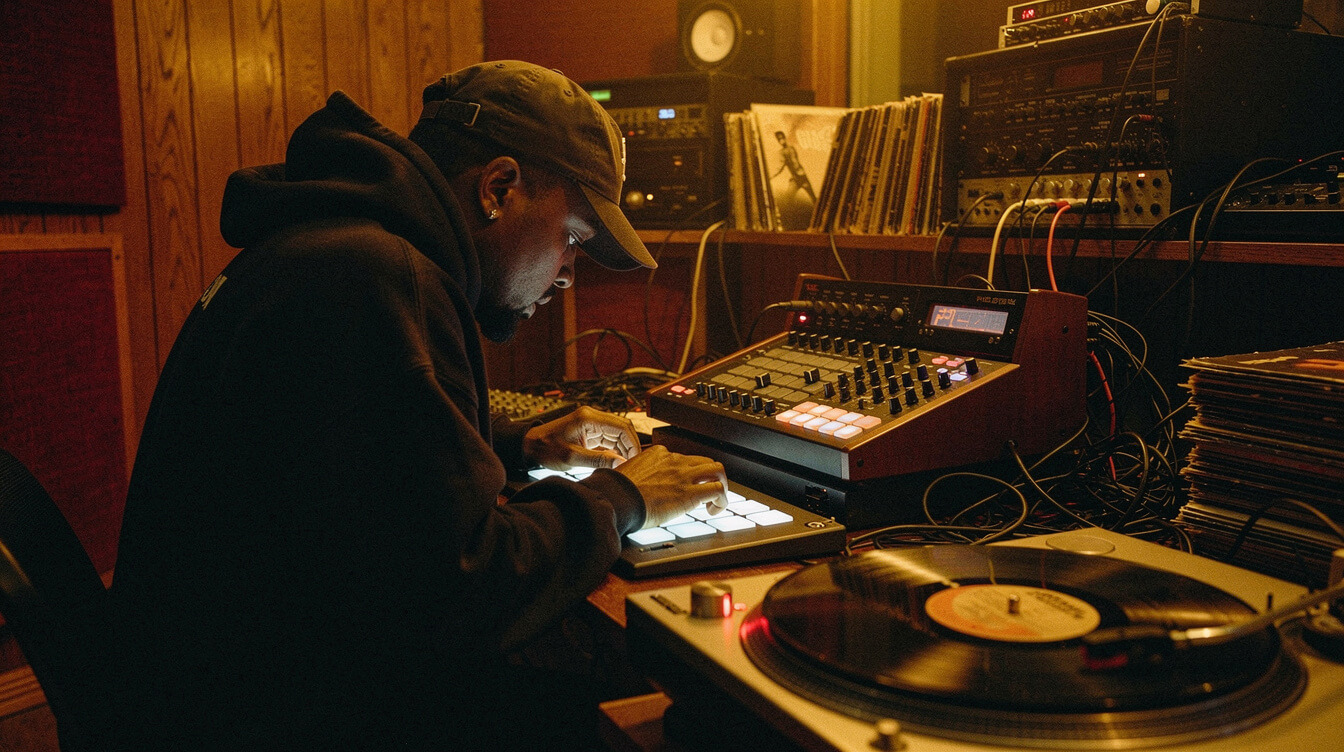
In the summer of 2001, Kanye West was a 24-year-old Chicago producer with a handful of placements — Foxy Brown, Beanie Sigel, some Harlem World cuts — and a hunger that Roc-A-Fella A&R Hip Hop and Jay-Z’s engineer Young Guru describe as “he would sleep on the studio couch and just wait for someone to skip a session.” Damon Dash famously didn’t want him signed as a rapper. Nobody wanted him signed as a rapper for another three years. But Jay-Z liked the beats — specifically, the way Kanye chopped up soul records and sped them up until the singer’s voice sounded like a Chipmunk chorus with grown-man weight underneath.
Kanye produced four full tracks on The Blueprint: “Takeover,” “Izzo (H.O.V.A.),” “Heart of the City (Ain’t No Love),” and “Never Change.” That’s a third of the album’s twelve tracks. Every single one of them became a career-defining Jay moment. “Izzo” flipped the Jackson 5’s “I Want You Back” and became Jay’s first genuinely radio-friendly top-ten hit — the record he’d been trying to make since Vol. 3. “Heart of the City” chopped Bobby “Blue” Bland’s “Ain’t No Love in the Heart of the City” into a Sunday-morning church loop that Jay rode with career-best restraint. “Never Change” sampled David Ruffin’s “Common Man” and became Jay’s most transparent autobiographical single of the era. And “Takeover” — well, we’ll get to Takeover.
What Kanye did on The Blueprint wasn’t just produce four songs. He installed a sonic template. Prior to 2001, chopped-soul-sample production existed — Diamond D, RZA, and Pete Rock had all worked in that lane through the ’90s — but nobody had done it at Kanye’s speed (the vocal sample pitched up an octave and clipped to eighth-notes) or with his taste for late-’60s Motown and early-’70s Philly soul. Every producer working in mainstream hip-hop between 2002 and 2007 studied these four beats. Just Blaze admitted it. Nine Inch Nails’ Trent Reznor cited it in an interview. Alchemist has said in podcast interviews that Kanye’s Blueprint work “made me delete a hard drive and start over.” When College Dropout finally arrived in February 2004, everyone who mattered in hip-hop had already been listening to Kanye West for three years.
Just Blaze’s Four Bangers: Girls, U Don’t Know, Song Cry, Blueprint
If Kanye got the launch pad, Justin “Just Blaze” Smith got the throne. Blaze produced four tracks on The Blueprint — “Girls, Girls, Girls,” “U Don’t Know,” “Song Cry,” and “Blueprint (Momma Loves Me)” — and his contribution is what kept the record from feeling like a Kanye demo tape. Where Kanye chopped soul into sped-up sunlight, Blaze chopped it into cinematic widescreen: slower loops, bigger drums, a keener ear for the emotional register of the source material.
“Girls, Girls, Girls” flipped Tom Brock’s “There’s Nothing in This World That Can Stop Me From Loving You” and gave Jay a summer-2001 chart hit that never got the platinum single treatment it deserved — the Q-Tip and Slick Rick co-writes on the outro alone would have made it a classic. “U Don’t Know” chopped Bobby Byrd’s “I’m Not to Blame” into two-and-a-half minutes of pure hustle-anthem menace; the drum programming on that track has been sampled or referenced by dozens of subsequent producers, including Just Blaze himself on a decade of Roc-A-Fella follow-ups. “Song Cry” flipped Bobby Glenn’s “Sounds Like a Love Song” and gave Jay his most emotionally exposed track of the era — the “I can’t see them coming down my eyes, so I gotta make the song cry” line has been quoted in ten thousand hip-hop essays and probably always will be.
The album’s title track, “Blueprint (Momma Loves Me),” was Blaze’s most personal contribution: an Al Green sample (“Sea Cruise”) warmed into a Marcy Projects family portrait, with Jay running through the entire cast of his mother, his father’s absence, his older brother, and the neighborhood elders who let a young Shawn Carter hustle in peace. It’s the album’s emotional keystone and it’s the reason the LP is titled what it is — the blueprint isn’t a business plan, it’s the family diagram.
Blaze recorded most of his Blueprint contributions at Baseline Studios in Manhattan, the Roc-A-Fella era hub that would remain hip-hop’s most important workroom through 2003. If you’ve ever wondered why so many mid-2000s East Coast records sound like they came from the same place — The Black Album, The Diplomatic Immunity, Get Rich or Die Tryin’, Reasonable Doubt-era reissues — it’s because they largely did.
DJ Premier & Bink: The Producers Who Didn’t Get Enough Credit
The Blueprint’s credit-split conversation almost always stops at Kanye and Just Blaze, and that’s a disservice to the two producers who bookended the record. DJ Premier — Gang Starr’s architect, Boom Bap’s founding father, and the man who had shaped Nas’s early sound on Illmatic — produced “So Ghetto,” track fourteen on the album’s original CD release (bonus track on some pressings). It’s a signature Premo cut: dusty vinyl chops, cutting on the hook, and Jay in his most classicist mode, name-checking Roc-A-Fella lieutenants over a beat that could have appeared on Reasonable Doubt five years earlier. Premier’s involvement was intentional continuity from Jay’s East Coast credibility era — he’d produced “D’Evils,” “Bring It On,” and “Friend or Foe” on Reasonable Doubt in 1996, and having him on Blueprint anchored the LP to that lineage even as Kanye’s soul-sample template pointed forward.
What makes Premier’s Blueprint contribution weight-bearing is timing: he was, at the moment of recording, also DJ’ing Nas’s Stillmatic sessions in the studio across town. When “Takeover” leaked in August 2001 and Nas began writing “Ether” as a response, Premier had to make a choice — and he chose to keep working with both. For a beefing hip-hop world, that positional neutrality mattered. It’s the reason Premier gets cited today as one of the few producers who survived the East Coast civil-war era without picking a side that would age poorly.
Then there’s Bink! — Roosevelt Harrell III, the Roc-A-Fella house producer whose two Blueprint contributions (“The Ruler’s Back” and “All I Need”) open and center the album. “The Ruler’s Back” is the LP’s opening statement, a Slick Rick “The Ruler’s Back” (1988) callback that Bink flips over a shimmering, mid-tempo loop with a proto-Kanye vocal chop on the outro. It’s arguably the most Blueprint-defining opener in Jay’s discography because it doesn’t try to be single; it announces a return to intentional, career-defining work. “All I Need” — a Michael D. Monroe sample flipped into a triumph-through-hardship loop — became the record’s most-slept-on cut. Ask any Roc-A-Fella era producer what track they wish more people talked about, and half of them will say “All I Need.”
Bink went on to produce for Beanie Sigel, Freeway, Cam’ron, and eventually Kendrick Lamar (yes — Bink co-produced “Institutionalized” on To Pimp a Butterfly, 14 years after Blueprint). His Blueprint work built the resume that carried him through two decades of East Coast production. He deserves more credit than the Kanye/Just Blaze binary usually leaves him.
Takeover vs Ether: The Nas Beef Timeline and the Prodigy Diss
“Takeover” is track two on The Blueprint. It’s the record’s second single and it’s the moment Jay-Z declared open war on both Nas and Prodigy of Mobb Deep in the same three-minute cut, over a Kanye West beat that samples The Doors’ “Five to One” flipped with a KRS-One vocal chop on the intro. The song’s structural elegance is that it takes down Prodigy in the second verse and Nas in the third, escalating in real time.
The Prodigy verse — “I don’t care if you Mobb Deep, I hold triggers to crews / You little f**k, I got money stacks bigger than you” — was the opening salvo of a beef that had been simmering since 1996. Jay flashed a picture of a young Prodigy in dance-class attire during the “Takeover” live performance at Summer Jam 2001, which is the moment most hip-hop heads point to as the beef going public. Prodigy has since said in multiple interviews that the beef never recovered its air; he attempted responses on Infamy (2001), but they never gained the cultural traction of a proper diss track. If you want the Mobb Deep counterpoint to the era, the flagship record is still The Infamous — the 1995 debut that established Havoc’s dusty-piano signature and Prodigy’s whispered menace as the sonic template Jay was attacking on Blueprint.
If you’re building a hip-hop wardrobe around the East Coast civil war era, the Mobb Deep The Infamous T-Shirt is the Queensbridge counter-statement to a Roc-A-Fella closet — the record that Prodigy always pointed back to when questions about his catalog came up, and the visual reminder of why the Takeover diss stung in the first place.
The Nas verse is the more historically consequential half. Jay went after Nas for artistic decline (“Because you know who did you know what / With you know who / But just keep that between me and you”), for allegedly sleeping with Carmen Bryan (mother of Nas’s daughter, whom Jay had also been involved with), and for what Jay framed as a fraudulent “God” persona built on one classic album (Illmatic) and diminishing returns thereafter. It was surgical. It was ugly. And it forced Nas’s hand.
Nas’s response — “Ether,” released on Stillmatic in December 2001 — is the reason The Blueprint sits in a two-record conversation for its entire life. The word “ether” entered hip-hop vocabulary as a verb meaning “to destroy in a diss.” Radio call-in polls ran for months debating who won. Most hip-hop writers now agree Nas won the battle on “Ether” but Jay won the war by outproducing and outselling him through the mid-2000s. Either way, the Takeover-Ether exchange became the most-studied hip-hop beef of the modern era, and it started on track two of Blueprint.
The Soul-Sample Template: How Blueprint Rewired Mid-2000s Hip-Hop Production
Before Blueprint, mainstream hip-hop production in 2001 was fragmented across three dominant lanes: Timbaland‘s syncopated bounce (Aaliyah, Missy Elliott, Jay-Z’s own “Hola’ Hovito” on this LP), The Neptunes‘ minimalist synth funk (Clipse, Jay-Z’s Dynasty era), and the fading Trackmasters radio formula (still present on Blueprint’s “Jigga That N***a”). None of those approaches sampled soul records the way Kanye and Just Blaze were about to. What Blueprint did was demonstrate, over the course of one platinum LP, that you could build an entire record around chopped-and-sped-up soul loops without any track feeling like a novelty.
The influence radiated outward almost immediately. Consider the sample-driven records that dropped in 2002-2004 in Blueprint’s wake: Nas’s God’s Son, Ghostface’s The Pretty Toney Album, Common’s Be, Kanye’s College Dropout, Talib Kweli’s The Beautiful Struggle, and Little Brother’s The Listening and The Minstrel Show. Every one of those records has at least three tracks built on the Blueprint’s soul-chop template. By 2004, the template had become so dominant that The Roots — a band that plays live instruments — released The Tipping Point as a partial pushback, arguing that live musicianship still had a place in hip-hop.
The template’s saturation ended around 2006, when Kanye himself pivoted away from it on Late Registration (orchestral arrangements) and Graduation (electronic synth), and when the Southern hip-hop wave (Lil Wayne’s Tha Carter II, T.I.’s King, Young Jeezy) shifted mainstream ears toward drum-heavy trap production. But the five years between 2001 and 2006 belong to Blueprint’s ghost. Any producer trying to sound like “classic New York” during those years was, whether they said it out loud or not, chasing what Kanye and Blaze had built for Jay.
The template also revived a specific crate-digging discipline that had been fading through the late ’90s. Sample clearance costs had spiked after the Bridgeport Music v. Dimension Films decision in 2005, but before that, Blueprint’s success sent producers back into ’60s and ’70s soul catalogs in a way that mirrored the Golden Age dig culture of the early ’90s. If you were shopping vinyl at A-1 Records in the East Village in 2003, you were competing with production teams for the same Bobby Byrd and Ann Peebles LPs Jay’s team had already flipped.
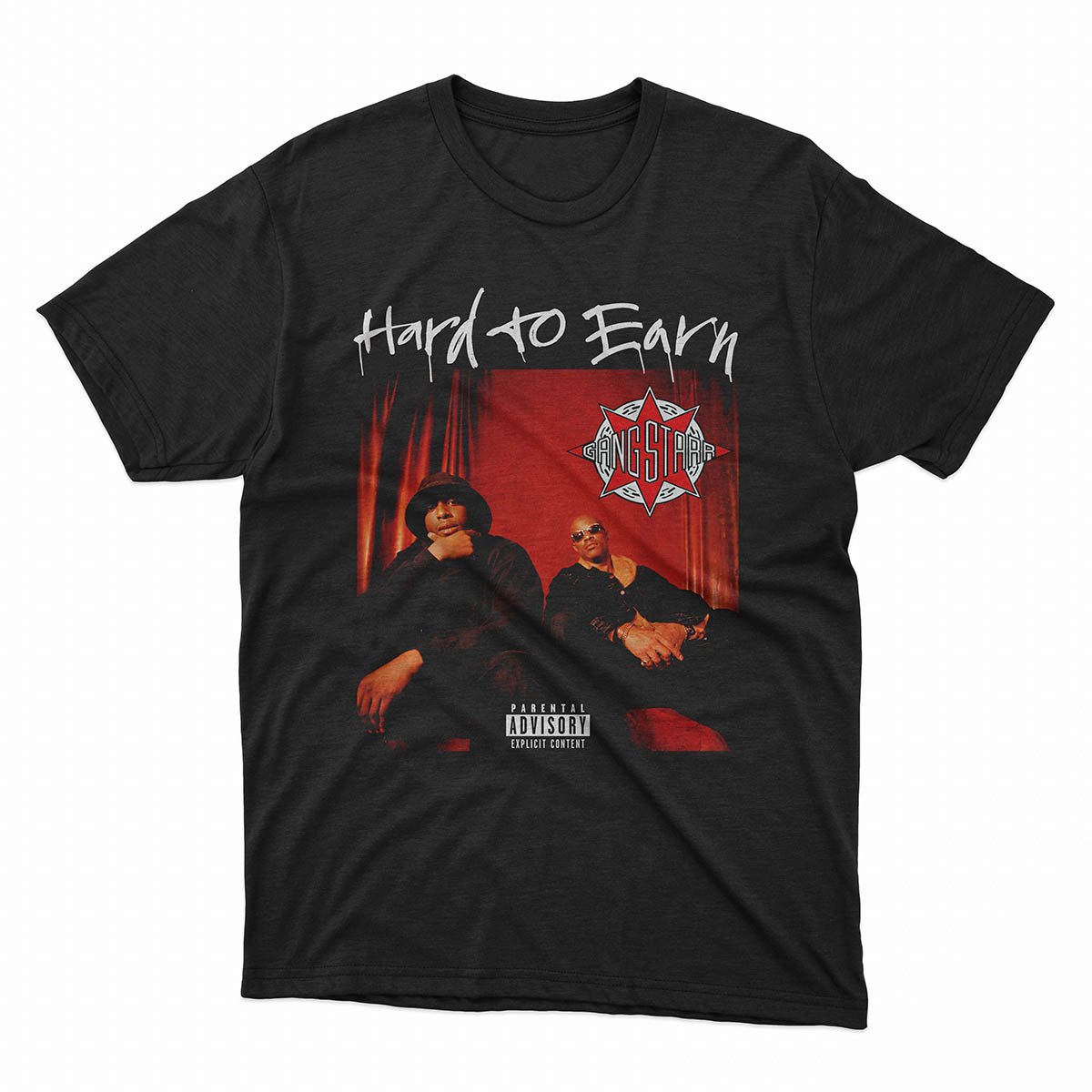
The Boom Bap production ethic that Blueprint amplified had older architects — chief among them DJ Premier, whose Gang Starr catalog remains the ur-text for East Coast sample-based hip-hop. If you want to trace the Blueprint template back to its source, the Gang Starr Hard to Earn T-Shirt is a wardrobe move that says you know where the soul-chop template really started. Premier was Jay’s connection to that lineage; his “So Ghetto” contribution on Blueprint is a direct handoff from the 1994 Boom Bap era to the 2001 Roc-A-Fella era.
Wear the Blueprint’s Producer Lineage
DJ Premier produced “So Ghetto” on Blueprint — but the soul-chop template started with Gang Starr’s Hard to Earn in 1994. Wear the record that Kanye and Just Blaze were studying seven years before Blueprint dropped.
Twenty-Five Years Later: Blueprint’s Place in the Hip-Hop Canon
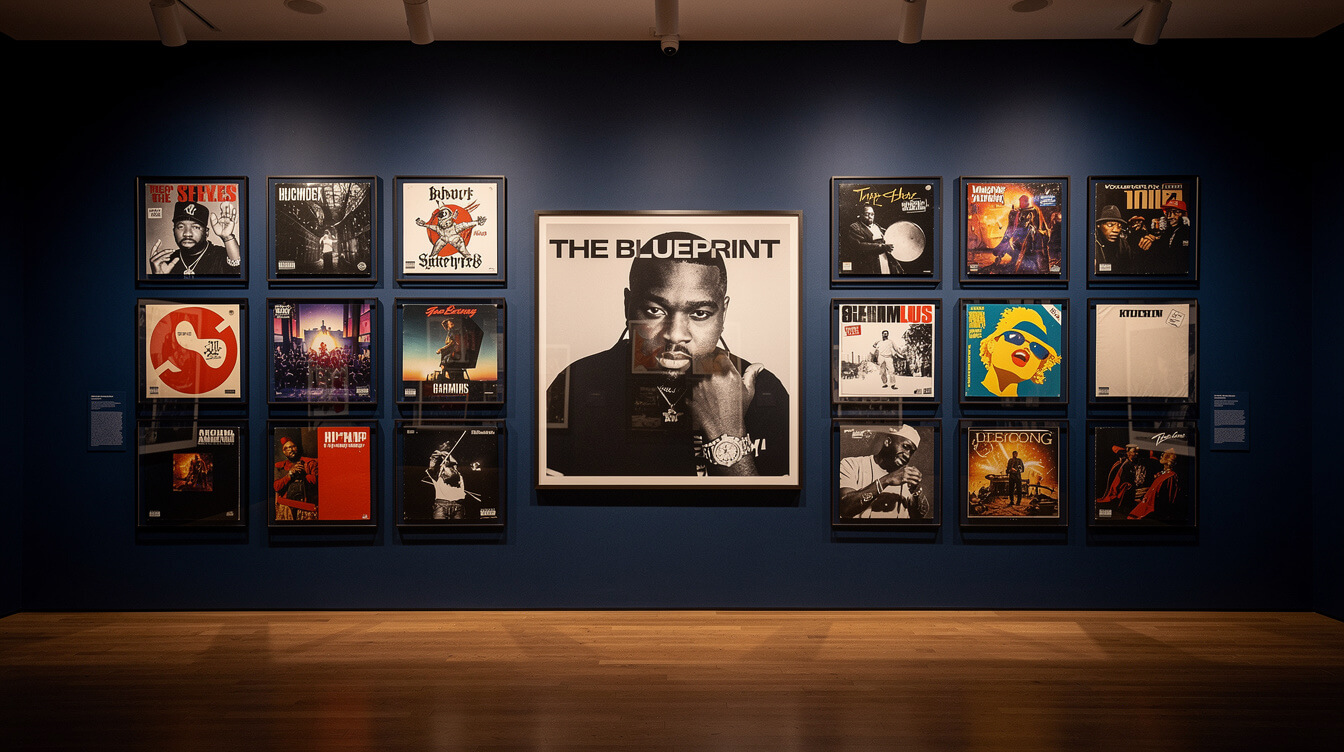
Where does Blueprint sit twenty-five years after its release? Rolling Stone put it at #50 on the 2020 “500 Greatest Albums of All Time” revision — behind Illmatic (#44) and Wu-Tang’s Enter the 36 Chambers (#28), but ahead of every other Jay-Z release. Apple Music placed it at #13 on the 100 Best Albums list published in 2024, making it the highest-ranked Jay-Z album on that particular chart. Pitchfork retroactively bumped it to their top ten of the 2000s. The Library of Congress added it to the National Recording Registry in 2021 — the twentieth-anniversary induction confirming its status as a culturally significant American recording.
What Blueprint isn’t: it isn’t Reasonable Doubt (Jay’s most beloved album, ranked higher by every crate-digging critic), it isn’t The Black Album (his most commercially successful farewell), and it isn’t 4:44 (his most personally accountable late-career work). What Blueprint is, and what nothing else in Jay’s catalog can claim, is the pivot record — the album that took him from being one of several top-tier East Coast rappers to being the singular voice of a new production era. Every subsequent Roc-A-Fella release, every Kanye West album from College Dropout through My Beautiful Dark Twisted Fantasy, and half the East Coast hip-hop released between 2002 and 2007 owes something to Blueprint’s template.
It’s also the album that gave hip-hop a public argument about lineage. The Takeover-Ether exchange forced a generation to pick a side, and that argument — Nas vs. Jay-Z, lyricism vs. commercial dominance, poet vs. mogul — became the framework hip-hop used for another decade to debate what mattered in the art form. Kendrick vs. Drake in 2024 was the Takeover-Ether descendant, whether either party admitted it or not.
Twenty-five years on, released on the morning history stopped in America, The Blueprint is the record Jay-Z made when he was trying to prove he was still the best rapper alive — and ended up handing the next twenty years of hip-hop production its master template instead. On September 11, 2026, when the anniversary hits, put the record on. Not for the anniversary. For the receipts.
Frequently Asked Questions
Who produced most of The Blueprint?
Kanye West produced four tracks (Takeover, Izzo (H.O.V.A.), Heart of the City, Never Change) and Just Blaze produced four tracks (Girls Girls Girls, U Don’t Know, Song Cry, Blueprint). Bink produced two tracks (The Ruler’s Back, All I Need). Timbaland produced Hola’ Hovito. Trackmasters produced Jigga That N***a. DJ Premier produced the bonus track So Ghetto. Eminem produced Renegade (with Luis Resto).
Is The Blueprint Jay-Z’s best album?
Depends on your criteria. Reasonable Doubt (1996) is more beloved among lyricism-first fans and crate-diggers. The Black Album (2003) is the most commercially successful and features Jay at his farewell-tour best. 4:44 (2017) is his most personally accountable late-career work. Blueprint sits between them as the pivot record — the album that established the template every subsequent Jay-Z LP would refer back to.
Why did Jay-Z release The Blueprint on September 11, 2001?
The release date had been set for September 18 but was pushed up a week to combat bootlegging after an early version leaked in August. The final September 11 date was decided months in advance, purely for commercial reasons. No one at Roc-A-Fella could have anticipated the events of that morning.
Who won the Takeover-Ether beef?
Most hip-hop writers now agree Nas won the individual battle on “Ether” (December 2001), which is why “ether” entered hip-hop vocabulary as a verb meaning to destroy in a diss. Jay-Z won the longer war by outproducing and outselling Nas through the mid-2000s. The beef officially ended when Jay and Nas performed together at the “I Declare War” concert in October 2005.
What samples are on The Blueprint?
Highlights: “Takeover” samples The Doors’ “Five to One” and KRS-One. “Izzo (H.O.V.A.)” samples the Jackson 5’s “I Want You Back.” “Heart of the City” samples Bobby “Blue” Bland’s “Ain’t No Love in the Heart of the City.” “Girls, Girls, Girls” samples Tom Brock’s “There’s Nothing in This World That Can Stop Me From Loving You.” “U Don’t Know” samples Bobby Byrd’s “I’m Not to Blame.” “Song Cry” samples Bobby Glenn’s “Sounds Like a Love Song.” “Blueprint (Momma Loves Me)” samples Al Green’s “Sea Cruise.” “Never Change” samples David Ruffin’s “Common Man.”
Final Thoughts: Put the Record On
The Blueprint didn’t need to become the most quietly influential hip-hop record of the 2000s. It just needed to be the best Jay-Z album of 2001. The fact that it did both — launched Kanye West, buried Nas hard enough to force “Ether,” and installed the soul-chop template every East Coast producer would chase for five years — is what makes it worth revisiting on the 25th anniversary. Rank it wherever you want in Jay’s discography. It doesn’t matter. What matters is that when you put the record on, you can hear the exact moment mid-2000s hip-hop was designed. Kanye’s first chorus on “Izzo” is that moment. Just Blaze’s first drum crack on “U Don’t Know” is that moment. Bink’s opening flip on “The Ruler’s Back” is that moment.
September 11, 2026 will pass with the anniversary coverage it deserves — a wave of listicles, retrospective mixes, and Nas vs. Jay-Z think pieces. Skip most of it. Put the record on instead. Track by track, twenty-five years later, it still sounds like a producer’s clinic and a lyricist’s finishing move at the same time.
Stay creative — The Custom Creative Team
Get the Culture in Your Inbox
Album anniversary breakdowns, producer credit deep dives, and merch drops — no fluff, just the receipts.

🎧 Never Miss a Drop
Exclusive product releases, hip-hop deep dives, and member-only discounts. Straight to your inbox.
Free forever. No spam. Unsubscribe anytime.
Get the Culture, Delivered
Deep dives into hip-hop history, exclusive product drops, and discounts sent straight to your inbox. No spam, just culture.
Join 2,000+ hip-hop heads already in the loop. Unsubscribe anytime.