Wu-Tang Clan 36 Chambers Album: The $300 Debut That Flipped New York Hip-Hop
The first Wu-Tang Clan 36 Chambers album session cost $300, paid mostly in quarters, in a walk-in-closet booth with a sock zip-tied over the microphone as a pop filter. The most influential rap debut of the 1990s was tracked on hand-me-down gear by a producer who built the beats on a trade-in Ensoniq sampler — and three decades later, the album still dictates how an entire culture dresses, identifies, and signs its name. Enter the Wu-Tang (36 Chambers) didn’t just flip New York hip-hop overnight; it gave the genre a uniform, a cipher, and a master plan.
This is the complete story — the $300 budget, the broken Ensoniq, the masked synagogue cover, the Five-Percent Mathematics encoded in the title, the nine-MC cast RZA conducted like a Shaolin sword school, and the contested 4x-Platinum receipts the official Wu-Tang store still gets wrong. We use Pitchfork’s retrospective for the production lore, RZA’s own Vanity Fair breakdowns for the kung-fu sample map, RIAA + Wikipedia for the certification truth, and Masta Killa’s NME quote for the “dream team” framing. Read it once and you’ll never hear “Bring da Ruckus” the same way again.
A $300 Debut: How 36 Chambers Flipped New York Hip-Hop in 1993

Released November 9, 1993 on Loud/RCA, Enter the Wu-Tang (36 Chambers) arrived in a year that should have buried it. Dr. Dre’s The Chronic had been chart-anchoring G-funk for a full year. Snoop Doggy Dogg dropped Doggystyle twelve days after the Wu album. A Tribe Called Quest released Midnight Marauders on the same day. The West Coast owned the airwaves, the Native Tongues owned the critics, and a nine-man crew from Staten Island — a borough most New Yorkers treat as a punchline — had no business interrupting either conversation.
What hit the streets instead was an album with the texture of a bootlegged kung-fu VHS and the strategy of a chess endgame. RZA had set himself a personal five-year plan: take over hip-hop by force, on his own production, with his own crew, on his own terms. The Wu-Tang Clan 36 Chambers album was the opening move. Critics noticed immediately. Rolling Stone reviewed it warmly that year, but it was the slow burn that mattered — The Source would later give it a five-mic retrospective, Apple Music ranks it #37 of all time, and Pitchfork eventually re-scored it a perfect 10. The album didn’t chase the moment. It rerouted it.
The deeper context matters. In late 1993, hip-hop’s commercial future looked like Snoop’s slow drawl and Dre’s synth glide. East Coast lyricism had become identified with Nas’s laser-cut interiority on the singles building toward Illmatic, or with the polished smoothness of Tribe. Nobody was pushing for raw, deliberately ugly, gang-vocal hip-hop with film dialogue stitched between every verse. RZA built the entire 36 Chambers aesthetic to reject the polish. The lo-fi hiss wasn’t a budget problem. It was the brand.
Inside the Firehouse Sessions: Broken Gear, a Sock-on-a-Hanger Mic, and the Most-Copied Sound in Rap

Pitchfork’s retrospective remains the only major publication that took the time to log the production receipts in detail, so we lean on it directly here. The first sessions for 36 Chambers happened at Firehouse Studios — Pitchfork says Brooklyn; Wikipedia simply locates Firehouse “in New York City,” with several secondary sources placing it in Manhattan. We flag the disagreement rather than fabricate certainty. What is not in dispute is the room: a closet-sized vocal booth, low ceiling, no acoustic treatment, a sock zip-tied to a hanger as the pop filter.
RZA’s sampler was an Ensoniq EPS he had traded from RNS of the U.M.C.’s. It was bruised, it dropped audio mid-loop, and it had limited polyphonic memory. The snare on “Bring da Ruckus” was famously rumored to be sampled off a paint bucket. The “C.R.E.A.M.” piano loop — the most replayed sample in 1990s hip-hop — came from The Charmels’ 1967 Stax single “As Long as I’ve Got You,” chopped and slowed on that same broken EPS. The accidental tape-reel splice at the front of “C.R.E.A.M.” — that ghostly preamble before the piano hits — was, by RZA’s own admission in interviews, an artifact of cheap reels stitched together because the studio couldn’t afford fresh stock.
The first session paid roughly $300, much of it in quarters. Ghostface Killah has gone on record saying he shoplifted canned goods during the sessions to feed the crew. Method Man got arrested for weed possession the same day the album cover was shot. U-God was incarcerated for the entire making of the album — which is exactly why only six of the nine members appear on the masked-synagogue front cover (more on that in a moment). When people call 36 Chambers a “raw” album, they mean it literally: there was no money for polish, no money for retakes, no money for the second-string takes most engineers would have spliced in.
What RZA built out of those constraints is the foundational template for an entire production school. Every DJ Premier dust-loop record after 1994, every El-P + Mr. Dibbs SP-1200 grind, every Madlib basement-tape aesthetic, every Griselda + Daringer record built in the last five years — all of them descend, directly or indirectly, from what RZA committed to tape in that closet booth. The Wu-Tang Clan 36 Chambers album sound was so widely copied so fast that by 1996 it had become its own subgenre.
The Code: Kung-Fu Samples, Five-Percent Mathematics, and the Masked Synagogue Cover
The title is a math problem. RZA’s own answer, given in multiple interviews: nine members, each with four chambers of the heart, equals 36. That’s Five-Percent Nation Supreme Mathematics — the numerological framework Wu-Tang members study and reference openly — hiding in plain sight. The “Enter the” half is a sandwich of two kung-fu film titles: Bruce Lee’s Enter the Dragon and the lesser-known 1983 Shaw Brothers film Shaolin and Wu Tang, which is also the single most-sampled film on the record.
Film dialogue appears on seven of the thirteen tracks. Shaolin and Wu Tang alone shows up on six of those seven. RZA breaks the sample map down himself on camera for Vanity Fair, walking through each cue. Other films pulled into the album: The 36th Chamber of Shaolin (1978), Executioners from Shaolin, Five Deadly Venoms, Ten Tigers from Kwangtung. These aren’t decoration. RZA structured the album around them — the “tiger style, snake style, shame on you” cipher that opens the record is lifted whole from Shaolin and Wu Tang, and the album’s entire mythology (chambers, swords, masters, exiles) is read through that 1983 film’s plot.
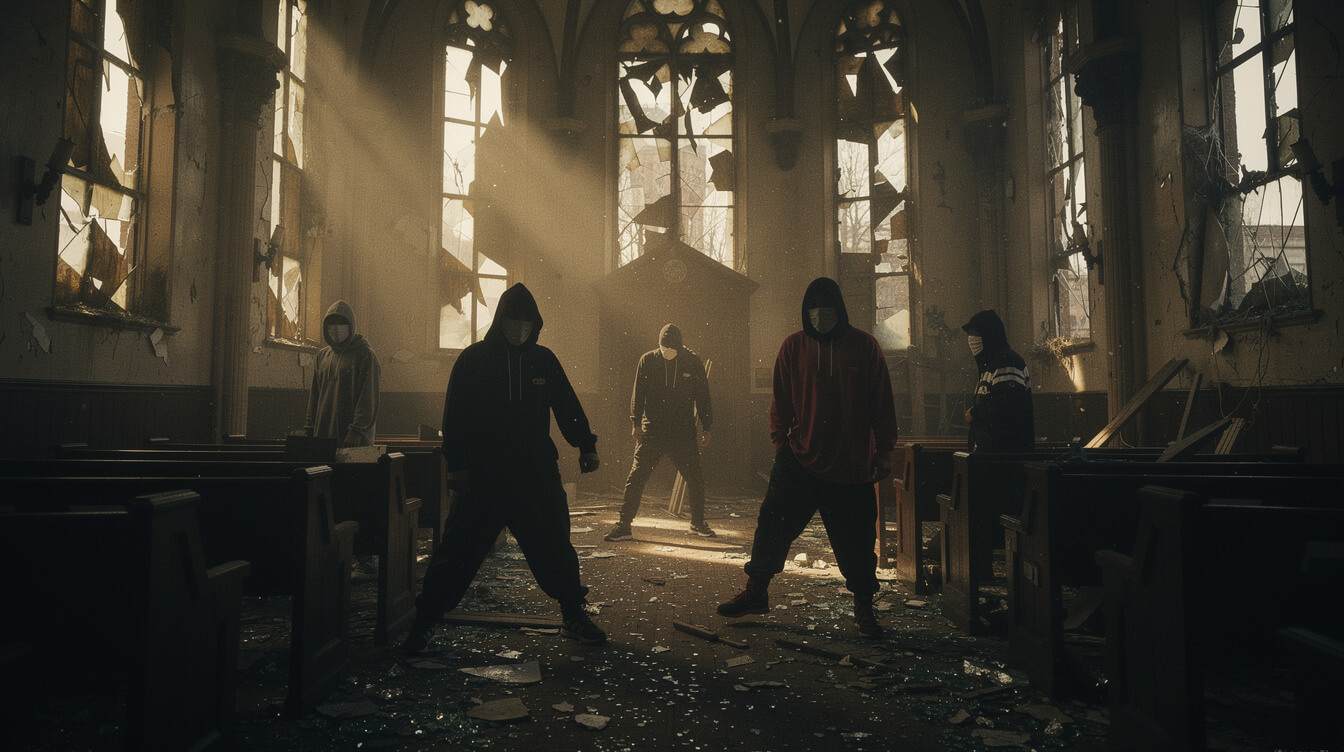
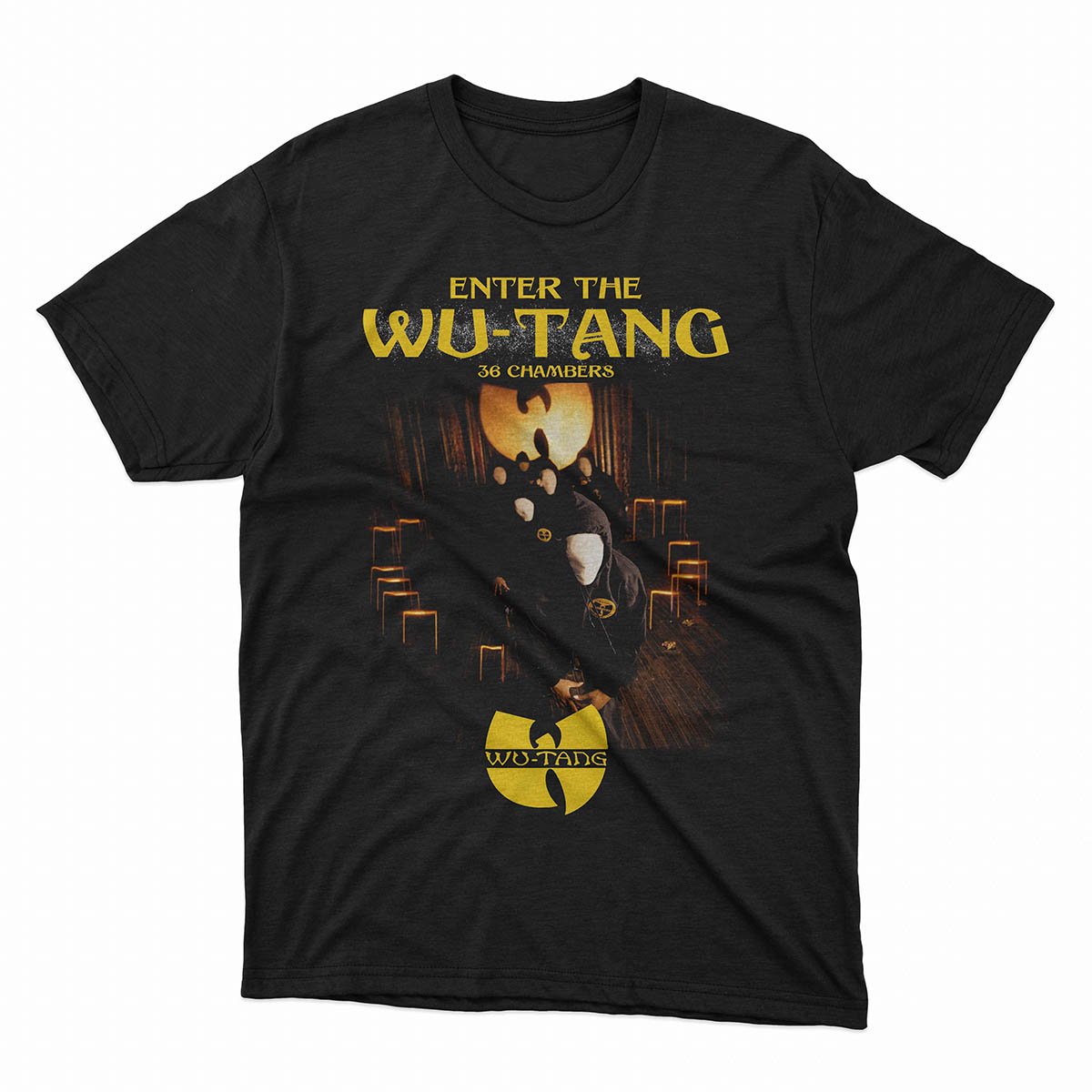
Then there is the cover. The widely circulated front photograph shows six masked figures inside an abandoned, broken-windowed building — a gutted synagogue in Staten Island, identified in interviews and Wikipedia. Only six members appear because U-God was incarcerated and Method Man was elsewhere that day. The masks were Halloween-aisle props. The cover image is, in other words, an accident of who made bail. And yet it became, almost instantly, the visual shorthand for the entire Wu-Tang aesthetic — masked figures, ruined sacred space, six instead of nine, the math half-finished. It reads like a story problem you have to solve to enter.
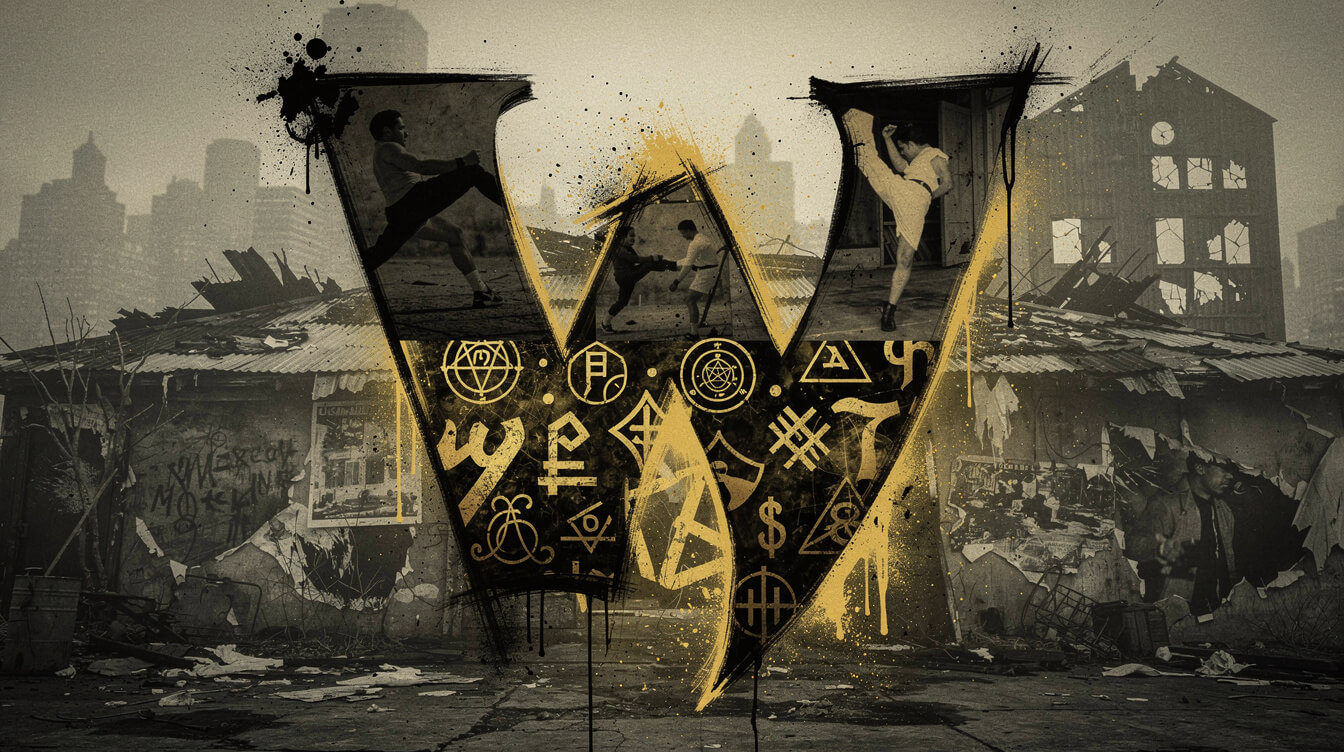
This is where the Wu-Tang Clan 36 Chambers album stops being a thing you stream and starts being a thing you wear. The masked-synagogue cover, the Mathematics W (a different logo we trace in our Wu-Tang Clan hat guide), the “tiger style” intro — all of it is iconography that escaped the album sleeve and became identity. We made an Enter The Wu-Tang (36 Chambers) tee that carries that exact gutted-synagogue energy — the cover as something you put on, not just play. If you cut your teeth on this album, you already know why the front cover deserves to live on a chest, not just a streaming thumbnail.
Nine MCs, One Weapon: How RZA Cast and Conducted the Wu-Tang Clan
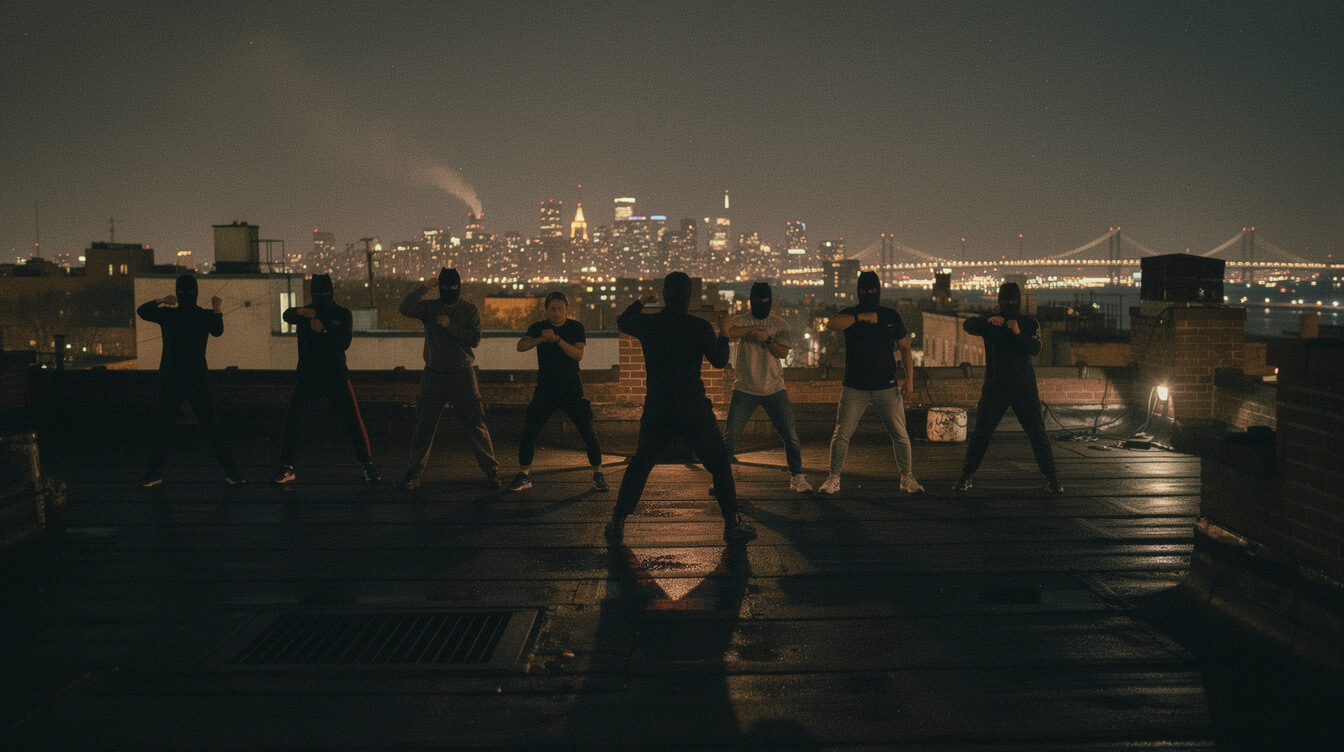
The nine-MC lineup is RZA’s greatest casting decision and his hardest production constraint. Masta Killa, the youngest of the crew, has talked in NME interviews about RZA explicitly building a “dream team” — picking each member for a distinct vocal personality, then training them to operate as a single weapon. For the full roster, including each MC’s real name, alias history, and role inside the group, see our breakdown of Wu-Tang Clan members’ real names.
The casting logic on the album is visible in a single track: “Protect Ya Neck.” Eight MCs trade verses with almost no hook, no chorus repetition, no production interlude. The verses are short. The handoffs are abrupt. Inspectah Deck opens with the technical, multi-syllabic warning shot. Raekwon brings the streetwise mafioso. U-God leans into the rumble. Method Man closes with the chorus-as-victory-lap. Every voice is identifiable in seconds. This was not an accident — RZA insisted on vocal contrast as a casting rule, the same way Shaw Brothers cast Five Deadly Venoms with one fighter per element.
The album also seeded the solo era that defined East Coast hip-hop from 1994 to 1997. Method Man’s own track on the album, with its instantly memorable hook, set up his solo debut Tical — which we dig into in our Method Man Tical retrospective. “Can It Be All So Simple” did the same for Raekwon and Ghostface, setting up Only Built 4 Cuban Linx and eventually Ironman; we cover the back end of that arc in our Ghostface Killah Ironman piece. Inspectah Deck’s lyrical role on 36 Chambers previewed the solo work we trace in Inspectah Deck Uncontrolled Substance. The Wu solo cluster is, in effect, a single nine-album expansion of 36 Chambers.
The Receipts: 4x Platinum, the Cert Resolved, and the Chart Numbers Everyone Mis-Quotes

Here is where the public record needs cleaning up. The Wu-Tang Clan 36 Chambers album sits at one of hip-hop’s biggest contested-cert moments. The official Wu-Tang store, several boilerplate label bios, and a chunk of secondary online copy still describe the album as “triple platinum” or “3 million units sold.” The RIAA upgraded the certification, and both Wikipedia and the RIAA database now list it as 4x Platinum (4,000,000+ US units). We resolve it bluntly: the “3 million” figure is stale. The 4x-Platinum cert is the current, RIAA-verified number.
Chart performance on release was respectable, not explosive. The album debuted at #41 on the Billboard 200 and peaked at #41 — the kind of mid-table chart line that, for a less culturally durable record, would have been forgotten. The slow burn matters more. By 1995, after Method Man and Raekwon’s solo records had detonated the brand, 36 Chambers went Gold. Platinum followed. The 2x, 3x, and finally 4x certifications accreted over the next twenty-five years.
“C.R.E.A.M.” was the commercial anchor — it reached #60 on the Billboard Hot 100, a number that looks modest until you remember the song has since become the most-streamed Wu track, the most-read Wu lyric on Genius (over 2.5 million annotations), and the line “cash rules everything around me” enters Oxford English Dictionary territory as a cultural idiom. “Method Man” charted at #69. “Can It Be All So Simple” did not chart highly on initial release but became one of the most-sampled lines in 1990s and 2000s R&B (Mariah Carey’s “Fantasy” Remix, among many others).
One last receipt that gets misquoted: track count. The original 1993 album runs 13 tracks, opening with “Bring da Ruckus” and closing on “Wu-Tang: 7th Chamber – Part II / Conclusion.” Expanded editions and the 30th-anniversary deluxe push streaming listings to 15 with bonus material. If you’re digging in vinyl crates, the original 1993 13-track edition is what you’re looking for — anything labeled “15 tracks” is an expanded pressing.
The Master Plan and the Afterlife: How One Album Became an Industry Takeover That Still Dictates Hip-Hop in 2026

RZA’s contract with Loud/RCA contained the most famous clause in hip-hop business history: each Wu-Tang member retained the right to sign individual solo deals with any other label. Wu-Tang Productions, the RZA-controlled umbrella, took a stake in those solo records (reported widely at around 50% on production, with additional clawback on solo earnings). The label structure was deliberately fractured — Method Man signed to Def Jam, Raekwon stayed on Loud, Ghostface to Razor Sharp/Sony, GZA briefly to Geffen, Ol’ Dirty Bastard to Elektra. By 1995, Wu-Tang had a foothold inside six major-label distribution machines simultaneously.
The strategic effect was lethal. When Method Man went platinum, RZA’s production fingerprint was on Def Jam radio rotation. When Raekwon’s Only Built 4 Cuban Linx dropped, the entire mafioso-rap subgenre was born — Nas, Mobb Deep, AZ, and the entire Roc-A-Fella opening salvo are downstream of that template. By the time the group released Wu-Tang Forever in 1997 as a double album that debuted at #1 (a feat almost impossible for a non-pop release in that era), Wu-Tang had effectively reorganized the East Coast major-label economy around itself.
The afterlife is the part that matters in 2026. The Wu-Tang Clan 36 Chambers album is the only major-label hip-hop debut whose visual language is now culturally inseparable from the record itself. The Mathematics W appears on murals, tattoos, sneaker collabs, anime crossovers, video game cameos, and Tokyo streetwear racks. The masked-synagogue cover is referenced in Travis Scott visuals, in Griselda album rollouts, in countless music-video set designs. The album’s influence on production is so total that 50% of the 2020s lo-fi rap underground (Roc Marciano, Mach-Hommy, Westside Gunn, Mike, Earl Sweatshirt, Navy Blue) is openly working in a RZA-descended sample-and-grit aesthetic.
This is the part the SERP misses. Every other write-up on this album treats it as either an encyclopedia entry or a Spotify checkout page. The truth is that the Wu-Tang Clan 36 Chambers album never stopped being a wearable cultural object — which is why we built our Wu-Tang Clan merch guide around authenticity, iconography, and vintage investment value rather than “where to buy a generic tee.” For specific gift use cases — birthday, anniversary, holiday — the curated Wu-Tang Clan gifts roundup pairs the iconography with intent.
Frequently Asked Questions
What is the 36 Chambers album?
Enter the Wu-Tang (36 Chambers) is the Wu-Tang Clan’s debut studio album, released November 9, 1993 on Loud/RCA. It was produced, arranged, mixed, and programmed almost entirely by RZA and is widely regarded as one of the greatest, most influential hip-hop albums ever made (Apple Music ranks it #37 of all time; Pitchfork rates it a perfect 10).
What does “36 Chambers” actually mean?
RZA’s own math: nine members, each with four chambers of the heart, equals 36. It also nods to the 1978 kung-fu film The 36th Chamber of Shaolin and Five-Percent Nation Supreme Mathematics. The “Enter the” half comes from Enter the Dragon and Shaolin and Wu Tang.
How many songs are on 36 Chambers?
The original 1993 album runs 13 tracks, opening with “Bring da Ruckus” and closing on “Wu-Tang: 7th Chamber – Part II / Conclusion.” Expanded and 30th-anniversary editions add bonus material, which is why some streaming listings show 15.
Is 36 Chambers platinum?
Yes — and bigger than a lot of listings admit. The RIAA has certified it 4x Platinum (4,000,000+ US units). Older copy, including the official Wu-Tang store, still says “triple platinum” or “3 million,” which is simply out of date.
Who produced 36 Chambers?
RZA, top to bottom — with a co-production credit to Ol’ Dirty Bastard on “Da Mystery of Chessboxin'” and Method Man on “Wu-Tang Clan Ain’t Nuthing ta F’ Wit.” He built the beats on a traded-for Ensoniq EPS sampler in a cramped, cheap studio.
What kung-fu movies were sampled on 36 Chambers?
Film dialogue appears on 7 of the 13 tracks. Shaolin and Wu Tang shows up on six of them; others include The 36th Chamber of Shaolin, Executioners from Shaolin, Five Deadly Venoms, and Ten Tigers from Kwangtung. RZA breaks several of these down himself on camera for Vanity Fair.
What’s the best song on 36 Chambers?
By chart impact and listener pull, “C.R.E.A.M.” leads — the group’s biggest single (Hot 100 #60) and its most-read lyric on Genius (2.5M+ annotations), trailed by “Protect Ya Neck,” “Method Man,” and “Da Mystery of Chessboxin’.”
Is 36 Chambers the rarest or “forbidden” Wu-Tang album?
No. That tag belongs to Once Upon a Time in Shaolin, the single-copy album sold as a one-of-one art piece. 36 Chambers is the opposite — one of the most widely owned, most bootlegged, most-worn albums in rap history, which is exactly why its imagery became wearable culture.
Final Thoughts
Three decades on, the most underrated thing about the Wu-Tang Clan 36 Chambers album isn’t the production lore, the chart receipts, or even the kung-fu sample map — it’s how completely the record refused to age. RZA’s closet-booth tape hiss still sounds like the future to the generation building rap in 2026. The Mathematics W is more recognizable than most national flags. And the masked-synagogue cover keeps escaping the album sleeve, landing on murals, tattoos, and clothing racks in cities the original nine MCs never toured.
If the album taught hip-hop anything, it’s that a culture survives by being wearable. Not “merchandise” — culture, carried. 36 Chambers was the first major-label hip-hop debut to encode an entire visual philosophy alongside the music, and that’s why the iconography still moves three decades later. The album is the blueprint. The cover is the uniform. The Mathematics W is the signature. Everything else is style.
Carry the 36 Chambers Myth
The masked-synagogue cover on a black tee. Not a generic Wu logo — the album image that made the W an identity. The cover as something you wear, not just stream.
Stay in the Cipher
Cultural deep-dives like this one, drops, and the occasional Wu-related receipt — straight to your inbox, no filler. Join the Custom Creative list.

🎧 Never Miss a Drop
Exclusive product releases, hip-hop deep dives, and member-only discounts. Straight to your inbox.
Free forever. No spam. Unsubscribe anytime.
Get the Culture, Delivered
Deep dives into hip-hop history, exclusive product drops, and discounts sent straight to your inbox. No spam, just culture.
Join 2,000+ hip-hop heads already in the loop. Unsubscribe anytime.