Wu-Tang Clan Hat: How Mathematics’ W Became the Most-Copied Logo in Hip-Hop — and Where to Find a Real One in 2026
There is no single Wu-Tang Clan hat. There is a snapback your barber wears, a dead-stock FlexFit a vintage dealer is quietly sitting on for sixty bucks, a $19.99 licensed cap on a beer-merch site, and a Yankees-coded fitted that doubles as a New York passport. They all carry the same mark — the W — and that mark is the most concentrated placement on the human body of what is arguably the most recognized symbol in music. Every top result Google serves you for this search is a product page with an “Add to Cart” button. None of them tell you what you are actually buying. This does.
We sell Wu merch for a living, so take the bias as disclosed. But the reason we wrote this instead of just listing SKUs is that the W deserves better than a price grid. It was engineered. Understanding how is the difference between buying a hat and buying into a thirty-three-year visual continuum. This piece goes deep on headwear specifically; for the full picture across tees, hoodies, and collectibles, start with our complete Wu-Tang Clan merch guide.
The W Wasn’t an Accident: How the Wu-Tang Logo Became Hip-Hop’s Cornerstone
Most logos are drawn after the music. Wu-Tang’s was part of the blueprint. In Question Time’s long-form breakdown of RZA’s five-year plan, the W is framed not as decoration but as “the Cornerstone” of Wu-Tang’s brand — and “perhaps the most significant and recognizable symbol in musical history.” That is a heavy claim, and the receipts hold up.
Rewind to 1992. RZA pitched a loose collective of nine MCs on a deal nobody fully understood: get on the bus, don’t ask where it’s going, give me five years, I’ll get us to number one. The plan wasn’t only about beats. It was about building “a wholly distinctive visual and auditory brand” — RZA’s words, paraphrased in the same breakdown. The sound would be raw, sample-loaded kung-fu grit. The look would be one letter.
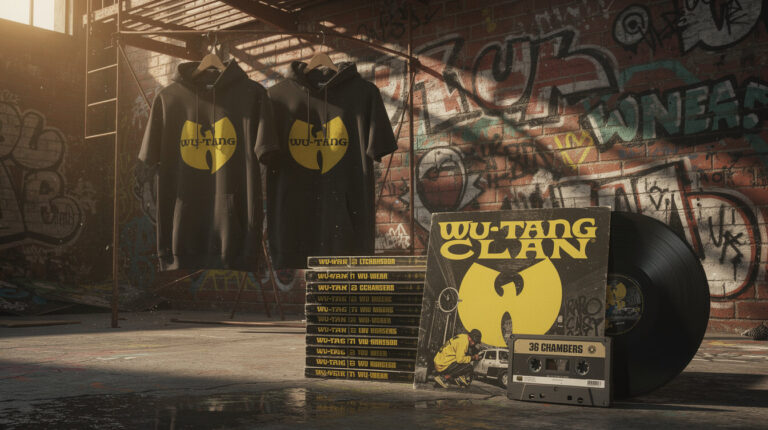
Here is the part the product pages will never explain to you. The W was designed to work twice. It is a visual logo — the angular split-W stamped on every album from Enter the Wu-Tang (36 Chambers) forward. It is also an auditory logo — the “Wu-Tang!” battle cry that detonates through “Protect Ya Neck” in 1993, the first single, a song with no chorus and no hook by design. One mark, two senses. That double-coding is why a kid who has never knowingly heard a Wu record can still recognize the W on a cap across a train platform. It was built to be portable.
The W also became a hand sign. Metalheads throw horns. Sixties peace marchers threw the V. Hip-hop crowds generally throw their hands up. Wu-Tang fans throw a W — fingers folded into the logo itself. When the symbol your fans make with their own hands is identical to the symbol on the merch, the merch stops being merch. It becomes a uniform. The hat is simply the highest, most visible mount point for it.
Credit for executing the mark is widely given to Allah Mathematics — Ronald Maurice Bean — who came up through the crew as a DJ and producer and is the name fans most consistently attach to the W’s final form. We qualify that because the design’s origin lives more in long-standing fan consensus and RZA’s own retellings than in a single notarized document, and we’d rather flag the seam than paper over it. What is not in dispute: the W predates Wu-Tang’s fame, not the other way around. If you want the human roster behind the symbol, we mapped the nine MCs who built the W separately.

The Wu-Tang Clan Hat Archetypes Nobody on Google Separates
Search “Wu-Tang Clan hat” and you get a wall of caps with no taxonomy. That’s the gap. There are at least five distinct archetypes, and which one you want depends entirely on what you’re trying to say.
1. The Snapback (the default)
The structured six-panel, flat or rounded bill, plastic-snap closure. This is the modern center of gravity. Wu-Tang’s official store anchors its catalog here with two flagships: the Wu-Tang Varsity Snapback — the legacy, neutral-W pick that currently sits at the very top of the organic search results — and the Final Chamber Hat, named for the 36 Chambers cycle and built for album loyalists who want the reference, not just the letter. If you own one Wu hat, it is almost certainly a snapback, and it should probably be one of these two.
2. The Fitted / FlexFit (the collector tier)
Before the snapback retook the culture, the FlexFit fitted was the default hat structure of the late ’90s and early 2000s. Wu-Tang FlexFits from that window are no longer being produced — they are dead-stock collectibles now, and they trade accordingly. This is the archetype the entire commercial SERP ignores, and it’s the one with the most interesting economics. We come back to the numbers in the vintage section.
3. The Dad Hat (the crossover)
Unstructured, curved brim, low crown, fabric strap. The dad hat is how the W moved from the head of a hip-hop head to the head of someone who owns one rap record and likes the aesthetic. That’s not a knock — crossover is how a logo survives thirty years. It’s a softer statement: the W as taste signal rather than allegiance.
4. The Wu York Fitted (the New York code)
The Wu York is the official store’s most conceptually loaded piece — the W rendered in a New York Yankees colorway and silhouette. To be precise: it is a stylistic homage, not a Yankees-licensed collaboration. It works because Wu-Tang and the Yankees are both visual shorthand for New York, so stacking the W in interlocking-NY navy-and-white reads as both at once. Royal Blue and Royal Red variants run the same play in different keys. If your hat needs to say “New York” before it says “Wu,” this is the one.
5. The Trucker and the Collabs
Foam-front trucker styles and limited New Era-style collaborations float around the edges of the catalog and the resale market. They are real but situational — buy them because you specifically want that silhouette, not as your first Wu hat.
The hierarchy nobody states out loud: Varsity is the safe legacy buy, Final Chamber is the album-coded buy, Wu York is the city-coded buy, the dad hat is the casual buy, and the vintage FlexFit is the connoisseur buy. Five doors, same W.
Where to Actually Buy a Real Wu-Tang Clan Hat in 2026
Source tier matters more here than for almost any other rap merch, because the W is one of the most counterfeited marks in the genre. Here is the map, ranked by trust.
Tier 1 — The official store. thewutangclan.com is the primary source and effectively the master catalog: the Varsity Snapback, the Final Chamber Hat, the Wu York, and the classic logo cap all live here, officially licensed, no authentication guesswork. It is not an accident that the official store’s own product pages occupy multiple slots in the top ten organic results — direct-to-consumer dominance for a commercial query usually means the brand is policing its own lane.
Tier 2 — Trusted licensed retailers. Two stand out. The Hip-Hop Museum DC (NHHM) sells a Wu-Tang yellow-logo snapback at $30 list, often discounted to around $25.50 — officially licensed, 100% cotton, embroidered W, structured six-panel. A museum gift shop carrying it is its own form of social proof: cultural institutions don’t stock bootlegs. WearYourBeer carries an officially licensed embroidered-logo adjustable snapback at $19.99 (SKU 870905, branded Wu Tang) — the honest budget-tier entry point if you want a real W without the official-store premium.
Tier 3 — Mixed marketplaces (proceed with eyes open). Amazon’s “wu-tang hat” results run into the hundreds — a lot of it genuinely licensed through H3 Sportgear or Bioworld, but interleaved with bootleg and drop-shipped product. The aggregate listing volume is exactly why Amazon ranks; it is not a quality signal. Etsy is taking two separate top-fifteen organic slots for variants of this search, and that inventory is overwhelmingly independent embroiderers and custom shops — great if you specifically want a one-off custom piece and know that’s what you’re buying, risky if you think you’re getting official product. eBay’s strength is the vintage and secondary market, which is its own conversation.
The rule of thumb: if you want certainty, buy Tier 1. If you want value with certainty, buy Tier 2. Only touch Tier 3 if you can authenticate — which is the next section. For the wider picture of where Wu product lives across categories, we keep the broader Wu-Tang gifts guide current.
How to Spot a Real Wu-Tang Clan Hat From a Bootleg
Nobody on the search results page will teach you this, because everybody on the search results page is selling you something. Here is the framework.
Check the licensing tag. Officially licensed Wu-Tang headwear carries a recognizable licensor mark — Wu-Tang Brand Ltd., H3 Sportgear, or Bioworld are the three you’ll see most. No licensor tag, or a tag that just says a generic factory name, is the single loudest red flag.
Read the embroidery. The W has tight inner curves. On licensed product the stitching holds those curves cleanly. On bootlegs the inner angles of the W are where it falls apart — wobbly stitch lines, uneven density, thread pull at the points. Zoom in on the listing photos before you buy; the W’s geometry is unforgiving and bootleggers consistently fail it.
Check the build. The snapback archetypes are structured six-panel construction. A floppy, unstructured cap sold as a structured snapback is reworked or fake.
Use price as a floor. New, licensed Wu-Tang hats start around $19.99 and climb. A brand-new “official” Wu cap at $9 on a no-name marketplace is, with near-certainty, a bootleg. Price isn’t proof of authenticity, but a price well under the licensed floor is proof of its absence.
This is a specific application of a broader skill. If you buy rap merch with any regularity, internalize our broader authentication framework for rap merchandise — the same tag/stitch/price logic protects you across the whole genre, not just the W. It’s the same discipline that separates a real Method Man Tical solo brand piece or a licensed Ghostface Ironman drop from the dropship sea.
The Vintage Market: Why a Dead-Stock FlexFit Costs $60
Here is the data point the commercial SERP physically cannot give you, because none of them deal in it. On a recent F As In Frank vintage clothing stream — a DM-to-buy reseller show running through a tray of ’90s snapbacks — the host hits a Wu-Tang FlexFit, flags it as “dead stock,” calls it “hard to find,” and prices it at $60 shipped. For context, in the same run he was moving vintage Nike snapbacks at $30 shipped and only a coveted Polo Sport piece matched the Wu’s $60. The Wu FlexFit wasn’t priced like a hat. It was priced like a collectible.
Three forces stack into that number. Scarcity: nobody is manufacturing 1998 Wu FlexFits anymore; the supply is fixed and shrinking. Era authenticity: a dead-stock FlexFit is a physical artifact from the exact window when Wu-Tang was rewriting the commercial ceiling for a rap group — you’re not buying a reference to the era, you’re buying the era. Silhouette obsolescence: the FlexFit fitted is no longer the default hat structure, which paradoxically makes the surviving period pieces more distinctive, not less.
The practical takeaway: a new licensed snapback and a dead-stock ’90s FlexFit are not competing products. One is a $20–$30 statement you wear every day. The other is a $60-and-climbing artifact you wear carefully or keep on the shelf. Know which purchase you’re actually making before you click.

Styling the Wu-Tang Hat in 2026: The Uniform Thesis
Everything above resolves into one idea: the hat is a single piece of a larger visual system. The W on the cap wants a body of W underneath it. That’s not a sales pitch, it’s how the symbol was designed to function — total, repeated, head-to-torso.
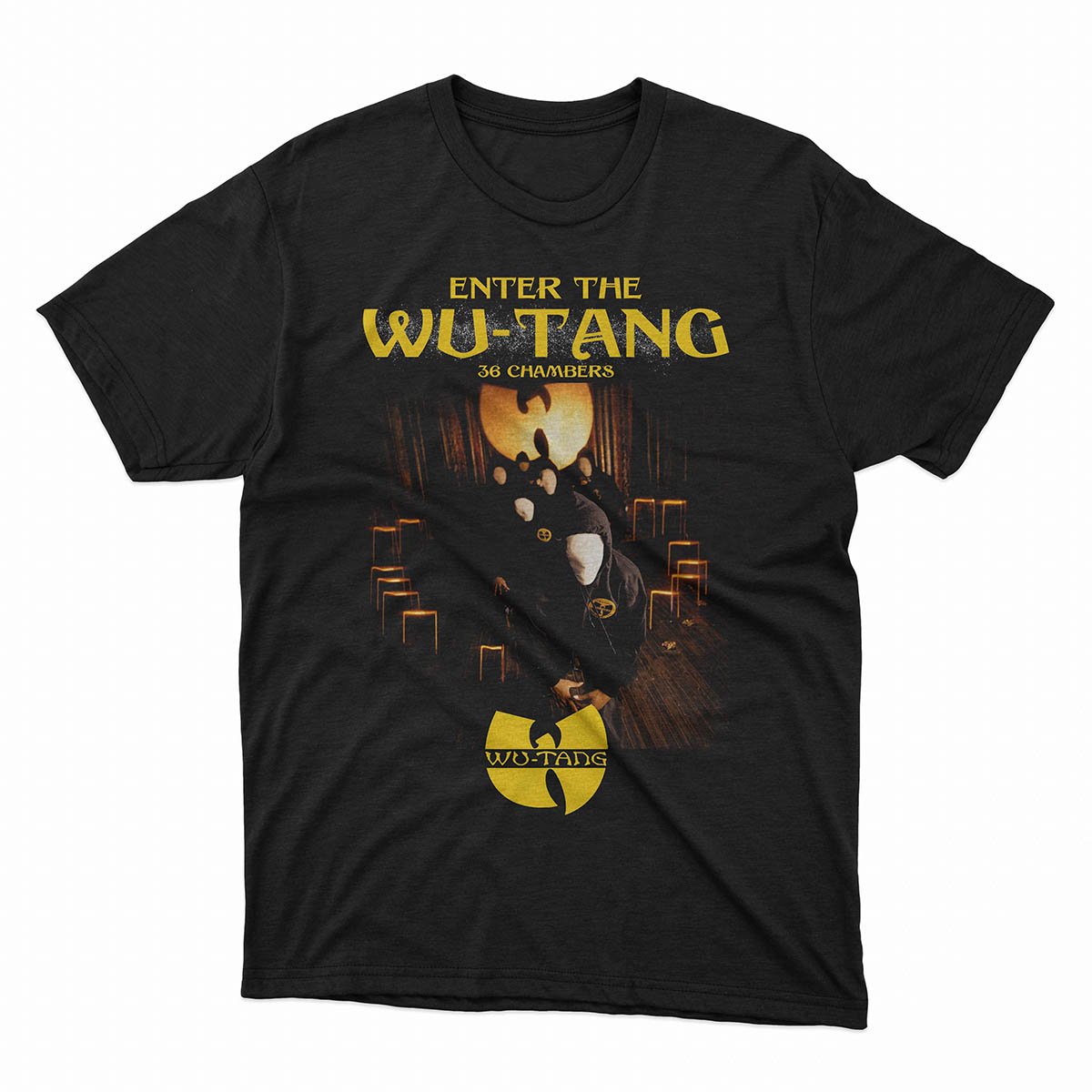
The cleanest execution is album-coded. The Final Chamber Hat pairs cleanly with our Enter The Wu-Tang 36 Chambers tee — both anchor on the album that started everything, so the hat and the shirt are quoting the same source instead of competing. That’s the difference between wearing two Wu things and wearing one coherent Wu statement.
If you’re New York-coded, run the Wu York fitted as the keystone and let everything else stay quiet — the Yankees silhouette is already doing the heavy lifting, so a plain black tee underneath reads as intentional restraint, not laziness. If you’re an album loyalist, the Final Chamber / 36 Chambers pairing is your uniform; add the broader Wu catalog only where it deepens the same reference. The mistake to avoid is logo soup — three different Wu silhouettes from three different eras fighting each other. Pick a code. Commit to it. The W rewards coherence; it punishes clutter.
Frequently Asked Questions
Who designed the Wu-Tang Clan logo?
The W logo is widely credited to Allah Mathematics (Ronald Maurice Bean), who began as Wu-Tang’s DJ and produced his way into a permanent fixture in the crew. The logo first appeared on the 36 Chambers cycle and has been the cornerstone of Wu’s visual brand for over 30 years — Question Time’s Origins-era essay frames it as “perhaps the most significant and recognizable symbol” in hip-hop.
Where can I buy an officially licensed Wu-Tang Clan hat in 2026?
The most direct source is thewutangclan.com, which carries the official catalog: the Wu-Tang Varsity Snapback, the Final Chamber Hat, the Wu York (Yankees-style colorway) snapback, and the Classic Logo Cap. Licensed retailers like the Hip-Hop Museum DC (around $30 for the yellow logo snapback) and WearYourBeer ($19.99 embroidered snapback) are reliable secondary sources. Amazon and Etsy listings are mixed — they include licensed H3 Sportgear / Bioworld product but also bootlegs.
How do I tell a real Wu-Tang hat from a bootleg?
Look for an officially licensed tag (Wu-Tang Brand Ltd., H3 Sportgear, and Bioworld are the most common licensors), clean embroidery on the W logo (bootleg W’s tend to have wobbly stitching on the inner curves), structured six-panel construction on the snapback styles, and a price floor of $19.99+ for new licensed product. If it’s $9 on a no-name marketplace, it’s a bootleg.
Is the Wu York hat connected to the New York Yankees?
Wu York is Wu-Tang’s nod to the Yankees colorway and silhouette — it’s a stylistic homage, not a Yankees-licensed collab. It works because Wu and the Yankees both function as visual shorthand for New York; stacking the W in NY navy/white reads as both at once. The Royal Blue and Royal Red colorway variants extend the same idea.
What is a Wu-Tang FlexFit hat and why is it expensive?
FlexFit was the dominant fitted-hat structure of the late ’90s and early 2000s, and Wu-Tang FlexFits from that era are dead-stock collectibles. A vintage clothing vlogger (F As In Frank) priced a dead-stock Wu FlexFit at $60 shipped on a recent reseller stream, calling it “hard to find.” The pricing reflects scarcity, era authenticity, and the FlexFit silhouette no longer being the default.
What hat goes with the 36 Chambers t-shirt?
The Final Chamber Hat (officially named after the 36 Chambers cycle) is the most direct visual pairing — both reference the same album. The Varsity Snapback is the classic-W neutral pick if you want the tee to be the focal point. If you’re going NY-coded, the Wu York completes a Yankees-flavored uniform.
Why has the Wu-Tang hat stayed relevant for over 30 years?
Two reasons. First, the W logo was designed to function as both a visual logo and an auditory logo (the “Wu-Tang!” battle cry) — that double-coding gives it cross-generational stickiness. Second, Wu-Tang is one of the few hip-hop crews where the brand outlasted the group’s internal drama; the public-facing logo never wavered even when members feuded.
Final Word: You’re Not Buying a Hat
Strip away the price comparisons and this is the whole thing: the Wu-Tang Clan hat is the most concentrated placement on the body of a symbol that was engineered in 1992 to outlive its own group — and it has. Knowing which one to buy means knowing the difference between a licensed Varsity snapback you’ll wear for a decade, a $19.99 WearYourBeer cap that does the honest job, and a $60 dead-stock FlexFit the vintage market is quietly hunting. Pick your tier, pick your code, authenticate hard, and wear it like you know what the W cost to build. Because you do now.
Complete the Wu Uniform
You got the hat. The 36 Chambers tee is the other half of the canon. Enter The Wu-Tang, on cotton.
Never Miss a Drop
Album deep dives, artist spotlights, exclusive merch drops, and the stories behind the culture. Straight to your inbox. No filler — just the real.

🎧 Never Miss a Drop
Exclusive product releases, hip-hop deep dives, and member-only discounts. Straight to your inbox.
Free forever. No spam. Unsubscribe anytime.
Get the Culture, Delivered
Deep dives into hip-hop history, exclusive product drops, and discounts sent straight to your inbox. No spam, just culture.
Join 2,000+ hip-hop heads already in the loop. Unsubscribe anytime.