Hip Hop Album Cover: A 50-Year History of Rap’s Most Important Art Form
The hip hop album cover is the only piece of artwork in modern music history that operates as a manifesto. Country has its boots, rock has its leather, jazz has its smoke — but in hip-hop, the front of the record is a flag, a press release, and a self-portrait all firing at once. From the moment Run-DMC stood on a Hollis street corner in matching Adidas, the genre decided that what you saw mattered as much as what you heard.
This is the real story of rap album art — the photographers nobody credits, the polaroid stack that built the golden age, the censorship fights that pushed the form forward, and the covers that turned regular kids into mythology. We’re skipping the listicle treatment that Billboard, Capital XTRA, and Revolt have already done five times over. This is a working tour through the art form, told the way the people who actually made these covers told it: in eras, in fights, and in the photographers’ contact sheets nobody bothered to credit.
Why the Hip Hop Album Cover Hits Different
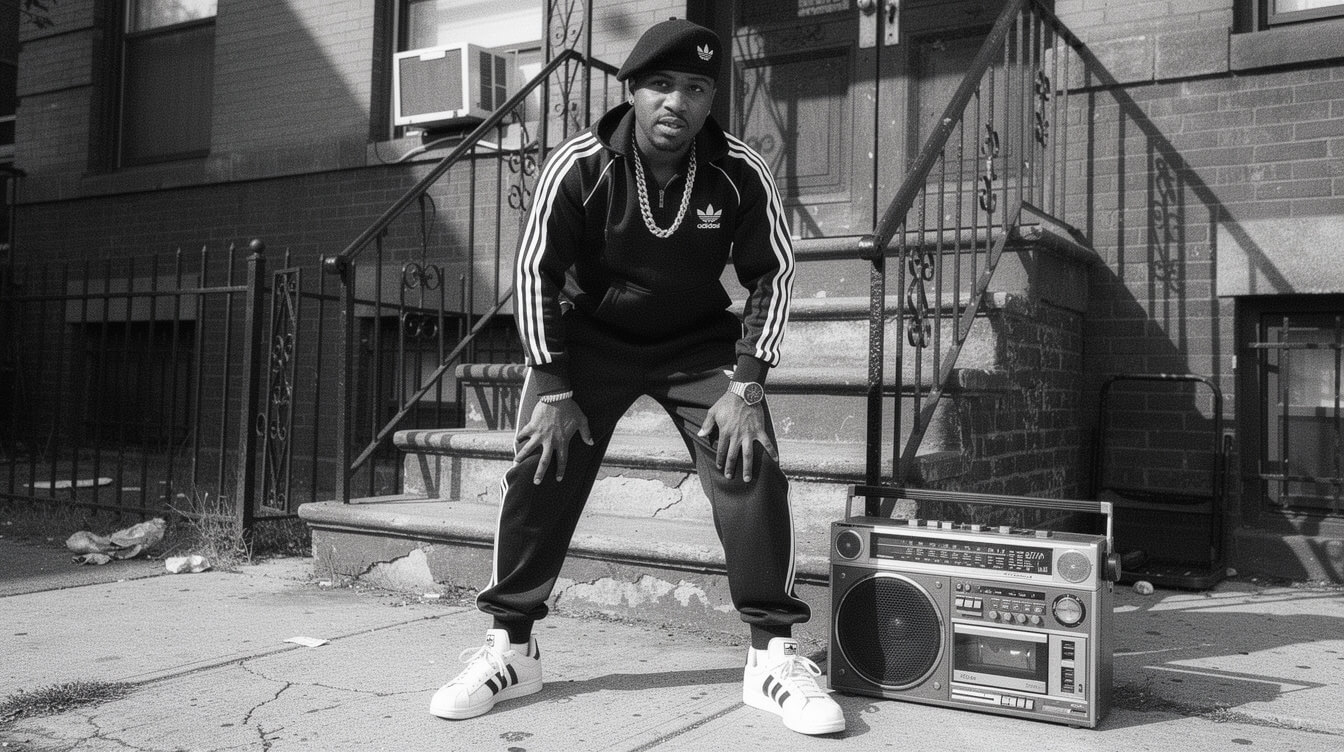
In every other genre, the cover is a poster. In hip-hop, it’s a deed. The cover is where rappers stake the claim of who they are, where they’re from, and what they refuse to be. The genre was born on the same Bronx blocks that birthed graffiti, so visual ownership was baked into the culture before the first record ever pressed. When Sugar Hill Gang dropped Rapper’s Delight in 1979, the cover was a cartoon, because nobody knew what hip-hop was supposed to look like yet. By 1984, Run-DMC’s self-titled debut had Joseph “Run” Simmons and Darryl “DMC” McDaniels in matching black fedoras, leather, and gold rope chains — and the rule was set. You wear the cover. The cover is the brand.
Think about what the front of Illmatic actually communicates. A toddler-aged Nas, baby photo superimposed over a grainy Queensbridge street scene. That single image makes a promise: this rapper is going to tell you about a real place, with real names, from someone who was already inside it before he could talk. No country record cover ever had to carry that much narrative weight. A rap LP front doesn’t decorate the music — it certifies it.
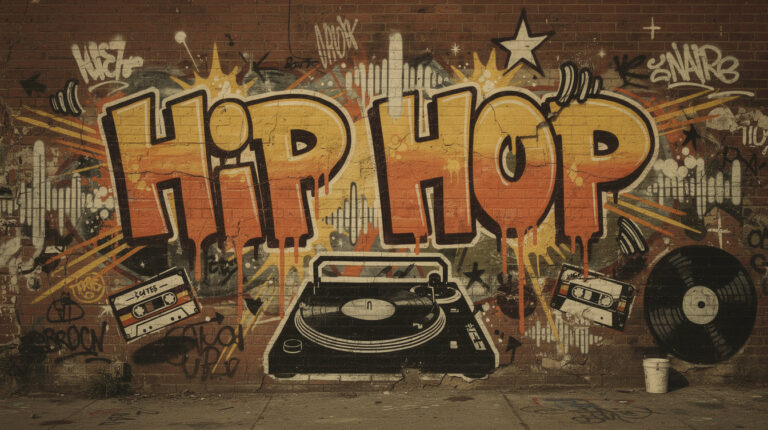
Hip-hop also had a head start on visual literacy. The same kids in the South Bronx in 1976 who were getting into DJing were already writing on subway cars. Tagging trains is the original act of branding yourself in public. By the time those same crews started pressing 12-inch records, the idea that your name had to look like something specific was already two generations deep. Graffiti is the parent. Album art is the child. Every typography choice on the cover of Strictly Business or Paid in Full is a graffiti choice translated into print. That lineage is part of why rap cover design moves so fast — the form is still being made by people who treat visual identity as oxygen, not decoration.
The Polaroid Era: Why Childhood Photos Defined the Golden Age
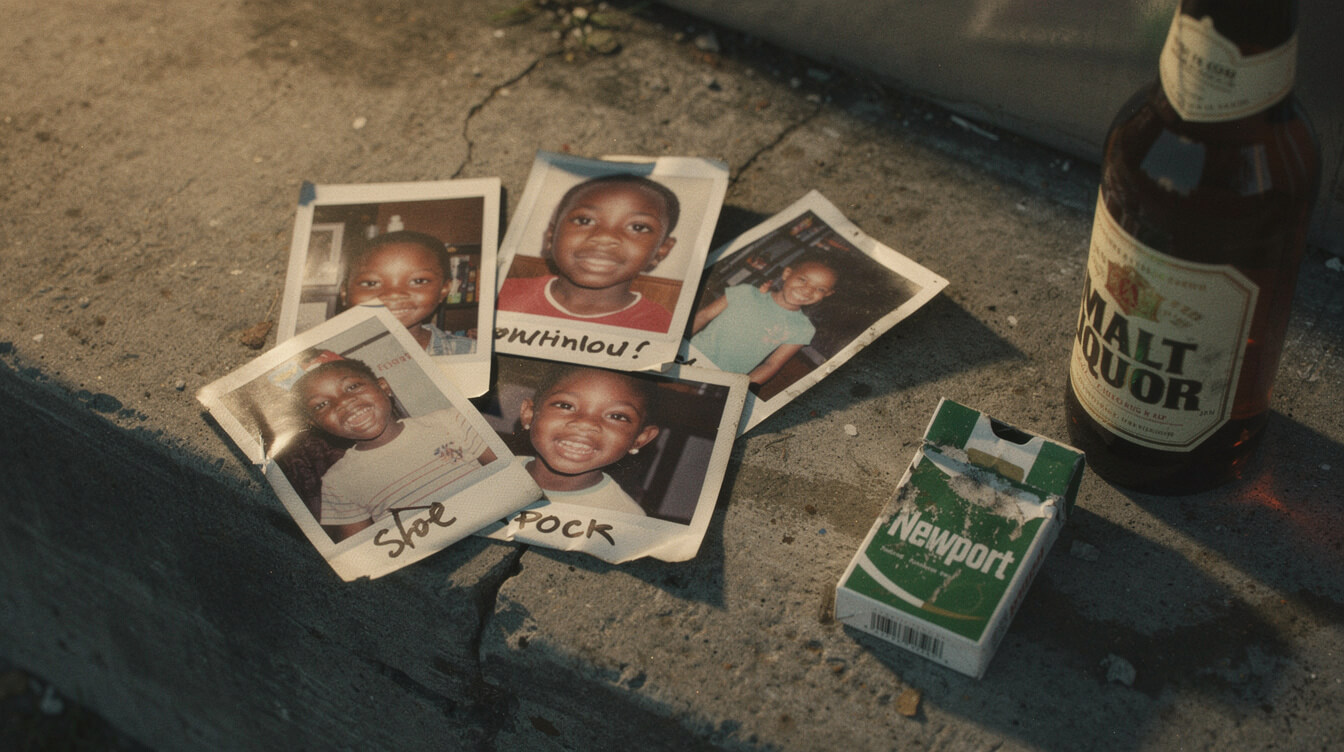
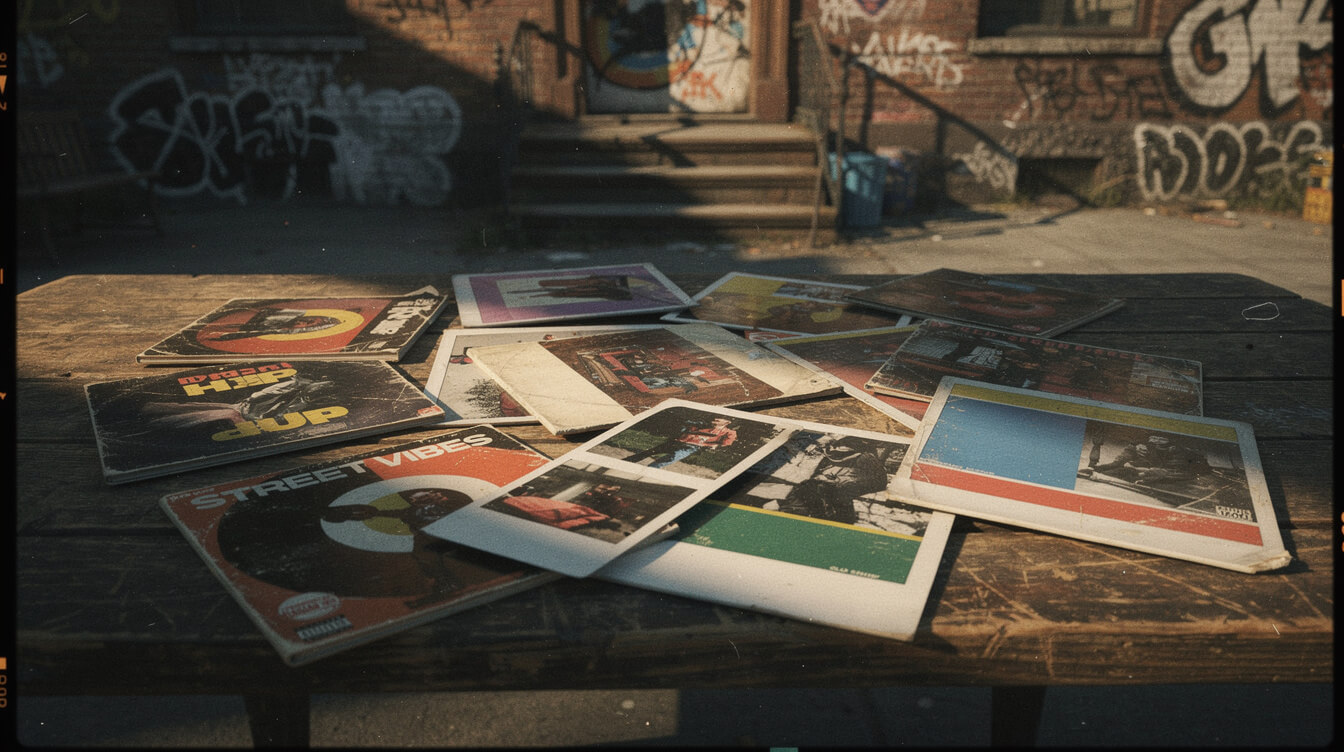
Between 1994 and 2012, the most powerful move a rapper could make on a cover was to use a childhood photograph. Nas’s Illmatic ran with a faded snapshot of seven-year-old Nasir Jones over Queensbridge in 1994. The Notorious B.I.G.’s Ready to Die followed months later with a wide-eyed baby afro against a stark white background. Kendrick Lamar’s good kid, m.A.A.d city pulled the move forward to 2012 — a polaroid of toddler Kendrick on his uncle’s lap, the uncle throwing a Crip set, eyes blacked out of the frame.
The polaroid wasn’t an aesthetic choice. It was an argument. Every one of those covers was saying the same thing: I’m not a fictional character. I am a child of this place, and this music is a documentary. When Jay-Z dropped his own response to that era with a mafioso aesthetic on Reasonable Doubt, he had to invert the whole formula — grown man, tailored suit, fedora pulled low, anonymous mansion. The polaroid era worked because it weaponized authenticity. By the time Wayne dropped Tha Carter III‘s baby-photo-as-collage cover in 2008, every fan in the world knew exactly what the move meant.
What made the era specifically hip-hop was the willingness to use these covers as legal evidence against the rapper himself. The Notorious B.I.G. would later release Ready to Die and then Life After Death with intentionally contradictory imagery — the baby on the first, the funeral suit and tombstone on the second — and the genre treated the pairing as an accepted bookend. No other genre’s biggest star would let his second cover declare him already-gone. Hip-hop did it because the cover doubled as record-keeping. Album art was where the rapper got to write his own gravestone, and the audience kept the receipt.
The Photographer Auteurs You’ve Never Heard Of
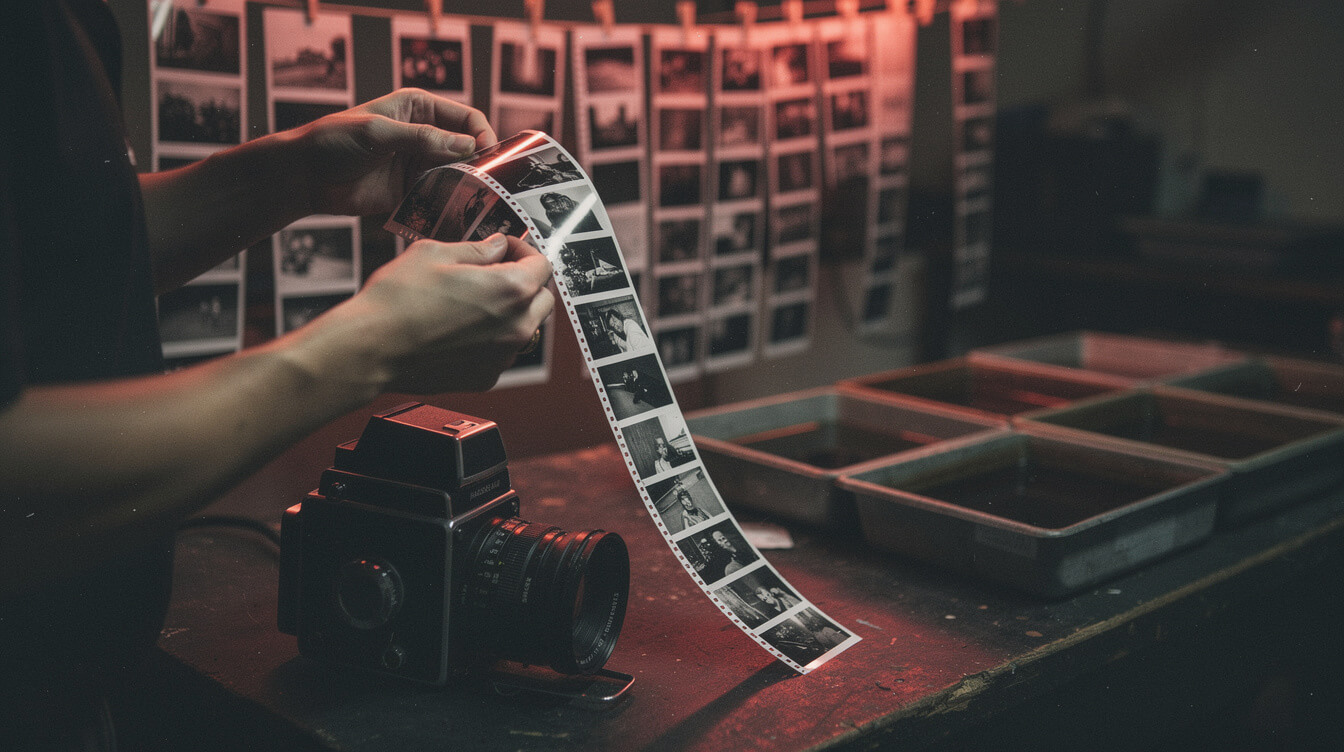
The rappers got the credit. The cameras did the work. If you care about hip-hop album art and you don’t know these four names, today is the day to fix that.
Jonathan Mannion is the most important hip-hop photographer of the last thirty years. He shot Jay-Z’s Reasonable Doubt at twenty-five years old, then went on to do over 300 album covers — DMX It’s Dark and Hell Is Hot, Aaliyah’s self-titled, Big Pun Capital Punishment, Kendrick Lamar’s To Pimp a Butterfly. The shadow-heavy, posed-but-relaxed look that defined the late 90s East Coast was his. Mannion grew up in Cleveland, assisted Richard Avedon in New York, and ported the Avedon discipline — controlled studio light, large-format Hasselblad and 4×5 work, a posed subject who looks unposed — into a culture that had been shooting on the fly. He’s the reason mid-90s rap covers suddenly look like editorial magazine portraits instead of camcorder grabs.
Daniel Hastings shot the Wu-Tang Clan masks for Enter the 36 Chambers, then Ghostface Killah’s Iron Man Polo era group portrait, and Method Man’s Tical. He understood that Wu didn’t want to be photographed — they wanted to be summoned. Cey Adams, a former graffiti writer turned Def Jam art director, handled the Public Enemy Fear of a Black Planet rollout and dozens of LL Cool J and Beastie Boys covers as Def Jam’s in-house visual conscience. Eric Haze designed the Beastie Boys logo and the EPMD Strictly Business cover — a sign painter and graffiti vet whose typography became the East Coast house style. Without these four, half the covers you grew up loving don’t exist.
The next tier matters too. Brian “B+” Cross — born in Limerick, based in Los Angeles — shot the early Stones Throw catalog, the iconic Endtroducing DJ Shadow sleeve, and most of the Mos Def, Common, and Madlib visual archive. Estevan Oriol documented West Coast life so deeply that Cypress Hill, Eminem, and Kid Frost all came to him for cover work. Glen E. Friedman — already known for skateboarding photography — shot the Beastie Boys’ Check Your Head and the Public Enemy publicity sessions that became album art. The lesson here: most great rap covers were not made by the rapper alone. They were collaborations with a small bench of photographers who understood that the cover was the genre’s first sentence.
Five Hip Hop Album Covers That Changed Everything
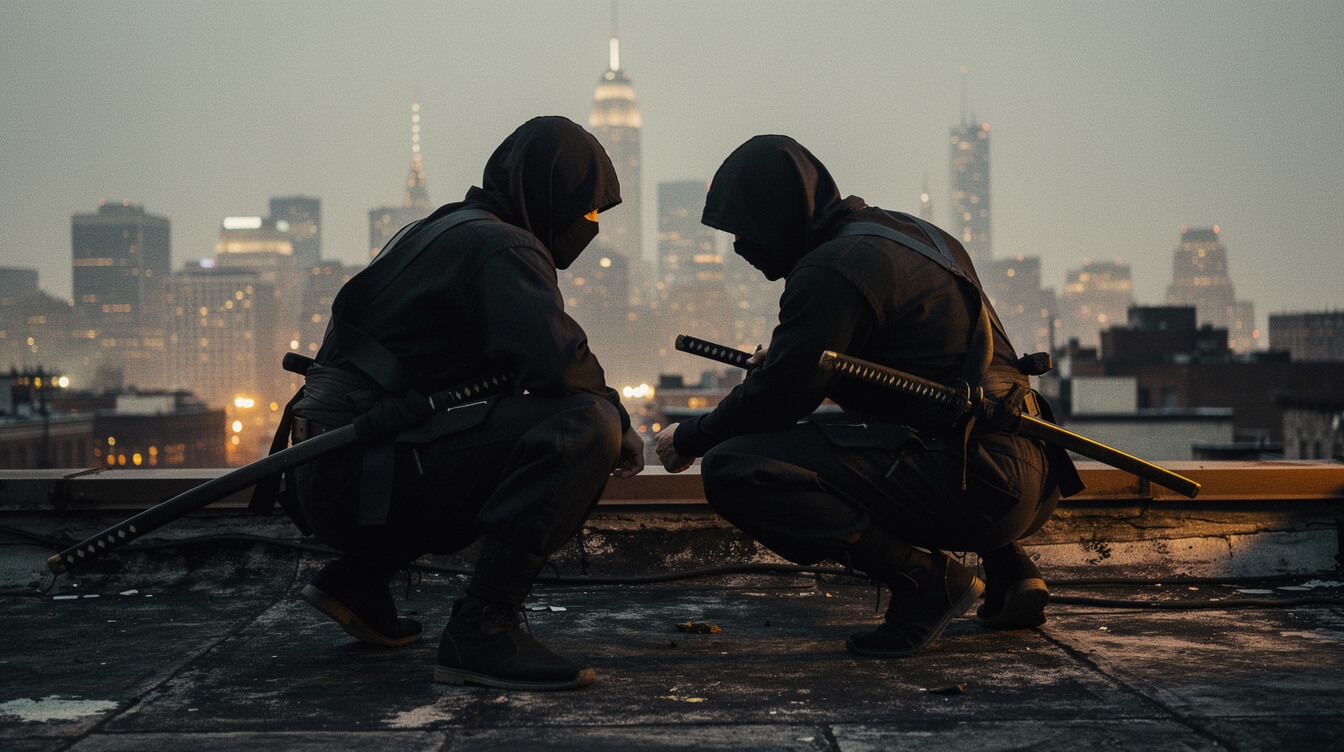
Nas — Illmatic (1994). Designed by Aimée Macauley with a photograph by Danny Clinch laid over an old family snapshot from photographer Tony Drayton. The transparency overlay was a pre-Photoshop darkroom trick — two negatives sandwiched in the enlarger. The cover predicted the album’s thesis: childhood and the projects, layered on top of each other, inseparable.
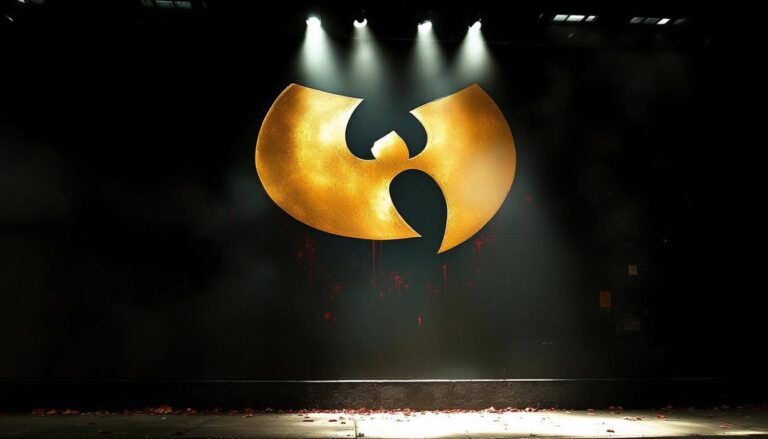
Wu-Tang Clan — Enter the Wu-Tang (36 Chambers) (1993). Daniel Hastings shot nine men in black hoods and ski masks in a single shadowy frame. Already explored in our deep dive on the album itself — the cover was an explicit rejection of the NWA solo-spotlight model. Wu came as one body, faceless, a collective threat. Every rap collective cover since has had to answer that move.
Jay-Z — Reasonable Doubt (1996). Mannion’s mafioso-portrait shoot at a private estate in upstate New York. The fedora, the cigar, the heavy contrast — Jay wasn’t playing the street rapper game, he was casting himself as the boss before the first verse landed. The cover sold him as inevitable.
Madvillain — Madvillainy (2004). Photographer Eric Coleman’s tight crop of MF DOOM in his metal mask, eyes barely visible. No name, no logo, no rapper — only the symbol. DOOM understood that in a culture obsessed with selfhood, anonymity was the ultimate flex. The cover became hip-hop’s first true logo-as-image.
Kendrick Lamar — To Pimp a Butterfly (2015). The unauthorized-feeling group photograph of shirtless Black men in front of the White House, baby on the lawn, Judge Mathis-style judge slumped in front. Designed by Vlad Sepetov around a Denis Rouvre concept. Every detail was a flag planted — and the cover instantly became one of the most analyzed pieces of album art in modern history.
What unifies all five is restraint about the rapper himself. Illmatic‘s Nas is a child. Wu wears masks. Jay looks past the camera. DOOM hides behind metal. Kendrick is one of fifteen people on the lawn. None of them sells the album by pointing at their own face. They sell it by pointing at a world. That’s the difference between a cover that markets a person and a cover that promises a piece of culture — and it’s the rule the genre’s best art directors have been quietly enforcing for thirty years.
The Controversies and Censorship Battles
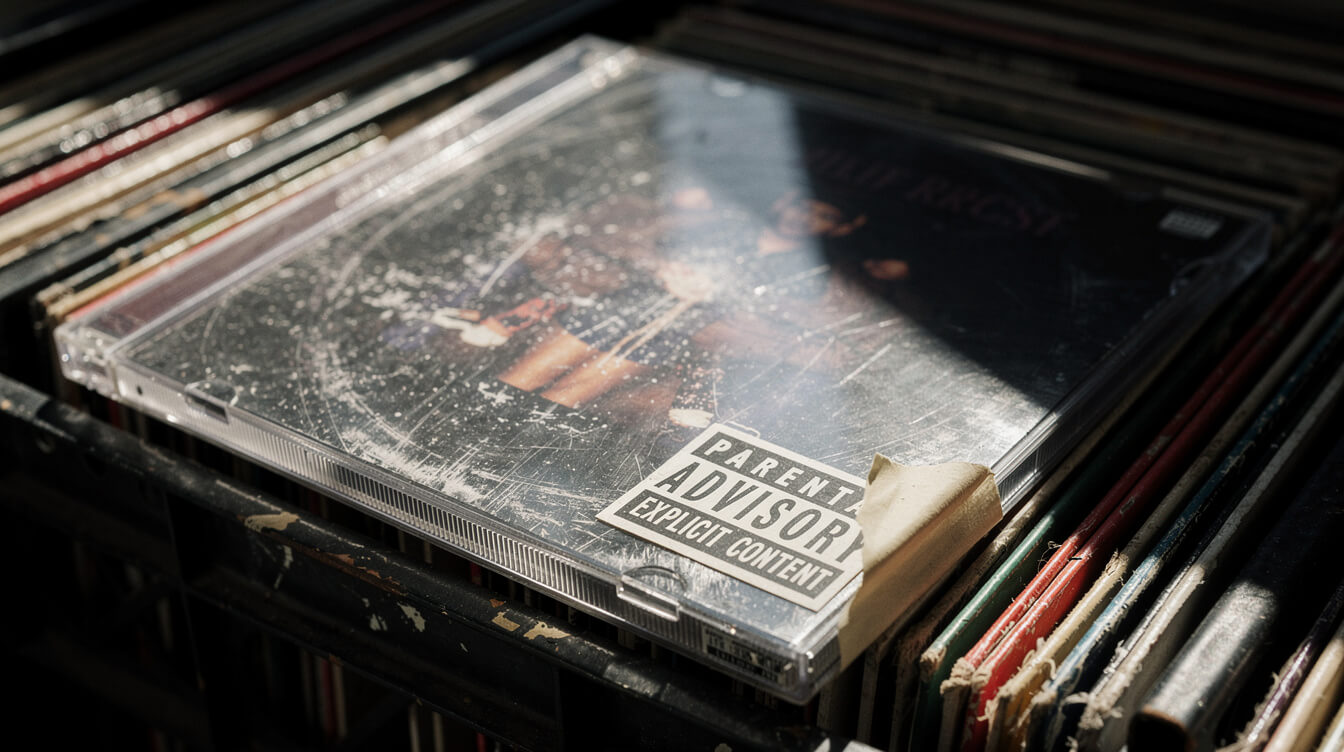
The Parental Advisory: Explicit Content sticker was invented in 1985, three years before Public Enemy’s Fear of a Black Planet, and hip-hop is the genre that gave it most of its work. Album cover wars were not a side story. They were where the genre fought for who got to speak.
Ice-T’s Power (1988) featured his girlfriend Darlene Ortiz in a black bikini holding a shotgun. Retailers panicked. Tower Records moved it behind the counter. Two-Live Crew’s As Nasty As They Wanna Be got banned outright in several Southern counties. Lil Kim’s Hard Core in 1996 — photographer Michael Lavine, Kim in a leopard-print swimsuit on a bearskin rug — was treated as obscene by some chains and as a manifesto by everyone else. The image is now in the permanent collection at MoCADA.
Public Enemy’s Fear of a Black Planet brought in NASA art-program member B.E. Johnson to render a Black planet eclipsing Earth. Def Jam wanted controversy, and they manufactured it through cosmic scale. Eminem’s The Marshall Mathers LP in 2000 ran with a moody porch photograph that looked harmless until parents read the lyrics. The cover taught the next generation of rappers that you didn’t always have to be explicit on the front to be threatening on the inside. The whole history of rap album art is also a history of who’s allowed to be on a shelf.
There’s also the quieter censorship that nobody talks about — the in-house Def Jam, Loud, and Tommy Boy designers in the late 80s and early 90s who had to negotiate with major-label parents about which images of Black men carrying weapons could ship. Some of the most legendary covers exist in two versions. Geto Boys got pulled and remade. The Source‘s magazine cover archive shows two and three lighting tests for the same shoot because the label’s distribution arm kept rejecting “too aggressive” poses. The form survived because the art directors kept pushing — and lost a lot of negatives along the way.
The Modern Hip Hop Album Cover: Minimalism, Yeezus, and the AI Era

Kanye West’s Yeezus in 2013 broke the form. No artwork. A clear plastic CD case with a single piece of red tape across the spine. Kanye argued that the album was its own statement and the cover had nothing left to add. Half the industry hated it. The other half realized he had just declared that the gravitational center of rap visual culture had moved.
What came after was a split. One lane went minimalist — Drake’s If You’re Reading This It’s Too Late, Travis Scott’s deceptively simple Astroworld head sculpture, Kendrick’s DAMN. caption-on-a-photo treatment. The other lane went maximalist with full art direction — Cardi B’s photo-art-directed Invasion of Privacy debut, OutKast-inheritor Tyler the Creator’s hand-painted IGOR and CALL ME IF YOU GET LOST covers, and Kanye’s later Donda all-black square. Kendrick’s GNX brought the photograph-as-album-cover language full circle — the Buick on the lawn, no rapper visible, the car carrying all the meaning.
Now we’re in the AI cover era. Drake’s For All the Dogs ran a child’s drawing. Lil Yachty went generative on his alt-rock pivot. The risk is that when anything can be made instantly, nothing carries the weight of a real photoshoot anymore. The discipline the form needs in 2026 is the same discipline Mannion brought in 1996: make the cover earn the music.
Streaming has also broken the unit. Singles now have their own art, EPs have their own art, deluxe-edition releases have their own art, and the playlist thumbnail has become the surface most fans actually see first. That means the “album cover” is now a system of related visuals rather than a single artifact — and most rappers haven’t figured out how to design at that scale yet. The artists who do — Tyler the Creator, Kendrick, Doja Cat, Megan Thee Stallion’s Traumazine rollout — treat every single drop as an entry in a connected visual universe. That’s where the form is going. The album sleeve isn’t dying. It’s evolving from a poster into a brand identity.
If you live for the eras when album art carried the weight of the music itself, our Nas Illmatic Hoodie wears the most-quoted polaroid in hip-hop history at chest height — built for heads who treat the cover as a creed, not a coincidence.
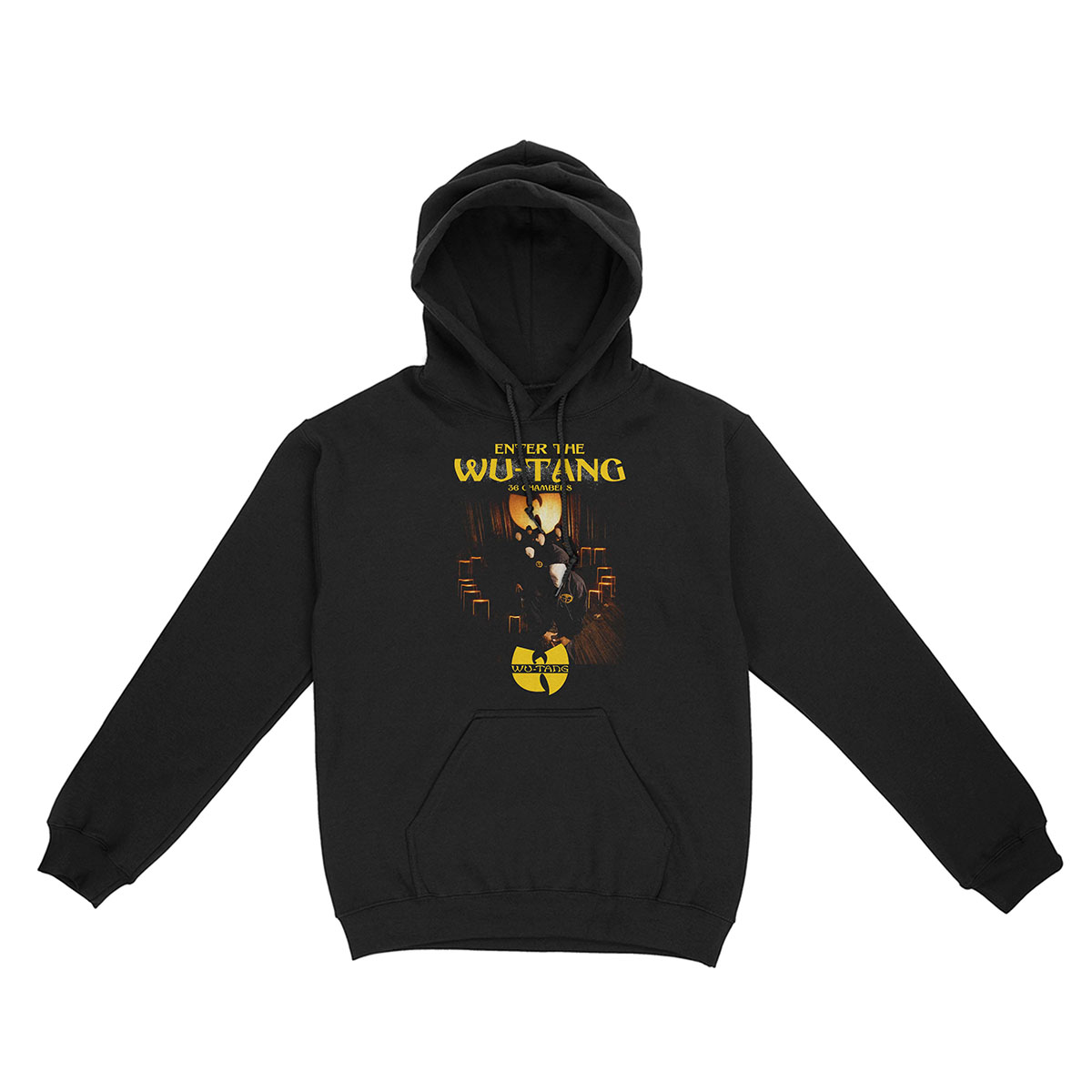
Wear the Cover That Shook 1993
Daniel Hastings shot nine masks in a single black frame and changed group photography forever. Our Enter The Wu-Tang 36 Chambers hoodie carries that exact image into the cold months — built for heads who know which cover started the whole faceless-collective era.
Frequently Asked Questions About Hip Hop Album Covers
What makes a hip hop album cover iconic?
Three things, almost every time. First, it has to make a claim about the rapper that the music will then prove — childhood photo equals authenticity, mafioso portrait equals power, mask equals myth. Second, it has to be technically distinct — a specific photographer’s signature, a specific design choice that nobody else is doing in that moment. Third, it has to age past its own era. Illmatic still hits in 2026 because the move it made in 1994 hadn’t been made before and hasn’t been topped since.
Who designs hip hop album covers?
It is almost never the rapper. The rapper picks the photographer and the art director. Major-label covers usually involve a designer (typography, layout), a photographer or illustrator (the central image), and the rapper’s own art-direction sign-off. At indie labels and on later self-released projects, the rapper often owns more of the creative — DOOM did much of his own design through the Madvillain era, and Tyler the Creator paints many of his own covers.
Why are so many hip hop album covers in black and white?
Three reasons. Mannion-era East Coast photography leaned on Tri-X film and high-contrast prints to evoke gritty newspaper documentation. Black and white also held up better when album art was printed at small CD-booklet size. And there’s a cultural reason — Black-and-white photography removes the distraction of clothing and skin tone choices and forces the eye onto the face, the pose, the architecture. The hip hop album cover learned what jazz album covers already knew.
What is the most expensive hip hop album cover photoshoot ever?
Public records are scarce, but Kanye West’s My Beautiful Dark Twisted Fantasy commission of George Condo for five separate cover paintings is widely cited as the most expensive single album-art deal in hip-hop history. Condo was paid a reported six-figure fee per painting. By contrast, Mannion shot Reasonable Doubt for a fraction of one of those numbers — the photographer was twenty-five, the budget was indie-Roc-A-Fella small.
Are hip hop album covers worth collecting?
Vinyl-pressing originals of Illmatic, Ready to Die, Reasonable Doubt, Enter the Wu-Tang, Aquemini, The Miseducation of Lauryn Hill, and Madvillainy have all appreciated sharply since 2018. First-pressing copies in clean shrink are now five-figure items in some cases. As physical media has thinned out, the cover has become the collectible — the music itself is on every streaming service, but the original 12-inch jacket is a one-time artifact.
Final Word
The hip hop album cover is the receipt. Strip the music away from any classic LP and the cover still tells you what the music was trying to be. That’s the move other genres never figured out. Forty-six years in, the form is shifting again — minimalism, AI, photographs that hide the rapper instead of showing him. The covers that survive 2026 will be the ones that still make a claim worth defending. Same rule as 1984. Same rule as 1993. Same rule as forever.
Stay creative — The Custom Creative Team.
Get the Culture in Your Inbox
Weekly reads on the hip hop album covers, photographers, anniversaries, and drops that actually matter. No clickbait. No corporate hype. Real culture only.

🎧 Never Miss a Drop
Exclusive product releases, hip-hop deep dives, and member-only discounts. Straight to your inbox.
Free forever. No spam. Unsubscribe anytime.
Get the Culture, Delivered
Deep dives into hip-hop history, exclusive product drops, and discounts sent straight to your inbox. No spam, just culture.
Join 2,000+ hip-hop heads already in the loop. Unsubscribe anytime.