Outkast T Shirt: The Complete Album-by-Album Buyer’s Guide From Southernplayalistic to Idlewild
Type “outkast t shirt” into Google and you’ll get an avalanche — Amazon, eBay, TeePublic, every print-on-demand outfit with a vector trace of the Stankonia cover. None of them know what they’re selling. An Outkast t shirt isn’t a band tee. It’s a piece of Southern hip-hop history — six studio albums, fifteen Grammy nominations, two of the greatest minds the genre ever produced, and an aesthetic legacy that runs from baby-blue Cadillacs to Afrofuturist comic books to crimson stage-explosions. This buyer’s guide breaks the catalog down album by album so you know exactly what era a tee is honoring, what the cover meant, and what the right shirt should look like on your shoulders.
If you’re new to the duo, start with our complete OutKast albums-ranked discography guide — then come back here for the wardrobe side of the equation. Every section below maps a record to the tee that earns the right to carry its name.
Why an Outkast T Shirt Isn’t Just Another Hip-Hop Tee
Outkast was always a contradiction. Two Atlanta kids — André Lauren Benjamin and Antwan André Patton — who refused every box hip-hop tried to put them in. Dre was the cosmic philosopher in feather boas and turbans; Big Boi was the pimp-walking strategist who kept the music tethered to the South’s funk traditions. Together they were “the coolest mother-funkers on the planet” — both their words and the title of the Source feature that crowned them in 1998.
That contradiction is the whole reason an Outkast tee is harder to design than, say, a generic Wu-Tang W or a Run-DMC block-letter classic. There is no single icon. There’s a duo, a sound, a city, a chronology, and six albums that each look and feel completely different from each other. A good Outkast t shirt has to choose a moment — and respect it.
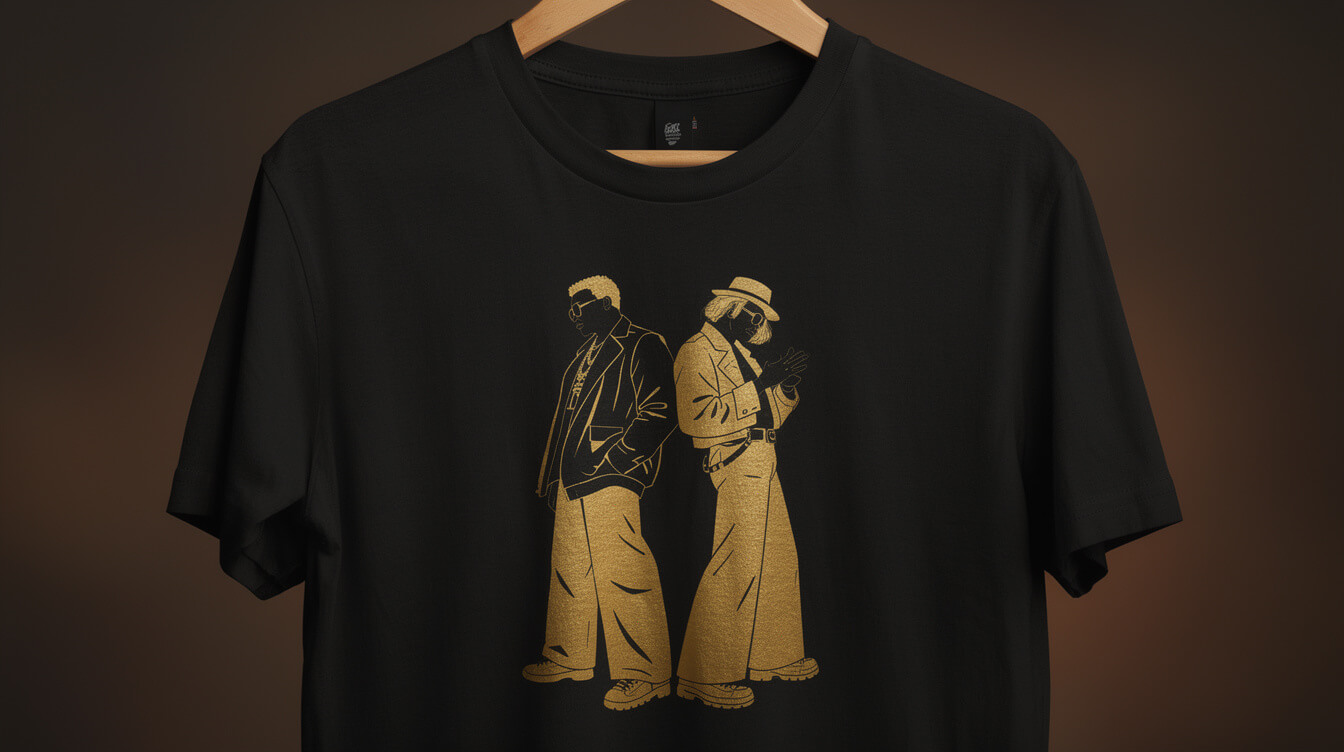
The tells of a quality piece are easy once you know them. Heavyweight cotton (Bella+Canvas 3001, Gildan softstyle, or comparable), screen-print or direct-to-garment ink that won’t crack after two washes, and most importantly, artwork that references the music — not just the logo. The Outkast brand mark is fine. But the Aquemini cosmology, the ATLiens comic-book panel, the Stankonia stripes — those are the visuals that signal you actually know the catalog.
The other thing to know: Outkast was always a duo, but Dre and Big are visually opposite. Big Boi is the constant — pimp-walking, fitted-cap, peacoat-and-Cadillac iconography. Dre is the shapeshifter — feather boas, turbans, jodhpurs, kilts, a flute on a Tibetan album cover. A great Outkast tee has to handle both energies in the same garment. The best ones lean on the album-era visual rather than the people, which is why the cover art always wins over the press photo. Cover art is the duo distilled. A photo of them is one moment frozen.
Southernplayalisticadillacmuzik (1994): The Origin Tee, And Why It’s the Rarest
The debut album that introduced the South to the rest of hip-hop. Released April 26, 1994 on LaFace Records — produced almost entirely by Organized Noize (Rico Wade, Sleepy Brown, Ray Murray) out of the famed “Dungeon” basement in Lakewood Heights. It went platinum, spawned “Player’s Ball” (which had already been a Christmas-EP smash the previous year), and gave the South its first national-stage rap argument: we don’t sound like New York, we don’t sound like LA, and we don’t have to. Dre walked off the 1995 Source Awards stage with the line “the South got something to say” before the East Coast crowd was done booing.
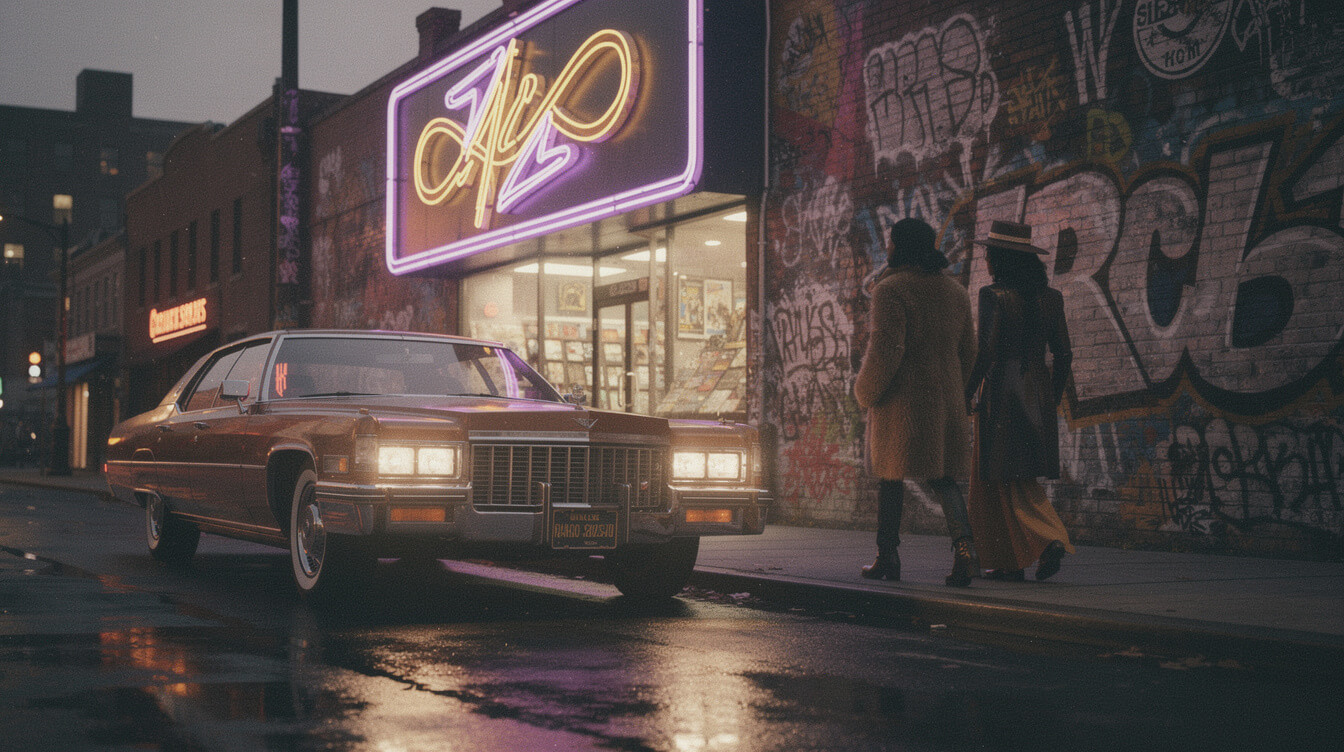
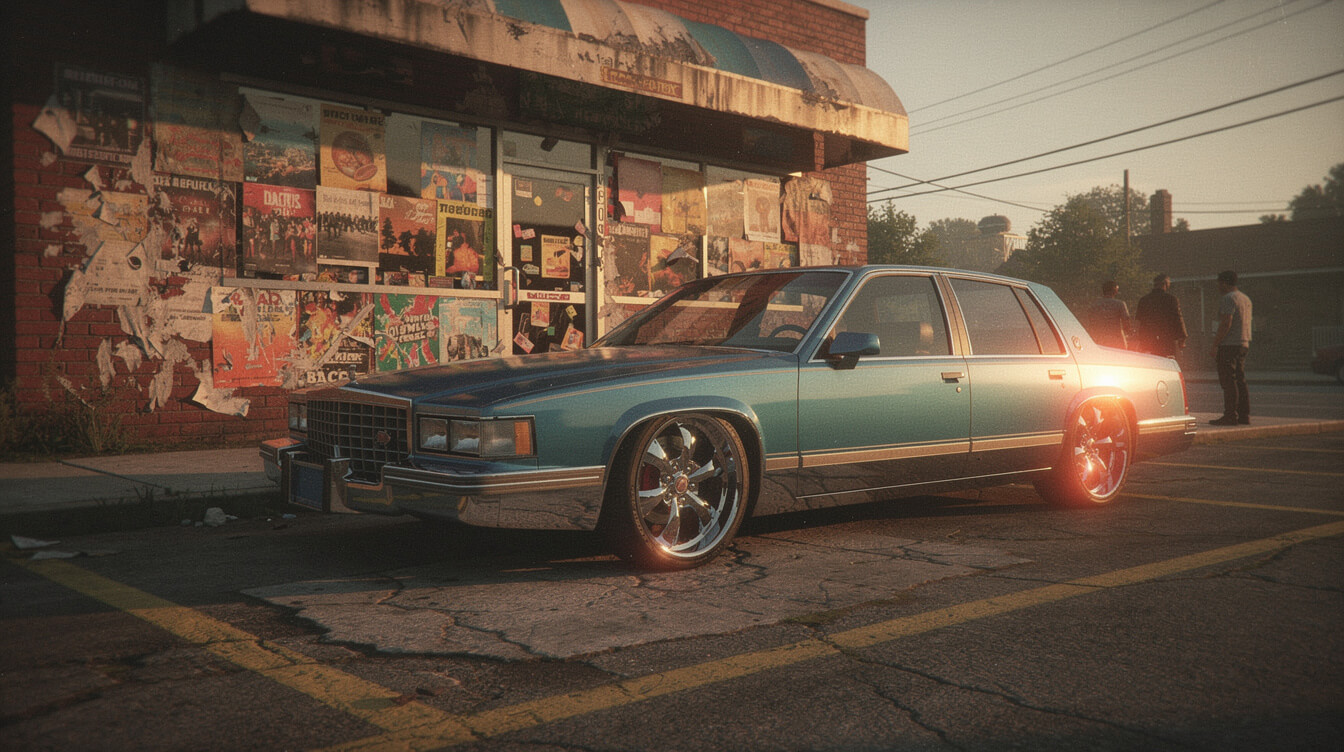
The cover — Dre and Big in front of a baby-blue Cadillac, both leaning into the lens with a stillness that would never appear on an Outkast cover again — defined a visual language for the album. Pimp-walk South, but with college-kid eyes. Any tee that wants to honor Southernplayalisticadillacmuzik should lean into that color story: the Cadillac blue, the wide-collar terry-cloth shirt energy, the early-90s ATL warmth before grunge color theory took over the rest of the country.
This era’s tees are the hardest to find well-executed because the cover photography is so specific. Most prints flatten the Cadillac into a silhouette and lose the magic. If you find one that holds the warmth of that 1994 image — keep it.
ATLiens (1996): The Afrofuturist Pivot That Changed Everything
Released August 27, 1996. Two years after the debut, Outkast did the unthinkable: they walked away from the Organized Noize sound and built their own. Dre and Big self-produced more than half of ATLiens as Earthtone III (their production team with Mr. DJ), filling the record with dub bass, Caribbean percussion, theremin sweeps, and lyric content that read like Afro-mythology written in the back of a Honors English notebook. It was sci-fi before “Afrofuturism” was a museum-show buzzword.
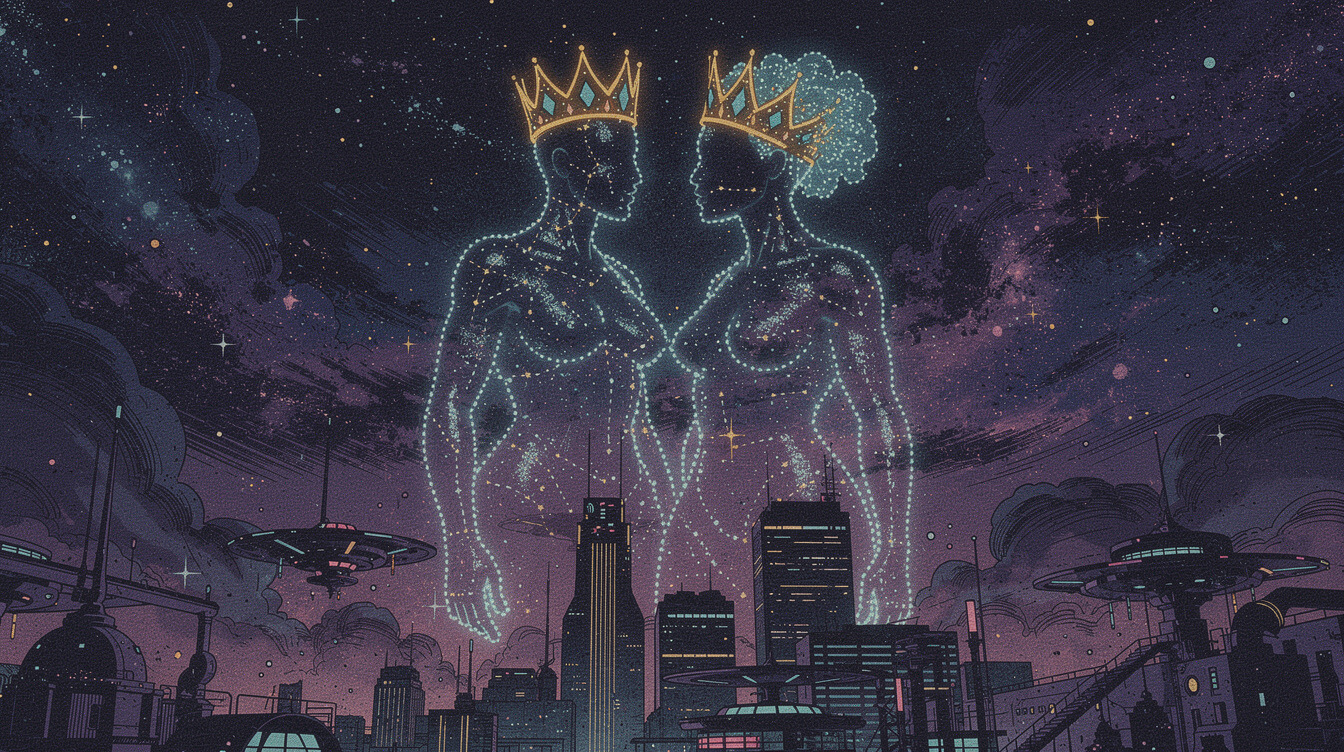
The cover is the legendary one — a literal comic-book panel illustrated by Vincent Carlucci, drawn in the gritty pulp aesthetic of mid-90s Marvel. That comic is the single most-licensed Outkast visual in t-shirt history because it’s perfect for screen printing: thick black lines, flat color blocks, two heroic silhouettes against a star field. If you see an Outkast tee with the comic-book panel printed full-front on heavyweight cotton, that’s the ATLiens shirt. Don’t accept thin polyester knockoffs of this artwork — the cover deserves real cotton.
For a deep read on what made the record so important to the South’s sonic identity, our ATLiens Afrofuturist-pivot retrospective walks through every track, every guest, and the full Earthtone III production philosophy. The album shaped everything that followed — including the masterpiece that came two years later.
Aquemini (1998): The Album Tee That Carries the Most Weight

If you only own one Outkast t shirt in your life, it should reference Aquemini. Released September 29, 1998. Five mics in The Source. Four-times platinum. Title coined from the duo’s astrological signs (Big Boi = Aquarius, Dre = Gemini). Two members, one mind. The Source review went on record calling it “an album so far ahead of its time, we may not catch up in 1999. Or 2000. Or 2001.” They were right — critics are still catching up.
The record was the pivot point of Southern hip-hop. “Rosa Parks” became a #1 R&B/rap single (and triggered a famous lawsuit from Mrs. Parks herself); “SpottieOttieDopaliscious” introduced an entire generation to the idea that a rap song could be a six-minute spoken-word memoir set to live horns; “Da Art of Storytellin’ (Parts 1 & 2)” set a new bar for narrative writing. The album’s visual identity — Dre and Big standing back-to-back on a celestial green field, surrounded by mystical symbology — is the most iconic image in the duo’s discography.
Production-wise Aquemini remains a masterclass: Mr. DJ co-producing as part of Earthtone III, Organized Noize returning for “Rosa Parks” and the horn arrangements on “SpottieOttie,” George Clinton himself dropping a guest verse on “Synthesizer” that sounds like the P-Funk lineage handing the Atlanta kids the keys. Raekwon shows up on “Skew It On the Bar-B,” extending the Southern-East Coast peace treaty Dre had implicitly called for at the ’95 Source Awards. The album’s interludes — barbershop conversations, mock-radio segments, the “Liberation” gospel coda — built a continuous Atlanta sonic environment that no double-disc retrospective has improved on since.
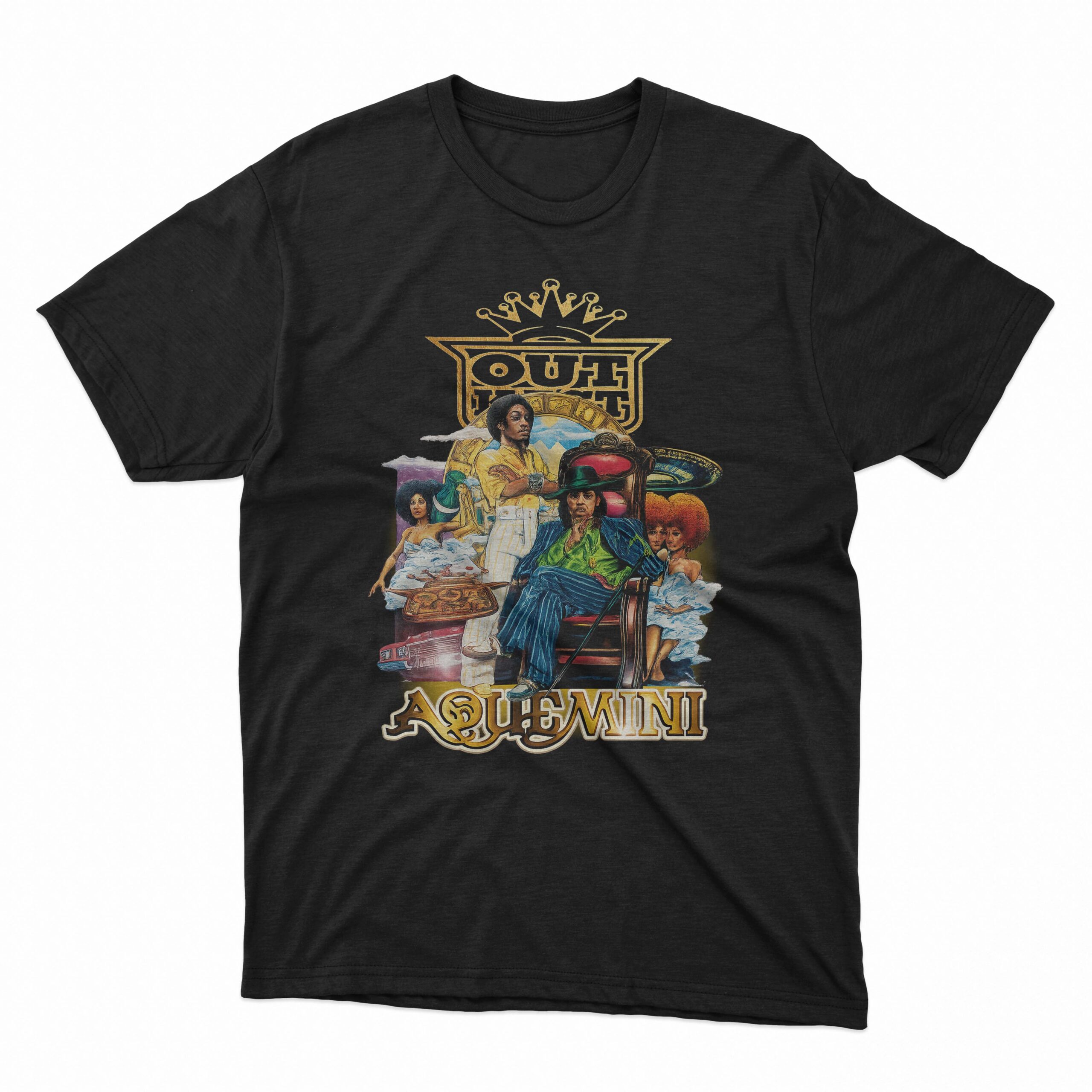
If you want a tee that honors this record, our OutKast Aquemini T-Shirt is exactly what the cover deserves — heavyweight Bella+Canvas 3001, available in Black, Navy, and Chocolate, printed with art that pulls from the album’s mystical iconography rather than just stamping a logo on the chest. It’s the piece for the heads who can quote “Da Art of Storytellin’ Pt. 1” from memory.
For the long-form story behind the record — how the album was almost called something else, why “Y’all Scared” got cut, and which sample on “Liberation” became one of the most-debated production credits of the late 90s — read our Aquemini: The 1998 Masterpiece That Saved Hip-Hop From Itself retrospective. It’s a companion read for anyone wearing the shirt.
Stankonia (2000): The Energy, The Cover, The Boss of the South
October 31, 2000 — Halloween release date, four times platinum, two #1 singles (“Ms. Jackson” and “B.O.B.”), and the album that finally broke Outkast across pop, rock, and electronic-music audiences who’d never paid attention to a rap record before. Stankonia is when the duo stopped being a southern phenomenon and started being a global one. The album was recorded almost entirely in their own newly-built Atlanta studio — also called Stankonia — and the looseness that came from owning the room is audible on every track.
The cover is one of the most identifiable in hip-hop: stark black-and-white silhouette photography of Dre and Big against the inverted American flag, the title rendered in the now-legendary red-white-and-black stripe banner. That stripe is the t-shirt move. Any Stankonia-era tee worth its cotton uses the stripe motif rather than trying to recreate the photo itself. The graphic translates beautifully to screen print — bold, anthemic, instantly readable from across a room. Pair it with selvedge denim or vintage Carhartt and you’re dressed for the era.
Pro tip: avoid the licensed-but-cheap tees that use the album’s track-list rendered as a back print. They were a Hot Topic-era cliché. The front-stripe minimal treatment is what the record deserves.
Speakerboxxx / The Love Below (2003): The Double-Album Tee Conundrum
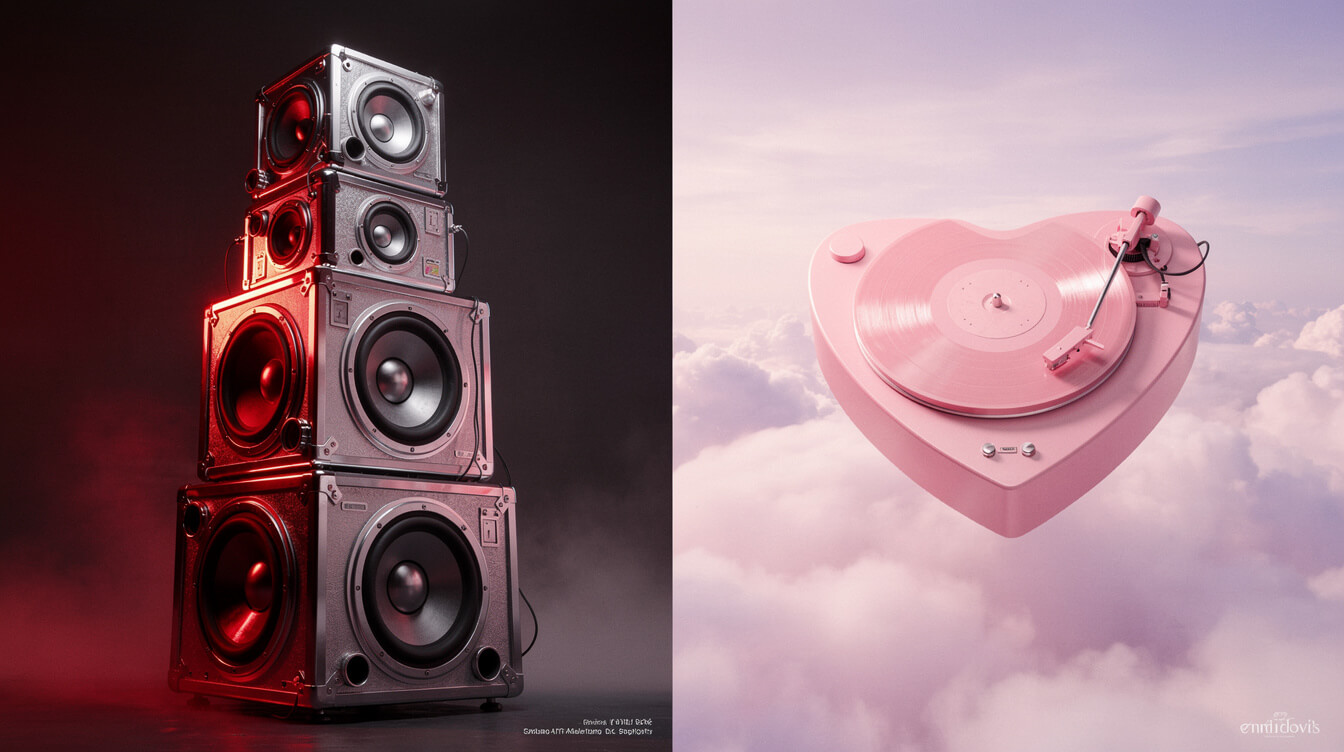
The 2003 double album is the highest-selling and most-decorated record in Outkast’s catalog — 11x platinum, Grammy Album of the Year, “Hey Ya!” and “The Way You Move” both hit #1 on the Billboard Hot 100 — and it’s also the hardest album to design a tee around. Because Speakerboxxx (Big Boi’s solo half) and The Love Below (Dre’s solo half) are two completely different aesthetic universes. Big’s record is brassy funk, club energy, the Atlanta strip-club soundtrack of the early 2000s; Dre’s record is the Stevie Wonder, Prince, Curtis Mayfield, jazz-romance project that pivoted the duo into pop history.
The double-album cover splits Dre and Big into two separate frames — and the best tees from this era do the same. A split-front design (Big’s side in chrome, Dre’s side in pink) is the move. A back print of the full tracklist arc — “Ghettomusick” through “A Day in the Life of Benjamin Andre” — is acceptable if the cotton is heavy enough to carry the ink. The cardinal sin is treating the album as a single visual unit — the music doesn’t ask to be one, and the shirt shouldn’t either.
Honorable mention to the 2006 Idlewild tees, which lean into the speakeasy-jazz visual world of the soundtrack film. They’re niche, they’re hard to find done well, and if you see one, it usually means the wearer is deep in the catalog. Respect.
Frequently Asked Questions About Outkast T Shirts
Are Outkast still together?
Outkast as a recording duo is on indefinite hiatus — their last full-length project was Idlewild in 2006. Big Boi released solo records (Sir Lucious Left Foot in 2010 is essential) and Dre released the flute-instrumental project New Blue Sun in November 2023, his first proper solo album under the André 3000 name. The two reunited briefly for a 2014 anniversary tour but haven’t recorded together since. The catalog is closed for now — which is exactly why the t-shirt market is so alive: the music isn’t being added to, but its cultural weight keeps growing.
What size do Outkast t shirts run?
Most quality hip-hop tees in this catalog use the Bella+Canvas 3001 fit — true-to-size, slightly tapered at the waist, runs an inch shorter than older Hanes-style heavyweight tees. If you want the boxy 90s fit, size up one. If you want a modern fitted look, take your usual size.
Where was Outkast from?
Atlanta, Georgia. Specifically, the East Point and Tri-Cities High School area where Dre and Big met as teenagers in the early 1990s. The whole Dungeon Family — Goodie Mob, Organized Noize, Witchdoctor, Cool Breeze, Big Rube — came out of the same southwestern Atlanta scene. Every Outkast tee is, on some level, an Atlanta tee.
What’s the rarest Outkast t shirt?
Original-tour merch from the Southernplayalisticadillacmuzik and ATLiens tours (1994-1997) is the holy grail — small print runs, often single-color screen prints on Hanes Beefy-Ts, and now selling for hundreds of dollars on the vintage circuit. The 1996 ATLiens “comic panel” tee in particular is a collector’s piece. Modern fan-art tees that draw from those original visuals are the practical alternative for anyone who doesn’t want to spend rent on Grailed.
Should I get an Outkast tee or an André 3000 tee?
If you want the duo as a duo — the funk, the chemistry, the back-and-forth between Dre’s surrealism and Big’s groundedness — get an Outkast piece tied to a specific album. If you want the post-Outkast solo legend (turban-era Dre, the flute records, the fashion archive), an André 3000 piece makes more sense. They tell different stories. For André’s birthday history alongside fellow May-27 birthday-twin Jadakiss, see our May 27 birthdays of André 3000 & Jadakiss piece.
Is the Outkast tee at Target / Hot Topic / Urban Outfitters officially licensed?
The majority of mass-market Outkast merch sold at Target, Urban Outfitters, and Hot Topic in the last five years has been officially licensed through Bravado or Epic Rights — which means the brand mark is legitimate, but the art is usually a logo-only reprint rather than album-era artwork. They’re fine entry-level pieces; they’re not the deep-catalog statement. The boutique tees from independent shops (including ours) are where the album-specific designs live, because the licensing for full cover-art reproduction is far more expensive and less common.
Can I wash a screen-printed Outkast tee in hot water?
No. Cold water inside-out, hang to dry, no fabric softener. Screen-print and DTG ink both crack under heat over time, and the kinds of detailed album-cover prints worth owning have ink-coverage areas that survive much longer with cold-wash care. If you treat the tee like vinyl — slipcase, careful handling, climate-controlled storage between wears — it’ll outlast the trend cycle.
How To Choose Your Outkast T Shirt: A Wardrobe Strategy
If you’re starting an Outkast tee rotation from scratch, here’s the order to build it: Aquemini first (it’s the catalog’s center of gravity), then a Stankonia stripe for the anthemic energy, then ATLiens for the visual story, then a Speakerboxxx split-print if you can find one done right. Southernplayalisticadillacmuzik and Idlewild are for the deep heads — earn those after the core four.
Pair them like you’d pair any record-store-vintage piece: dark denim, broken-in workboots or shell-toes, an unbuttoned overshirt for layering, and a chain that doesn’t try too hard. The point of a great hip-hop tee is that the music does the talking — the wardrobe just sets the room. For more on how album-cover aesthetics shape contemporary streetwear, our 50-year history of the hip-hop album cover traces the lineage from Rapper’s Delight to GNX.
And whatever you do — don’t buy a tee where the cover art is centered on the chest pocket with no context, no era, no story behind it. The catalog deserves better. The duo deserves better. And so do you.
Wear the album the catalog was built around.
Our OutKast Aquemini T-Shirt is built for the heads who can quote “Da Art of Storytellin” from memory. Heavyweight Bella+Canvas 3001 cotton, Black / Navy / Chocolate.
Final Thoughts: The Tee Is The Receipt
An Outkast t shirt is a receipt. It says you came up on Southern hip-hop or that you found it on your own, late. It says you can name an Earthtone III credit or that you’ve held onto the same Aquemini shirt through three apartments. The catalog has given the culture more than thirty years of music, and a good tee just keeps that conversation going.
Buy the album-anchored shirts. Skip the logo-only ones. Wear the era you actually love rather than the one a buyer at a fast-fashion shop guessed would sell. The South has something to say — and your wardrobe should be saying it back.
Get the next album breakdown in your inbox.
Weekly hip-hop catalog deep-dives, era guides, and the occasional drop announcement — written by heads, for heads.

🎧 Never Miss a Drop
Exclusive product releases, hip-hop deep dives, and member-only discounts. Straight to your inbox.
Free forever. No spam. Unsubscribe anytime.
Get the Culture, Delivered
Deep dives into hip-hop history, exclusive product drops, and discounts sent straight to your inbox. No spam, just culture.
Join 2,000+ hip-hop heads already in the loop. Unsubscribe anytime.