90s Hip Hop Fashion Female: The Era-by-Era Style Bible for the Women Who Built the Look
90s hip hop fashion female style wasn’t a sidebar to the men’s era — it was its own revolution running parallel, often louder, and with sharper rules. From Salt-N-Pepa’s asymmetric bobs and four-finger nameplate rings in 1988, to Lauryn Hill’s natural-hair classroom photo on Miseducation in 1998, the women of golden-age hip-hop built a wardrobe vocabulary that the industry still steals from in 2026. This is the deep cut on the era — the designers, the magazines, the stylists, the brands, and the cultural fights that put these looks on the front of The Source, Vibe, and MTV in the first place. Forget the listicle on top of Google. This is the receipts version.
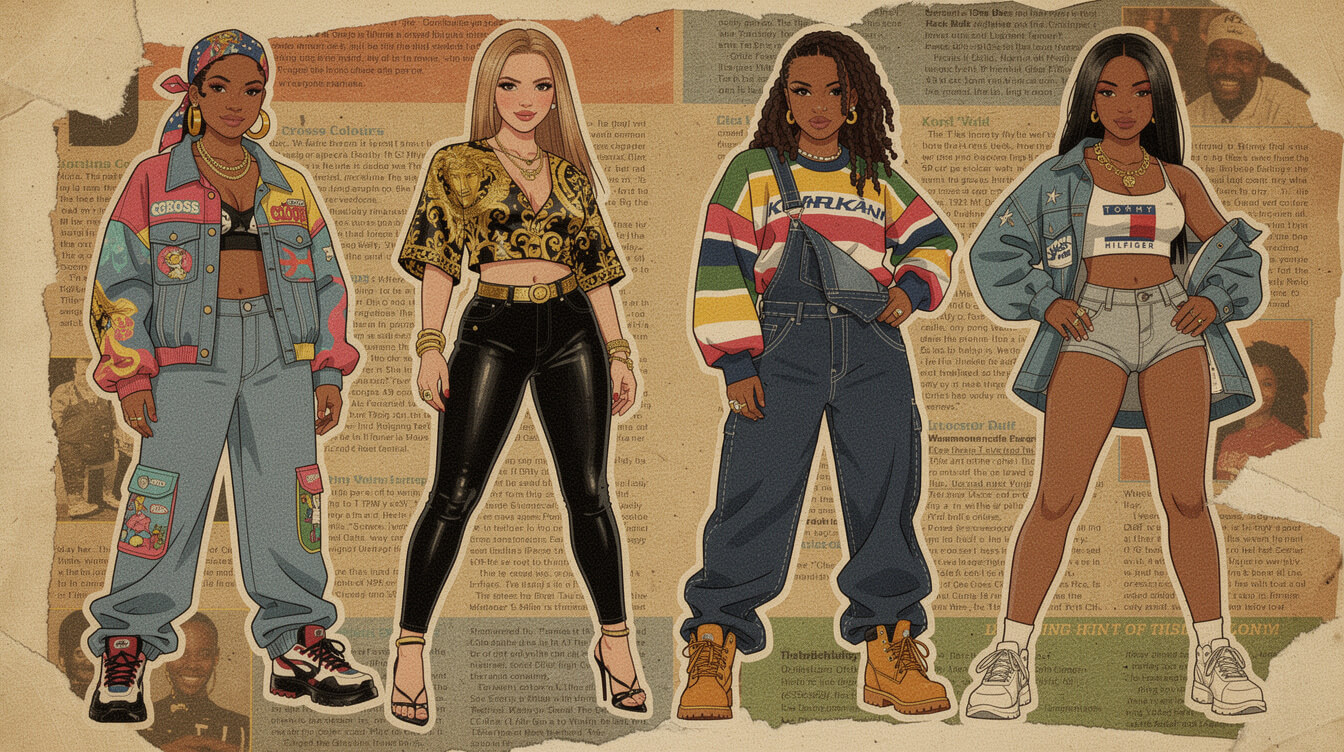
Across this guide we’ll walk the four phases of 90s hip hop fashion female aesthetics — pioneer punk, Native Tongues bohemian, Bad Boy luxury, and Aaliyah-era tomboy chic — then close with the Black-owned brands that actually cut and sewed these silhouettes, and the FAQs that come up every time the era trends on TikTok again.
Why 90s Hip Hop Fashion Female Style Was a Cultural Force, Not a Sidebar
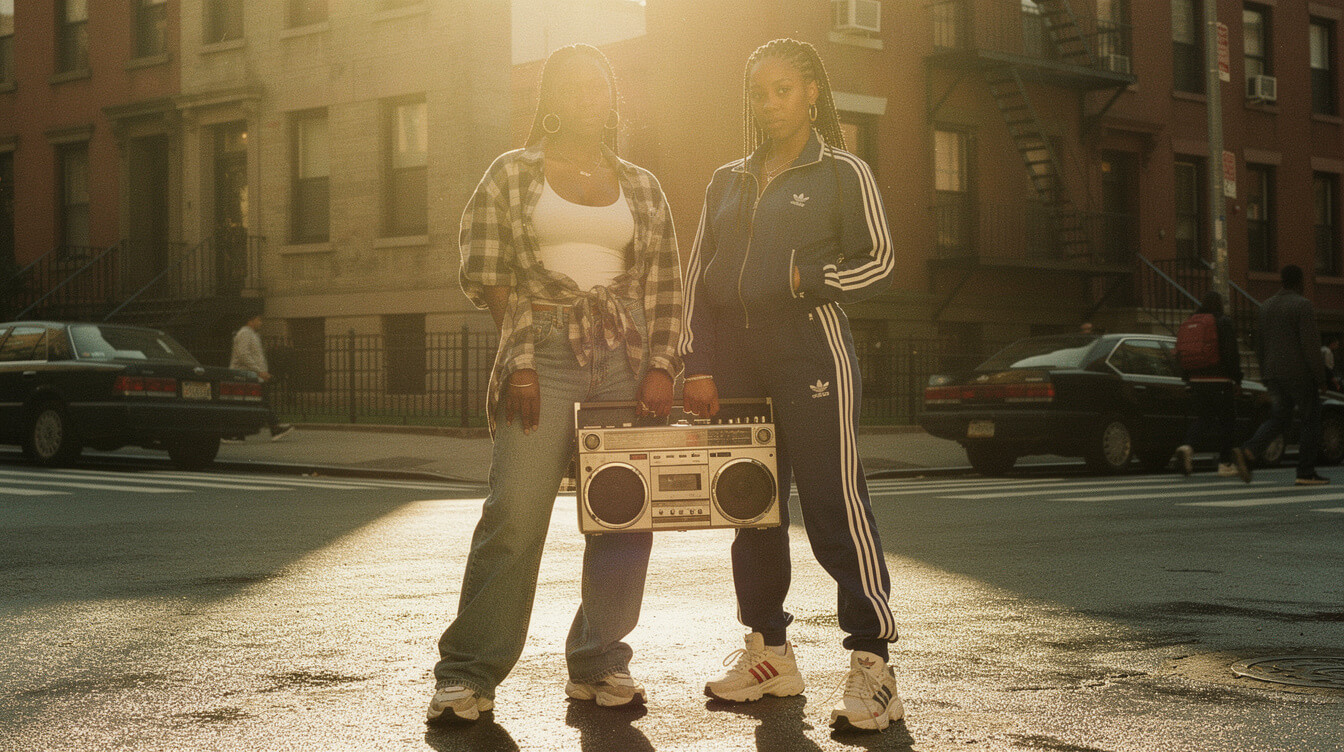
For most of pop history, women’s fashion in a music genre is treated as a derivative — what the men wore, but smaller, tighter, more accessorized. That framing doesn’t survive five seconds of looking at Roxanne Shanté in 1985, Sweet Tee in 1988, or any photo of Yo-Yo and Ice Cube together in 1991. Female emcees and Black women fans built 90s hip-hop fashion in parallel, drawing from sources the men didn’t have access to: the Black hair-salon economy of New York, Philly, and Atlanta; the church-hat / Sunday-best tradition; the African-medallion bohemianism of Brooklyn block-party DJs; the Bronx ballroom voguing scene; and the working-mom durability of double-stitched denim and Reebok Freestyles. The result was a uniform that simultaneously had to telegraph cultural authority and survive a 14-hour shift, and the look they landed on still defines what “fashion” means in 2026 streetwear.
The receipts are in the magazines. YSB, The Source, Sister 2 Sister, Honey (launched 1998 by Joicelyn Dingle and Kierna Mayo), and the early issues of Vibe built entire editorial spreads around Black women in hip-hop fashion that the white mainstream — Vogue, Harper’s Bazaar, Cosmo — wouldn’t touch until at least 1997. The fashion was deemed too loud, too urban, too gendered. So Black-owned magazines and Black-owned ad agencies built the visual canon themselves. By the time Tommy Hilfiger figured out in 1994 that putting Aaliyah in an oversized red-white-and-blue logo set sold more units than any model in the history of his brand, the canon was already a decade old.
Crucially, the women of 90s hip hop fashion also kept the men’s fashion honest. Lil Kim’s Versace silk catsuit at the 1999 VMAs forced Diddy and Mase to step their tailoring up. Mary J. Blige in combat boots, a leather Africa medallion, and a cropped jersey on the What’s the 411? tour set the template that Pharrell, Tyler, and now A$AP Rocky still riff on. You can’t tell the story of the men’s era without the women — and you can’t tell the women’s story by ranking outfits.
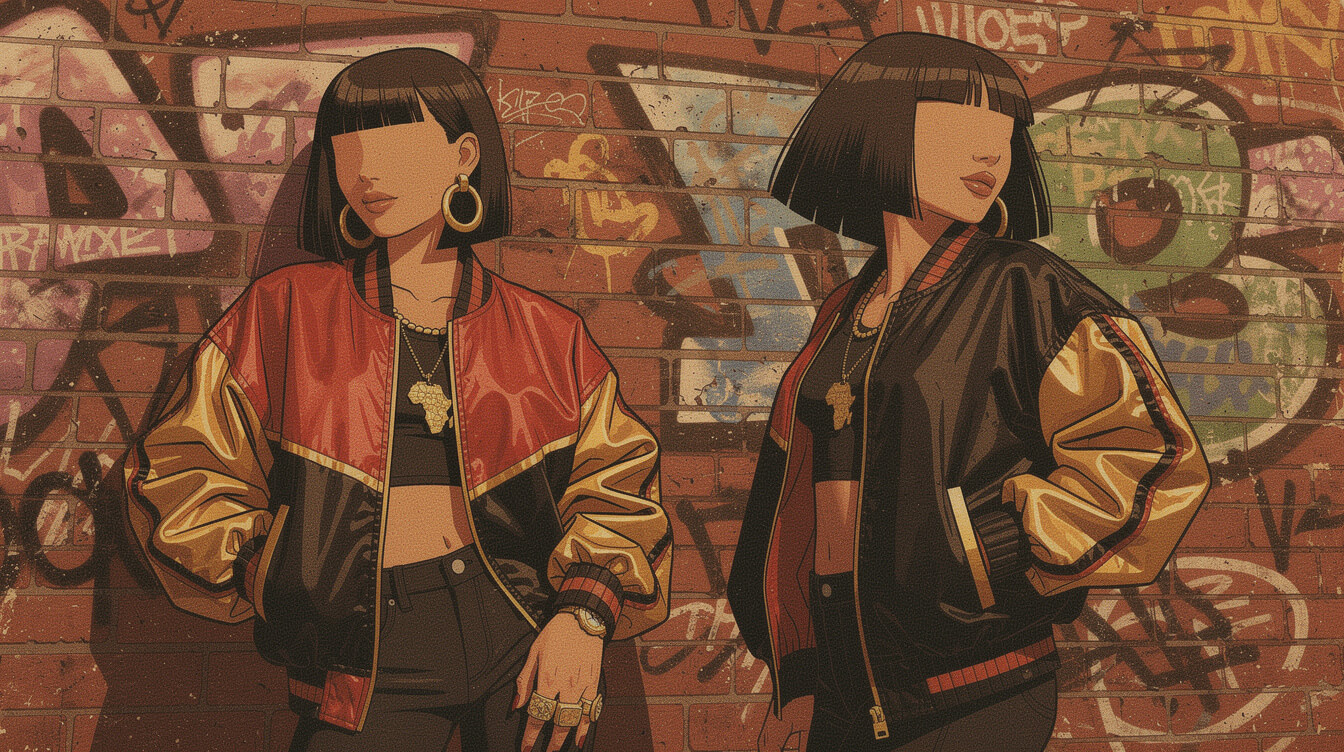
The Pioneers of 90s Hip Hop Fashion Female Style (1986–1990): MC Sha-Rock, Salt-N-Pepa, and the Asymmetric Bob Revolution
The first wave was the Funky Four Plus One More’s MC Sha-Rock — the first commercially recorded female emcee, on the 1980 Sugar Hill release “That’s the Joint” — and her look was already the blueprint: high-top fade, large gold earrings, leather coat, sneakers. By the time Salt-N-Pepa dropped Hot, Cool & Vicious in 1986 and the “Push It” video in 1987, that look had hardened into a signature: oversized neon-and-black bomber jackets (made by the Brooklyn-based shop Dapper Dan and his copycats), gold bamboo door-knocker earrings the size of a CD, four-finger nameplate rings spelling out S&P, and the asymmetric bob — one side shaved down, the other side falling to the chin — that the hairstylist Laurie Wright built around the group and that became the single most-imitated Black women’s hairstyle of the decade.
The pioneer-era uniform did three jobs at once. It signaled MC authority (the chains, the rings, the gold — borrowed straight from the men’s playbook but bigger, louder, brighter). It signaled Black femininity on Black-women’s terms (the asymmetric cut, the press-and-curl variations, the long acrylic nails painted by Asian-American nail technicians in Queens). And it signaled durability — these were stage clothes that had to survive 90-minute high-energy sets in front of crowds that often included rowdy male peers who needed to be visually outranked. Cheryl “Salt” James and Sandra “Pepa” Denton chose neon and metallic specifically because the colors photographed well under the cheap stage lighting of the chitlin-circuit clubs they came up in.
MC Lyte, debuting in 1988 with Lyte as a Rock, took the same vocabulary in a colder direction. Where Salt-N-Pepa went neon, Lyte went monochrome: black bomber, black jeans, black Pumas, gold rope chain, gold-rimmed Cazals. Her engineer Audio Two was her brother King of Chill, and the family aesthetic was Brooklyn-East-Flatbush hard-rock minimalism, the polar opposite of the Queens flash. The split between Lyte’s restraint and Salt-N-Pepa’s exuberance was the first big internal debate of 90s hip hop fashion female styling: minimalism versus maximalism. Every era of women’s hip-hop fashion since has been a remix of that same fork.
If you want the prehistory of all this, our eighties hip-hop fashion deep dive walks the men’s foundation that this era simultaneously borrowed from and exploded outward.
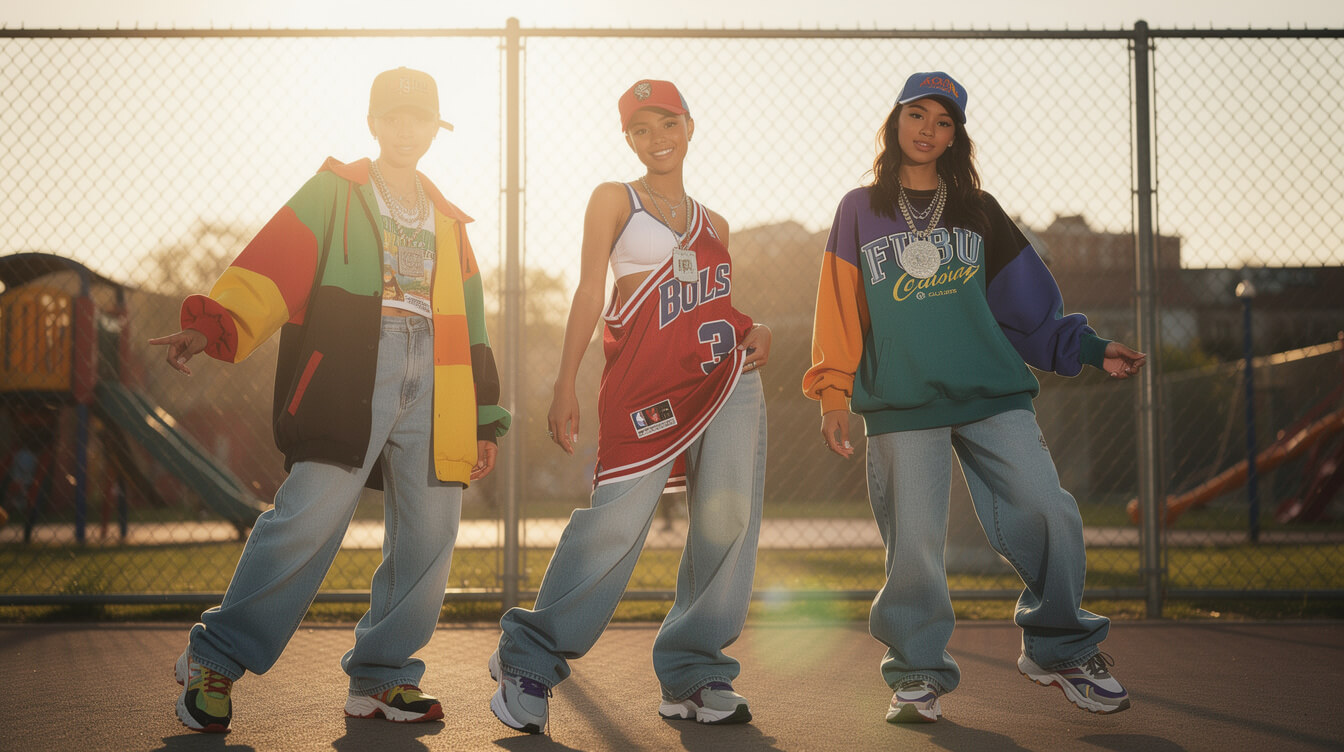
The Native Tongues Bohemian Era (1990–1993): Queen Latifah, Monie Love, and Conscious-Era Style
While Salt-N-Pepa were turning Queens into a global fashion lab, a parallel current ran out of Brooklyn and New Jersey — the Native Tongues collective. A Tribe Called Quest, De La Soul, Jungle Brothers, and the women orbiting them — Queen Latifah, Monie Love, Lyte Funkie Ones-era Bahamadia, and Apache’s running mate Tashira Norman — built a softer, weirder, more Afro-centric wardrobe that flat-out rejected the gold-rope minimalism of the early MCs.
Queen Latifah’s 1989 All Hail the Queen cover photo by Eli Reed is the document. She’s in a kente-cloth crown, a kente-cloth scarf draped across the shoulder, no jewelry. The look is regal, anti-glamour, deeply Afrocentric. By 1991’s Nature of a Sista’, Latifah had added an oversized navy-blue army surplus blazer with leather elbow patches, baggy paint-splattered jeans, and Doc Martens — a wardrobe that previewed nearly every “Black bohemian” aesthetic of the 2010s. The credit for the styling goes to her then-manager Sha-Kim “Shakim” Compere and a Newark-based stylist named Yvette Romero who would go on to dress Erykah Badu in the late 90s.
Monie Love, the British emcee who linked up with Native Tongues after the 1989 Queen Latifah “Ladies First” duet, brought a London-by-way-of-Jamaica spin: long box braids with cowrie shells, tartan kilts over baggy black jeans, and Adidas Gazelles. Her 1990 Down to Earth album cover, shot by Janette Beckman, set the visual rule that British and Caribbean female MCs could enter the American hip-hop fashion conversation through accessory specificity — the cowrie shells, the kilt, the very-British DM boots — without copying the New York uniform wholesale.
The Native Tongues era is also where the African medallion — wood, brass, leather-cord — went from men’s accessory to a clearly femme-coded statement. By 1992, you couldn’t get a photo of Lauryn Hill at a Fugees rehearsal without one. By 1996, the medallion would migrate from a literal pendant to a tattooed motif, and by 1998 it would become a Mary J. Blige headwrap-and-beadwork callback. The throughline is uninterrupted.
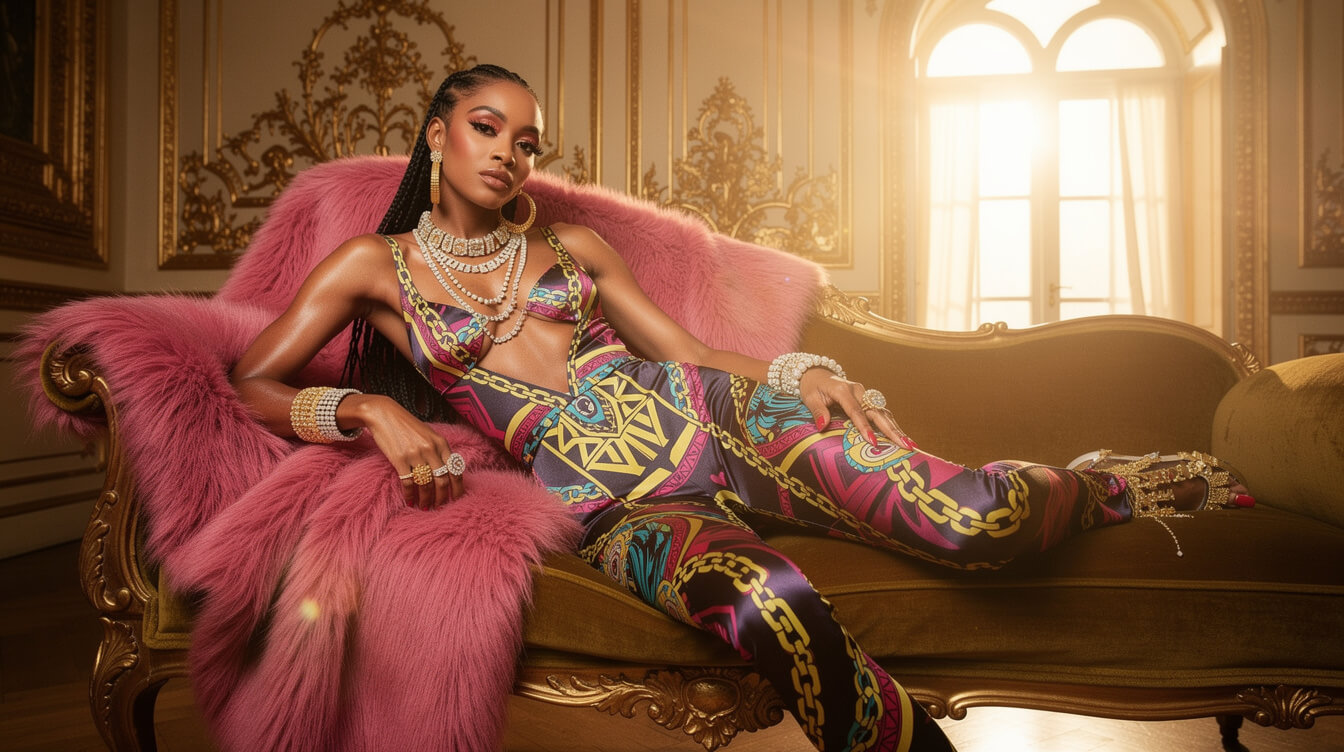
The Bad Boy Glow-Up (1995–1997): Lil Kim, Mary J. Blige, and the Versace Era
Bad Boy Records, founded by Sean “Puffy” Combs in 1993 in a Lefrak City office in Queens, fundamentally rewrote how Black women in hip-hop could dress. The label’s two flagship women — Mary J. Blige and Lil Kim — and the third star in Faith Evans, who married Notorious B.I.G. in 1994 — collectively built what fashion historians now call the “Bad Boy Glow-Up.” The previous decade’s rules said female emcees dressed tough, dressed minimal, or dressed Afrocentric. Puffy and his stylist Misa Hylton-Brim — a 19-year-old Black woman from Mount Vernon who would later marry Kim’s manager and dress Aaliyah, Mariah, and Missy — said the women would dress like they were the wealthiest people on Earth.
Misa Hylton-Brim’s 1996 styling of Lil Kim for the cover of Hardcore — the squat pose, the leopard-print bikini, the matching pasties — was a deliberate provocation, but the deeper move was the next 18 months of red-carpet looks: the lavender Versace bunny-fur jumpsuit at the 1999 MTV Awards (with the pasty in the cutout still being copied by 2026 stylists), the Chanel-monogrammed wig-and-pearl-mask combination at the 1999 VMAs that gave Kim her own dedicated Vogue spread, and the Donatella Versace personal-friendship arc that put Kim in haute couture custom pieces years before any other Black woman in pop. The strategy was: take European luxury, refuse to pay deference to it, and make the brand chase the artist.
Mary J. Blige, meanwhile, ran the parallel-but-opposite play. Her stylist on What’s the 411? (1992) was Sybil Pennix, who put Mary in combat boots, a hockey jersey, a leather Africa medallion, and the iconic blonde finger waves — a look that signaled I came from Yonkers, I’m not pretending I didn’t. By the time of Share My World (1997), Mary had upgraded to custom Karl Kani three-piece suits, suede Versace Chelsea boots, and the trademark blonde flips, but the working-class throughline never broke. Vogue’s Anna Wintour famously sat next to Mary at the 1998 VMAs and admitted later that Mary’s wardrobe taught her that streetwear and luxury weren’t separable categories.
The luxury moment didn’t just rewrite fashion — it rewrote the lyrical pen, and that lineage is alive in 2026. When we built our Rapsody The Idea of Beautiful T-Shirt, we did it because Marlanna Evans is the direct descendant of the Bad Boy-era women who refused to choose between bars and beauty — her North Carolina debut album lives in the same emotional ZIP code as Mary, Foxy, and Kim, just with 2012 microphones.
The Bad Boy era also weaponized the rented private jet, the styled-out tour bus, and the magazine cover. Faith Evans’s Faith album cover, shot by Marc Baptiste in 1995, was the first Vibe magazine cover of a female R&B/hip-hop hybrid artist in a Chanel suit. The image traveled. Within 18 months every Black woman in pop — Brandy, Monica, Janet, Whitney — had a Chanel-adjacent magazine cover in her press kit.
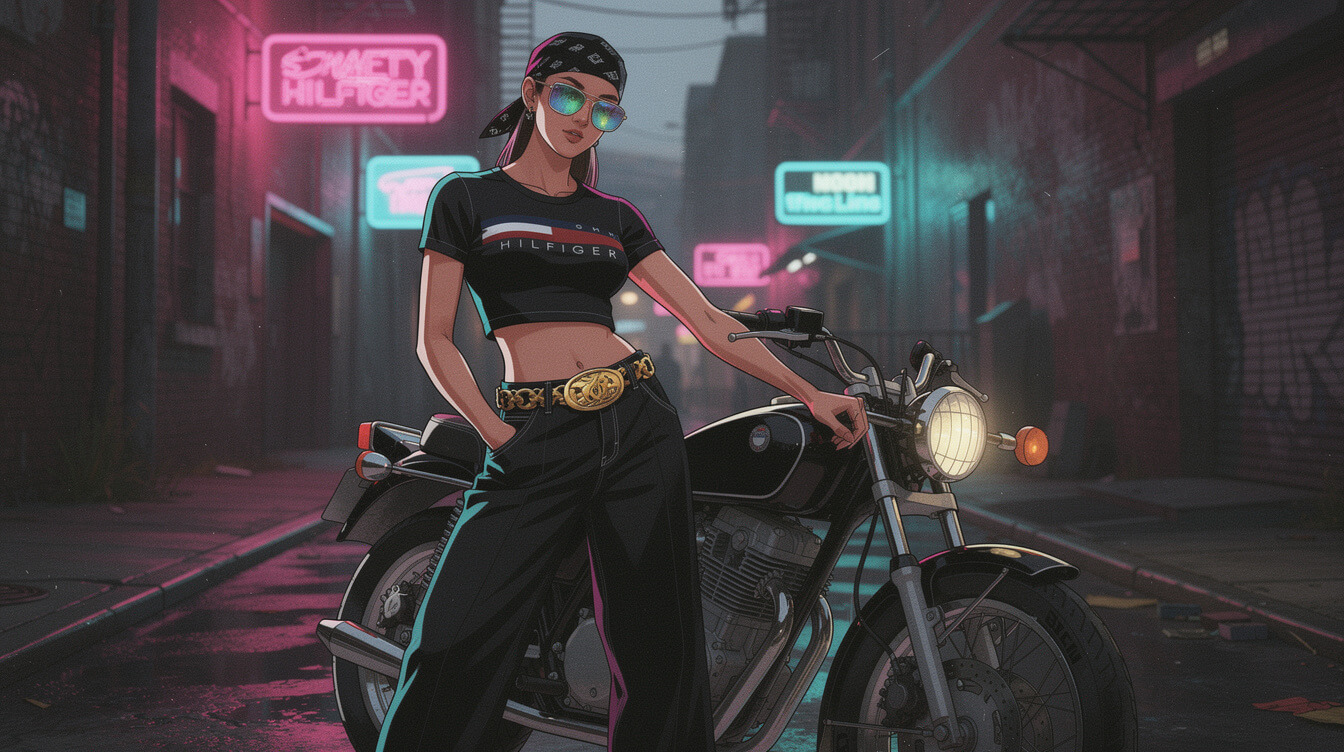
Aaliyah and the Tomboy-Chic Blueprint (1996–2001)
Parallel to the Bad Boy luxury moment, Aaliyah Dana Haughton — signed to Jive at 12, dropped by R. Kelly’s Blackground at 14, picked up by Missy Elliott and Timbaland at 17 — built the single most-copied silhouette of 90s hip hop fashion female history. The look: baggy low-rise Tommy Hilfiger jeans worn with the boxer briefs deliberately showing, an oversized matching Tommy logo crop-top or sports bra, a black bandana tied across the forehead, a long black side-part with one swoop covering the right eye, mirrored aviator sunglasses, and military combat boots or Air Force 1s.
The stylist of record was Misa Hylton-Brim again — the same Misa who had styled Lil Kim’s Versace bunny suit was simultaneously running a polar-opposite play for Aaliyah. Where Kim went hyper-feminine luxury, Aaliyah went sexy tomboy. The Tommy Hilfiger partnership was sealed when 17-year-old Aaliyah walked the Spring 1997 New York runway in the boxer-briefs-out outfit and Hilfiger’s stock jumped 32% that quarter. The look — eventually nicknamed “the Aaliyah” by stylists — has been worn on red carpets by Rihanna, Beyoncé, Solange, Zendaya, Sza, Lola Young, Latto, Doja Cat, and yes, every single 2024 TikTok 90s-style influencer.
The technical move was specific. Aaliyah’s tomboy-chic wasn’t just “wear men’s clothes.” It was tailored men’s clothes — Hilfiger’s design team, working with Misa, cut the boxer briefs an inch lower in the back so the visible-waistband look had a deliberate proportion. The crop tops were two sizes smaller than the jeans were two sizes larger, deliberately. Aaliyah’s silhouette was a cinched-waist hourglass made entirely out of relaxed-fit basics, and the technical complexity of that proportion is why every imitator since has had to study the photographs. Her 1996 BET Awards red-carpet look, shot by Albert Sanchez, is in the permanent collection of the Costume Institute at the Met for a reason.
For the full cultural context on Aaliyah’s contemporaries in the women’s hip-hop pen, see our complete guide to Lauryn Hill’s discography — Lauryn was the only 90s woman who consciously rejected both the Bad Boy luxury play and the Aaliyah tomboy play, building a third aesthetic of head-wraps, kente-print blouses, and natural hair that prefigured the entire 2010s natural-hair movement.
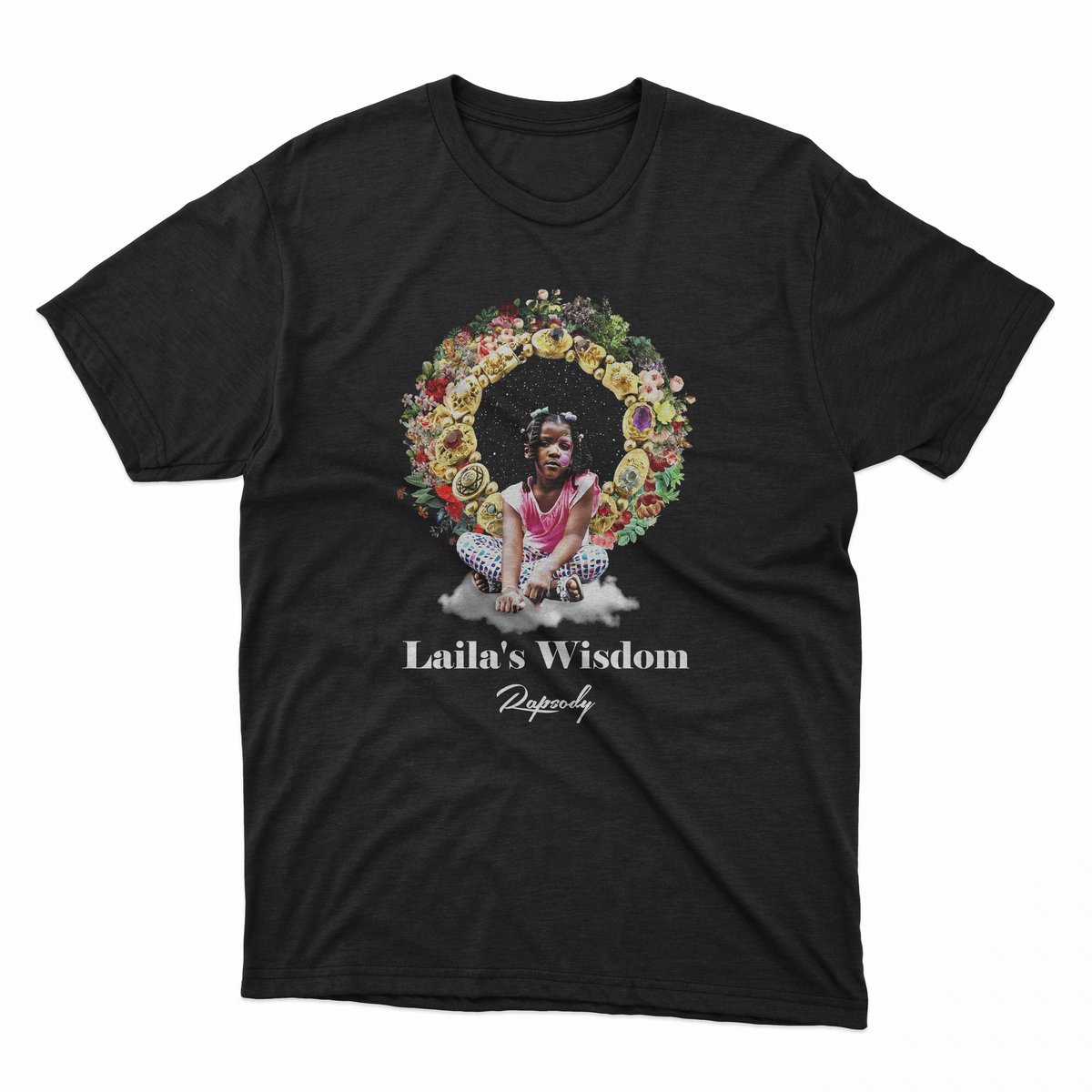
Carry the Lineage on Your Chest
Rapsody named her sophomore album after her grandmother. Lauryn put The Miseducation in a wood-cut classroom photo. MC Lyte stood next to Patti LaBelle on her first cover. The women of hip-hop have always built fashion around legacy — wear it loud.
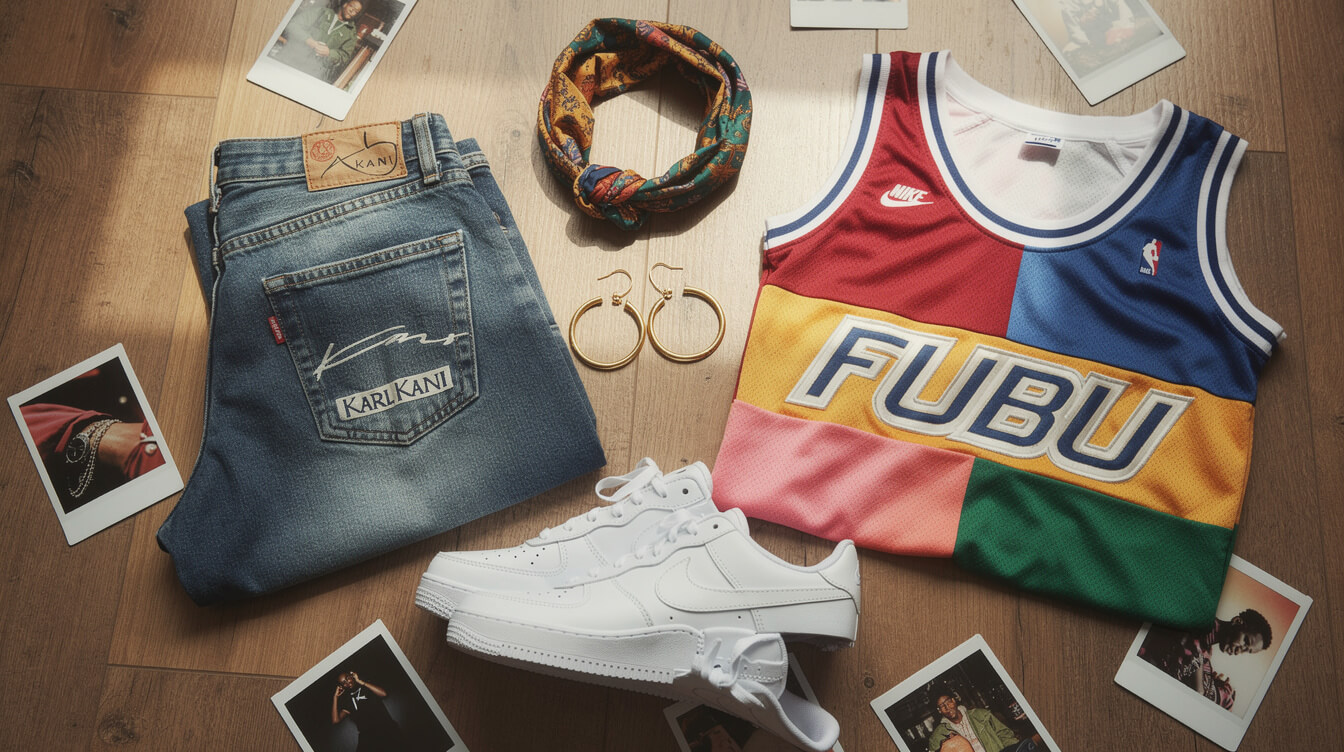
The Black-Owned Designers Who Actually Dressed These Women: Karl Kani, FUBU, April Walker, Cross Colours
Nothing about the 90s hip hop fashion female canon would have existed without the four Black-owned brands that cut and sewed the silhouettes. The men’s-fashion conversation tends to credit the brands by their founders’ names — Karl Kani, the FUBU four — but the women’s side adds two critical names the canon often skips: April Walker of Walker Wear and Carol “C.J.” Jackson of Cross Colours.
Karl Kani, founded by Carl Williams in 1989 in Brooklyn, was the first Black-owned brand to put women in oversized denim cuts that weren’t just men’s sizes shrunk down. His 1993 women’s line — designed with input from his stylist sister Lyric Williams — introduced the curved low-rise denim block that became the template for every Aaliyah-style baggy jean of the decade. Aaliyah, Mary J. Blige, and TLC all wore Kani head-to-toe across the 1994–1997 stretch, and the brand’s revenue went from $34 million in 1993 to $58 million in 1995 largely on the women’s volume.
FUBU — For Us, By Us — founded by Daymond John, J. Alexander Martin, Carl Brown, and Keith Perrin in Hollis, Queens in 1992, is best known for the men’s jerseys, but the brand’s women’s-line launch in 1995 (a partnership with stylist Sybil Pennix, the same Sybil who styled Mary J. Blige) was where the durable cropped-jersey-and-overalls look came from. The 1996 FUBU women’s spring catalog, shot by Eric Johnson, is the single best visual document of mid-decade women’s hip-hop streetwear that exists.
Cross Colours, founded by Carl Jones and T.J. Walker in Los Angeles in 1989, was the chromatic anchor of the era. The brand’s “Clothing Without Prejudice” tagline meant pan-African red-yellow-green-and-black color blocking across every garment, and the women’s pieces — overalls, baggy jeans, color-block hooded tees — were the official uniform of Yo-Yo, MC Lyte’s “Cha Cha Cha” video, and TLC’s Ooooooohhh… On the TLC Tip press cycle in 1992. By the time Cross Colours hit $80 million in sales in 1993, the women’s line was outselling the men’s two-to-one.
April Walker’s Walker Wear, founded in Brooklyn in 1991, is the under-credited fourth pillar. April Walker — a Black woman designer working in a male-dominated streetwear industry — is the person who put Run-DMC in their later-90s suits, but she also designed the custom three-piece suits Mary J. Blige wore on Share My World, the leather pants Queen Latifah wore in the “U.N.I.T.Y.” video, and the entire wardrobe of TLC’s Crazy Sexy Cool press cycle in 1994. Walker is the woman behind some of the most-copied silhouettes of the entire era, and her name is missing from 80% of the fashion-history coverage of 90s hip hop. If you read one footnote in this whole guide, make it that one. For more on how this era’s sweatshirt and outerwear designs influenced modern streetwear, see our 46-year history of the rapper sweatshirt.
Frequently Asked Questions About 90s Hip Hop Fashion Female Style
What were the must-have items of 90s hip hop fashion for women?
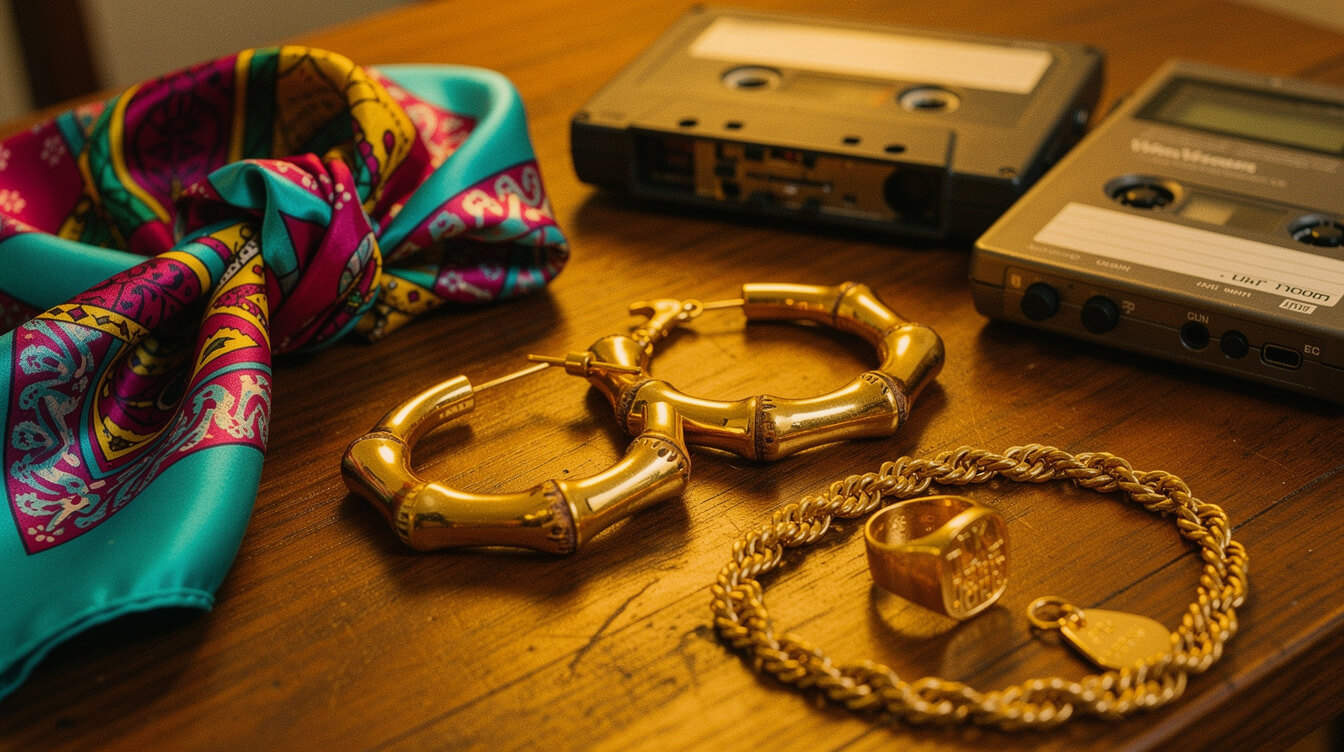
The non-negotiables: oversized bamboo door-knocker gold earrings (preferably 3 inches or larger), a four-finger gold nameplate ring, a baggy low-rise pair of jeans (Karl Kani, Tommy Hilfiger, or FUBU were the brand-name standards), an oversized cropped jersey or sports-team tee, Air Force 1s or Reebok Freestyles or combat boots, a bandana or silk headscarf, and a thick gold rope chain. By 1996–1997, you added a Versace-print silk crop top or matching set if you were doing the Bad Boy luxury play, or a fitted Tommy Hilfiger logo set if you were running the Aaliyah tomboy track.
Who is the most influential female hip-hop fashion icon of the 90s?
Honest answer: it’s a tie, and the tie is by era. For 1988–1992, Salt-N-Pepa (specifically Pepa’s asymmetric bob and the matching neon bomber jackets) is the most-imitated look. For 1993–1995, MC Lyte and Queen Latifah ran the minimalist and Afrocentric flagship looks. For 1996–1997, Lil Kim’s Versace luxury moment generated the most magazine covers. For 1996–2001, Aaliyah’s tomboy-chic generated the most lasting imitation — the silhouette is still being copied in 2026, twenty-five years after her death. If you forced a single name, it’s Aaliyah, because her influence has the longest tail.
Why is 90s hip hop fashion for women trending again in 2026?
Three converging reasons. First, the children of the original 90s rap fans are now in their teens and 20s and are mining their parents’ closets for Y2K-adjacent fashion — TikTok’s “Aaliyah core” and “Lil Kim core” hashtags have a combined four billion views as of mid-2026. Second, the high-end fashion houses — Marc Jacobs, Versace, Tommy Hilfiger — have explicitly revived their 90s collaborations with hip-hop styling, with the Tommy x Aaliyah Estate capsule in 2024 selling out in 11 minutes. Third, the rise of female emcees like Latto, GloRilla, Doja Cat, Megan Thee Stallion, and Cardi B has put the 90s template back on the red carpet — Cardi’s 2024 VMAs Versace bunny-suit homage to Lil Kim was the most-screenshotted fashion moment of that calendar year.
What’s the difference between 80s and 90s hip hop fashion for women?
The 80s women’s hip-hop look (Roxanne Shanté, MC Sha-Rock, Sweet Tee, very early Salt-N-Pepa) was a direct borrow from the men: leather jackets, gold rope chains, Adidas tracksuits, asymmetric bobs in their first iteration. The 90s split into four parallel tracks — pioneer-era hardness, Native Tongues bohemian, Bad Boy luxury, and Aaliyah tomboy-chic — none of which mapped to a male equivalent. The 90s also added two technologies the 80s didn’t have: the Black-owned design houses (Karl Kani, FUBU, Cross Colours, Walker Wear) and the Black-owned fashion magazines (Honey, Sister 2 Sister, later Suede). The 90s is when women’s hip-hop fashion became a self-contained industry rather than a derivative.
Where can I find authentic 90s hip hop fashion pieces today?
Vintage Karl Kani, Cross Colours, and FUBU pieces from 1992–1996 routinely sell on Grailed and Depop in the $200–$1,200 range for jackets, $80–$400 for jeans. April Walker’s Walker Wear has been re-issued in limited-edition drops through Walker’s own site. For modern wearable callbacks — artist-tribute tees that channel the era’s energy without paying $400 for a vintage jersey — independent streetwear shops like ours are where the lineage lives now. Our era-by-era 90s hip-hop fashion blueprint covers the broader men’s-side context and links to the apparel that draws on this canon.
Why the 90s Set the Bar — and Why the Women Set the Highest Part of It
The thirty-year retrospective on 90s hip hop fashion female style keeps clarifying one thing: the women’s side of the era wasn’t an accessory to the men’s. It was the more fashion-literate, more globally aware, more design-sophisticated half of the decade. The Bad Boy women had personal relationships with Donatella Versace and Karl Lagerfeld before the men did. The Native Tongues women were the first to introduce kente cloth and African textiles into US street style. Aaliyah’s Tommy Hilfiger partnership was the single most-profitable streetwear collaboration of the entire decade for any artist of any gender. And the Black-owned design houses — Karl Kani, FUBU, Cross Colours, Walker Wear — were quietly running a $300+ million-a-year industry that the mainstream fashion press refused to cover until well into the next millennium.
When you see Beyoncé in a Tommy-logo crop top, when you see Latto in a Versace bunny suit, when you see Doja Cat in a Karl Kani throwback, when you see a TikTok creator in a tightly tied bandana headband and door-knocker hoops — you’re watching a thirty-year transmission. The women who actually built this style — Misa Hylton-Brim, Sybil Pennix, Yvette Romero, April Walker, Lyric Williams, Joicelyn Dingle, Kierna Mayo, and every Black woman fashion editor whose name didn’t make the magazine masthead — invented an entire visual vocabulary. The least we can do is read the credits.
Cultural Receipts, Delivered Weekly
Get our hip-hop history deep dives, anniversary breakdowns, and first dibs on new artist tee drops. No spam, just culture.

🎧 Never Miss a Drop
Exclusive product releases, hip-hop deep dives, and member-only discounts. Straight to your inbox.
Free forever. No spam. Unsubscribe anytime.
Get the Culture, Delivered
Deep dives into hip-hop history, exclusive product drops, and discounts sent straight to your inbox. No spam, just culture.
Join 2,000+ hip-hop heads already in the loop. Unsubscribe anytime.