Kool Keith’s Black Elvis: The Spaceborne Rock-Star Album Sony Couldn’t Sell (And the 24-Year Sequel That Finished It)
Type black elvis kool keith into a search bar and you get the surface-level version: a 1999 album, a weird alias, a footnote between Dr. Octagon and whatever Keith did next. That version is wrong — or at least, it’s the story Sony wanted you to have. The real one is stranger and better. Black Elvis/Lost in Space is the closest thing Kool Keith ever made to a pop record, and his label buried it on purpose, and twenty-four years later he came back and finished the job himself.
This is the whole story — the wig, the two albums released as one statement, the protest tracks where Keith leaked his own label’s emails, the posthumous Roger Troutman verse nobody talks about, and the 2023 sequel that quietly vindicated everything. If you came in through our Kool Keith biography hub, consider this the deep-dive on the record that defines his relationship with the music industry.
Two Albums, One Wig: The Black Elvis / Dr. Dooom Double Move

Here is the thing every retrospective gets wrong by treating these as two separate solo records: in 1999, Kool Keith dropped two full-length albums under two different personas, and they were designed to be read together. Black Elvis/Lost in Space was the commercial Keith — major label, self-produced, pop-leaning, an intergalactic rock star you could theoretically put on the radio. First Come, First Served, released as Dr. Dooom, was the anti-commercial Keith — a horrorcore concept record that opens with Dr. Dooom literally murdering Dr. Octagon to clear the table.
The tell is the prop. For the promo photos, Keith used the same rubberized Elvis Presley wig for both the Black Elvis shoots and the Dr. Dooom material. One piece of costume, two opposite records, one coordinated artistic statement: here is Keith the marketable star, and here is Keith burning the marketable star to the ground. The two albums were reportedly meant to land close together — a his-and-his diptych about what the industry wants from him versus what he’ll actually give them. Sony’s delays scrambled the timing, but the intent survives in the artifacts. You don’t share a wig between two characters by accident.
Keith had been building toward this since the 1980s. Before any of the aliases, he was the most dizzying lyricist in Ultramagnetic MCs, a Bronx crew whose Critical Beatdown rewired what a rapper could sound like. The personas didn’t come from nowhere — they came from a writer who’d already proven he could out-rap anyone and got bored doing it straight.
Who Is Black Elvis? Kool Keith’s Intergalactic Little Richard

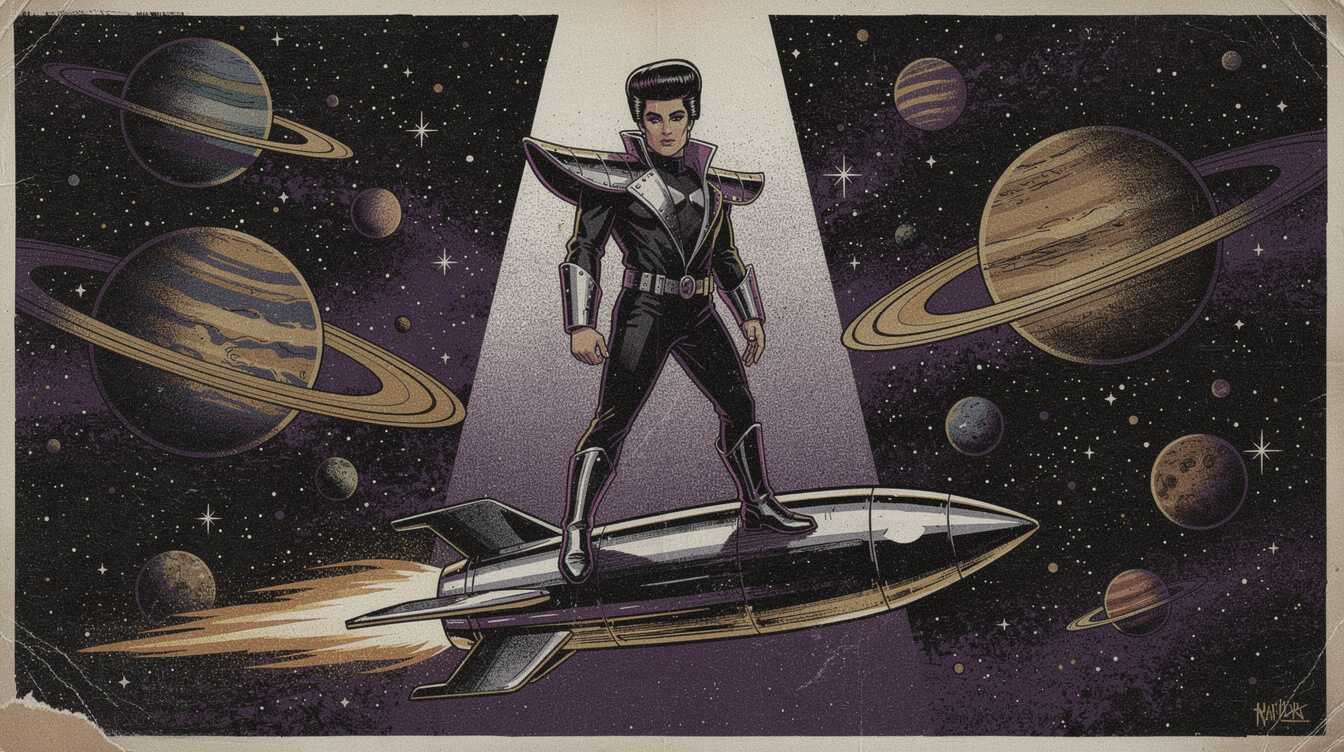
AllMusic’s John Bush nailed the character in five words: “an intergalactic Little Richard.” Black Elvis is a megalomaniac rock star who happens to live in the future and tour between planets. He’s not a rapper playing a rapper — he’s a rapper playing a stadium-filling space megastar who is mildly annoyed that you don’t already know this about him. The braggadocio isn’t hip-hop flexing; it’s rock-god entitlement, the kind of unearned cosmic confidence that’s funny and a little menacing at the same time.
What makes the persona land is that it’s Keith’s most accessible mask. Dr. Octagon is a time-traveling extraterrestrial gynecologist-surgeon — gloriously unsellable. Dr. Dooom is a cannibal landlord. Black Elvis, by contrast, is a recognizable archetype: the egomaniac performer. You can hum the hooks. There are actual songs here, with choruses, built to be performed for crowds. That accessibility is exactly what makes the label’s failure to sell it so damning. Keith handed Columbia the most radio-shaped version of himself he would ever record, and they still couldn’t figure out the box it went in.
The Album in Two Halves: Lost in Space vs. Black Elvis

The record is literally split into two thematic sides, and the sequencing is the concept. The Lost in Space side leads with the cosmic material — “Lost in Space,” “Rockets on the Battlefield,” “Livin’ Astro,” “Supergalactic Lover,” “I’m Seein’ Robots.” This is Black Elvis adrift between planets, the sci-fi half. The Black Elvis side flips into rock-star swagger and music-industry satire — the same character on a different day, back on Earth, dealing with the business. Two sides, one persona, no contradiction. He’s a touring megastar who lives in the future; of course he’s lost in space half the time.
This was also the first full-length Keith produced entirely himself — tracked at Bridge Studio in Conshohocken, Pennsylvania, across 1998–99, with drum programming from Kutmasta Kurt and Marc Live, co-production from Nightcrawler, and Jeremy Larner serving as executive producer alongside Keith. Knowing he ran the boards changes how the record sounds: the lurching, off-kilter funk isn’t a producer’s interpretation of Keith — it is Keith, unfiltered.
The sample work rewards close listening. “Supergalactic Lover” interpolates Teddy Pendergrass’s 1979 slow-burner “Come Go With Me.” “Static” flips Madness’s ska-pop staple “Our House” — a genuinely deranged source for a rap record. “Maxi Curls” chops Charles Earland’s jazz-funk cut “Snake.” And “All the Time” rides a Faith Evans “You Used to Love Me” sample, very possibly the only Kool Keith track in existence built on a Bad Boy R&B record — a quiet joke about commercial rap hiding inside the “commercial” album. If the genre-bending production logic interests you, it runs straight through his catalog; we trace it further in our breakdown of Dr. Octagon’s “Earth People”.
The guest list tells its own story. This is an album about an egomaniac star who doesn’t need anyone, and yet Keith stacks it with peers: Sadat X of Brand Nubian, Kid Capri on hosting duty, Black Silver, Motion Man, and Pimpin’ Rex all turn up — and Roger Troutman delivers the talkbox. For a “solo” rock-star concept record, that’s a deliberately crowded green room, and it cuts against the Black Elvis myth in a way that’s clearly intentional: the megastar persona insisting he’s a lone genius while the credits prove he came up in a community. That tension — the loner who’s actually surrounded — is the album’s quiet emotional engine, and it’s the kind of detail the streaming-blurb version of this story never bothers to notice.
The Dr. Octagon Shadow — And Why “Retread” Misses the Point

When the album dropped, some critics filed it under “more weird Kool Keith,” with AllMusic framing parts of it as retreading familiar territory. That read misses the entire point. Black Elvis isn’t a Dr. Octagon retread — it’s the deliberate opposite of Dr. Octagon, and you only see that if you treat the personas as a connected body of work rather than a string of gimmicks. Octagon is surreal, abstract, anti-narrative. Black Elvis is structured, hooky, satirical, aimed outward at the industry. Same writer, inverted thesis. Calling the second one a copy of the first is like calling a photo negative a copy of the photo. For the full origin story of the alias that started it all, see our piece on who Dr. Octagon really is.
If Black Elvis is Keith’s commercial twin, Dr. Octagon is his anti-commercial twin — the persona that started the whole alter-ego catalog. We made our Kool Keith Dr. Octagonecologyst tee for the heads who entered Keith’s universe through the gynecologist from Jupiter — the canonical entry point before the wig, the rocket, and the rest of the masks.
The Sony Sabotage: “Release Date,” “Test Press,” and Roger Troutman’s Last Verse

Here’s the part that turns this from an album review into a case study. Sony/Columbia kept pushing the release back through 1998 into 1999 with no real promotional plan attached. Keith got so fed up that he did two things no major-label artist is supposed to do. First, he recorded an entire other album — the Dr. Dooom record — to vent while he waited. Second, he turned the album itself into the complaint.
“Release Date” and “Test Press” aren’t songs about the music industry in the abstract. On them, Keith published his Ruffhouse executives’ actual email addresses and told fans to write in and demand the label promote the record. That’s not a metaphor. That’s an artist using his own major-label album as a distribution channel for a grievance against the label that’s distributing it. It is one of the most punk things to ever happen on a Columbia release, and almost no other retrospective slows down to register how insane that move is.
There’s a heavier note buried on the tracklist too. Roger Troutman — the Zapp frontman and talkbox pioneer — appears on “Master of the Game.” Troutman was murdered on April 25, 1999, months before the album’s August 10 release. His verse here is posthumous, which most write-ups skip entirely. It reframes the song: a talkbox legend’s voice surfacing on a record about being misunderstood by an industry, released after he was gone. The album’s lone single, “Livin’ Astro,” got an MTV Amp video that introduced five named Keith personas in one clip — Original Black Elvis, Orange Man, Kid in the Commercial, Lonnie Hendrex, and Light-Blue Cop. One single. Five characters. Zero label push behind any of it. The chart numbers — No. 180 on the Billboard 200, No. 74 R&B/Hip-Hop, a No. 10 Heatseekers peak — don’t measure the music. They measure the missing marketing budget.
Where Black Elvis Sits in Kool Keith’s Persona Universe

The most useful lens on Keith comes from the Def Goldbloom documentary, which frames his discography as a science-fiction Cinematic Universe — 50-plus solo albums, dozens of aliases, every record a node in one expanding mythology rather than a standalone release. Black Elvis isn’t a one-off. It’s a planet in a system, slotting between Dr. Octagonecologyst (1996), Sex Style (1997), First Come, First Served as Dr. Dooom (1999), and Matthew (2000). This is the same instinct for character-as-shield that runs through underground rap’s whole masked lineage — the line that connects Keith to MF DOOM’s villain mythology and the tradition of the rapper who hides in plain sight behind a persona.
Here’s how the major full-album personas actually break down:
| Persona | Flagship Album | Thematic Core | Sound |
|---|---|---|---|
| Dr. Octagon | Dr. Octagonecologyst (1996) | Time-traveling alien surgeon; pure surrealism | Avant-garde, sample-warped, abstract |
| Dr. Dooom | First Come, First Served (1999) | Cannibal landlord who kills Dr. Octagon; anti-commercial | Grimy, horrorcore, deliberately ugly |
| Black Elvis | Black Elvis/Lost in Space (1999) | Intergalactic rock-star megalomaniac; industry satire | Hooky, funk-driven, pop-shaped |
| Mr. Nogatco | Nogatco Rd. (2006) | Abducted, experimented on; paranoid sci-fi | Dark, claustrophobic, conceptual |
| Tashan Dorrsett | The Preacher (2012) | Keith’s “no-alias alias”; closer to the man himself | Stripped, direct, less costumed |
Read the table top to bottom and Black Elvis stops looking like a detour. It’s the pivot point — the one time Keith aimed a persona outward, at the business, instead of inward, at the void.

Cop the Dr. Octagon tee — the canonical Kool Keith starter shirt.
Same artist, different persona. Where Keith’s alter-ego universe began — and the cleanest way to rep the whole catalog on your chest.
The 24-Year Sequel and the Collector’s Guide
The story doesn’t end in 1999 — that’s just Act 1. The arc runs 1999 Ruffhouse pressing → 2017 reissue → 2023 sequel, and reading it as one continuous gesture is the thing no other write-up does. On June 30, 2023, Kool Keith released Black Elvis 2 on Mello Music Group — a sequel a full twenty-four years later. Fan reception framed it as a braid of Dr. Dooom and Dr. Octagon energy woven back into the Black Elvis concept, which is exactly right: it’s Keith finally getting to finish the statement Sony interrupted. Black Elvis 2 doesn’t replace the original. It retroactively turns it into Act 1 of a now-completed arc — proof that the persona was never a failed experiment, just an unfinished one.
For collectors, the pressing history matters. The original 1999 Ruffhouse/Columbia copies are the artifact — the document of the major-label era, missing-promo-budget and all. The key reissue is the 2017 Music On Vinyl 180-gram 2xLP, catalog number MOVLP1722, which is the version to chase if you want a clean playable copy without paying original-pressing prices. If you’re building a Kool Keith shelf, the move is straightforward: an original Ruffhouse press for the history, the MOVLP1722 reissue for the rotation, and Black Elvis 2 to close the loop.
That a 1999 commercial “failure” earned a deluxe audiophile reissue almost two decades later is the whole argument in one data point. Music On Vinyl doesn’t press 180-gram double LPs of records nobody cares about. The catalog spoke louder than the SoundScan numbers ever did — and the 2023 sequel on a respected independent label was the final word. Black Elvis outlived the people who decided he wasn’t worth promoting.
Black Elvis FAQ
Who is Black Elvis in Kool Keith’s discography?
Black Elvis is one of Kool Keith’s many alter egos — a megalomaniacal rock-star persona he debuted on the 1999 album Black Elvis/Lost in Space. AllMusic critic John Bush described him as “an intergalactic Little Richard.” Black Elvis represents Keith’s most overtly commercial, pop-leaning solo work, pitched somewhere between Dr. Octagon’s surrealism and traditional rap-stardom braggadocio.
When did Kool Keith release Black Elvis/Lost in Space?
August 10, 1999, on Ruffhouse / Columbia / SME Records. It was Keith’s fourth solo studio album and his major-label debut after the indie-released Dr. Octagonecologyst (1996), Sex Style (1997), and First Come, First Served (1999, as Dr. Dooom).
What does “Lost in Space” refer to on the album?
The album is split into two thematic halves. The Lost in Space side leads with cosmic, sci-fi-themed tracks (“Lost in Space,” “Rockets on the Battlefield,” “Livin’ Astro,” “Supergalactic Lover,” “I’m Seein’ Robots”), while the Black Elvis side flips into rock-star and industry-satire material. Keith built Black Elvis as a touring megastar who happens to live in the future and travel between planets — the two sides are the same character on different days.
Is there a Black Elvis 2?
Yes. Kool Keith released Black Elvis 2 on Mello Music Group on June 30, 2023 — a 24-year sequel. Fan reception framed it as “a mixture of Dr. Dooom and Dr. Octagon” braided into the Black Elvis concept, suggesting Keith finally got to finish what Sony interrupted in 1999.
How many aliases does Kool Keith have?
Hundreds, depending on how you count one-off cameos versus full-album personas. Documented full-album aliases include Dr. Octagon, Dr. Dooom, Black Elvis, Mr. Nogatco, Tashan Dorrsett, Spankmaster, Number One Producer, Big Willie Smith, and Diesel Truckers (with Kutmasta Kurt), among many more across his 50-plus solo albums.
Why was Black Elvis/Lost in Space delayed?
Sony/Columbia repeatedly pushed the release date back through 1998–1999 with no clear promotional plan. Keith was so frustrated he recorded an entire other album (First Come, First Served as Dr. Dooom) in the meantime and used two album tracks — “Release Date” and “Test Press” — to publish his Ruffhouse executives’ email addresses, asking fans to demand better promotion.
Who produced Black Elvis/Lost in Space?
Kool Keith self-produced the entire album — his first time handling production solo on a full-length. Drum programming was handled by Kutmasta Kurt and Marc Live; Nightcrawler co-produced; Jeremy Larner served as executive producer alongside Keith. The record was tracked at Bridge Studio in Conshohocken, Pennsylvania, in 1998–99.
What samples are on Black Elvis/Lost in Space?
“Supergalactic Lover” interpolates Teddy Pendergrass’s “Come Go With Me” (1979). “Static” flips Madness’s “Our House.” “Maxi Curls” uses a chopped sample from Charles Earland’s “Snake.” “All the Time” rides a Faith Evans “You Used to Love Me” sample — possibly the only Kool Keith track to ever use a Bad Boy R&B sample.
Final Thoughts: The Album That Was Always Ahead of Its Label
The reason black elvis kool keith still pulls searches a quarter-century later isn’t nostalgia — it’s that the record finally makes sense in hindsight. In 1999 it looked like a misfire: weird alias, no hits, a label that didn’t push it. In 2026, with the persona universe fully mapped, the 2017 reissue in collectors’ hands, and Black Elvis 2 closing the arc, it reads as exactly what it always was — Kool Keith’s most generous, most accessible record, sabotaged by a company that signed an artist it never bothered to understand. Black Elvis didn’t fail. He was just early, and his label was late.
If this sent you down the rabbit hole, the rest of the catalog is waiting — and so is the merch table. Browse our rap merchandise hub for more artist-driven gear, or grab the Dr. Octagon tee below and start your own persona collection from the beginning.
Deep cuts, not the algorithm.
We dig up the lore the SERP skips — persona deep-dives, lost classics, collector guides. Get it before everyone else does.

🎧 Never Miss a Drop
Exclusive product releases, hip-hop deep dives, and member-only discounts. Straight to your inbox.
Free forever. No spam. Unsubscribe anytime.
Get the Culture, Delivered
Deep dives into hip-hop history, exclusive product drops, and discounts sent straight to your inbox. No spam, just culture.
Join 2,000+ hip-hop heads already in the loop. Unsubscribe anytime.