EPMD’s Strictly Business: How a 1988 Drum Break Ended Up Inside ‘Creepin”
EPMD Strictly Business dropped June 7, 1988, and it didn’t sound like anything else in hip-hop. No guest verses, no outside producers except DJ K La Boss cutting the breaks — just Erick Sermon and Parrish Smith looping funk and rock records into something slower, greasier, and meaner than the East Coast was used to. It peaked at a modest No. 80 on the Billboard 200 and still went RIAA gold within four months. Rolling Stone would later rank it No. 453 on its list of the 500 greatest albums ever made. But the number that matters most today isn’t a chart position — it’s the drum break buried inside “You’re a Customer” that resurfaced, more than three decades later, inside a Metro Boomin, The Weeknd, and 21 Savage record that went triple platinum.
Strictly Business: The Album That Made Long Island a Hip-Hop Powerhouse
In 1988, hip-hop’s geography ran through the Bronx, Queensbridge, and Compton. Brentwood, New York — a working-class stretch of Long Island nobody outside the Island had a reason to know — wasn’t on that map. Erick Sermon and Parrish Smith changed that with one record.
EPMD (Erick and Parrish Making Dollars) recorded Strictly Business at North Shore Soundworks and Island Media in West Babylon, then released it on Fresh/Sleeping Bag Records. What separated it instantly from the boom-bap crowding rap radio in ’88 was tempo and attitude. Where Public Enemy and Boogie Down Productions were building urgency and political heat, EPMD slowed everything down — draggy, funk-drenched loops under two MCs who rapped like they were bored of impressing anybody. That laid-back menace became its own subgenre: unhurried, bass-heavy, deceptively simple. Redman, Das EFX, and half of the Hit Squad crew that EPMD built afterward all trace back to this tempo.
The album carried no outside guest emcees and no outside producers — a flex in itself for a debut. Every beat, every scratch (courtesy of DJ K La Boss), every joint was in-house. That self-sufficiency became as much a part of the EPMD identity as the raps themselves, and it’s the thread that runs through everything else in this piece.
Reception and Certifications
Critics caught up to what the streets already knew. AllMusic gave Strictly Business a full five stars in retrospective. NME scored it 9 out of 10 on release. Mojo, reviewing it decades later as a reissue, matched AllMusic’s five stars. In 2012, Rolling Stone slotted it at No. 453 on its list of the 500 greatest albums of all time — rare air for a debut hip-hop record with zero guest features. The RIAA gold certification, which landed just four months after release, is the number that tells the real story: this wasn’t a critics’ darling propped up by press. It moved units in real time, off word of mouth and mixtape circulation, in an era before SoundScan even existed to track it properly.
Four years later, that foundation let Sermon and Smith build something bigger than a duo. By 1992, EPMD was presiding over the Hit Squad — an extended crew that included Redman, K-Solo, Das EFX, Hurricane G, and Knucklehedz. None of that expansion happens without Strictly Business proving the business model first.
The Sample That Started It — Eric Clapton’s “I Shot the Sheriff” and the Title Track

The title track — released as a single on September 10, 1988 — is built on a loop most listeners never clock: Eric Clapton’s 1974 reggae-rock cover of Bob Marley’s “I Shot the Sheriff.” Flip the source and it’s a genuinely odd choice for a rap record. Clapton’s version is mid-tempo, guitar-forward, radio-soft. EPMD stripped it down to its rhythm guts and turned it into something with actual weight behind it — proof of the group’s ear for finding hip-hop inside records nobody else would think to touch.
That’s the whole Strictly Business production philosophy in miniature: go outside the expected sample pool (ZZ Top’s “Cheap Sunglasses,” Steve Miller Band’s “Fly Like an Eagle,” and Kool & the Gang’s “Jungle Boogie” all show up elsewhere on the album), strip the source to its rhythm section, and let two unbothered voices ride on top. It’s why the album still sounds sturdy almost 40 years later — the drums do the work, not the production trend of the moment.
That crate-digging range is part of what separated EPMD from labelmates working the same golden-age moment. A lot of 1988 rap production stayed inside a narrow lane of funk breaks — James Brown, Kool & the Gang, the usual suspects. EPMD raided classic rock and yacht-adjacent radio staples with the same confidence, betting that the drum pocket mattered more than the genre it came from. That’s a production instinct that took years to become conventional wisdom in sample-based hip-hop; EPMD was running it from the jump.
If you want to hear where EPMD took that same “find the break inside the unlikely record” instinct next, we broke down the “You Gots to Chill” sample chain — built on a Zapp & Roger loop instead of a rock record — in a separate piece on the golden-age classic.
The Singles That Broke the Album First
“Strictly Business” wasn’t even the album’s lead single — that was “It’s My Thing,” pushed out in 1987 ahead of the LP to build word of mouth on Long Island and in the New York mixtape circuit before the full release. “You Gots to Chill” followed on April 30, 1988, and did the heavy lifting of getting EPMD onto college and mix-show radio. By the time the “Strictly Business” single itself dropped that September, the group already had two records establishing the sound — the title track and closing single “I’m Housin'” (1989) were there to cement it, not introduce it. That sequencing, lead with the hooks, follow with the statement piece, is part of why the album built gold-level sales despite never cracking the Billboard 200’s top 75.
“You’re a Customer”: The Drum Break That Wouldn’t Die

Deeper in the tracklist sits “You’re a Customer” — a lesser-known cut next to “It’s My Thing” and “You Gots to Chill,” but the one with the longest afterlife. Its drum intro, a tight, snapping break with a distinct pocket, has been sampled and interpolated for over three decades. Havoc & Prodeje flipped it in 1993 (“Lay Low, Part 1”). OutKast pulled it into “Crumblin’ Erb” in 1994. Jodeci touched it on a 7″ remix of “Come & Talk to Me” that same era.
That’s already a run most golden-age deep cuts never get. What makes “You’re a Customer” different is that its second life didn’t stop in the ’90s — it kept surfacing in mainstream R&B and rap two more times, decades apart, each time introducing the break to a completely new generation that had never heard the original.
Genius and WhoSampled both independently confirm the chain: “You’re a Customer” feeds directly into two major 2000s-and-beyond records most listeners would never connect back to a 1988 Long Island b-side.
Why This Particular Break Kept Getting Picked
Not every drum intro on a golden-age album has this kind of afterlife. “You’re a Customer” works as a perennial sample source for the same reason a lot of the era’s most-flipped breaks do: it’s isolated cleanly at the top of the track, before the bassline and scratches crowd in, which makes it easy to chop and re-loop without fighting other instrumentation for space. DJ K La Boss’s cuts on Strictly Business were never buried deep in the mix — EPMD’s whole aesthetic was built on drums doing the talking, which is exactly the quality that makes a record “samplable” thirty and forty years later. Producers digging through golden-age crates aren’t just looking for a good song; they’re looking for four bars that isolate clean. “You’re a Customer” happens to offer exactly that, twice over — once for the Havoc & Prodeje and OutKast generation in the early ’90s, and again for the Metro Boomin generation three decades later.
From Mario Winans to Metro Boomin: Tracing the Sample Through 2004 and 2022

The first resurfacing came in 2004, on Mario Winans’ “I Don’t Wanna Know” — the tearful, Enya-sampling R&B smash featuring P. Diddy that spent three weeks at No. 2 on the Hot 100. “You’re a Customer” is credited as a sample source on that record, with EPMD’s break folded into the production’s percussion bed — the quiet structural work most listeners never consciously clock, but that every publishing check still accounts for.
The second, and the one that’s actually generating money in 2026, is Metro Boomin, The Weeknd, and 21 Savage’s 2022 smash “Creepin’.” Here’s the exact chain: “Creepin'” is built as a remake of Winans’ “I Don’t Wanna Know” — same melodic hook, same emotional register — and that 2004 record is the one that originally sampled “You’re a Customer.” So Sermon’s writing credit flows through two decades and two separate hit records back to a 1988 album track most casual EPMD fans have never heard by name. “Creepin'” went triple-platinum.
Owning the Publishing
Erick Sermon has been direct about what that connection is worth. In a 2024 interview with Bootleg Kev, he said his publishing stake in the Metro Boomin version brings in roughly $240,000 every four months. “This is not no boast or nothing, but me owning my own publishing, everybody calls me,” Sermon told Bootleg Kev, framing the check as proof of what artists lose when they don’t hold onto their own rights. “I only own four percent of that record,” he added — meaning even a minority stake in a song built three steps removed from the original sample is still paying out six figures, quarterly, on a track EPMD recorded when both members were barely out of their teens.
If you’re digging into this catalog for the first time, the record that started the whole chain is still available in our shop. The EPMD Strictly Business T-Shirt puts the original album art on your chest — the same cover that’s been quietly funding two decades of sample clearances.
Why EPMD’s Business-First Ethos Still Resonates in Rap Today

The name says it before the music does. “Erick and Parrish Making Dollars” wasn’t a boast — it was a mission statement. Parrish Smith has told the story of the group’s name evolving from “EEPMD” (Easy Erick and Parrish the Microphone Doctor) down to something tighter, partly because N.W.A’s Eric Wright had already claimed “Eazy-E” and they didn’t want the confusion. But even the trimmed-down version kept “Making Dollars” front and center. That’s not typical for a debut rap group in 1988 — most groups were selling a persona or a message first and a business second. EPMD flipped the order.
That business-first identity shows up in the album’s mechanics, not just its title. No outside producers means no split publishing on the beats. No guest verses means no cleared features eating into the group’s cut. Every choice on Strictly Business protected the two-man operation’s ownership of its own product — and it’s exactly why a 38-year-old drum break can still generate real income for Erick Sermon when a new generation of producers finds it.
You can draw a straight line from that instinct to today’s independent-rap economy — artists who own their masters, run their own labels, and treat catalog value as seriously as the music itself. EPMD wasn’t preaching that model. They were just doing it, quietly, on Long Island, four years before anyone made “ownership” a talking point.
The Long Game
Sermon has been outspoken about what most young artists get wrong today, telling Bootleg Kev that plenty of newer acts “don’t have a clue” when it comes to publishing, and pointing to the streaming era’s “fast food” release cycle — something dropping every hour, disposable by design — as the opposite of what built Strictly Business’s staying power. EPMD’s catalog has moved through Sleeping Bag, Def Jam, RBC, BMG, and now Roc Nation over nearly four decades, but the publishing on “You’re a Customer” stayed Sermon’s. That’s the whole lesson in one sentence: labels change, distributors change, but who owns the actual composition determines who gets paid when a future producer finds the break.
Frequently Asked Questions
Did Strictly Business go gold or platinum?
Gold. The RIAA certified Strictly Business gold within four months of its June 1988 release, despite the album only peaking at No. 80 on the Billboard 200 — a sign of how much of its audience bought it outside the channels that drove chart position at the time.
What samples are on the Strictly Business title track?
The title track loops Eric Clapton’s 1974 reggae-rock cover of Bob Marley’s “I Shot the Sheriff,” stripped down to its rhythm section. Elsewhere on the album, EPMD pulled from ZZ Top’s “Cheap Sunglasses,” Steve Miller Band’s “Fly Like an Eagle,” and Kool & the Gang’s “Jungle Boogie.”
Does “Creepin'” really sample EPMD?
Yes. Metro Boomin, The Weeknd, and 21 Savage’s 2022 hit “Creepin'” interpolates the drum break from EPMD’s “You’re a Customer” — a fact confirmed independently by both Genius and WhoSampled’s sample databases. It’s the same break that surfaced in Mario Winans’ 2004 hit “I Don’t Wanna Know” featuring P. Diddy.
Where is EPMD from?
Brentwood, New York, on Long Island — outside the boroughs that dominated hip-hop’s early geography. Strictly Business is widely credited with putting Long Island hip-hop on the map ahead of acts like Public Enemy (Roosevelt) and De La Soul (Amityville) that followed from the same stretch of the Island.
What does EPMD stand for?
Erick and Parrish Making Dollars — a direct reference to members Erick Sermon and Parrish Smith. Parrish Smith has said in interviews that the name evolved from an earlier version, “EEPMD” (Easy Erick and Parrish the Microphone Doctor), shortened partly because N.W.A’s Eric Wright had already claimed the stage name Eazy-E.
How much does Erick Sermon earn from the EPMD sample in “Creepin'”?
Sermon has said publicly that his four percent publishing stake in “Creepin'” nets him approximately $240,000 every four months — income traced back through Mario Winans’ 2004 “I Don’t Wanna Know” to the original “You’re a Customer” break on Strictly Business.
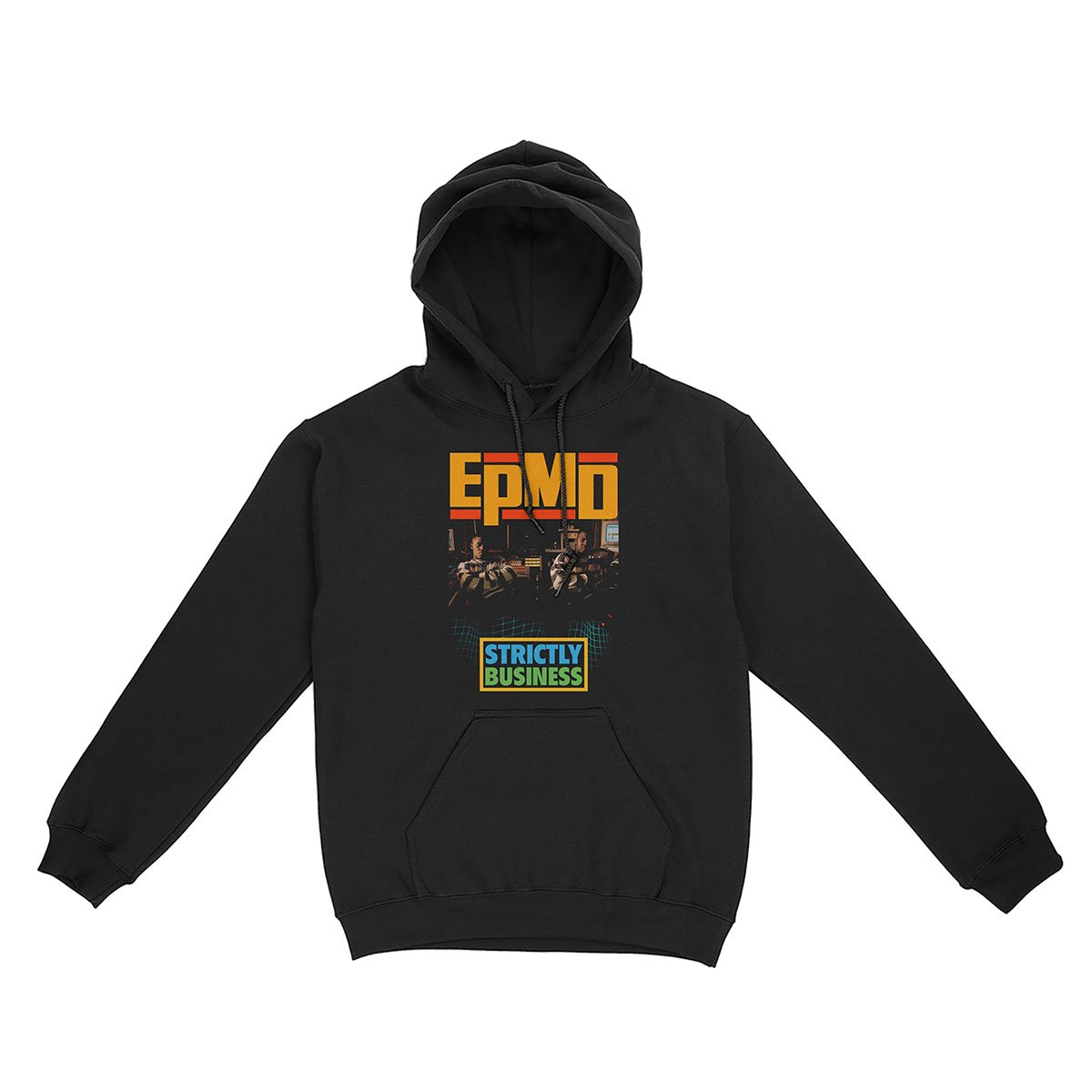
Rep the Record That Built Long Island
The EPMD Strictly Business Hoodie carries the same energy as the album that put Brentwood on the map — heavyweight, no-frills, built to last. Business first.
Final Thoughts: Why EPMD Strictly Business Still Pays in 2026
Strictly Business never needed a big chart run to matter. It sold on word of mouth, went gold on the strength of a sound nobody else had, and put a Long Island town most rap fans couldn’t have found on a map onto hip-hop’s permanent map. But the real proof of the album’s staying power isn’t the Rolling Stone ranking or the AllMusic five stars — it’s a drum break from a deep cut still turning up inside triple-platinum records almost four decades later, still cutting Erick Sermon a check every four months.
That’s the part worth sitting with. Golden-age hip-hop gets talked about in nostalgia terms a lot — the sound, the fashion, the eras that get memorialized in “old school” playlists. Strictly Business complicates that framing. It’s not just a record people look back on; it’s a record that’s still economically active, still getting sampled, still generating new royalty statements in 2026 for a group that recorded it when both members were in their early twenties. EPMD called their group “Making Dollars” before they’d made any. Strictly Business is the reason they still are.

Deep Cuts, Delivered
Sample breakdowns, catalog history, and new drops — straight from the Custom Creative crew. No spam, just the culture.

🎧 Never Miss a Drop
Exclusive product releases, hip-hop deep dives, and member-only discounts. Straight to your inbox.
Free forever. No spam. Unsubscribe anytime.

Get the Culture, Delivered
Deep dives into hip-hop history, exclusive product drops, and discounts sent straight to your inbox. No spam, just culture.
Join 2,000+ hip-hop heads already in the loop. Unsubscribe anytime.