Stetsasonic: The Brooklyn Pioneers Who Invented the Hip-Hop Band
The official record says Stetsasonic formed in 1981 in Brooklyn, dropped three albums on Tommy Boy, and produced one half of the Native Tongues sound via Prince Paul. Wikipedia-grade stuff. The front page of Google will tell you that and not much else.
Here’s what it won’t tell you. MC Delite is the man who first put the phrase “Hip Hop Band” on wax — on a 1985 record called “Straight From The Letter,” five years before The Roots cut Organix. Bobby Simmons (not Chad Smith) is the drummer on the Red Hot Chili Peppers’ “Higher Ground” cover Daddy-O produced — listen back, it’s documented in the band’s own April 2024 Sway interview. The Sugar Hill deal that almost happened was $100 split nine ways at 4% wholesale, which the band walked away from before the ink dried. And the reason “Go Stetsa I” cut through every other record at Latin Quarters in 1988 is that Bobby Simmons mic’d the drums from inside the Calliope Studios bathroom and left the door open for natural reverb.
This is the Stetsasonic story the encyclopedia entries don’t tell. Primary sources only — Sway’s 2024 interview, Kraze the King of Content’s three-part Untold Story series, Trouser Press, Wikipedia’s track-by-track production credits — woven into the long arc that runs from a Stetson-hat-wearing trio called Crown Supreme + Daddy-O + Delite, through the WBLS rap contest of 1984, all the way to Here We Go Again, the band’s fourth album, released April 5, 2024, on SpitSLAM Records.
Before The Roots: How a Brooklyn Six-Man Crew Coined “The Hip Hop Band”
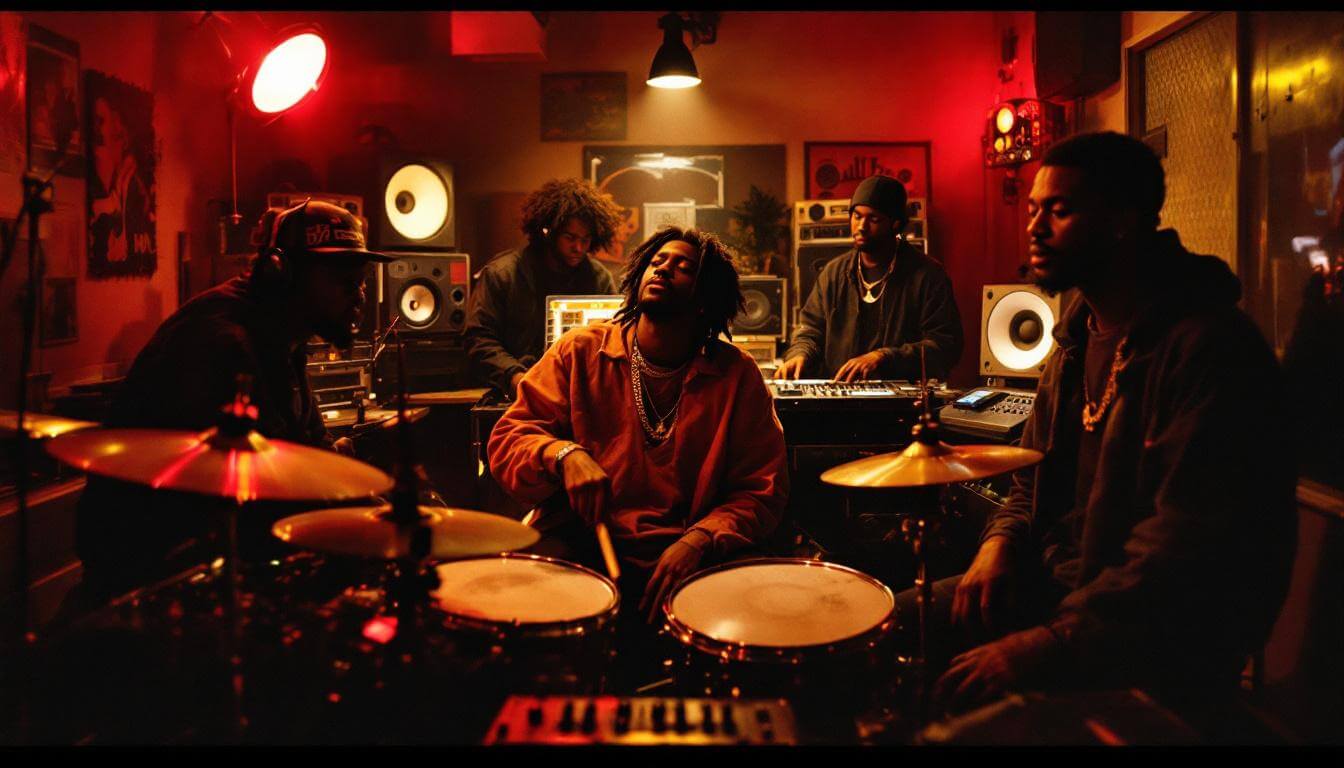
Ask any hip-hop fan who invented the hip-hop band and the answer comes back the same way: The Roots. Black Thought and Questlove. Philadelphia, 1987. Organix cut at Sigma Sound in 1993, dropped 1993, and from there a lineage that runs through D’Angelo, Erykah Badu, and the entire Neo-Soul shelf at Tower Records. That answer is wrong. Not in the sense that The Roots aren’t extraordinary — they are — but in the sense that they didn’t coin the phrase, didn’t ship the concept, didn’t operationalize it. Stetsasonic did.
The phrase “Hip Hop Band” first appeared on a Stetsasonic record called “Straight From The Letter” in 1985. MC Delite said it. Bobby Simmons, on Sway’s Universe in April 2024, walks through the receipt: “Nobody pinned the name hip-hop band in ’83, ’84. But it was pinned by Delite in ’85 when you said, ‘Straight from the letter, with the hip-hop band, there you go, London and even Japan, there you go.'” That’s the moment. Five years before The Roots cut their first demo. Six years before D’Angelo’s first sessions. The concept of live instrumentation in hip-hop had a few precedents — Fatback Band had a rapper guest on “King Tim III” in 1979 — but, as Daddy-O is careful to point out in the same Sway interview, Fatback was a funk-fusion act with a rapper on a record. Stetsasonic was the first crew to call themselves a hip-hop band and mean it operationally: live drummer (Bobby Simmons, ex-Lillo Thomas and Kashif), a producer/keyboardist who could play (DBC, the Devastating Beat Creator), a human beat-box (Wise), and three MCs (Daddy-O, Delite, Frukwan) with Prince Paul on the boards.
That mattered because, in 1986, no one wanted what Stetsasonic was selling. The drum machine was king. Roland’s TR-808 was rewriting the entire low end of New York rap — read our piece on the TR-808’s 45th anniversary for the long view on that. Stetsasonic deliberately moved the other way. Bobby Simmons told Sway he wanted live drums on “Go Stetsa I” specifically because everyone else had a drum machine. That was the whole pitch. “I wanted us to have live drums,” Simmons said. “The plan was to prove, to show people that we are going” — pause — “because, you got to remember too, Sway, at the very beginning of the time, everybody in hip-hop just had a DJ.”
Tom Silverman, the Tommy Boy founder who signed the band on the strength of DBC playing the bassline to “If You Can’t Say It All Just Say STET” live in front of him, would later admit, on his own Sway appearance, that the label didn’t quite know what to do with the vision. They could sell rap. They didn’t know how to sell a band that made rap. That gap between vision and label comprehension is the through-line of the whole Stetsasonic story.
The Stetson Brothers, the WBLS Contest, and the $100 Sugar Hill Deal They Walked From
Before Stetsasonic was Stetsasonic, it was the Stetson Brothers — named after the Stetson hats Daddy-O, Delite, and an early third member called Crown Supreme wore as their visual signature. The Hip-Hop Database Wiki has the origin date as 1979, Wikipedia says 1981, HipHopBeBop’s discography pegs the first two acetates at 1982. The truth is somewhere in there — different members joining at different times — but the operational birthday of the group most fans recognize is 1982, when Daddy-O and Delite reformed as The Stetsasonic 3 MC’s after Crown Supreme departed. Wise, DBC, Prince Paul, Bobby Simmons, and Frukwan filled out the lineup over the next two years.
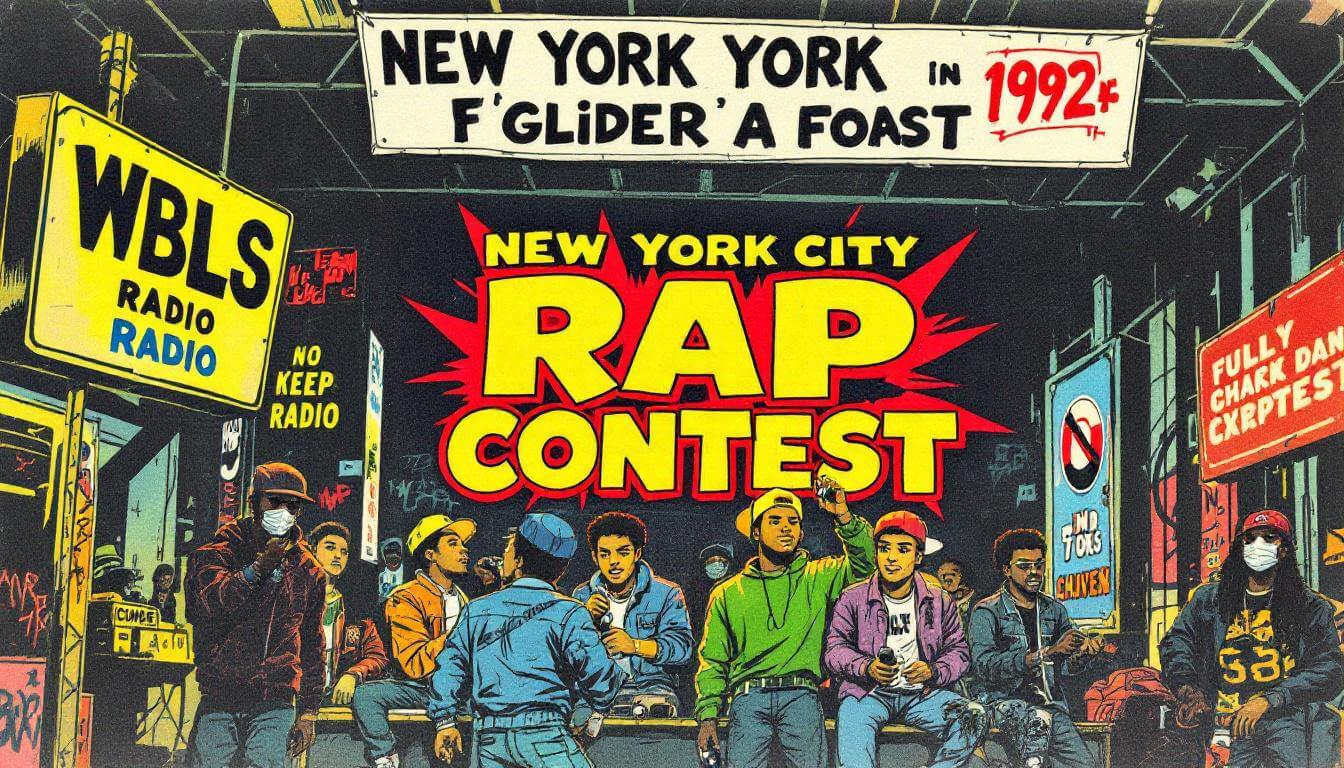
The break came at a WBLS rap contest in 1984 — a citywide MC battle Mr. Magic’s Rap Attack radio show hosted. According to the band’s own account in Kraze the King of Content’s Untold Story series, Stetsasonic won first, second, AND third place in their respective categories. “Because of our experience and our uh understanding um the professionalism that was needed, uh we aced it,” Bobby Simmons said in the Kraze interview. That contest cracked open a door. The first label to offer a deal was Sugar Hill — Sylvia Robinson’s empire, the original rap label, fresh off “Rapper’s Delight” money.
The pitch was a set piece, in retrospect a little too perfect. According to Daddy-O on Kraze, the band drove up to Sugar Hill’s two-campus operation in Englewood, New Jersey. Melle Mel rolled past with two women on his arm, playing Frisbee in the lot. Bobby Robinson Sr. pulled up in the 280SL convertible. The Furious Five were posted up with rented Mercedes-Benzes. Then Tyrone walked the band up the hill to meet Sylvia Robinson — past her own Rolls-Royce parked at the spot. The whole choreography read like a recruitment pitch.
The contract didn’t. Sugar Hill offered $100 split nine ways and 4% wholesale royalty — which works out to roughly 2.5 retail points. “It was a horrible contract,” Daddy-O told Kraze flatly. “So we just didn’t take it. We had a lawyer look at it. We didn’t take it.” When Sway pushed the same point in 2024, Daddy-O’s framing was sharper: that was the offer. They never signed. The full quote, verbatim from the Sway transcript: “We didn’t sign. That was the offer. They were going to split it nine ways. I know, right. Exactly. But the Sugar Hill Gang was a put-together 3 MC’s act. The Sugar Hill band was musicians that Sylvia and Bobby hired to play on the record. Session musicians that played with Ashford and Simpson. So there was no hip-hop band.”
Tommy Boy was the second-place prize — the deal the band landed after Pop Art (Philadelphia, didn’t want to travel) and Profile fell off the table. It would take another year and a half before the offer materialized. DBC sealed it by playing the funky bassline to “If You Can’t Say It All Just Say STET” live for Tom Silverman in 1985. Single went into rotation on New York radio that year. Album followed in 1986. Stetsasonic was officially a band on a label, with the contractual room to record like one.
On Fire (1986): The Album That Said the Hip-Hop Band Could Exist
The Trouser Press review of On Fire — Ira Robbins writing — gets the album exactly right in one sentence: “The sound of On Fire is hard and spare: one-at-a-time raps over rhythm tracks (including human beat box noises) with sporadic bits of music added.” That’s the documentary truth. In 1986, Stetsasonic was still figuring out how to be a hip-hop band in the studio. The album leans heavy on Wise’s beat-box, on Daddy-O’s verses cycling through familiar topics (“My Rhyme,” “Faye,” “Bust That Groove”), and on the kind of compression-forward DJ Premier-before-DJ-Premier production aesthetic that defined the mid-eighties Tommy Boy roster.
What’s interesting about On Fire from forty years out is what it isn’t yet. The live-band concept is there in the liner notes — the band is named “Stetsasonic the Hip-Hop Band” right on the sleeve — but the production hasn’t fully caught up to the manifesto. The live drums show up sporadically. The samples are restrained. The “Stet’s Theme” cut is still essentially a drum-machine record. The band is announcing what they want to be more than fully executing it. Which is, in a way, the most honest debut-album move possible: stake the claim, then spend the next two records earning it.
The album moved units modestly. AllMusic’s Steve Huey gives On Fire three stars and calls it “the work of a band still finding its voice.” Hip-Hop Database Wiki’s entry has it as a critical mixed bag. Daddy-O on Sway is even franker — he describes the era as “the time of always working” with the implicit subtext that no one in the band had yet figured out what their non-Daddy-O production identities would be. Prince Paul was still an apprentice in 1986; his crate-digging, jokes-into-skits, sample-collage signature was about a year and a half away from full bloom. DBC’s keyboard chops were on display but underutilized.
Forty years later, when we sat down to make our Stetsasonic On Fire Foundation Tee, the whole point was to honor this record — the imperfect debut, the manifesto-in-progress, the album that said a hip-hop band could exist before it had fully proven a hip-hop band could rule. On Fire is the foundation. Everything Stetsasonic and Prince Paul did from 1987 forward — and that’s a lot — sits on top of it.
In Full Gear (1988): The Bathroom Drums and the Latin Quarters Test
In Full Gear, released June 21, 1988, is the album. It’s the one. Sixty-three minutes, a sprawling double-LP, two production identities now in conflict and conversation (Prince Paul’s sample-collage on “Talkin’ All That Jazz” and “Float On”; Daddy-O’s tighter pocket-funk approach on “Go Stetsa I”). Wikipedia’s track-by-track credits make the split clear: Prince Paul produced “Sally,” “Float On,” and “Talkin’ All That Jazz.” Daddy-O produced “Go Stetsa I,” “Stet Troop ’88,” and “It’s In My Song.” DBC produced “DBC Let The Music Play.” Wise produced the beatbox tracks. Six members, four production minds, one album.
“Sally,” released as the first single on April 15, 1988, was originally meant for On Fire two years earlier — Prince Paul confirmed this on Sway. He and Frukwan had cut the beat as a remix for Jesse Saunders that didn’t get used. Daddy-O and Delite wrote the verses on top of it. The song’s lazy, summer-evening lope — built around a sample that “faintly resembles Wilson Pickett and Sly Stone without quoting them,” per Ira Robbins’s Trouser Press review — became the soundtrack to first-time New York visits for an entire generation of MCs. Sway recounted his own version on the show: 1989, first trip to the Tunnel as a young California kid with King Tech and the Duke of Denmark, hearing “Sally” downstairs and watching the whole floor lock into it. “That beat, that music had become the soundtrack in my head of New York.”
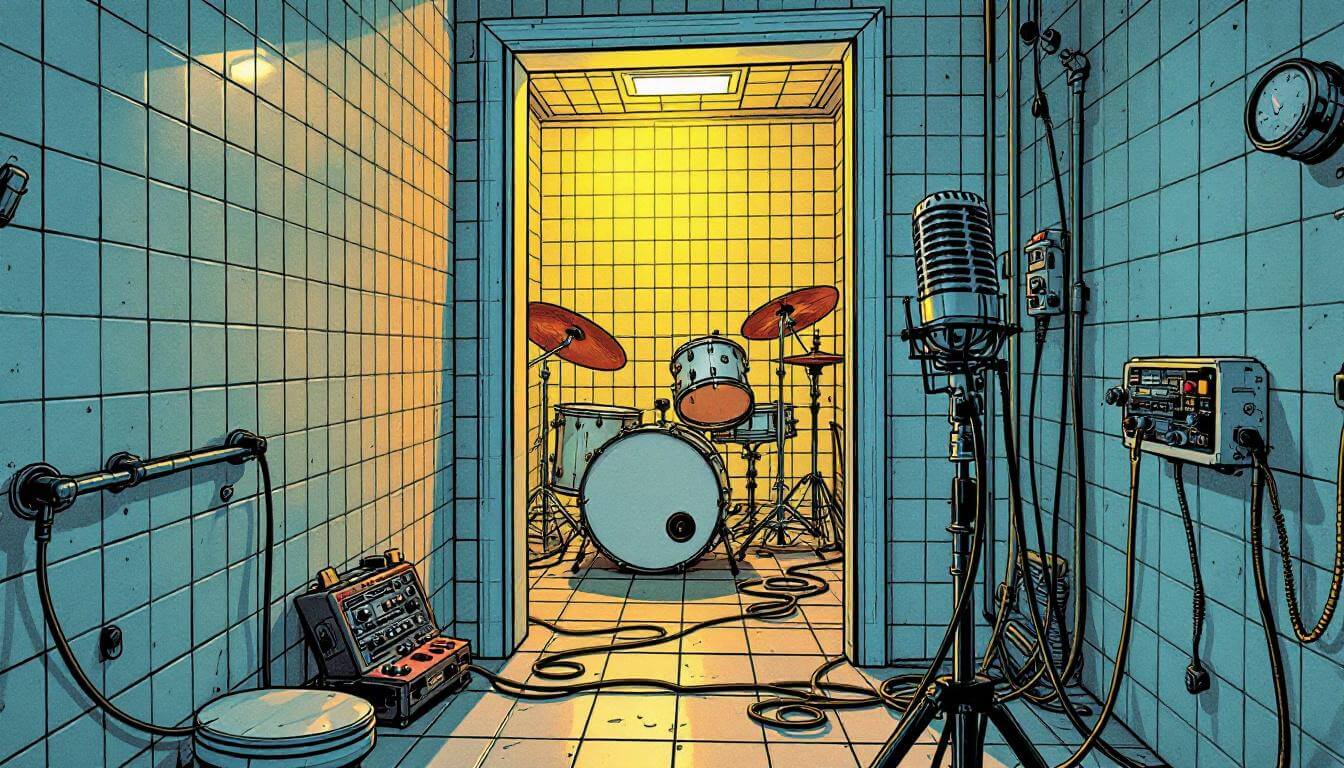
“Go Stetsa I” is where the bathroom-drums story comes from — the receipt that’s been hiding in plain sight for thirty-five years until Bobby Simmons finally said it out loud on Sway in 2024. The drums on “Go Stetsa” cut through every record played at the Latin Quarters in 1988. They were the loudest, fattest, most-dimensional drums in the room. The reason, Bobby explained: “We had to mic the drums from the bathroom. From the bathroom of Calliope Studios. Leave the bathroom door open. So you can get the rest. We shouldn’t be telling people this, man. Now they going to” — and Sway cut in, laughing — “now they can literally just just just reverb it and just make it sound like it’s the ambience of the room. Right.” That’s a production technique. It’s also a metaphor for how Stetsasonic operated: take the studio’s structural limitations and weaponize them into a signature.
The Latin Quarters in 1988 was, by every account, the most violent and most musically alive club in New York rap. Daddy-O DJed there. When “Go Stetsa I” came on, per Daddy-O’s own quote on Sway, “everybody tuck your chain in. If you had on a nice pair of sneakers, either take it off and use your socks to do the Roger Rabbit.” Chain-snatches were standard. One witness in the same Sway segment recalls a guy showing up with a sword on the dance floor — at which point the conversation pivoted to whether Stetsasonic’s “Self Destruction” feature the next year was, in part, a response to the chaos their own record had soundtracked. Probably it was.
Talkin’ All That Jazz: The Clapback at Gladys Knight That Built Jazz Rap
The most cited Stetsasonic song — the one that ends up on every “essential 1988” playlist and every Golden Age documentary — is “Talkin’ All That Jazz.” Released as the second In Full Gear single on September 16, 1988. Peaked at #34 on the US R&B chart. Named the 17th-best single of 1988 by Robert Christgau’s Village Voice Pazz & Jop poll. Remixed by Dimitri from Paris a decade later (1998) and hit #1 on the UK Dance chart. The song is the doorway through which jazz rap walked into the building — A Tribe Called Quest, Gang Starr, and the entire Native Tongues collective followed it within twelve months.
The song is also a clapback. A specific, named, on-the-record clapback. Bobby Simmons told Sway the origin story directly: he was watching a televised talk show — Gladys Knight, James Mtume, and another R&B producer Bobby couldn’t name — and the three of them were criticizing hip-hop artists for sampling without credit. “I called Daddy-O because I heard an interview,” Bobby said. “It was Gladys Knight, James Mtume, uh, it was another record producer I can’t get his name. They were on a talk show talking about how rap artists are stealing from them.”
Stetsasonic’s response on “Talkin’ All That Jazz” opens with the now-iconic Daddy-O line: “Heard you on the radio talking about rap, saying all that crap about how we sample. Give an example. Think we’d steal a beat? You let us get away with that. There’s no real damage…” It’s a direct address. The Lonnie Liston Smith sample that anchors the track — the one from “Expansions” — was cleared by Daddy-O personally before recording. That’s part of the song’s whole point. Stetsasonic wasn’t ripping anyone off. They were building a bridge between jazz musicianship and hip-hop production by paying jazz musicians for their participation. As Daddy-O put it on Sway: “Lonnie Liston Smith said, ‘Hey, you know, go for it. He said you guys got this. This is the young blood now.’ I mean, he got it for a price, though.”
That paid-clearance practice is the part most SERP results bury. In 1988, very few rap acts were clearing samples. James Brown was getting strip-mined for breakbeats and getting paid nothing. Eric B. & Rakim were sampling James Brown in the same era and the cease-and-desist letters were starting to fly. Stetsasonic positioned themselves on the right side of that ledger from the jump — and the positioning was as much aesthetic as it was ethical. The argument the song makes is that sampling is a form of cultural lineage, not theft, when it’s done with credit and clearance. That argument cleared the rhetorical space for Q-Tip to sample Lou Reed on “Can I Kick It” two years later. For Gang Starr to put DJ Premier’s jazz-inflected production on the map. For the entire jazz-rap subgenre, in fact, to even exist as a marketable category.
The footnote that makes the song even more poignant: Daddy-O and Bobby eventually became friends with James Mtume. They made peace before Mtume died in January 2022. “James Mtume said, all I’m saying is pay me,” Bobby said. “And we like, well, we’re paying people.”
Self Destruction (1989): When Stetsasonic Was the First Call
The Stop the Violence Movement happened because someone got killed at a hip-hop show. August 1988, a Boogie Down Productions concert at the Nassau Coliseum, a young fan named Julio Fuentes was stabbed in a fight in the parking lot. KRS-One and journalist Nelson George responded by organizing the rap industry into a Stop the Violence supergroup that fall and winter. The single, “Self Destruction,” dropped on January 15, 1989. It went RIAA Gold. It topped the US Rap chart at #1. All proceeds went to the National Urban League.
Stetsasonic was on the call. MC Delite is on the record. Per the band’s recollection on Sway, the invitation wasn’t a surprise — Stetsasonic was the conscious-rap act of the moment. They’d already released “Freedom or Death” on In Full Gear the year before — Christgau’s Pazz & Jop ballot specifically called out “Freedom or Death” and “Talkin’ All That Jazz” as the album’s “credos of revolution and sampling, respectively.” They were going to make Free South Africa before Blood, Sweat & No Tears dropped in 1991, while the apartheid divestment movement was at full intensity. They were the obvious first call alongside Public Enemy.
Bobby Simmons on Sway, on the politics: “We were that type of band. We knew that if we have something to say, we’re going to say it. And those guys — they when there was something to talk about, we talked about it. I don’t want nobody to get at me, because I be seeing typewriter secretaries on social media… but there was a moment where we’d seen something that was bad, we talked about it.” The point isn’t that Stetsasonic invented conscious rap — Public Enemy, BDP, and X-Clan all had claims to that lineage too — but that Stetsasonic was operationally the most reliable, most always-on conscious-rap act of the late eighties. If something needed to be said, they would say it on a record. That made them indispensable to the political-rap moment of 1989, in a way that doesn’t get acknowledged in the standard It Takes A Nation-centered histories.
The Self Destruction lineup is also the most documented snapshot of who counted as “the room” in 1989: BDP, MC Delite from Stetsasonic, Kool Moe Dee, MC Lyte, Doug E. Fresh, Just-Ice, Heavy D, Daddy-O on the back-end production work, Chuck D from Public Enemy. That’s the room. Stetsasonic was in it without anyone needing to negotiate the invitation. By 1989, the conscious-rap world simply assumed Stet would show up.
Hiatus to Here We Go Again: Frukwan, Higher Ground, and the 2024 Return

Blood, Sweat & No Tears dropped in 1991. It was, per Trouser Press, an “engaging state-of-the-art album seamlessly loaded with diverse music, thoughtful and/or amusing raps, and more friendly family atmosphere than an Italian wedding.” It was also recorded without Frukwan. The push-out, per Daddy-O on Kraze’s Untold Story series, came down to a clothing-line dispute. Frukwan had an idea to launch a Stetsasonic clothing brand. The other members disagreed about how the money would split. Per Daddy-O’s specific quote: “We get into this whole big thing about the clothing because we’re getting this whole big thing about, ‘I can make clothes, I don’t need you taking my money.’ And he leaves. That’s the day we at Rush, we at Russell’s office, some point leads the group.” The fissure that killed Frukwan’s role wasn’t musical — it was business.
Wise has covered Frukwan’s third verses on Stetsasonic’s live shows ever since. “Wise now becomes that third verse,” Daddy-O told Kraze. “He can mimic Frukwan fairly well. And I honestly say, on tour, sometimes people don’t even miss him.” (Frukwan went on to co-found Gravediggaz with Prince Paul, RZA, and Too Poetic in 1994 — the band’s full Wu-adjacent horrorcore second act. Per the 2024 Sway interview, Frukwan is currently on hiatus from Stetsasonic. Bobby Simmons: “Frukwan right now is just in hiatus somewhere.”)
The Tommy Boy contract dispute that ended Stetsasonic’s first run in 1992 had less drama. Tommy Boy wanted a fourth album. The band, scattered across solo production work — Daddy-O on his own album with Island Records, Prince Paul producing De La Soul and 3rd Bass and Queen Latifah, Bobby producing Shabba Ranks and the Rocky 5 soundtrack — didn’t want to deliver one. “We never said to each other, ‘yo, I quit,'” Bobby told Sway. “We never quit. We just said we’re just not going to do a Stetsasonic album, period.” That’s a hiatus, not a breakup. They were always going to come back.
Prince Paul, of course, walked out of Stetsasonic’s studio in 1989 and walked into De La Soul’s, where he produced 3 Feet High and Rising — the album that effectively founded the Native Tongues movement. We’ve written about the De La Soul lineup and the long arc of what happened to De La Soul — Prince Paul’s fingerprints are on both stories. Stetsasonic was where his sample-collage approach was incubated. De La’s debut is where that approach met three Long Island MCs and detonated. The line from “Talkin’ All That Jazz” to “3 Feet High and Rising” runs through one producer’s apartment in Brooklyn.
There’s also the Bobby Simmons Higher Ground footnote — the one nobody outside of the band’s inner circle knew until Sway’s 2024 interview. The Red Hot Chili Peppers covered Stevie Wonder’s “Higher Ground” on Mother’s Milk in 1989. Daddy-O produced the cover. The drums on the cover are not Chad Smith. The drums on the cover are Bobby Simmons. Bobby’s exact quote: “Red Hot Chili Peppers, sorry, you respect God, I don’t mean to cut you off, Red Hot Chili Peppers, that’s not Chad on the drums. That’s me. I just want to make that clear.” Daddy-O didn’t print the credit. Thirty-five years of rock-history attribution credit went to Chad Smith. That’s a hip-hop receipt that needs filing.
Stetsasonic reunited in 2008. They’ve recorded and toured intermittently since. Here We Go Again, the band’s fourth studio album, dropped April 5, 2024, on SpitSLAM Records — the label they co-founded. The lead single is “Lolita,” conceived by Daddy-O and Delite as a grown-up sequel to “Sally” (“the now-time advancement of Sally,” Daddy-O told Sway). The band’s full Unsung episode aired on TV One on April 14, 2024. The 2024 Sway interview is the best primary-source biography of the band that exists.
Frequently Asked Questions About Stetsasonic
What does the name “Stetsasonic” mean?
According to the band, “Stet” means style and “sonic” means sound — Stetsasonic = “style of sound.” But that’s the second name. The original collective was The Stetson Brothers, named after Stetson hats, before they renamed themselves The Stetsasonic 3 MC’s around 1982 and finally just Stetsasonic when DBC, Wise, Prince Paul, and Frukwan joined the lineup.
Was Stetsasonic part of the Native Tongues Posse?
No — Stetsasonic was never an official Native Tongues member alongside De La Soul, A Tribe Called Quest, Jungle Brothers, and Queen Latifah. BUT the Native Tongues sound is largely Prince Paul’s sound, and Prince Paul was a Stetsasonic founding member who left the band’s studio every day to go produce De La Soul’s 3 Feet High and Rising in 1989. Stetsasonic is the unofficial Native Tongues precursor — the petri dish where the producer who shaped the collective grew up.
What was Stetsasonic’s biggest song?
“Talkin’ All That Jazz” (1988) — peaked at #34 on the US R&B chart, named the 17th best single of 1988 by Robert Christgau’s Village Voice Pazz & Jop poll, and remixed by Dimitri from Paris in 1998 to hit #1 on the UK Dance chart. Bigger by commercial metric: “Self Destruction” (1989) as part of the Stop the Violence Movement supergroup — went RIAA Gold and topped the US Rap chart at #1. Bigger by cultural reach in NYC clubs in 1988: “Go Stetsa I,” the Latin Quarters anthem.
Who is in Stetsasonic?
The full lineup is Daddy-O (Glenn Bolton), MC Delite (Marvin Wright), Wise the Human Mix Machine (Leonardo Roman), Prince Paul (Paul Huston), DBC the Devastating Beat Creator (Martin Namley), Bobby Simmons (drums), and Frukwan (Arnold Hamilton). Frukwan is currently on hiatus per the band’s April 2024 Sway interview. Originally the group was called The Stetson Brothers (Daddy-O, Delite, Crown Supreme) — Crown Supreme left early.
Did Stetsasonic break up?
Officially, no — Stetsasonic went on hiatus in 1992 after refusing a fourth Tommy Boy album, reunited in 2008, and released their fourth studio album Here We Go Again on SpitSLAM Records on April 5, 2024. Per Bobby Simmons in the April 2024 Sway interview: “We never said to each other ‘yo I quit’ — we just said we got other things going on.” Their full story aired on TV One’s Unsung on April 14, 2024.
Why is “Talkin’ All That Jazz” a clapback?
The song’s opening line — “Heard you on the radio talking about rap, saying all that crap about how we sample” — is a direct response to a televised interview in which Gladys Knight, James Mtume, and other R&B veterans criticized hip-hop artists for sampling without credit. Daddy-O explains on Sway that Stetsasonic personally got the sample cleared by Lonnie Liston Smith before using it, which is partially the point: the song reframed sampling as cultural lineage, not theft, and laid the bridge for jazz rap. A Tribe Called Quest and Gang Starr followed within a year.
Who is Prince Paul and what’s his connection to Stetsasonic?
Prince Paul (Paul Edward Huston) was Stetsasonic’s main beat-maker from the start. After “Talkin’ All That Jazz,” he was tapped by De La Soul to produce 3 Feet High and Rising (1989) — the album that effectively launched the Native Tongues movement. He later co-founded Gravediggaz with Frukwan, RZA, and Too Poetic; produced 3rd Bass and Queen Latifah; and put out the Handsome Boy Modeling School and Prince Among Thieves projects. Stetsasonic is where his sample-collage approach was honed.
Did Stetsasonic invent the term “hip hop band”?
Yes — according to Bobby Simmons on Sway’s Universe (April 2024), the phrase was first coined by MC Delite on Stetsasonic’s 1985 record “Straight From The Letter.” Five years before The Roots cut Organix (1993), six years before D’Angelo’s first sessions. The concept (live instrumentation in hip-hop) had precedent in the Fatback Band, but Fatback was a funk-fusion band that happened to have a rapper guest — Stetsasonic was the first crew to call themselves a hip-hop band and mean it operationally.
The Receipt: Why Stetsasonic Still Matters
Stetsasonic isn’t a footnote in the live-instrument hip-hop story. They’re the chapter heading. They literally coined the phrase “hip hop band” on a 1985 record. They ran the blueprint for The Roots and D’Angelo half a decade before either existed. They produced Prince Paul, who then handed the world De La Soul’s 3 Feet High and Rising. They walked away from a $100 nine-way-split Sugar Hill deal that would have buried them. They mic’d drums from inside a bathroom so the song would cut through every speaker at the Latin Quarters. They cleared their samples when no one else was clearing samples. They showed up for Self Destruction without anyone needing to negotiate the invitation. And forty years after their debut, they came back and dropped Here We Go Again on their own label, with the same lineup minus the one member they pushed out over a clothing-line dispute that nobody but them remembers.
The mainstream hip-hop encyclopedia gives Stetsasonic three paragraphs and moves on. That’s the gap this piece closes. The next time anyone tells you The Roots invented the hip-hop band, hand them a copy of “Straight From The Letter” from 1985 and let MC Delite settle it.
Never Miss a Drop
Album deep dives, artist spotlights, exclusive merch drops, and the stories behind the culture. Straight to your inbox. No filler — just the real.
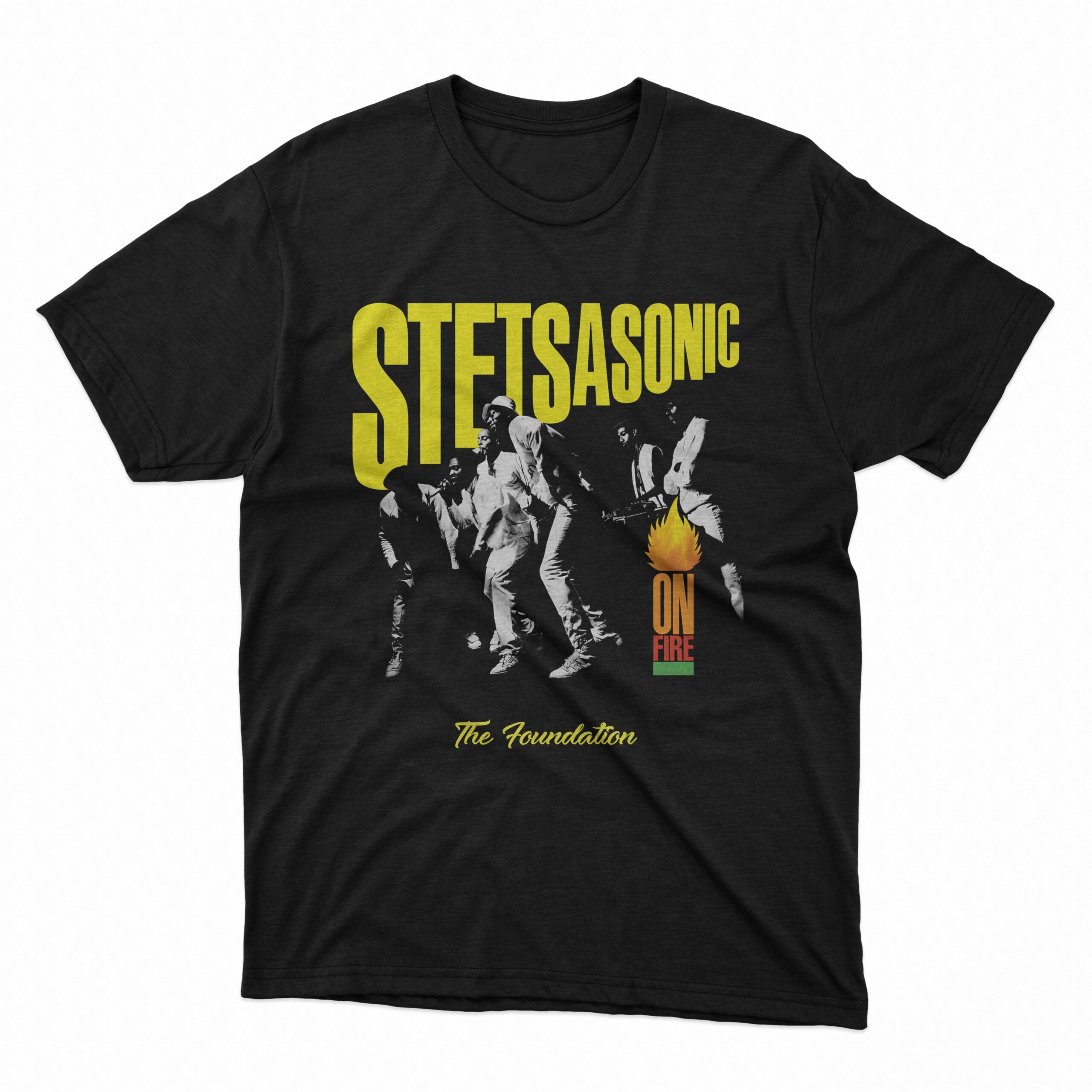
The Foundation Tee — Built for the Stet Heads
We made a black tee that honors the record that started the hip-hop band conversation. On Fire dropped October 15, 1986 — the day Stetsasonic stopped being a 3 MC’s act and became the genre’s first band. Print is photo-quality, fabric is the standard Gildan 64000 we use across the catalog. If you came here looking for the artifact, this is the tribute piece.

🎧 Never Miss a Drop
Exclusive product releases, hip-hop deep dives, and member-only discounts. Straight to your inbox.
Free forever. No spam. Unsubscribe anytime.
Get the Culture, Delivered
Deep dives into hip-hop history, exclusive product drops, and discounts sent straight to your inbox. No spam, just culture.
Join 2,000+ hip-hop heads already in the loop. Unsubscribe anytime.