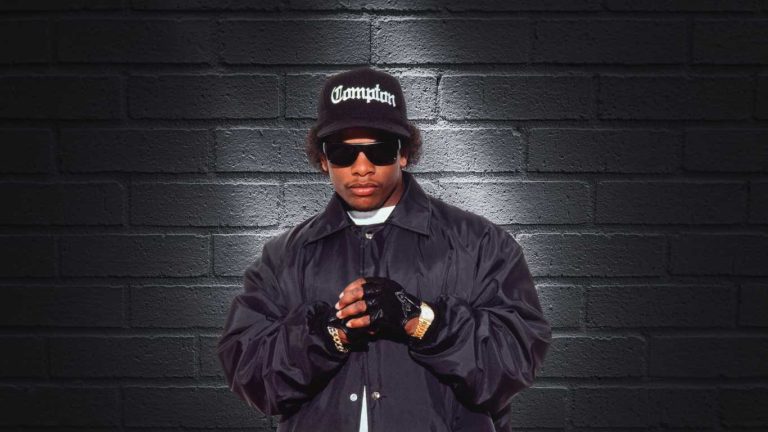
Menace II Society (1993) at 33: How the Hughes Brothers Made the Most Beautifully-Shot Hip-Hop Film Ever
On May 26, 1993, twenty-one-year-old twin brothers Albert and Allen Hughes released Menace II Society, a $3.5 million debut feature that redefined how Black life in South Central Los Angeles would be shot, scored, and remembered on screen. Three decades later, the SERP for menace ii society is dominated by plot recaps and star ratings, but the reference sites miss the whole point: this was never just a hood movie. It was a hip-hop film in the truest sense — cast from the West Coast rap roster, soundtracked by the artists it portrayed, and shot like an album cover come to life. This is the retrospective the algorithm won’t write.
What follows is a full cultural teardown of Menace II Society: the cold open that rewired Black cinema, the twin-brother production story, the West-Coast rap casting decisions, the soundtrack that scored a generation, the post-Rodney-King Los Angeles the Hughes Brothers documented, the rivalry with Boyz N the Hood that split hip-hop cinema into two schools, and the lineage that runs from Watts in 1993 to every cold open you’ve watched since. Buckle in.
The Cold Open That Rewired Black Cinema
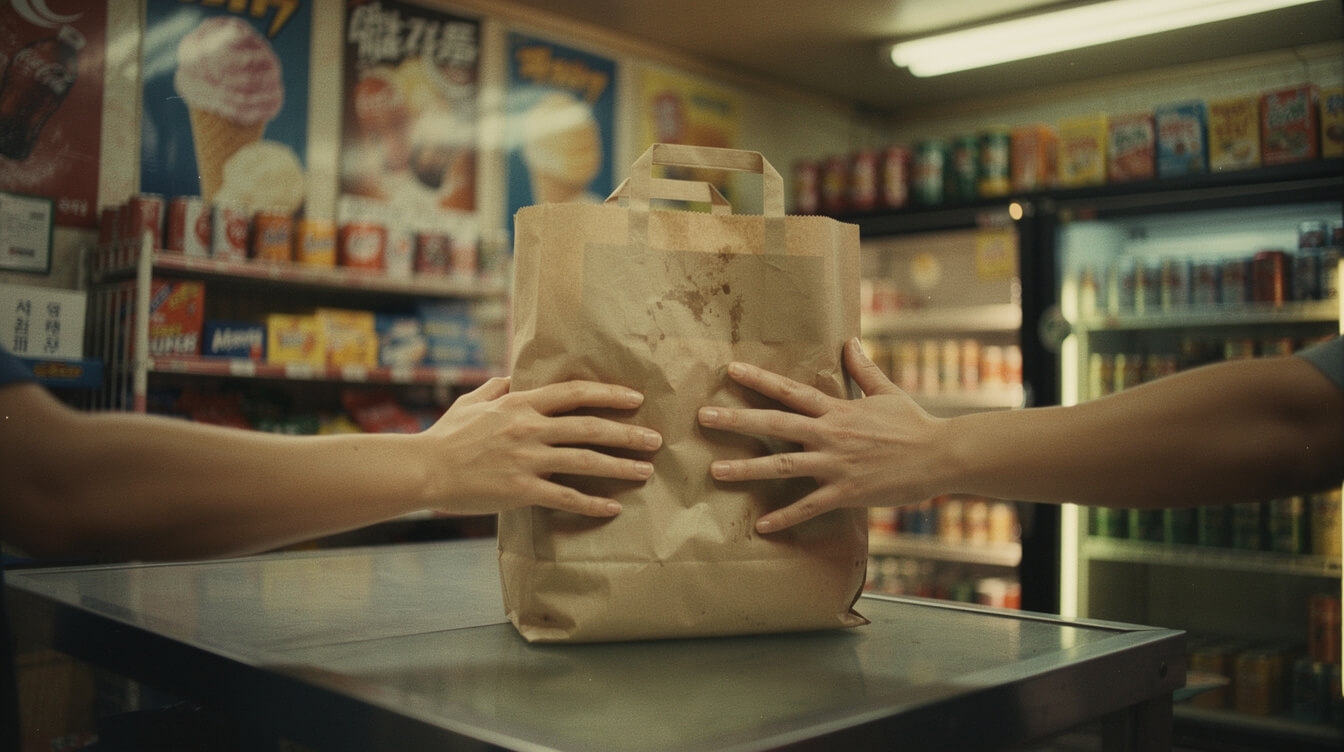
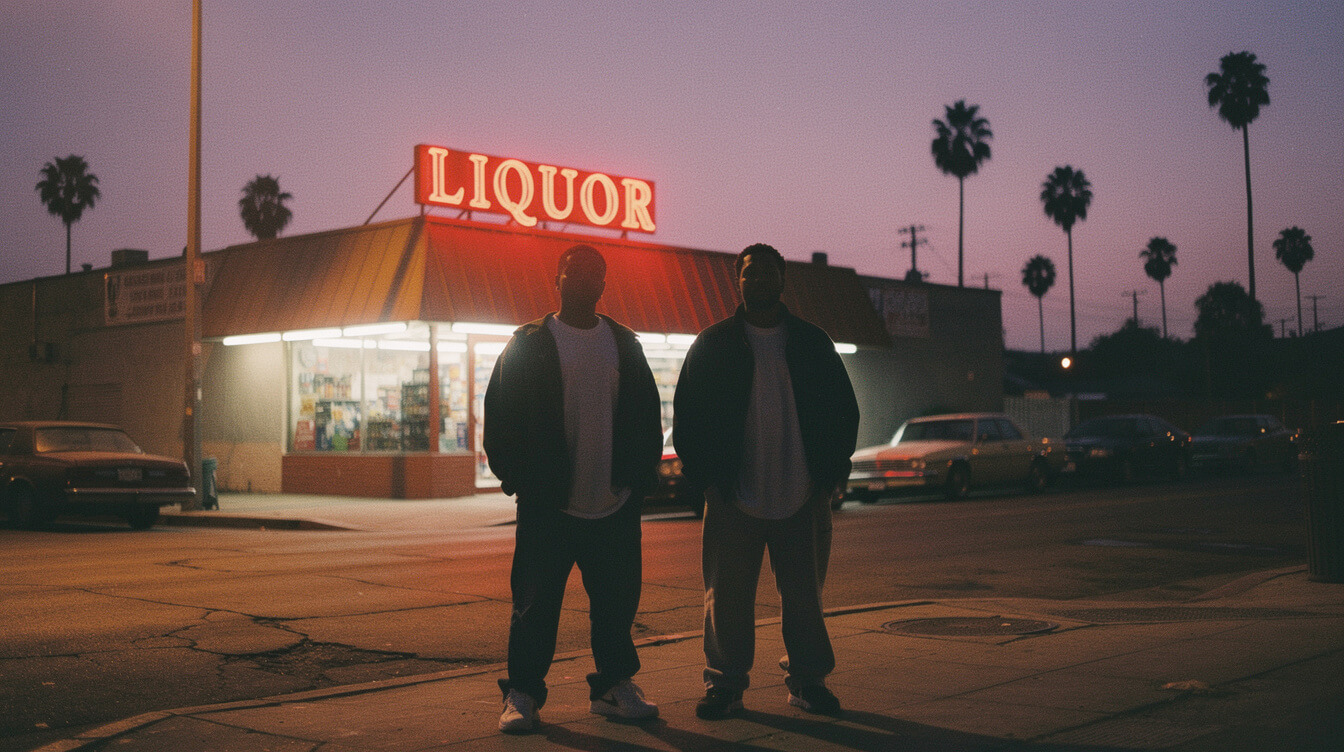
Every serious conversation about Menace II Society starts with the first three minutes. Caine Lawson (Tyrin Turner) and O-Dog (Larenz Tate) walk into a Korean-owned corner liquor store. There is nothing about this scene that reads like the opening of a movie. There is no title card, no orchestral swell, no dolly-in on a face — just a fluorescent buzz, a wide handheld lens, and two kids in a store. The clerk mutters, “I feel sorry for your mother.” O-Dog stops. Turns. And then, without ceremony, executes the man and his wife on the sales-floor tile, grabs the security tape, and leaves.
What made this cold open legendary was not the violence. Black cinema in 1993 had already established that gun violence would be part of the visual vocabulary. What was new — what nobody had done before, and what every director in the following thirty years would steal — was the refusal to earn it. The Hughes Brothers gave the audience no time to sympathize, no exposition, no montage of Caine’s childhood before letting the trigger get pulled. The message: this is the world. Adjust. There would be time later — a full ninety minutes — to explain how these kids became these kids. But that came after.
This is what critics missed in 1993 when they filed the film under “gangsta drama.” The cold open is a formal thesis: the everyday brutality of Reagan-Bush-era South Central was not going to be softened for the multiplex. Tyger Williams’ screenplay — his first — makes the case that the men, women, and children of Jordan Downs housing were living with a kind of atmospheric violence that had no first act. So the film has no first act either. It just begins, mid-life, with a killing.
Trace the DNA. Every prestige cold open since — Nate Parker’s The Birth of a Nation, the opening of Moonlight, the shooter POV of Widows, the entire structure of Barry Jenkins’ short-form work — owes a stylistic debt to this liquor-store scene. And nobody has topped it, because nobody since has been twenty-one and unafraid of what a studio audience is willing to accept.
Twin Brothers at Twenty-One: The Music-Video Roots That Shaped the Look
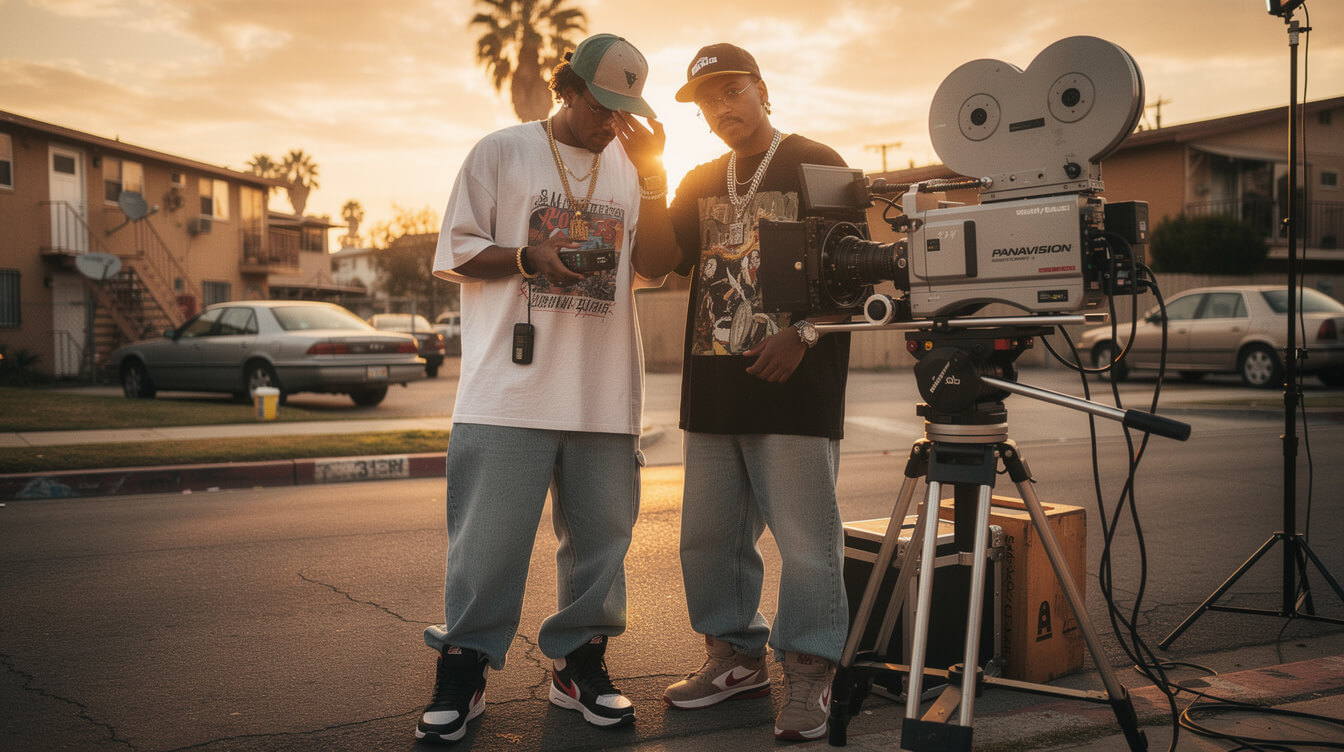
Albert and Allen Hughes were born April 1, 1972. When principal photography wrapped on Menace II Society, both were twenty-one years old. Nobody in a New Line Cinema executive suite green-lit this film because the twins were seasoned. They got the shot because of what they had already done — dozens of music videos for hip-hop and R&B acts, cut fast, shot cheap, moved by a DIY confidence that most film-school graduates could not match.
Before Menace, the Hughes Brothers had directed videos for Tupac Shakur, Digital Underground, Tone Lōc, Too $hort, and others. That music-video literacy is baked into every frame of the movie. Watch how the Hughes twins use time — an early shot of Caine walking home fills the frame with static geometry, palm-tree silhouettes bisecting the sky like an album-cover composition. There is no scene in the film that is not composed. Nothing is accidental. That is not a first-time filmmaker’s instinct; that is a music-video director’s discipline.
Cinematographer Lisa Rinzler — one of the most underrated DPs of the 1990s — deserves equal credit. Her work on Menace pulls from the documentary photography tradition (think Larry Clark’s Tulsa, think Danny Lyon’s Chicago work) to give South Central a rough, sun-bleached honesty. Rinzler shot on 35mm Kodak stock, mostly natural light, with the deep grain and blown highlights that were about to become the visual dialect of every serious Black film of the decade.
The Hughes Brothers were not the first Black directors to have artistic control over a studio film — Spike Lee had been building his catalog since 1986, and John Singleton had broken through in 1991. But they were the first to come to feature filmmaking straight from the MTV world, and it shows. Cuts land on the beat. Dialogue overlaps like a well-mixed record. And the film’s runtime — a lean 97 minutes — is engineered like an album, not a novel.
The Casting: MC Eiht, Larenz Tate, and the West-Coast Rap Roster
The casting decisions on Menace II Society tell you everything about what kind of movie the Hughes Brothers were trying to make. This was not a film that recruited Broadway actors and coached them into “sounding urban.” The lead trio — Tyrin Turner as Caine, Larenz Tate as O-Dog, and Jada Pinkett as Ronnie — were young Los Angeles actors, but most of the supporting bench came directly from West Coast hip-hop.
The most consequential rap casting was MC Eiht as A-Wax. Eiht was already a fixture in the LA scene as the frontman of Compton’s Most Wanted, whose Straight Checkn ‘Em (1991) and Music to Driveby (1992) had established his slow, measured delivery as one of the most quotable in West Coast rap. His A-Wax character in Menace is largely a walking cameo — a rival gang enforcer with a handful of lines — but Eiht’s screen presence is enormous. He performs his lines like verses. He lets silence do the work. When A-Wax leans out of a car window in the film’s final act, the theater in 1993 knew exactly what was about to happen because they knew Eiht’s discography.
Then there is Too $hort, playing Lew-Loc — a small role but a meaningful one. Oakland’s Too $hort had been putting out records since 1983 and was a full decade into his career by the time Menace shot. His cameo signaled the film’s Bay-Area-to-LA solidarity, a gesture that would matter to audiences in a way East Coast critics did not immediately parse. Bay-based rapper Pooh-Man also appears, alongside a rotating roster of uncredited West-Coast MCs and street cast.
The Hughes Brothers did not just cast rappers for authenticity. They cast for voice. Every performer in the film sounds like they belong to the same neighborhood, and half of them literally did. This is what most reference sites get wrong when they list the cast alphabetically: the casting is the film’s foundational research. It is not decoration.
The Soundtrack as Character: Every Track Placed on Purpose
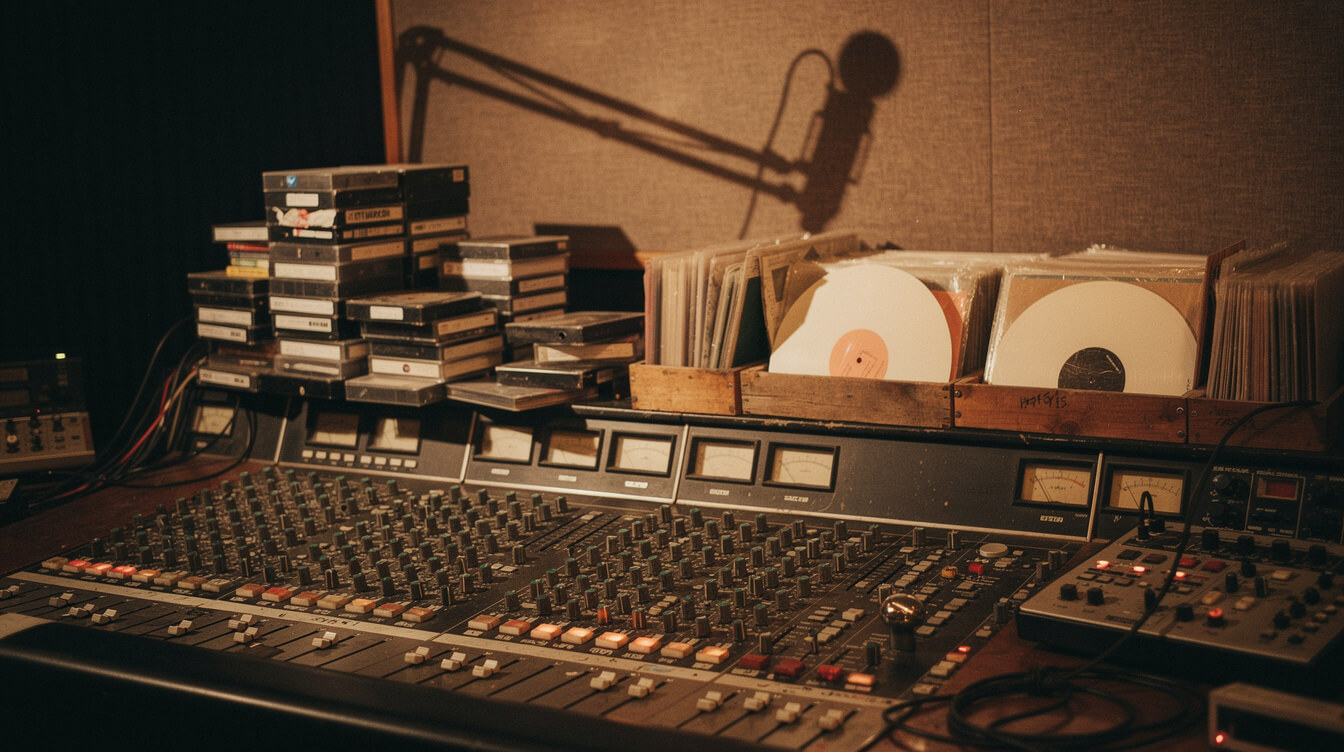
The Menace II Society original soundtrack, released by Jive Records on May 25, 1993 — one day before the film opened — was not a marketing tie-in. It was a curated West Coast document that stood as a hip-hop record on its own. Music supervisor QDIII (Quincy Jones III, who also handled the film’s score) treated the soundtrack as a second screenplay: every needle-drop had to move the story.
The anchor track was MC Eiht’s “Streiht Up Menace”, which doubled as Eiht’s own solo debut single and the film’s de-facto theme. When the song plays over the film’s final sequence — the Watts drive-by that rewrites Caine’s fate — it is not underscoring the scene, it is narrating it. Eiht’s flat, first-person delivery (“I was a fool with the big booming system…”) turns the movie’s ending into an autopsy report in real time. There is no other soundtrack cue in the film that could have carried that weight. It had to be Eiht, because Eiht had already lived — and rapped — the material.
Spice 1’s “Trigga Gotta Rhyme” shows up as street-corner ambience. Boss appears with “Recipe of a Hoe.” Sir Mix-A-Lot’s “The Player” pushes a car scene. Too $hort contributes “It’s a Set Up.” Pete Rock & CL Smooth’s “Death Becomes You” — one of the only East Coast placements — provides a hushed, jazz-sample eulogy where the story needs one. The through-line is that every track is placed to score a specific emotional beat, and every artist chosen is someone who could have written the story themselves.
If you are trying to understand how deeply this era of Ruthless Records, Death Row, Rap-A-Lot, and Priority Records shaped Black cinema of the mid-1990s, the Menace soundtrack is the Rosetta Stone. Peer catalogs from the same LA moment — records by N.W.A., Ice Cube’s solo work, DJ Quik, King Tee, Compton’s Most Wanted — form a shared universe that Menace plugged directly into.

Wear the Ruthless-Records Era
Above The Law’s 1990 debut LP sits in the same LA-hard-funk universe as MC Eiht and Spice 1 — the sonic backbone of the Menace era. Our tribute hoodie brings the Ruthless catalog forward.
Watts, Crenshaw, and the Post-Rodney-King Los Angeles of ’93
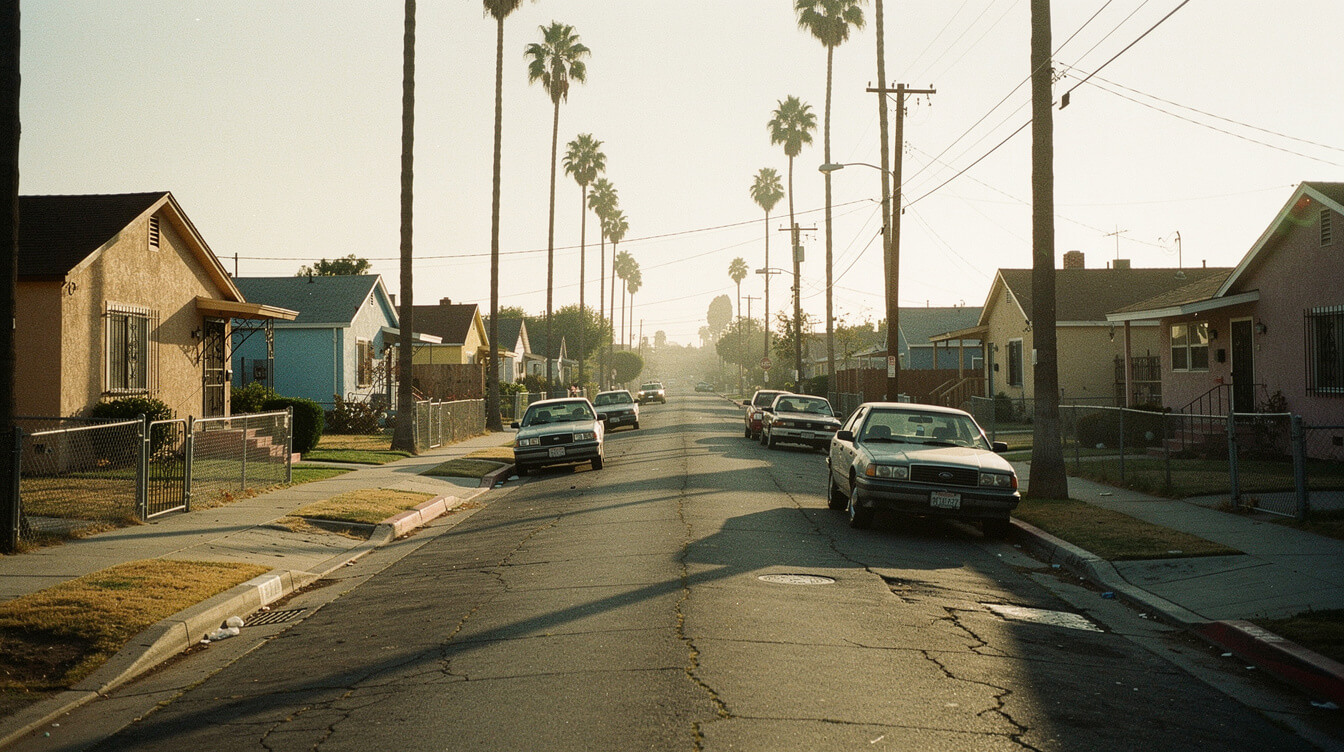
You cannot talk about Menace II Society without talking about April 29, 1992. That was the day four LAPD officers were acquitted in the beating of Rodney King, and Los Angeles burned for six days. Fifty-four people died. Over two thousand were injured. Estimated property damage exceeded a billion dollars. Every neighborhood the Hughes Brothers wanted to film in was still visibly scarred a year later. The palm trees in Menace shade blocks that had been on fire twelve months earlier.
The film is very deliberately set in Jordan Downs, a Watts housing project south of downtown that had been a center of the ’65 Watts Rebellion and remained one of the most surveilled Black communities in the country. The Hughes Brothers shot on location — not on studio backlots — and they hired residents as extras. Some of the most memorable street cast were not credited actors. They were the block.
What Menace did that no film before it had quite managed was to make the LAPD helicopter itself into a character. The distant whup-whup of the LAPD air unit — what South Central residents call the “ghetto bird” — is present in nearly every exterior scene. There are shots where the helicopter is the only sound. This was not a Foley choice; the Hughes Brothers left in the actual ambient audio because it was the honest score of the neighborhood. Anyone who lived in South Central in 1993 will tell you that soundtrack was scored by the city itself.
Contrast this with how Ice Cube — who was, in 1993, the reigning conscience of West Coast hip-hop — was documenting the same moment on wax. His post-N.W.A. albums (AmeriKKKa’s Most Wanted, Death Certificate, The Predator) covered exactly the ground Menace was filming on. Cube’s records were the audio; the Hughes Brothers made the visuals. Together, they left a more complete document of post-Rebellion Los Angeles than any journalistic account.
Boyz N the Hood vs. Menace II Society: The Split That Defined Hip-Hop Cinema
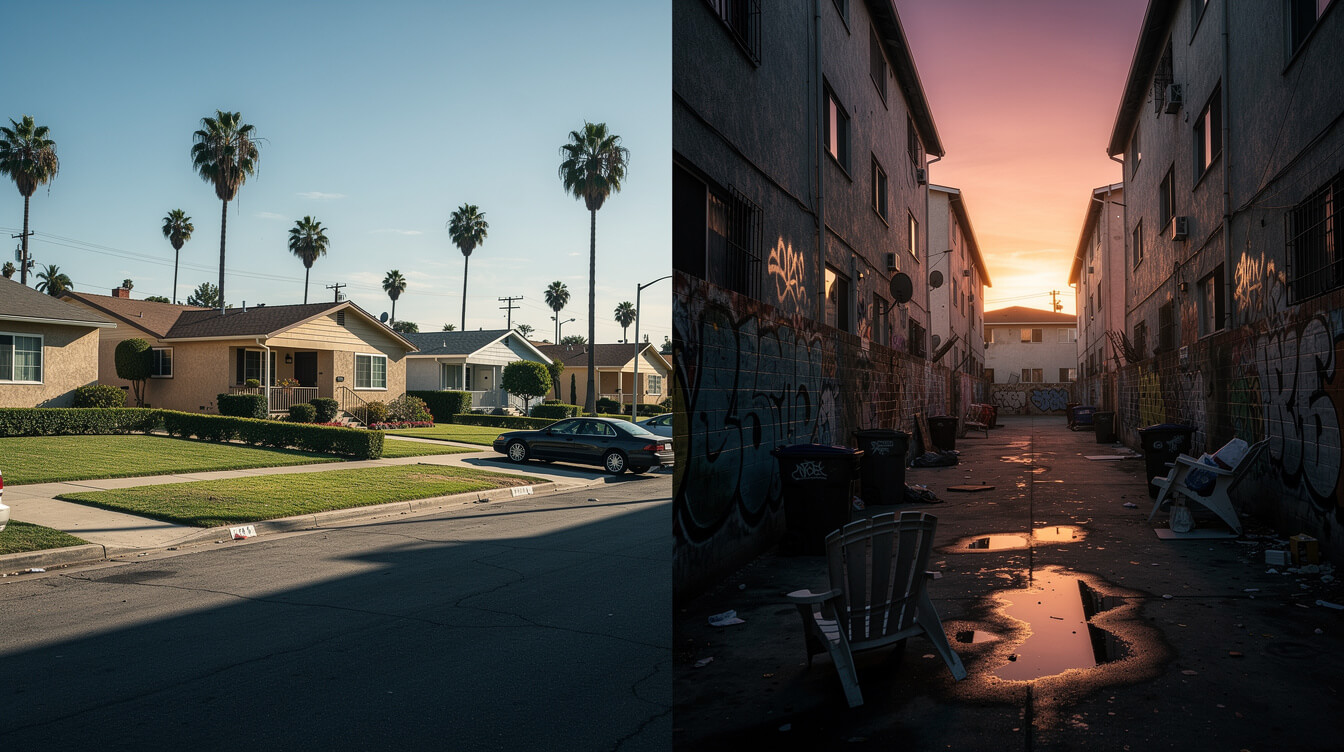
John Singleton’s Boyz N the Hood opened on July 12, 1991 — twenty-two months before Menace II Society. Both films were set in South Central Los Angeles. Both centered young Black men navigating gang life. Both were made by first-time directors under thirty. Both featured extensive hip-hop soundtracks. And both are, to this day, treated as siblings in the “hood cinema” canon.
But watch them back-to-back and the split is unmistakable. Singleton’s Boyz is a coming-of-age narrative with a redemption arc. Tre Styles (Cuba Gooding Jr.) is raised right, gets into Morehouse, and escapes. Furious Styles (Laurence Fishburne) is a moral compass explaining, on camera, that the neighborhood’s condition is a policy failure. Singleton wrote the film to argue that education and Black male mentorship could break the cycle. The film has a thesis. It is telling you what to think.
Menace has no thesis and no exit ramp. Caine is not raised by a Furious Styles — his father (a brief Samuel L. Jackson cameo) is a drug dealer who shoots a man over a card game in the film’s flashback prologue, and his mother is a heroin addict who overdoses when Caine is a boy. Caine is raised, effectively, by television, by his grandparents’ Bible readings that he ignores, and by the older kids on the block. There is no moral tutor. When Mr. Butler (Charles S. Dutton) tries to be one in the film’s third act, Caine listens politely and does nothing.
The rivalry — which was real, and which spilled into 1993 press coverage — was ultimately a philosophical fight about whether Black cinema had an obligation to model hope. Singleton said yes. The Hughes Brothers said the honest answer was that hope was a middle-class luxury and that some kids die before they turn twenty for entirely explicable structural reasons. Both films are correct. Both films are essential. But Menace was the harder pill, and it is the reason the film aged into a canon text while Boyz aged into a great movie.
Legacy: From Menace to Belly, Paid in Full, and Every Cold Open Since

Trace the lineage forward from 1993 and you can watch Menace II Society quietly rewire the visual grammar of Black cinema for the next thirty years. In 1998, Hype Williams released Belly — a film whose iconic cold open (Nas, DMX, and Method Man robbing a nightclub in ultraviolet blue) is a direct grandchild of the Menace opening. Williams cited the Hughes Brothers as foundational in early press. The blueprint: begin mid-crime, no exposition, let the visual do the work.
In 2002, Charles Stone III’s Paid in Full — a Harlem-cocaine story with Wood Harris, Mekhi Phifer, and Cam’ron — pulled the Menace playbook eastward. The unbroken tracking shots of drug transactions, the refusal to sensationalize the money as glamour, and the fatalism of the third act all read like a Hughes Brothers homage set in 1980s Harlem.
F. Gary Gray’s Straight Outta Compton (2015) worked from the same source code — a South Central biography told with soundtrack-driven precision. Gray’s opening drug-raid sequence borrows the Menace handheld language directly, and much of the film’s Compton establishing photography could be intercut with Lisa Rinzler’s 1993 footage and you would not immediately notice the seam.
You can push further. Every prestige Black-cinema cold open of the last decade — Moonlight, If Beale Street Could Talk, The Harder They Fall, Judas and the Black Messiah — owes some measure of formal debt to that first sequence in the corner liquor store. When Barry Jenkins or Ryan Coogler shoot a scene of everyday Black life without editorial hand-holding, they are working in a visual tradition that Albert and Allen Hughes helped codify at age twenty-one.
The film also invented the modern soundtrack album as a canonical document. Before Menace, soundtracks were compilations. After Menace, they became curated statements — the Above the Rim soundtrack (1994), Set It Off (1996), The Wood (1999), and the entire late-’90s cycle followed the QDIII model. Music supervisors began to think like A&Rs.
Frequently Asked Questions About Menace II Society
When did Menace II Society come out?
May 26, 1993, distributed by New Line Cinema. The soundtrack, released by Jive Records, arrived one day earlier on May 25.
Who directed Menace II Society?
Twin brothers Albert and Allen Hughes, both twenty-one years old at the time of release. It was their debut feature. The screenplay was written by Tyger Williams from a story he developed with the Hughes Brothers.
Where was Menace II Society filmed?
Primarily on location in South Central Los Angeles, including the Jordan Downs housing project in Watts. The Hughes Brothers deliberately avoided studio backlots and hired local residents as extras.
What rappers appeared in Menace II Society?
The film featured extensive West Coast rap casting: MC Eiht (Compton’s Most Wanted) as A-Wax, Too $hort as Lew-Loc, and Pooh-Man in a supporting role, alongside rotating uncredited street cast.
Is Menace II Society based on a true story?
No, but it is deeply grounded in the lived reality of post-Rodney-King, post-’92-Rebellion Los Angeles. The characters are composites; the locations, the LAPD presence, and the neighborhood conditions are documentary. Tyger Williams drew on his own upbringing and extensive research in South Central to write the screenplay.
What is the significance of the opening scene?
The Korean-liquor-store cold open — O-Dog’s execution of the store owner and his wife — is widely considered the most influential opening scene in Black cinema. It established the film’s refusal to earn its violence with sympathetic exposition and set the template for the modern prestige cold open in Black film.
Why is Menace II Society considered a hip-hop film?
Because every layer of the production — casting, soundtrack curation, visual composition — was drawn from hip-hop practice. The Hughes Brothers were music-video directors first. The performers came from the West Coast rap roster. The soundtrack was assembled by QDIII with the discipline of a compilation album. And the film’s pacing, cuts, and needle-drops follow hip-hop’s structural grammar more than they follow traditional Hollywood dramatic form.
Final Thoughts: Why Menace II Society Still Matters at Thirty-Three
Reference sites will tell you that Menace II Society earned $27.9 million on a $3.5 million budget, scored 76% on Rotten Tomatoes, and holds a Criterion Collection release. All of that is true and none of it explains the film’s staying power. Menace matters at thirty-three because it was the first hip-hop film that treated its audience like adults — an audience that already knew the code and did not need to be walked through it.
The Hughes Brothers made a film that assumed you understood who MC Eiht was, that assumed you had lived through 1992, that assumed you had heard Straight Outta Compton and could recognize the geography being photographed. They did not condescend. They did not moralize. They shot the neighborhood the way the neighborhood documented itself in music and let the record speak. That confidence is what most of the imitators have never quite matched.
Thirty-three years later, the film’s opening frame — a Korean neon sign glowing red at dusk, a paper bag changing hands, and the sudden, unearned violence of the moment — remains the most cited cold open in Black cinema. Every director who has picked up a handheld camera since 1993 has answered its question one way or the other. Whether they know the Hughes Brothers’ names or not, they are working in the visual language those twenty-one-year-old twins invented in a summer of shooting on a $3.5 million budget in Watts.
That is why we still write about Menace II Society. Not because it aged well — though it did — but because everything after it is the aftermath.

Rep the LA That Made This Film Possible
Before there was Menace, there was Straight Outta Compton — the 1988 N.W.A. record that put South Central on the world map. Our N.W.A. hoodie salutes the album whose soundtrack made the neighborhood filmable in the first place.
Get Hip-Hop Cinema Deep-Dives in Your Inbox
One long-form retrospective every week — the films, the records, the receipts most sites miss. Straight from the Custom Creative crew.
Stay creative — The Custom Creative Team

🎧 Never Miss a Drop
Exclusive product releases, hip-hop deep dives, and member-only discounts. Straight to your inbox.
Free forever. No spam. Unsubscribe anytime.
Get the Culture, Delivered
Deep dives into hip-hop history, exclusive product drops, and discounts sent straight to your inbox. No spam, just culture.
Join 2,000+ hip-hop heads already in the loop. Unsubscribe anytime.