Ghostface Killah Supreme Clientele: Inside Wu-Tang’s Most Coded Album
Ghostface Killah Supreme Clientele dropped on February 8, 2000, and it still sounds like it’s speaking a language the rest of rap hadn’t learned yet. Four years after Ironman and two years after Wu-Tang Forever nearly swallowed the Clan whole, Ghostface came back with an album that didn’t just rap — it scatted, stuttered, and free-associated its way through 20 tracks, and somehow made that sound like the most confident record in the Wu-Tang catalog. This is the story of why it works.
1996 to 2000: What Changed for Ghostface Between Ironman and Supreme Clientele
Four years is an eternity in late-90s hip-hop years. Ironman (1996) arrived while Wu-Tang Clan was still a tight, insular unit riding the high of 36 Chambers and Return to the 36 Chambers. By the time Ghostface got back to a solo record, the group had put out the sprawling double-disc Wu-Tang Forever (1997) — a commercial smash that also fractured the Clan’s internal chemistry, with nine voices competing for space across 27 tracks and RZA’s once-ironclad control over the sound starting to loosen at the edges.
The Health Scare and the Studio Time That Followed
Ghostface spent part of this stretch dealing with a diabetes diagnosis serious enough to require hospitalization, and he’s talked openly in later interviews about recording portions of Supreme Clientele while managing his health. That context matters because it reframes the album’s urgency — this isn’t a rapper coasting on group momentum, it’s an artist who’d had real reasons to think about mortality making the loosest, most unguarded record of his career.
Wu-Tang Forever’s Backlash and the Room It Opened Up
Critics were colder on Wu-Tang Forever than the sales numbers suggested, and several members’ solo records that followed — Meth’s Tical 2000, Raekwon’s underperforming sophomore run — were already complicating the “every Wu solo album is untouchable” narrative. Ghostface needed Supreme Clientele to not sound like a retread of Ironman, and the way he solved that problem is the real story of this record.
Rikers Island and a Trip to Benin
The making of this record wasn’t abstract trouble, either. Ghostface served a four-month sentence at Rikers Island during this stretch stemming from a 1995 gun charge — a detail he references directly on “Buck 50.” Around the same period, he took a trip to Benin, West Africa, and has described it since as a cultural and spiritual awakening, telling The Source something close to: forget the Tommy Hilfiger and the Polo, in Africa everything just felt the same, stripped of the materialism he’d grown up chasing in New York. That trip is where early versions of “Nutmeg,” “One,” and “Buck 50” got written. It’s hard to separate the album’s willingness to abandon conventional structure from an artist who’d just spent time somewhere that convinced him the usual American status markers weren’t the point.
All of this was unfolding against a tense backdrop for the whole Clan — 1999 saw federal investigators reportedly looking at Wu-Tang as a criminal enterprise, the kind of pressure that makes “RZA and Ghostface widening the production circle” look less like a creative experiment and more like a group finding whatever stability it could while the walls closed in from multiple directions at once.
The Real Story Behind Supreme Clientele’s Production
Here’s where a lot of casual retrospectives get it wrong: this is not a “RZA stepped away” album. RZA and Ghostface are credited as co-executive producers on Supreme Clientele, and RZA personally produced five tracks himself, including the intro, “The Grain,” “Buck 50,” “Stroke of Death,” and “Child’s Play.” What actually changed is something more interesting than RZA’s absence — it’s the size of the bench.
Mathematics, Hassan, Carlos “Six July” Broady — the In-House Roster That Built This Sound
Where Ironman leaned almost entirely on RZA’s boards, Supreme Clientele spreads production across nearly a dozen different hands: Mathematics (the RZA protégé who’d go on to produce “C.R.E.A.M.”-adjacent work across the Wu catalog) handled “Mighty Healthy” and “Wu Banga 101.” Carlos “Six July” Broady — the Bad Boy-affiliated producer who’d worked on Biggie’s “Hypnotize” — took “Saturday Nite” and “We Made It.” Juju of the Beatnuts produced “One.” Inspectah Deck produced “Stay True” himself. Hassan (credited elsewhere as Haas G of the U.M.C.’s) built “Apollo Kids,” the song that gave the world one of Ghostface’s most quoted opening lines. Black Moes-Art, The Blaquesmiths, Choo the Specializt, and Carlos Bess round out a credits list that reads less like a RZA solo showcase and more like a full in-house label roster flexing at once.
That’s the untold production story: Supreme Clientele doesn’t sound different from Ironman because RZA disappeared. It sounds different because RZA and Ghostface deliberately decentralized the sound — opening the boards to a wider bench while still curating the whole thing as executive producers — and that structural choice is exactly why the album feels less like one man’s dark, grimy vision and more like a city block’s worth of competing textures stitched into something cohesive.
The single best proof of how far outside the usual Wu production circle this album reached: “Nutmeg,” arguably the record’s signature opening statement, was produced by Black Moes-Art — who, at the time, was cutting Ghostface’s hair. It’s his only major production credit in the Wu catalog, and it anchors the album’s most quoted, most confusing-on-first-listen verse. You don’t get a credit like that on a record RZA is tightly controlling start to finish. You get it on a record where the executive producers trusted the right ear wherever it came from.
If this is the era of Ghostface’s catalog that grabs you, the Ghostface Killah Supreme Clientele Hoodie is built off the album’s own cover art and visual identity — a direct way to rep the record rather than a generic Wu piece.
Apollo Kids Dropped First and Set the Tone
“Apollo Kids” actually hit the streets as the lead single on December 10, 1999, nearly two months ahead of the album itself — a Raekwon feature built on a Solomon Burke “Cool Breeze” soul sample that Hassan chopped into something harder than the original. The Chris Robinson-directed video leaned into the Starks Enterprises bit from the skits, staging it as a giant factory churning out sneakers, which told you exactly what kind of record this was going to be before a single note of “Nutmeg” played. It only cracked #32 on the Hot Rap Singles chart, but it’s since been pulled onto the 2003 compilation Shaolin’s Finest — the kind of slow-building reputation that outlasts the chart number entirely.
Rap as Jazz Scatting: Decoding the “Incoherent” Verses on Nutmeg and Mighty Healthy
Play “Nutmeg” for someone who’s never heard Supreme Clientele and watch their face. The opening verse is a flood of half-finished images — jewelry, cereal boxes, kung-fu references, half a punchline about a Lamborghini — that refuses to resolve into a clean narrative. That’s not a flaw. It’s the entire point.
The Method Behind the “Madness”
Ghostface has described his own writing process as closer to painting than storytelling — he’s chasing images and sounds in sequence, the way a jazz soloist chases a scale, rather than building toward a punchline the way a more traditional battle-rap verse would. “Mighty Healthy” is the clearest example: the verses jump associatively from one vivid image to the next, daring the listener to keep pace rather than slowing down to explain the connective tissue. It’s the rap equivalent of scatting — content that communicates through rhythm, tone, and texture as much as through literal meaning.
This is also why Supreme Clientele rewards repeat listens in a way a lot of 2000-era rap didn’t. The first pass through “Nutmeg” sounds like chaos. The fifth pass starts revealing a logic — recurring images, a street-level sense of humor, a rhythm scheme that locks into Mathematics’ bassline exactly where it needs to. Ghostface wasn’t being incoherent. He was asking listeners to read him the way you’d read abstract art: for feeling and composition first, meaning second.
Why Critics Reached for “A+” Instead of Confusion
What’s remarkable is how fast the critical establishment caught up to what Ghostface was doing. The Source — not an outlet known for handing out its top rating lightly in 2000 — gave Supreme Clientele an A+ on release, and AllMusic’s retrospective review credits the album with dodging the sophomore slump specifically by refusing to chase the Ironman formula. That’s a notably different reception than most “the rapper got weirder” pivots get on first listen; usually critics need a few years of distance to credit an artist for abandoning an approach that already worked. Supreme Clientele got that credit almost immediately, which says something about how deliberately constructed the “chaos” actually was underneath the surface.
The Soul-Sample Palette That Makes This Wu-Tang’s Warmest-Sounding Dark Album

Sonically, Supreme Clientele is a strange, specific contradiction: the lyrical content is as dark and street-level as anything on Ironman, but the sample palette is warm — soul loops, muffled vocal chops, keys that sound like they’re coming through a slightly blown speaker in a barbershop. It’s the sound of RZA’s chamber-music aesthetic filtered through a wider crew of producers who grew up on the same soul 45s but weren’t trying to replicate the 36 Chambers grime for its own sake.
Chopping Soul the Wu Way
Compare the sample choices here to Mathematics and the other in-house producers’ later work and you can hear the throughline: these are soul and funk loops pitched down and chopped just enough to feel haunted, never cleaned up enough to feel smooth. It’s the difference between a sample that sounds expensive and one that sounds lived-in. Supreme Clientele picked lived-in, every time, and that choice is a big part of why the album ages better than a lot of its more polished 2000-era peers.
A Different Kind of Dark Than Ironman
Ironman‘s palette leaned into RZA’s signature chamber-music grime — minor-key loops, martial-arts samples, a sound built for alleyways. Supreme Clientele keeps the street-level subject matter but swaps the sonic temperature: horns and vocal chops that feel warmer, closer to barbershop-radio soul than kung-fu theater. It’s a subtle move, but it’s the reason the album can hold both “incoherent” rapid-fire verses and a genuinely comfortable, head-nodding listen at the same time — the beats give the ear somewhere soft to land while the bars keep throwing curveballs.
The DOOM/Madlib Lineage: How Supreme Clientele’s Style Echoed Forward
Critics writing about MF DOOM’s 2003 album Vaudeville Villain have drawn a direct line back to Supreme Clientele’s willingness to abandon popular trends in favor of all-out, image-dense rhyming — the same refusal to slow down and explain himself that made Ghostface’s verses feel so alien in 2000. That’s not just critical conjecture dressed up after the fact, either.
Born Like This, Victory Laps, and the DOOMSTARKS Tease
Ghostface and DOOM’s relationship wasn’t theoretical — it played out in the booth. Ghostface appeared on DOOM’s 2009 album Born Like This on the track “Angelz,” and in 2011 the two released the single “Victory Laps,” complete with a Madlib remix sitting right alongside the original. The long-teased “DOOMSTARKS” collaborative album between Ghostface and DOOM never fully materialized before DOOM’s passing, but the fact that two of abstract rap’s most private, press-averse figures kept circling back to work with each other says something real about mutual respect between the generation Supreme Clientele helped set loose and the Wu veteran who got there first.
You don’t have to squint hard to hear it: DOOM’s internal-logic wordplay and Madlib’s loop-based, off-kilter productions both share DNA with an album that proved you could abandon linear storytelling entirely and still move a crowd — as long as the images you’re throwing out are vivid enough to land even when the throughline doesn’t.
Why That Lineage Matters More Than a Trivia Footnote
It’s easy to treat “this influenced that” claims as critic trivia, but the Ghostface-to-DOOM line is really a statement about what hip-hop decided was allowed to count as skill. Before Supreme Clientele, rap’s technical gold standard was mostly measured in multisyllabic rhyme schemes and airtight narrative — the Rakim-to-Nas lineage. Ghostface added a third axis: vividness of image over clarity of sentence. DOOM built an entire masked-villain mythology on that same axis a few years later, and Madlib’s beat-tape aesthetic — loops left loose and unresolved on purpose — is the production-side mirror of the same instinct. That’s a real shift in what “good rapping” was allowed to sound like, not just a stylistic coincidence between three guys who liked working together.
The Lineage Didn’t Stop at DOOM and Madlib
Kanye West has been vocal about Wu-Tang’s imprint on his own style, and the Ghostface connection wasn’t just admiration from a distance — the two actually linked up on record decades later for “No Face,” and rumors of a full Supreme Clientele 2 collaborative project between Ghostface and Kanye have circulated in hip-hop press for years, surfacing again as recently as 2026. Whether or not that record ever fully materializes, the fact that it’s even a persistent rumor — one of the biggest producer-rappers of his generation wanting to sit inside this specific album’s universe — tells you how far Supreme Clientele’s fingerprints actually travel.
Deep Into the Ghostface Catalog
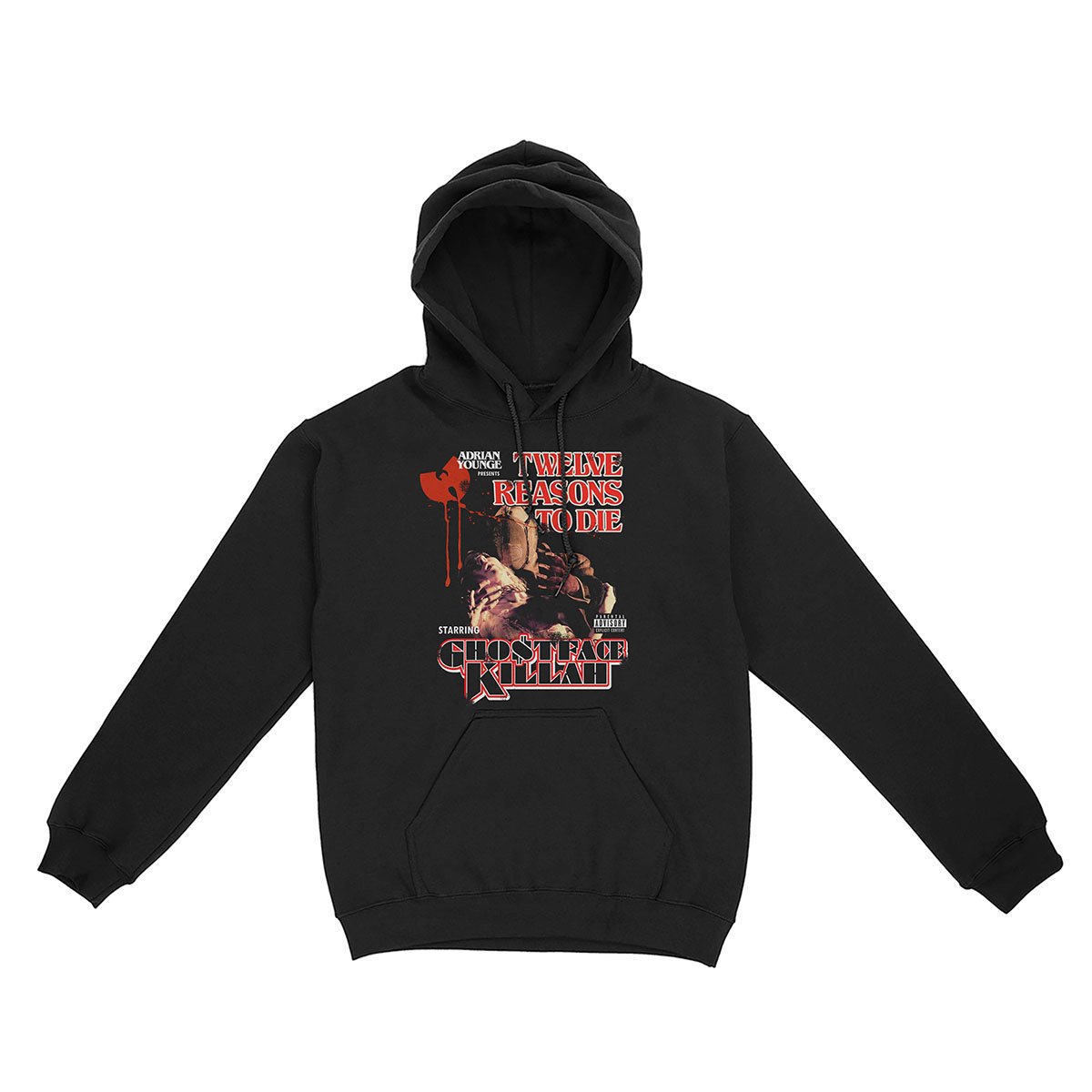
If Supreme Clientele put you on, the Twelve Reasons to Die Hoodie carries that same cinematic, Wu-coded energy from a different era of the Ghostface catalog — built for heads who ride for the whole run, not just one album.
Frequently Asked Questions About Ghostface Killah’s Supreme Clientele
When did Supreme Clientele come out, and how did it perform commercially?
Supreme Clientele was released February 8, 2000, on Razor Sharp/Epic Records. It debuted at #7 on the Billboard 200 and #2 on the Top R&B/Hip-Hop Albums chart, and went on to earn RIAA Gold certification.
Who produced Supreme Clientele?
RZA and Ghostface Killah served as co-executive producers, with the actual beats spread across a wide in-house roster: RZA himself (5 tracks), Mathematics, Carlos “Six July” Broady, Juju of the Beatnuts, Inspectah Deck, Hassan of the U.M.C.’s, Black Moes-Art, The Blaquesmiths, Choo the Specializt, Haas G, and Carlos Bess.
How was Supreme Clientele received by critics?
Overwhelmingly well, both on release and in retrospect. The Source gave it a top “A+” rating, and it’s routinely cited by critics and fellow artists as the moment Ghostface fully separated his voice from the rest of the Clan — cleaner than Ironman, stranger, and far more influential on the generation of rappers that followed.
What’s the most famous line or moment on the album?
“Apollo Kids” gets cited most often — its opening verse and the Raekwon feature made it the lead single, and it’s the track most likely to show up on a “best Ghostface verses” list. “Nutmeg” is the deeper-cuts answer: the verse that confuses first-time listeners and rewards everyone who sticks with it.
Did Ghostface’s personal life during this period show up in the music?
Directly. His four-month stay at Rikers Island from an earlier gun charge gets referenced on “Buck 50,” and the spiritual reset he underwent during a trip to Benin fed directly into early versions of “Nutmeg,” “One,” and “Buck 50” — this is one of the rare classic albums where you can trace specific real-life events to specific tracks with this much precision.
Is Supreme Clientele considered Ghostface’s best album?
It’s in every serious conversation about his best work, usually trading the top spot with Fishscale (2006) depending on who you ask. What separates Supreme Clientele is its influence footprint — it’s the album most directly cited by the abstract-rap generation that followed, which gives it a cultural weight the catalog’s other high points don’t carry in quite the same way.
Final Thoughts: Where Ghostface Killah’s Supreme Clientele Ranks in the Wu Solo Catalog
Twenty-five years on, Supreme Clientele still functions as a dividing line in the Wu-Tang solo catalog — the record where a member of the Clan proved he could build something that didn’t lean on RZA’s singular sound to feel complete, while RZA himself was still right there in the credits the whole time. That’s a harder trick than “RZA stepped away and someone else stepped up.” It’s a group of producers and one rapper deciding, together, to build something stranger and warmer than anything the Clan had made before, and trusting that the audience would catch up. Twenty-five years of critics and rappers citing this record as a turning point says they did.
For the full arc of how this fits into Ghostface’s run, check out our breakdown of every Ghostface Killah album ranked, or go track-by-track with the essential cross-catalog guide to his best songs. And if the Wu-Tang W is calling your name after all this, our definitive Wu-Tang merchandise guide covers every way to rep the 36 Chambers.
Culture Delivered Weekly
Deep catalog breakdowns, product drops, and the stories behind the merch — straight to your inbox.

🎧 Never Miss a Drop
Exclusive product releases, hip-hop deep dives, and member-only discounts. Straight to your inbox.
Free forever. No spam. Unsubscribe anytime.
Get the Culture, Delivered
Deep dives into hip-hop history, exclusive product drops, and discounts sent straight to your inbox. No spam, just culture.
Join 2,000+ hip-hop heads already in the loop. Unsubscribe anytime.