Souls of Mischief: How Four Oakland Teenagers Chilled From ’93 ‘Til Infinity and Built the Hiero Blueprint
On September 3, 2026, the Hieroglyphics crew dropped All Said and Done, their first group album in 13 years. The release date was no accident. In Oakland, 9/3 has been Hiero Day since 2012, a date picked as a nod to one song: Souls of Mischief‘s “93 ’til Infinity.” Thirty-three years after four East Oakland teenagers rapped about chilling, that song still sets the calendar for a whole crew and keeps turning up in other rappers’ freestyles.
Search Souls of Mischief right now and you get anniversary stubs, CD listings and a Google panel that only shows three of the four members. So this is the full story. Who the four MCs are, how they came up inside the Hieroglyphics crew, who produced every track on the debut, which 1974 jazz-fusion record the title track flips, why Jive cut them, and how they built one of rap’s first independent internet businesses out of that drop. Every date and credit below is checked against liner notes, interviews and chart records, because this crew deserves receipts, not vibes.
Who Are Souls of Mischief? Four MCs From East Oakland

First correction, because half the internet gets it wrong: Souls of Mischief is a quartet, not a trio. The four MCs are A-Plus (Adam Carter), Opio (Opio Lindsey), Phesto (Damani Thompson) and Tajai (Tajai Massey). They came together as a group in 1991 in East Oakland, all born in the mid-’70s. When “93 ’til Infinity” hit, they were barely out of high school.
Friends Before They Were a Group
This wasn’t a label putting four strangers together. Tajai and A-Plus go back to elementary school. “I began rapping at age eight (1983) with A Plus,” Tajai said in a 2005 interview. “We did not have any equipment as youngsters, so rapping and breaking were the most appealing (read: free) pastimes.” A-Plus’s dad was a programmer, and Tajai has said the two of them “grew up programming.” Long before samplers, they were two Oakland kids who could make machines do things.
A-Plus isn’t actually from Oakland. “My parents came from Jamaica,” he told SoundSlam in 2003. “I was born in Denver, Colorado. I grew up in Oakland from 5 and up.” Phesto filled in the rest of the circle in a 1996 interview on the crew’s own website: “I had known Tajai since Junior High, as well as Del. Tajai introduced me to A Plus and Opio.” Opio tells it from the other side. He met Casual in seventh grade, around age 12, and Casual “would play me some of A-Plus and Tajai’s music.” By high school, Phesto said, the crew had “formed a concrete set of groups within Hieroglyphics.”
Why “Souls of Mischief”?
The name is literal. “As kids we were very mischievous and wild, so we decided on the name based on that,” Tajai explained. “We are trying to make mischief on the mic, to stir things up.” A-Plus has told the rest of it: the group spent days walking the neighborhood brainstorming, and their demos and first contracts actually said Soulz of Mischief, with a Z. They dropped the Z at the last minute.
The Rap Nerd Who Became an Architect
Here’s the detail most profiles skip. Tajai earned a BA in anthropology from Stanford in 1997, while the crew was building its independent label. Then he went back to school and earned a Master of Architecture from UC Berkeley in 2014. That’s an MC who rapped about chilling while studying things most rappers never touch, and the same curiosity is all over the group’s records: the vocabulary, the left turns, the refusal to rap like anyone else in 1993.
The Hieroglyphics Crew: Del’s Orbit and the Third Eye
You can’t tell the Souls of Mischief story without the Hieroglyphics crew. The core lineup is Del the Funky Homosapien, Casual, Pep Love, producer Domino, DJ Toure and all four Souls. Snupe, Mike G and Jay-Biz all came through in the early years too. Think of it as a crew where everybody produced, everybody rapped, and everybody checked everybody’s verses.
The Ice Cube Connection
The door into the industry was Del. He’s Ice Cube’s cousin, and he ran with and wrote for Cube’s crew Da Lench Mob before going solo. As SF Weekly put it in 2000, “Del’s cousin, Ice Cube, helped Del get signed to Elektra, where he released… I Wish My Brother George Was Here in 1991.” That album put the crew’s name in front of the industry. We broke down Del’s run in our Del the Funky Homosapien birthday piece, and if you rep the album that started it all, our Del – I Wish My Brother George Was Here T-Shirt is cut for exactly that.
Cube is also part of why the crew is called Hieroglyphics at all. They started out as the Mad Circle, but that name ended up with WC’s group. A-Plus later put it plainly: “Cube thought that name was more appropriate for some gangsters.”
Domino and the Groove Merchant
Domino is the outlier. Damian Siguenza is from San Francisco, the only Hiero member from across the bridge. Crate-digging around the city led him to Groove Merchant Records on Haight Street. That’s where New York A&R Dante Ross introduced him to Del in 1991. Domino ended up producing a big chunk of the Souls debut and later managed the crew’s business side.
The Third Eye Logo
The crew’s logo, three dots over a flat bar, is a mark fans literally tattoo on themselves. Del drew it. According to the crew’s own 1996 website, the old Mad Circle logo was an angry two-eyed face. When the name changed, “Del added an extra eye and made the mouth a straight bar.” Fans have pointed out since that three dots over a bar is also how the Maya wrote the number eight. That’s a great coincidence, though Del has never said it was the plan.
Del did say this, to SF Weekly in 2000: “When I invented that symbol, I never thought it would get this big. I’ve seen about 20 people with that tattoo… I saw a Redman and Method Man video, and there’s somebody in the crowd with a Hiero shirt on. I think slowly but surely people are starting to pay attention to us.” A crew logo spreading through East Coast crowds by word of mouth is a good picture of how hip-hop merch was supposed to work.
“Burnt” and the Jive Deal
The Souls got their shot on Del’s records. They needed their parents’ permission to stay out all night recording “Burnt,” the B-side to Del’s “Mistadobalina.” When Stretch & Bobbito played “Burnt” on New York radio, labels started calling. Sophia Chang signed them to Jive. Pitchfork’s history of the group reports a detail that matters later: they picked Jive partly because Jive let them keep their publishing. The deal was negotiated by Opio’s stepfather, the same lawyer who got Ice Cube out of his Ruthless contract.
93 ‘Til Infinity: The Souls of Mischief Debut, Producer by Producer

Jive released 93 ’til Infinity on September 28, 1993. It came out in the year after The Chronic, when every West Coast A&R wanted G-funk, and it sounded like none of that. It was jazzy, dense and talky. Four teenagers traded verses about skill, about survival in Oakland, and about knowing exactly how good they were.
Where It Was Made
The album was recorded at Hyde Street Studios in San Francisco. Per the Discogs liner credits, most of it was mixed at Battery Studios in New York, with tracks 1, 2, 4, 10 and 12 mixed back at Hyde Street, and mastered at The Hit Factory by Tom Coyne. An Oakland record with New York finishing.
The Producer Map
No outside producers. Everything came from inside the crew. Here’s who made what, straight from the original CD’s credits (Discogs release 260608):
- Let ‘Em Know: Domino
- Live and Let Live: Domino (Bill Ortiz on trumpet)
- That’s When Ya Lost (feat. Pep Love): Del, with A-Plus on scratches
- A Name I Call Myself: Del
- Disseshowedo: Domino and Jay-Biz, A-Plus on scratches
- What a Way to Go Out: Domino, Casual on extra vocals
- Never No More: A-Plus
- 93 ’til Infinity: A-Plus
- Limitations (feat. Casual and Del): Jay-Biz
- Anything Can Happen: A-Plus
- Make Your Mind Up: Del, A-Plus on scratches
- Batting Practice: Casual
- Tell Me Who Profits: Casual
- Outro: Domino
Two jewels are hiding in that list. First, A-Plus produced the title track while he was still a teenager. Second, the publishing notes for tracks 3, 4, 9 and 11 (Del’s productions and the Del-featured “Limitations”) list Street Knowledge Music. That’s Ice Cube’s company. Lench Mob Records was founded as Street Knowledge Records. So Cube’s publishing is printed on one of the least gangsta records of 1993.
How It Landed
Commercially, the album peaked at No. 85 on the Billboard 200 and No. 17 on Top R&B/Hip-Hop Albums. Critically, it landed harder. Reviewing it alongside Midnight Marauders in January 1994, the Washington Post’s Gil Griffin heard “the distant trumpet shouts and fuzzy drum brushes in ‘Never No More’ and the combination of record-scratches and Ramsey Lewis keyboard samples on ‘Make Your Mind Up.'” In 1998, The Source put it on its list of the 100 Best Rap Albums.
That Tribe pairing went further than one review. Souls of Mischief, Del and Casual are all among the artists pictured on the cover of A Tribe Called Quest’s Midnight Marauders, released that same fall. So were Black Moon, whose own 1993 debut we covered in our Enta Da Stage deep dive, and the Pharcyde. In the fall of 1993, the jazz-rap new school was one crew, and the Oakland kids were in it.
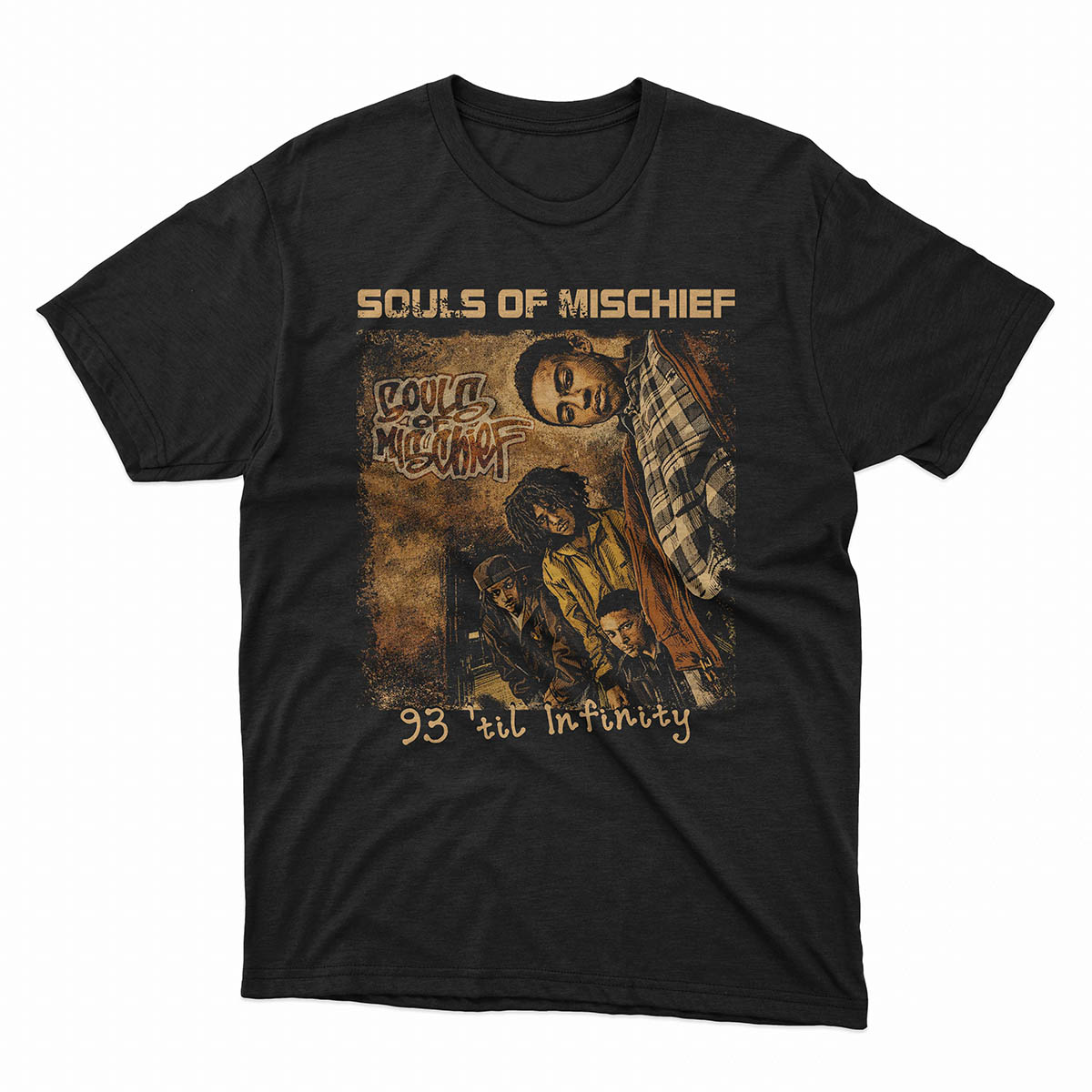
This Is How We Chill, Since ’93
Four East Oakland teenagers, an all-Hiero production squad, and a jazz-fusion flip that never got old. Our 93 ’til Infinity tee and hoodie are made for heads who know the producer credits.
The Sample: Billy Cobham’s “Heather” and a Beat Called ’91 ‘Til Infinity’
Everybody asks it, so here’s the answer up front: “93 ’til Infinity” samples “Heather” by Billy Cobham, from his 1974 album Crosswinds. The original runs 8 minutes 25 seconds, with solos from George Duke and Michael Brecker. Duke is also on keys. Crosswinds reached No. 2 on Billboard’s Jazz Albums chart. The 12-inch’s liner notes spell it out: “contains a sample of Heather performed by Billy Cobham.”
A Dollar-Bin Record at 45
The way A-Plus found and flipped it is the real jewel. “It was in the dollar bin,” he told Spin in 2013. Because his sampler had very little sampling time, he listened to his samples sped up: “I used to listen to my samples on 45, because I didn’t have much sampling time in my sampler.” Hearing “Heather” fast changed how he heard it. His thought: “I’m gonna make it uptempo.” That’s the gear limits of 1990s hip-hop in one sentence. You couldn’t sample long, so you sped it up, and that made the groove.
From ’91 to ’93
The song is older than the title. A-Plus told XXL the full origin: “It was originally a song called ’91 ’til Infinity’ I made [when] we were still in high school and hadn’t been discovered yet. It was a slower, more somber beat.” He loved it so much he “might’ve shed a tear.” When the record deal came, the crew brought the idea back: “let’s do a ’92 ’til Infinity.’ Oh but this album ain’t going to come out ’til ’93 so let’s call it ’93 ’til Infinity.'”
There’s a twist. A-Plus had already handed that beat to Pep Love: “I ended up giving that beat to Pep Love while we was recording… Ultimately I had to take the beat back from Pep Love.” That episode started a crew rule: producers play new beats for everyone first, before anyone claims one. And Tajai says the whole album depended on the song: “we weren’t going to have a title before we made that song.”
If that dollar-bin-to-classic story is why you love this record, our Souls of Mischief – 93 ’til Infinity T-Shirt is basically the liner notes you can wear.
The Single, the Video, the Chart
“93 ’til Infinity” was actually the second single. “That’s When Ya Lost” came first in spring 1993, and the Discogs catalog numbers run in that order. The title track went to No. 72 on the Billboard Hot 100, the group’s only Hot 100 entry ever, plus No. 11 on Hot Rap Singles and No. 65 on R&B. Rolling Stone notes it grew through The Box and BET’s Rap City while radio held back.
The video, directed by Michael Lucero, did a lot of that work. It wasn’t really “filmed around the Bay,” as some anniversary posts claim. The group shot in Yosemite and at Pinnacles, deep in Northern California, which explains the mountains. Opio believes the hand-across-the-lens “talent wipe” transitions may have been a first. Lucero also shot Organized Konfusion’s “Stress” before he died in 1998, at just 34.
The B-side is worth a listen too. “Disseshowedo,” which is also track 5 on the album, samples Main Source’s “Fakin’ the Funk” and Jerry Butler and Jerry Peters’ “Speak the Truth to the People (Frankie’s Theme),” from the 1972 Melinda soundtrack. More than 31 years after release, on April 16, 2025, the RIAA certified the single Platinum.
After Jive: No Man’s Land, Hiero Imperium and the Indie Blueprint
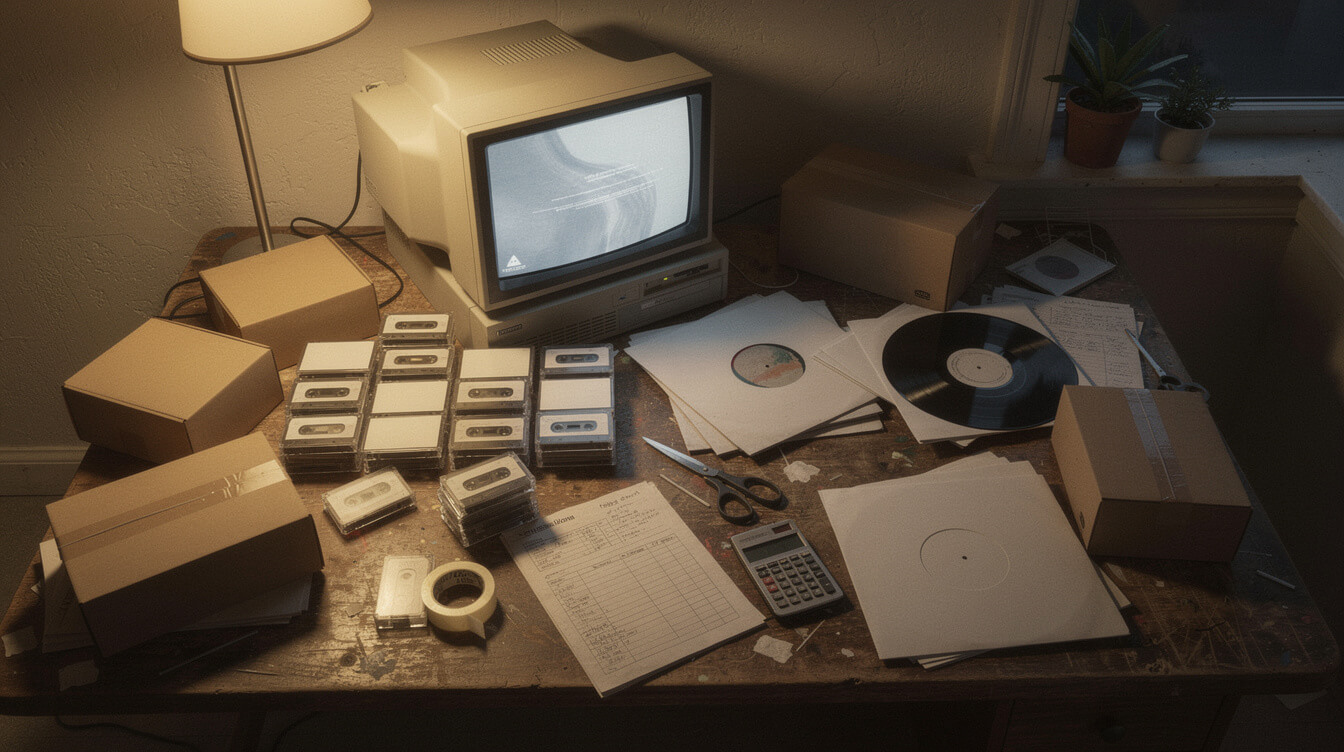
The follow-up, No Man’s Land (1995), was even more in-house. Production came from A-Plus, Opio, Tajai, Casual, Del, DJ Toure, Jay-Biz and Snupe. It peaked at No. 111 on the Billboard 200 and No. 27 on R&B/Hip-Hop Albums, and “Rock It Like That” reached the Hot Rap chart. It also got them dropped.
Dropped the Day It Dropped
The details are rough. In a 1997 Rap Pages feature, Domino said the crew found out on the day No Man’s Land came out that Jive was dropping Souls and Casual, effective immediately. The record sold somewhere around 30,000 to 40,000 copies. “Our main thing was that we wanted to have longevity in the industry, like a Gang Starr or Tribe,” Domino said. “Maybe sell some units, but to also build a career.” Opio was blunter: “They were frustrated with us, we were frustrated with them.” Domino summed up the mood in two words: “We’re free.”
Hieroglyphics Imperium
So they did it themselves. By the mid-’90s the crew had launched Hieroglyphics Imperium Recordings, with Domino as manager, in-house producer and the guy booking the early indie tours. The internet piece of the story is a real jewel. Hieroglyphics.com started on August 15, 1995 as a fan site, run by a fan who went by StinkE. Tajai found it, and the crew made it official. Hip-hop groups going direct-to-fan online are normal now. In the mid-’90s, a rap crew adopting a fan’s web page as its official home, and later its own store, was close to unheard of.
They used it. The Souls of Mischief album Focus came out as a cassette in May 1998, sold directly through the crew’s online store, with a vinyl pressing following in 1999. The Hiero group album 3rd Eye Vision (March 24, 1998) became the label’s calling card, with East Bay Express reporting sales of more than 100,000 copies. Then came the Souls album Trilogy: Conflict, Climax, Resolution (October 24, 2000), which reached No. 37 on the Independent Albums chart, and the Hiero group album Full Circle (October 7, 2003). The label released O.C.’s Smoke and Mirrors in 2005 and distributed Goapele’s Even Closer.
Domino’s take on going indie is the best business advice in this post: “We had so much success and made so much money doing it independently, we were like, why get signed?”
The Bay’s DIY DNA
This wasn’t new for the Bay. Too $hort sold tapes out of his car trunk in the early ’80s and put out Don’t Stop Rappin’ on Oakland’s 75 Girls Records in 1983. E-40 started Sick Wid It in Vallejo in 1989, which we touched on in our E-40 greatest-hits retrospective. Funny enough, Too $hort and E-40 also ended up on Jive alongside the Souls. What Hiero added was the internet, years before Bandcamp existed. The Bay’s own piano-man genius Shock G came up in the same Oakland underground, running on a totally different frequency.
The Second Act: Prince Paul, Adrian Younge and There Is Only Now
Plenty of ’90s groups stopped making records. Souls of Mischief kept making interesting ones.
Montezuma’s Revenge With Prince Paul
After the Tour Stories EP (January 2009), the group teamed up with Prince Paul, the De La Soul and Gravediggaz architect, for Montezuma’s Revenge (December 1, 2009). They recorded for six weeks in an isolated house on Montezuma Road, which gave the album its name. It came out on Clear Label Records, an imprint run by Tajai. Prince Paul handled most of the production, with Domino on some tracks.
There Is Only Now: A Concept Album Built on a Real Night
Then came the boldest record of their career. There Is Only Now (August 26, 2014, Linear Labs) is a full concept album, produced entirely by Adrian Younge, the composer known for analog, soul-soaked scoring. The story is built on something that really happened. As Tajai told NPR’s Microphone Check in 2014: “this incident happened in 1994 to a member of Hieroglyphics named Domino. We were all there and Dante Ross was there and a rapper, Saafir… I’m running down the street from bullets.”
The cast is stacked. Busta Rhymes plays the villain, Womack. Snoop Dogg shows up, along with William Hart of the Delfonics and Scarub. Ali Shaheed Muhammad of A Tribe Called Quest narrates as a DJ on a made-up Oakland radio station, K-NOW. The Tribe connection was in the plan from the start. Younge pitched the record to fans who miss “the sounds of 93 ’til Infinity meets The Low End Theory meets De La Soul Is Dead.” If you need a refresher on those reference points, check our pieces on The Low End Theory and De La Soul Is Dead.
The Doc, Hiero Day and a 2026 Album
In 2013, director Shomari Smith released Til Infinity: The Souls of Mischief, a documentary built on more than 50 interviews, including Yasiin Bey and Stretch Armstrong. By then, the song had become a holiday. Hiero Day started in 2012 as a fan’s idea to play Hiero music every 9/3, after “93.” The first one drew several thousand people to a stage at 19th and San Pablo in Oakland. In 2013, Mayor Jean Quan made September 3 official Hiero Day in Oakland. Her proclamation called the crew “a steadfast cultural and musical force, a pioneering entity in technology and innovation and shining example of local, homegrown business with worldwide appeal.” It usually lands on Labor Day weekend now, and the 2026 edition moved across the bay to The Midway in San Francisco.
Which brings us back to the top. All Said and Done, Hieroglyphics’ fourth group album and their first since The Kitchen (2013), came out September 3, 2026. It was produced by A-Plus, Domino and DJ Toure, and led by the single “Drum Talk.” Souls of Mischief are still on the road too. They’re booked on Atmosphere’s Winter Carnival Tour starting January 14, 2027.
‘Til Infinity, Literally: Who Flipped It After
Few beats have been rapped over by as many later artists as “93 ’til Infinity.” Here’s the verified family tree:
- Consequence feat. Kanye West, “03 ‘Til Infinity (Freestyle)”: from Consequence’s 2004 mixtape Take ‘Em to the Cleaners. The title alone shows where their heads were in 2004.
- J. Cole, “Til’ Infinity”: from The Warm Up (2009), sampling the original.
- Freddie Gibbs, “How We Do (’93 Til Freestyle #3)”: Gibbs over the beat in 2009. Souls of Mischief shouted it out on their own socials.
- Big K.R.I.T., “Somedayz”: K.R.I.T. over the “93” instrumental, the Mississippi branch of the family tree.
A note for the comment section: Joey Bada$$’s “95 Til Infinity” is a title nod only. Lee Bannon produced it with a different beat, so it doesn’t belong on the sample list, whatever the playlists say.
From Gatorade to the All-Time Lists
During the 2017 NBA Playoffs, Gatorade put the instrumental under a Paul George spot. The critics caught up too. In 2019, the BBC polled 108 critics in 15 countries for the greatest hip-hop songs of all time. “93 ’til Infinity” landed at No. 7, one spot below “C.R.E.A.M.” and one above the Pharcyde’s “Passin’ Me By.” In 2023, Rolling Stone ranked it No. 5 among the greatest West Coast hip-hop songs. It also showed up on the soundtrack to A24’s 2024 film Y2K, reaching a generation born after Focus came out on cassette.
The Other West Coast
That BBC neighbor isn’t a coincidence. The Pharcyde and Souls of Mischief were both part of the same 1992-93 moment, young crews proving the West Coast was more than G-funk. We covered the LA side in our Pharcyde members breakdown, and our Bizarre Ride T-Shirt pairs naturally with anything Hiero. For the cold months, the Souls of Mischief – 93 ’til Infinity Hoodie is how you chill from November ’til infinity.
Souls of Mischief FAQ
Where is Souls of Mischief from?
East Oakland, California. A-Plus was born in Denver and moved to Oakland at five, and the group came together there in 1991.
Who are the members of Souls of Mischief?
Four MCs: A-Plus (Adam Carter), Opio (Opio Lindsey), Phesto (Damani Thompson) and Tajai (Tajai Massey). Some sites, and even Google’s members carousel, leave Opio out. It’s a quartet.
What song did 93 ’til Infinity sample?
Billy Cobham’s “Heather,” from his 1974 jazz-fusion album Crosswinds. A-Plus found it in a dollar bin and sped it up into the beat.
Are Souls of Mischief part of Hieroglyphics?
Yes. The Hieroglyphics crew includes Del the Funky Homosapien, Casual, Pep Love, Domino, DJ Toure and all four Souls of Mischief members. The crew also runs its own label, Hieroglyphics Imperium.
What movie is 93 ’til Infinity in?
The song is the subject of the 2013 documentary Til Infinity: The Souls of Mischief, directed by Shomari Smith. It also appears on the soundtrack to A24’s 2024 film Y2K, and its instrumental ran in Gatorade’s 2017 NBA Playoffs ad with Paul George.
Is 93 ’til Infinity certified?
Yes. The RIAA certified the single Platinum on April 16, 2025, more than three decades after it came out. The album itself has no RIAA certification.
Why is September 3 Hiero Day?
Because 9/3 reads as “93.” Fans started Hiero Day in 2012, and Oakland Mayor Jean Quan made September 3 official Hiero Day in 2013.
Four kids who grew up programming computers made a record about chilling that turned into a holiday, a Platinum plaque three decades later, and a business model the industry eventually copied. That’s the Souls of Mischief story: no outside producers, no compromise, and no expiration date. Put it on, let the Cobham loop ride, and you’ll hear why it’s still 93 ’til infinity.
Stay creative — The Custom Creative Team
Get the Liner-Note Receipts First
One email a week: record histories, producer credits and new drops from the Custom Creative team. No spam, just culture.

🎧 Never Miss a Drop
Exclusive product releases, hip-hop deep dives, and member-only discounts. Straight to your inbox.
Free forever. No spam. Unsubscribe anytime.
Get the Culture, Delivered
Deep dives into hip-hop history, exclusive product drops, and discounts sent straight to your inbox. No spam, just culture.
Join 2,000+ hip-hop heads already in the loop. Unsubscribe anytime.