Wu-Tang Clan T-Shirt: The Definitive Guide to Every Era, Drop and Bootleg in the Wu Tee Game
Search wu-tang clan t-shirt on Google and you get ten shopping pages and zero answers. Every result in the top ten is a store category page — the official Wu-Tang Shop, Amazon, Hot Topic, Rockabilia, Nike SNKRS, TeePublic. Nobody actually explains what you’re looking at. Why does a Walmart Wu tee cost $13.99 while a near-identical printed-cotton shirt on the official store runs $40? Why do 1997 tour tees clear $800 on Grailed while a 2026 reprint of the same graphic clears nothing? What was Wu Wear, and why does it matter for what’s hanging on the Hot Topic rack right now?
Here’s the thing nobody on the search results page is willing to tell you: every Wu-Tang Clan t-shirt you can buy in 2026 descends from one of four genealogical branches. Learn the four and you stop being a mark — you become a fan who knows exactly what they’re holding. This is the deep cut to our rap merchandise guide, and a companion to our Wu-Tang Clan gifts breakdown. Let’s build the family tree.
The Four Branches of Every Wu-Tang Clan T-Shirt
Strip away the marketing and there are exactly four ways a Wu-Tang shirt comes into existence. Branch one is the official Wu-Tang Shop catalog — the Clan’s own merch channel, lean and premium, anchored at $40. Branch two is Wu Wear, the streetwear empire the group built in 1995 and ran into the late 2000s; the original pieces are now collector currency. Branch three is the licensed mass market — Walmart, Amazon, Hot Topic, Rockabilia, Old Navy, even Nike — all of them paying the same licensing body, all of them at wildly different price points. Branch four is the indie print-on-demand and tribute tier — TeePublic, Etsy, independent hip-hop boutiques — fan-made art, fan-friendly prices, no license attached.
Three of those four branches are paying Wu-Tang Productions LLC for the right to print the name and the marks. The fourth is something different: original artwork made by people who love the records, sold honestly as homage. None of these branches is “fake.” But they are absolutely not the same product, and the gap between them is the entire story of the Wu-Tang Clan t-shirt. Walk through them in order.
Branch One: The Official Wu-Tang Shop Catalog
Go to thewutangclan.com and the first thing you notice is restraint. The official tee collection is small by design — a Classic Wu Tee at $40, a Wu Flag Tee at $40, a handful of seasonal graphics, topping out at a $120 Wu-Tang Forever hockey jersey. No 200-design wall. No bargain bin. The price anchor is deliberate: $40 says “this is the group’s shirt,” not “this is a band tee from the merch table.”
What you’re paying for at the official tier isn’t better cotton — it’s proximity. These are the designs the Clan signs off on, the graphics that show up in the “Wu Wednesday” drops and the tour pages. The famous “W” — the shield that fuses kung-fu cinema iconography with Five Percenter numerology — was designed by Mathematics (the Clan’s longtime DJ and producer) back in 1992, before 36 Chambers even dropped. On the official catalog, that mark is used the way the group intends it. If you want the shirt the Clan themselves would hand you, branch one is the only branch that actually is that shirt. Everything else is a license or a love letter.
Branch Two: Wu Wear, Hip-Hop’s First Streetwear Empire
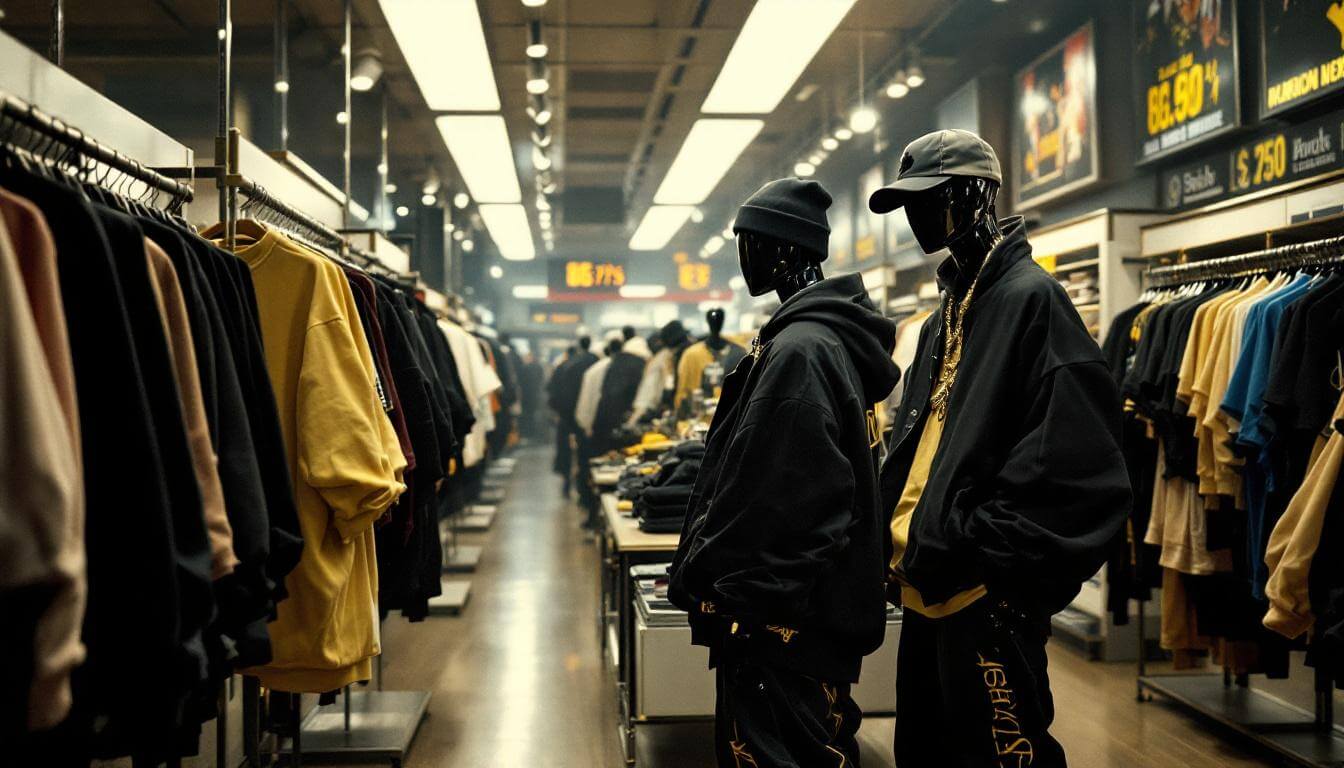
This is the branch the SERP completely ignores, and it’s the most important one. Before Supreme was a resale religion, before BAPE, before Sean John, before Rocawear — there was Wu Wear. As the Take Flight 214 documentary “The Rise and Fall of Wu Wear” lays out, Wu-Tang was “the first streetwear company launched and owned by a rap group” — and not a small one, but a nine-deep Staten Island machine at the height of its powers.
The origin is pure Wu economics. RZA had what seemed like a hundred mouths to feed and was always hunting new revenue. His childhood friend and the Clan’s executive producer, Oliver “Power” Grant — RZA and GZA’s cousin and the closest thing the group had to a business brain — pitched a clothing line in 1995. RZA greenlit it. Wu Wear launched mail-order only, but the Clan was buzzing so hard that demand outran the mailbox almost immediately. Within a couple of years the line was carried in Macy’s, Rich’s and other major department stores across North America. By 1998, Wu Wear was reportedly moving north of $20 million a year. It predated Sean John (1998) and Rocawear (1999) by years. The Wu-Tang Clan didn’t follow the rapper-clothing-brand playbook — they wrote it.
What made Wu Wear different from a band tee was that it was a whole lifestyle, not a logo slap. At a moment when hip-hop’s aspirational uniform was Tommy Hilfiger and Polo — other people’s brands, worn as status — Wu Wear flipped the equation: the culture making and owning its own clothes, “for the streets, by the streets,” as the Take Flight 214 doc frames it. Listen to streetwear designer Kali One of Blokafornia Drip describe his first real lesson in fashion: “They was the first ones that I seen put their logo on a shirt… it wasn’t just rappers like had their own logo, but you could buy the CD and then you could buy the coin that came with it or the chain.” Wu put the “W” on tees, polos, denim, hats, coins and chains — Kali half-jokes they even had Wu toothbrushes. That total-saturation, buy-into-the-world approach is the default for every artist brand now; in 1996 it was genuinely unheard of. Kali credits Wu directly as the reason he thought fashion could be his own lane at all — proof the Wu Wear blueprint is still seeding new streetwear two decades after the brand’s peak.
The fall is as instructive as the rise. A nine-member group’s worth of business interests is a hard machine to run, and when financial pressure hit, Wu Wear couldn’t hold its major-retail footprint the way a Sean John or a Rocawear later would. It receded from department stores through the 2000s and has come back only in licensed, on-and-off relaunches since — never again the $20M-a-year cultural juggernaut it was in 1998. That trajectory is exactly why the originals matter. The original Wu Wear pieces — the big-red-“W” polos, the camo colorways, the “Killer Bees” graphics vintage collectors still hunt — are branch two in its purest form, and they are finite. They were made in a specific window, by a specific operation, that no longer exists in that form. A faded 90s Wu Wear shirt isn’t expensive because the cotton is rare; it’s expensive because that exact moment in hip-hop fashion is never coming back, and a real piece of it is a real piece of it. That scarcity is what turns a vintage Wu-Tang Clan t-shirt into a financial instrument.
Branch Three: The Licensed Mass Market
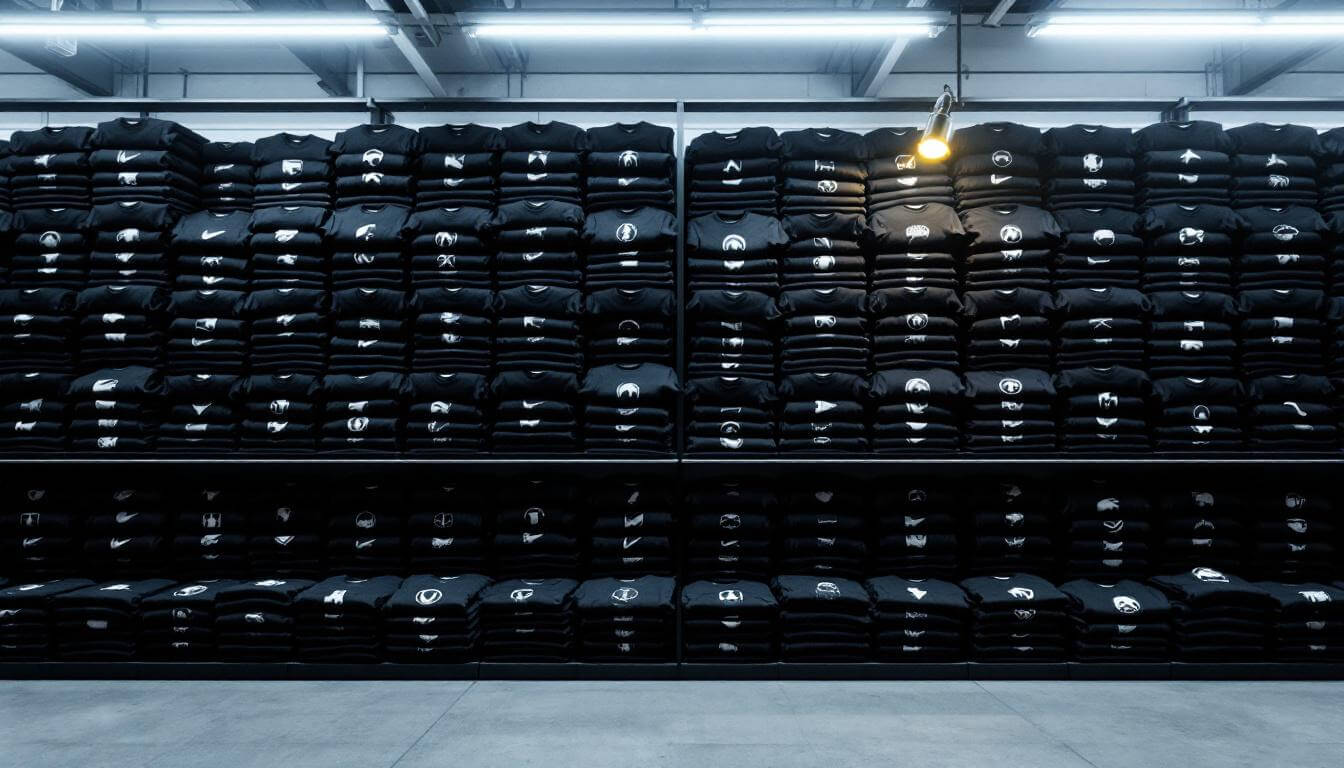
This is the branch most people actually buy from, and it’s the one with the widest price spread for what is, functionally, the same object. Here’s the tier map, straight off the shelves:
- Big-box licensed: Walmart and Old Navy run a Wu-Tang logo tee at $11.99–$13.99. The “Classic Bold Logo” Walmart tee is $13.99.
- Amazon mid-tier: the dominant sweet spot is around $19.11 — Amazon hosts hundreds of licensed designs in the $11.99–$26 band, with generic “Classic Black Wu-Tang Logo” listings doing the volume.
- Mid-premium retail: Hot Topic, Rockabilia and Spencer’s sit in the $24–$28 range. Rockabilia alone lists 93 official licensed Wu products. Hot Topic’s “editorial” is one paragraph of lyric-callout copy — “bring the ruckus,” “Wu-Tang is for the children” — which is as close as the SERP gets to writing about this shirt.
- Credible-curator licensed: Okayplayer’s shop (the Questlove-affiliated hip-hop outlet) and the UK’s Amplified carry tighter licensed selections aimed at heads rather than mall traffic.
- Designer collab: the Nike x Wu-Tang Clan men’s tee (style IF2343-010) launched via Nike SNKRS at $45. Nike’s own copy frames it as honoring “their journey,” with the “W” called “a true symbol of authenticity and rebellion.” It put the Clan in the same collab tier as Travis Scott and Off-White — a cultural milestone, not a wardrobe staple.
Here’s the part the search results will never admit: a $13.99 Walmart Wu tee and a $40 official Wu tee are, materially, almost the same shirt — printed graphics on a cotton blank. The price gap isn’t quality. It’s licensing position and distribution. Every shirt in this branch routes a royalty back to Wu-Tang Productions LLC, the entity that controls the name and the marks; that’s the through-line that makes branch three “real” Wu-Tang regardless of which retailer’s tag is in the collar. What you’re choosing between at $13 versus $27 versus $45 isn’t authenticity — it’s how the same license is packaged. One is commodity band merch through a big-box pipeline, one is mid-premium mall retail, one is a Nike co-sign. Knowing that doesn’t make the $13 tee bad — it makes you a buyer who isn’t confused about what the extra $30 is actually buying, which is positioning, not cotton. That clarity is the entire reason to learn the genealogy of the Wu-Tang Clan t-shirt before you spend.
Branch Four: Indie Print-on-Demand and Tribute Tees
The fourth branch is the one that doesn’t pay a license, and the honest ones don’t pretend otherwise. TeePublic, Redbubble, Etsy and independent hip-hop boutiques sell fan-made designs — reinterpretations, art-school flips, homages to album covers. This tier is fan-priced and fan-driven. The catch is honesty: a tribute piece should be sold as a tribute, an artist’s response to the music, not passed off as official or vintage.
That’s the lane we built in. We made our Enter The Wu-Tang (36 Chambers) tee as an artistic homage to the cover that 1993 collectors spend years hunting — the visual language of that record reinterpreted on black cotton, not a reproduction of an official mark. It is branch four, by design and by disclosure: a love letter to 36 Chambers, not a licensed product and not a vintage piece. If you want the official shirt, branch one is down the page. If you want a clean tribute to the album that started all of this, that’s what this is, and we’d rather tell you exactly where it sits than let you find out at the register. Solo-era heads can read that same logic across our Method Man Tical, Ghostface Ironman and Inspectah Deck Uncontrolled Substance pieces — tributes to specific records, named as such.
The 36 Chambers Tee and Why the Holy Grail Stays the Holy Grail
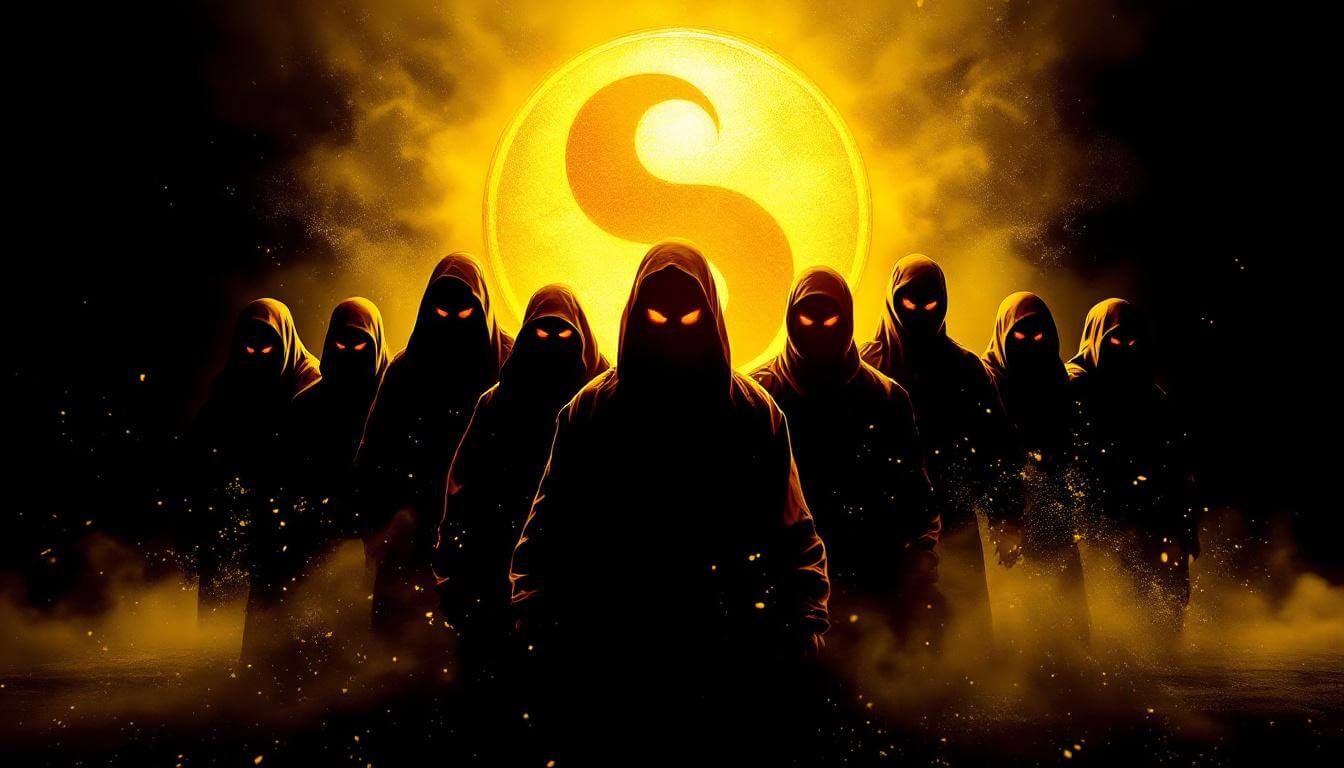
Enter the Wu-Tang (36 Chambers) dropped November 9, 1993. The original promo tee from that era — a record-store and tour giveaway, never a mass retail run — is the single most chased Wu-Tang Clan t-shirt in existence. It’s not chased because the cotton is special. It’s chased because authentic examples are genuinely rare, and because the album cover itself became the most-quoted visual in hip-hop: those nine masked silhouettes against the yellow shield.
That image is the gravitational center of the entire genealogy. Every Wu tee made since 1994 either quotes the 36 Chambers visual language directly or is consciously, deliberately not-that. The official catalog riffs on it. The licensed mass market simplifies it into a logo. Vintage collectors authenticate against it. Tribute artists — us included — answer it. When a vintage dealer on a channel like War Vtg unrolls a faded Wu piece and the room goes quiet, that’s the 36 Chambers lineage doing the talking. Understand that one cover and you understand why this shirt carries weight no other band tee in hip-hop carries. As Raekwon put it on Joe Rogan’s show, “there’s only one Wu-Tang… one group of nine assassins.” There’s only one shirt that means what this one means, too.
How to Authenticate a Vintage Wu-Tang Clan T-Shirt
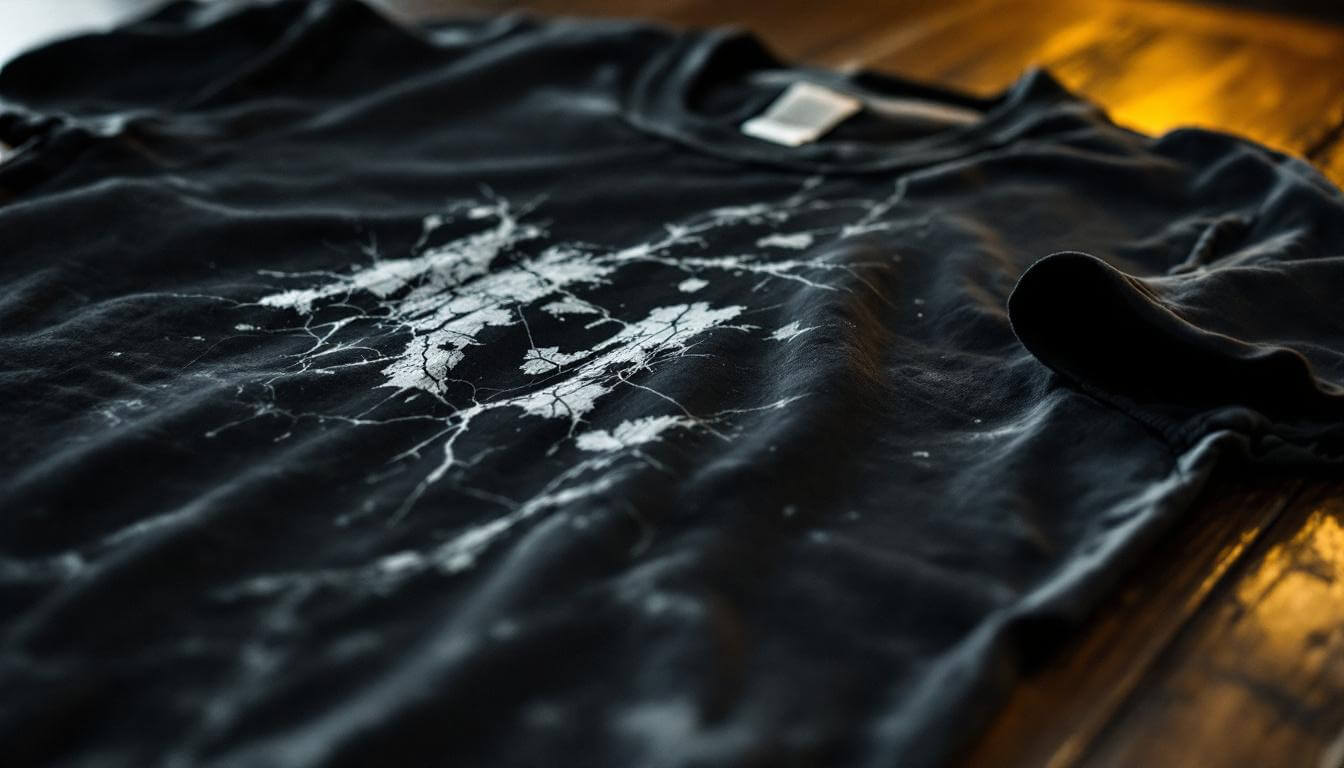
If you’re spending $300–$800 on a 1997 Wu-Tang Forever tour tee — and authentic ones regularly clear that on Grailed and eBay — you need to know how dealers separate real vintage from a 2020s reprint. Vintage rap-tee collectors like the ones on War Vtg and dealers such as F As In Frank and Procell authenticate on four signals before they’ll list a piece:
- The tag. Wu Wear used specific neck tags by era; 90s licensed promos used the blank-maker’s tag of the day. A tag that doesn’t match the claimed year is the fastest tell.
- The stitch. Genuine 90s blanks are typically single-stitch at the hem and sleeves. Double-stitch usually means a modern blank — i.e., a reprint.
- The print process. Era-correct screen prints have the cracking and hand of period plastisol, not the flat, even tone of a modern DTG or fresh screen.
- The blank itself. 90s Wu pieces lived on identifiable blanks of the era — Hanes Beefy-T, Fruit of the Loom and a few others. A blank that wasn’t in production in 1997 can’t be a 1997 shirt.
The honest takeaway from collector culture: a beautifully faded shirt with the right tag, the right stitch and a believable story is the grail; a crisp “vintage-look” tee with a modern blank is branch three or four cosplaying as branch two. There’s nothing wrong with a tribute or a licensed tee — there’s a lot wrong with paying vintage money for one. For a wider read on buying authentic across the catalog, our Wu-Tang Clan gifts guide maps the same honesty rules onto the rest of the Clan’s merch.
Frequently Asked Questions About the Wu-Tang Clan T-Shirt
What’s the difference between an official Wu-Tang t-shirt and a licensed one?
Both pay Wu-Tang Productions. The official Wu-Tang Shop (thewutangclan.com) is the Clan’s own channel — lean catalog, ~$40 anchor, designed with the group. “Licensed” is everything else under the same legal license, from Walmart’s $13.99 logo tee to Hot Topic’s $26 graphics — lower retail, far broader distribution.
Are vintage 90s Wu-Tang tees worth money?
Yes. Authentic 1993–1999 pieces — 36 Chambers promos, Wu-Tang Forever tour tees, Method Man Tical and ODB memorial shirts — trade $300–$800+ on Grailed and eBay. Original Wu Wear pieces, especially the Macy’s-era denim and Killer Bees graphics, are heavily collected. Provenance — tag, screen quality, seam construction — is everything.
What is Wu Wear and is it still around?
Wu Wear was the Clan’s own streetwear brand, founded in 1995 by Power (Oliver Grant, RZA and GZA’s cousin and the group’s executive producer). It was the first rap group to launch its own line and crack mainstream retail — $20M+ a year by 1998 through Macy’s and Rich’s. It predated Sean John and Rocawear. The original run faded by the late 2000s; it has been relaunched periodically through licensing since.
How can I tell if a vintage Wu-Tang tee is a bootleg?
Check the neck tag against the claimed era, look for single-stitch hems on 90s blanks, judge the screen-print process (period plastisol vs. flat modern print), and confirm the blank (Hanes Beefy-T, Fruit of the Loom and similar) was actually in production then. Reputable dealers — F As In Frank, Procell — authenticate before listing.
What was the Nike x Wu-Tang collab?
A men’s tee (style IF2343-010) released through Nike SNKRS at $45, midweight cotton, relaxed fit. Nike framed it as honoring the Clan’s journey and called the “W” “a true symbol of authenticity and rebellion.” It put Wu-Tang in the same collab tier as Travis Scott and Off-White — a milestone, not an everyday staple.
Why is the 36 Chambers album-art tee so iconic?
Because the cover — nine silhouettes against the yellow shield — became hip-hop’s most-quoted visual. The original 1993 promo tee was a record-store and tour giveaway, so authentic examples are genuinely scarce. Every Wu tee since either quotes that visual or consciously avoids it.
Where can I buy an authentic Wu-Tang t-shirt today?
Official: thewutangclan.com or major licensed retailers (Hot Topic, Amazon, Rockabilia, Spencer’s, Walmart). Vintage: Grailed, carefully filtered eBay, Procell and specialist rap-tee dealers. Tribute/independent: indie hip-hop brands selling honest homages — the branch our Enter The Wu-Tang (36 Chambers) tee lives in, sold as art, never as official or vintage.
What does the Wu-Tang “W” actually mean?
Designed by Mathematics, a Wu-Tang DJ and producer, in 1992. The shape draws on Asian calligraphy and kung-fu film iconography — central to Wu-Tang’s Shaolin / 36 Chambers / Five Percenter mythology. It’s been the one constant across every era of Wu merch.
The Final Word on the Wu-Tang Clan T-Shirt
Every Wu-Tang Clan t-shirt on Earth sits in one of four branches: the official catalog, the Wu Wear empire, the licensed mass market, or the indie tribute tier. That single map is the difference between rocking a $13 Walmart tee, building a $400 vintage collection, and supporting an independent artist’s homage — and being able to tell, at a glance, which is which. The shirt isn’t just cotton. It’s a 1993 Staten Island record that rewrote hip-hop, a streetwear empire that came before all of them, and a “W” that still means something three decades later. Buy whichever branch you want — just know which one you’re holding. That’s the whole game.
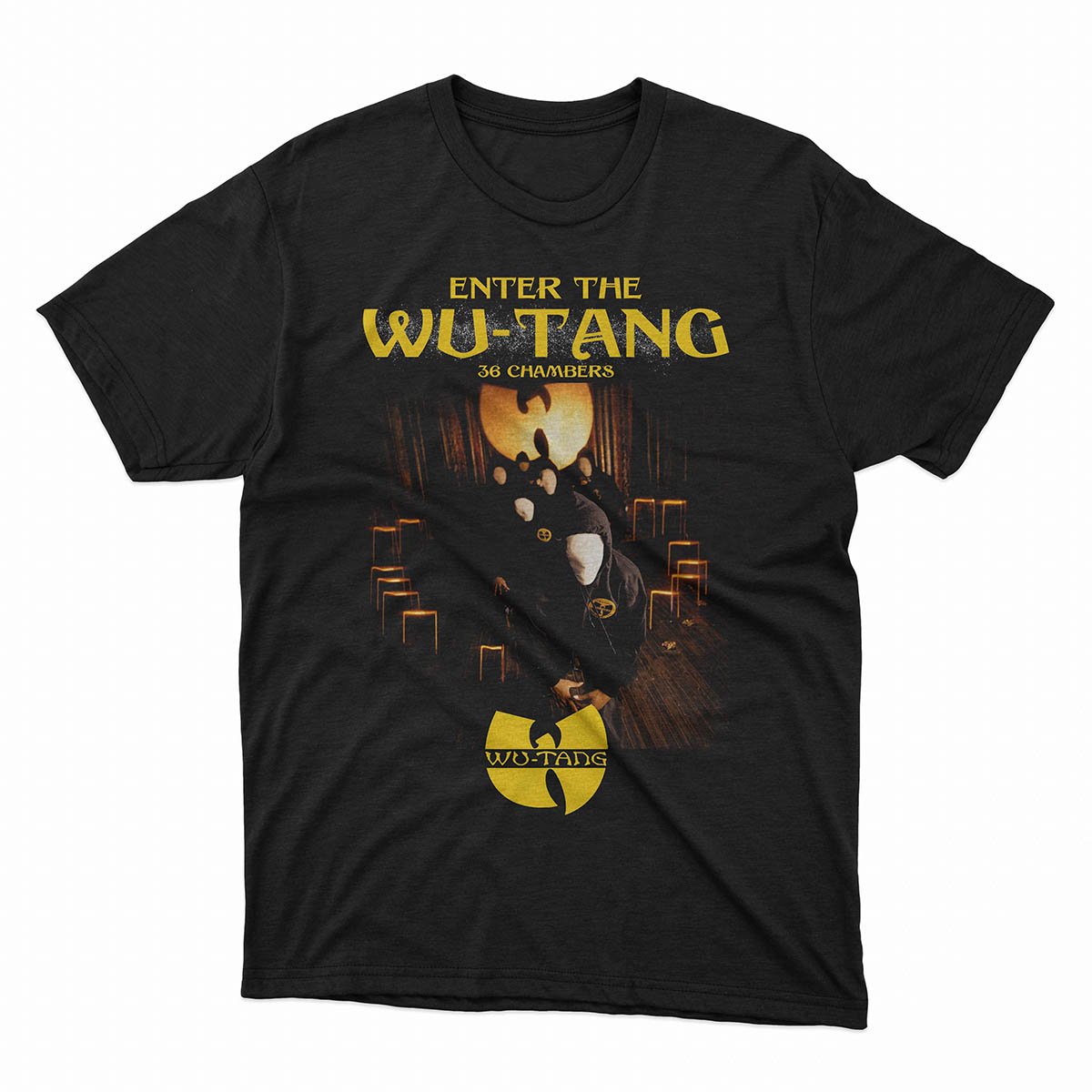
A Tribute to 36 Chambers
We made a tee that quotes the 36 Chambers cover as homage — branch four, sold honestly as art. Not licensed, not vintage, just a clean love letter to the record that started it all.
Never Miss a Drop
Album deep dives, artist spotlights, exclusive merch drops, and the stories behind the culture. Straight to your inbox. No filler — just the real.

🎧 Never Miss a Drop
Exclusive product releases, hip-hop deep dives, and member-only discounts. Straight to your inbox.
Free forever. No spam. Unsubscribe anytime.
Get the Culture, Delivered
Deep dives into hip-hop history, exclusive product drops, and discounts sent straight to your inbox. No spam, just culture.
Join 2,000+ hip-hop heads already in the loop. Unsubscribe anytime.