Jurassic 5 Members: The Full Story Behind Hip-Hop’s Six-Headed Crew
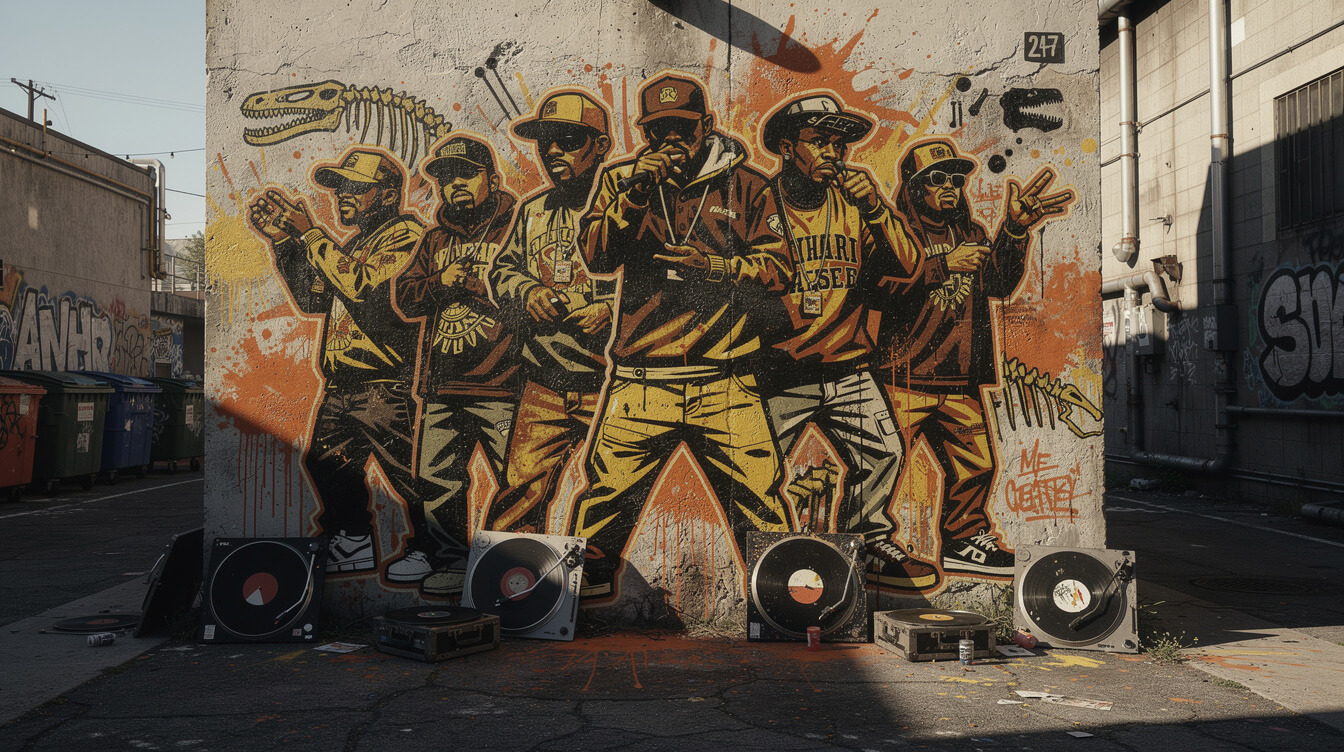
Six people. Two rival crews that didn’t know each other existed until a party in Silver Lake changed everything, plus one solo DJ who showed up with a drum machine and sealed the deal. That’s the real story behind the Jurassic 5 members — not a group that formed in a garage with a shared vision, but three separate scenes in Los Angeles that collided, argued about James Brown, and somehow walked out the other side as the tightest six-man rap crew of the golden era’s back half.
If you know Jurassic 5 from “Concrete Schoolyard” or “What’s Golden” blasting out of a car with the windows down, you know the sound. What most people don’t know is the genealogy — the fact that this “crew” is actually the merger of two entirely separate Los Angeles factions, plus a sixth guy who almost didn’t need anybody else. Here’s who they are, where they came from, and how six distinct hip-hop educations turned into one voice.
Who Are the Jurassic 5 Members?
The Jurassic 5 members are four MCs and two DJs: Chali 2na (Charles Stewart), Akil (Dante Givens), Zaakir — also known as Soup — (Courtenay Henderson), Marc 7 (Marc Stuart), DJ Nu-Mark (Mark Potsic), and Cut Chemist (Lucas Macfadden). Six voices, six turntables’ worth of history, one crew that came out of the legendary Good Life Cafe scene in South Central L.A. — the same open-mic circuit that incubated Freestyle Fellowship and the broader Project Blowed movement.
They debuted nationally in 1995 with the single “Unified Rebelution,” a title that doubled as a mission statement: this was six people from three unrelated corners of the city, unified by a shared refusal to sound like anybody else on the radio. What almost nobody covering this group gets into is how that unification actually happened — because it wasn’t one crew adding members. It was a full-on merger of two separate groups, each with its own founding myth, its own high school, and its own sound, before DJ Nu-Mark walked in as the missing piece.
Understanding the Jurassic 5 members means understanding three origin stories that ran in parallel for years before they ever shared a stage.
The Good Life Rules That Built Their Work Ethic
The Good Life Cafe wasn’t a normal open mic. It was a health-food store in South Central that hosted a weekly hip-hop night with a strict, self-policed rulebook: no cursing, no biting another MC’s style, and a crowd that would chant you off the mic without hesitation if you weren’t bringing something real. That environment produced some of the most technically demanding MCs of the ’90s underground — the Freestyle Fellowship and Project Blowed camp came out of that same room — and it’s the crucible both Unity Committee and Rebels of Rhythm passed through before they ever merged. Six people who’d each already survived a crowd that showed zero mercy for a weak verse don’t need to fight each other for space on a track. They already know what it costs to earn four bars.
Unity Committee: Chali 2na, Marc 7 & Cut Chemist’s Silver Lake Beginning
Half of Jurassic 5’s DNA traces back to Unity Committee — sometimes stylized U.N.I.T.Y., short for “United Nations of Intelligence Teaching Youth” — a group that started forming around 1987 out of Marshall High School in Silver Lake. Chali 2na and Marc 7 met there and clicked instantly; both were transplants (Chali from Chicago, Marc from New Jersey) navigating a new city, and that shared outsider status became the glue.
Chali 2na wasn’t even primarily a rapper at first. He was a graffiti writer — the guy who drew Jurassic 5’s early logos and handled the group’s visual identity before he ever took the mic seriously in 1987. His arrival in L.A. came out of real turmoil: he’s talked about losing family, nearly getting evicted, and watching a close friend get killed back in Chicago before he made the move. “That was all around me,” he’s said, “but it wasn’t in me. I was more of an artist.”
Cut Chemist entered the picture in early 1987 at a Silver Lake Recreation Center party, introduced to Chali by a mutual friend. He was already deep into DJing — hip-hop radio station KDAY had rewired his brain a few years earlier, and by 1986 older DJs were bringing him to parties as a “secret weapon” scratch specialist, notable partly because, as he’s put it, it was a novelty at the time to see a white kid scratching the way he was. A classmate at LACES (Los Angeles Center for Enriched Studies) named Thayod Ausar owned a sampler — Cut had never seen one up close. He eventually bought Ausar’s Roland S-10, paired it with his dad’s 4-track, and that combination is where Cut Chemist the producer was born.
The three of them started converging on a small side room in Cut Chemist’s mother’s Silver Lake house — glass- and wood-paneled, originally used to hang plants, with zero acoustic treatment and, somehow, a naturally flattering reverb on vocals. They nicknamed it the Red October Chemical Storage Facility, and it stayed the group’s clubhouse and recording spot for more than a decade, long after major labels entered the picture.
Rebels of Rhythm: Akil and Zaakir’s South Central Half of the Story
Five miles south, at Manual Arts High School, a completely separate crew called Rebels of Rhythm was forming around the same era — this is where the other two core Jurassic 5 members came from. Akil and Zaakir met in high school around 1987, both growing up in South Central. Akil has talked about coming up right near Florence and Normandie, the intersection that became ground zero for the 1992 L.A. riots, with a father who worked parties as a “selector” rather than a hands-on-the-mic DJ, cutting reel-to-reel tapes instead.
Rebels of Rhythm originally had a third MC, Shawny Mac (also known as Afrika), who rhymed alongside Akil through the early ’90s but didn’t make it into the eventual Jurassic 5 lineup. Zaakir — going by his teenage nickname Soup back then — actually didn’t set out to be an MC at all. He wanted to be a hype man. It was Akil who heard him freestyling at a show and pushed him to rhyme more seriously.
In 1992, the group pressed a two-song cassette — “Jessica” and “Da Rhythm” — in a tiny batch sold only at gigs. What set Rebels of Rhythm apart wasn’t aggression; it was the opposite. Consciously melodic, deliberately positive, closer to a throwback vocal group than a battle-rap crew. That’s a big part of why, when the two factions eventually merged, the chemistry worked instead of clashing: both camps were already allergic to the gangsta-rap wave dominating L.A. radio at the time. “We weren’t pro-Black since we had a white guy in the group,” Chali 2na has said of the combined crew’s ethos, “but I would definitely say we were pro-right. We were conscious rappers.”
Zaakir’s road into the group also came with a practical advantage nobody talks about: he’d worked as an unpaid intern at Loud Records out of high school, then did college radio promotions at Immortal Records, a second stint at Loud, and eventually Interscope — the same label Jurassic 5 would sign to. Those connections helped get the group’s earliest independent releases charting on college radio before anyone in the industry knew Soup could rap at all.
DJ Nu-Mark: The Solo Piece That Made It Six
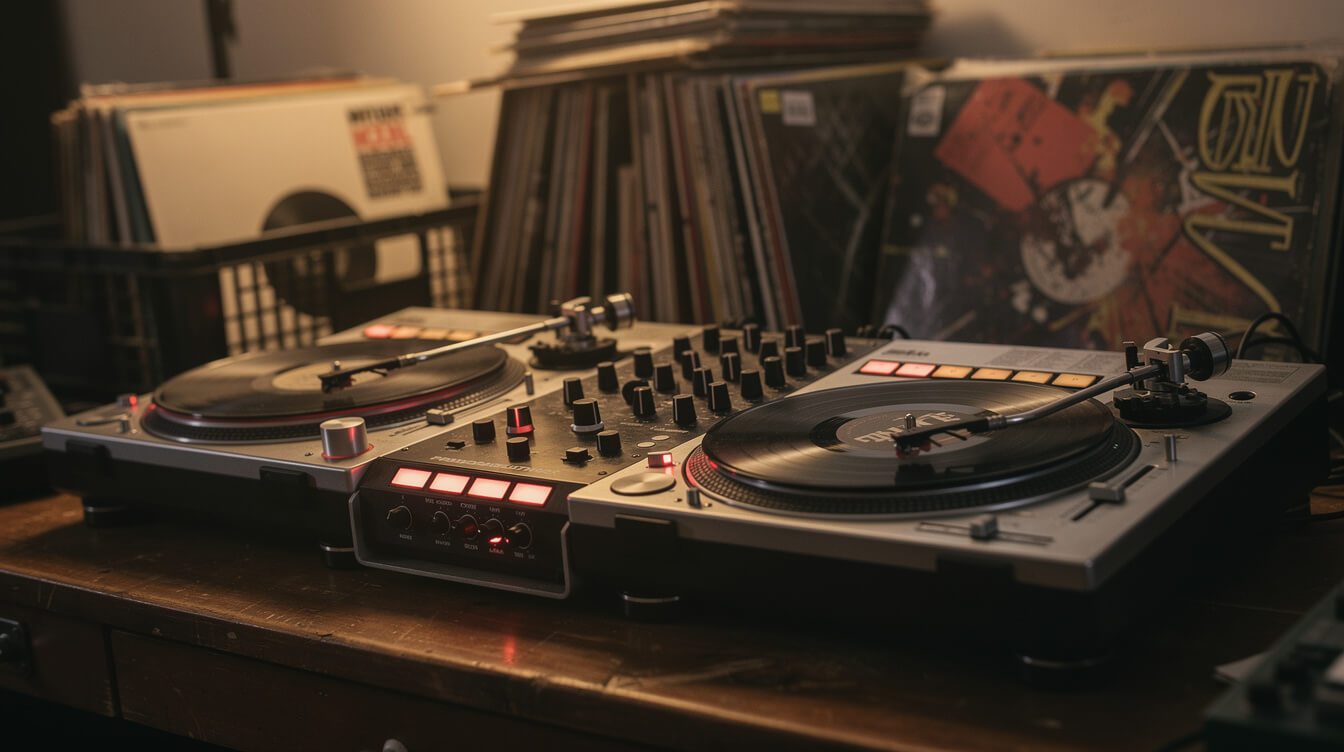
Unlike the other five, DJ Nu-Mark didn’t come up through either crew — he arrived as a one-man faction. Growing up between North Hollywood, Mid-City, and Silver Lake, Mark Potsic was a drummer first, playing in his school jazz band and entering junior-high drum battles by age 12. A friend with an uncle who DJ’d exposed him to hip-hop breaks, and from there the trajectory was set: by ninth grade he’d bought a Roland TR-606 drum machine and a pair of belt-drive turntables, and was digging for records to scratch — and eventually sample.
He cut his teeth with a DJ crew called Bumrush Productions, working house parties and small clubs, and used the money to upgrade to the industry-standard Technics 1200s. His drumming background shaped his whole approach behind the turntables — he’s described gravitating toward more rhythmic records and scratching in a more percussive style than most of his peers. By the early ’90s, the choice between rock, jazz, and hip-hop wasn’t close anymore. “Rock wasn’t raw to me,” he’s explained. “808 beats were raw. Melle Mel was raw.”
When Nu-Mark connected with the combined Unity Committee / Rebels of Rhythm camp, the six-piece lineup was complete — two DJ-producers with completely different entry points into the craft (Cut Chemist’s sampler-first, radio-nerd path versus Nu-Mark’s drummer-turned-DJ path), and four MCs split between two schools of thought that happened to share the same core values. That friction-free overlap is the actual reason Jurassic 5’s sound holds together as well as it does on record: nobody in the six-person lineup was trying to out-shout anybody else.
Two DJs, One Group — Why That Almost Never Works
Most crews from this era built around a single DJ-producer. Jurassic 5 ran two, and that’s rarer than it sounds — split production credits usually mean split egos. It worked here because Cut Chemist and Nu-Mark came up learning completely different instincts: Cut’s ear was built on radio-era scratch technique and crate-digging for breaks, while Nu-Mark’s was built on literal drum technique first, turntables second. On record, that shows up as texture rather than competition — one guy thinking like a musician programming a kit, the other thinking like a DJ chasing the perfect loop. Four MCs could lean on either style depending on what a given verse needed, which is part of why the group’s catalog never sounds like it’s repeating itself from track to track.
The Good Life, Quality Control, and How the Jurassic 5 Members Built a Career
Once assembled, the Jurassic 5 members built their reputation the way most of their Good Life peers did — live, on a stage with a strict no-cursing, no-biting, crowd-can-boo-you-off policy that forced every performer to actually earn the mic. The name itself came from a joke: in a 2002 interview with the Sydney Morning Herald, Chali 2na explained that he played an early recording for a friend’s mother, who cracked, “You guys think you sound like the Fantastic Five, but you sound more like the Jurassic Five.” It stuck.
They debuted on TVT Records with “Unified Rebelution” in 1995, then released the Jurassic 5 EP in October 1997 on the indie label Rumble — a release that lined them up alongside Company Flow, Black Star, and Kool Keith as part of the mid-’90s alternative hip-hop wave. That EP got repackaged with extra tracks and released in the UK as their self-titled debut full-length in 1998, going Gold there via the BPI before Interscope ever entered the picture.
Quality Control, their 2000 major-label debut proper, is where the story shifts. It peaked at No. 43 on the Billboard 200, moved roughly 387,000 copies in the U.S., and went Gold in the UK — a legitimate commercial breakthrough for a crew that had built its entire foundation on live open-mic credibility rather than radio play. Two years later, Power in Numbers pushed them to No. 15 on the Billboard 200 with similar U.S. sales, arguably the high-water mark of the group’s discography and the one that features “A Day at the Races” with Big Daddy Kane and Percee P — a golden-age torch-passing moment that later synced into the 2003 skateboarding game Tony Hawk’s Underground.
If the Power in Numbers era is your entry point into this group, our Jurassic 5 – Power in Numbers T-Shirt is built off that exact album era — a direct nod to the record that took six people from three different origin stories to a Billboard top-20 placement.
Cut Chemist left to pursue a solo career before the group’s fourth and final studio album, Feedback, dropped in 2006 — the remaining five carried it to another No. 15 Billboard 200 finish. The group split in 2007, citing musical differences after more than a decade together.
Where Are the Jurassic 5 Members Now — And Your Questions, Answered

Cut Chemist rejoined the fold in 2013 for a full reunion — Coachella, an international run through the UK, Ireland, Portugal, Spain, and Japan, a Glastonbury set in 2014, and a Word of Mouth Reunion Tour that same summer. In 2016, the group released “Customer Service,” their first new song in a decade. Nu-Mark, meanwhile, has stayed busy as a producer and solo artist outside the group, and the crew’s catalog has kept finding new audiences — “Jayou,” originally from the 1997 EP, got a second life in December 2024 when Kellogg’s used it in a national ad campaign, introducing a whole new generation to a beat that’s nearly three decades old.
Here’s what people ask most about the Jurassic 5 members and their history:
How many members are in Jurassic 5?
Six: MCs Chali 2na, Akil, Zaakir (Soup), and Marc 7, plus DJ-producers Cut Chemist and DJ Nu-Mark. No lineup changes ever stuck — the six who recorded Quality Control in 2000 are the same six who reunited in 2013.
Did any of the Jurassic 5 members leave the group?
Cut Chemist stepped away before 2006’s Feedback to focus on a solo career, meaning that album and the subsequent touring cycle were done as a five-piece. He returned for the 2013 reunion, restoring the original six.
Is Jurassic 5 still together?
The group reunited in 2013 and has performed together intermittently since, including major festival dates and a 2016 single, without formally disbanding again. They’re not on an active album cycle, but the lineup remains intact.
What’s the best Jurassic 5 album to start with?
Quality Control (2000) is the most complete introduction — the album where the Good Life-honed chemistry between all six members first got a proper studio budget behind it. Power in Numbers (2002) is the commercial and arguably artistic peak if you want the group at its most polished.
What genre is Jurassic 5?
West Coast hip-hop with a strong alternative hip-hop identity — closer in spirit to Company Flow or Black Star than to the G-funk sound most people associate with ’90s Los Angeles rap. The six-piece lineup leaned hard into live-band-style vocal interplay and old-school-referencing production, which is exactly why it stood apart from what else was coming out of L.A. at the time.
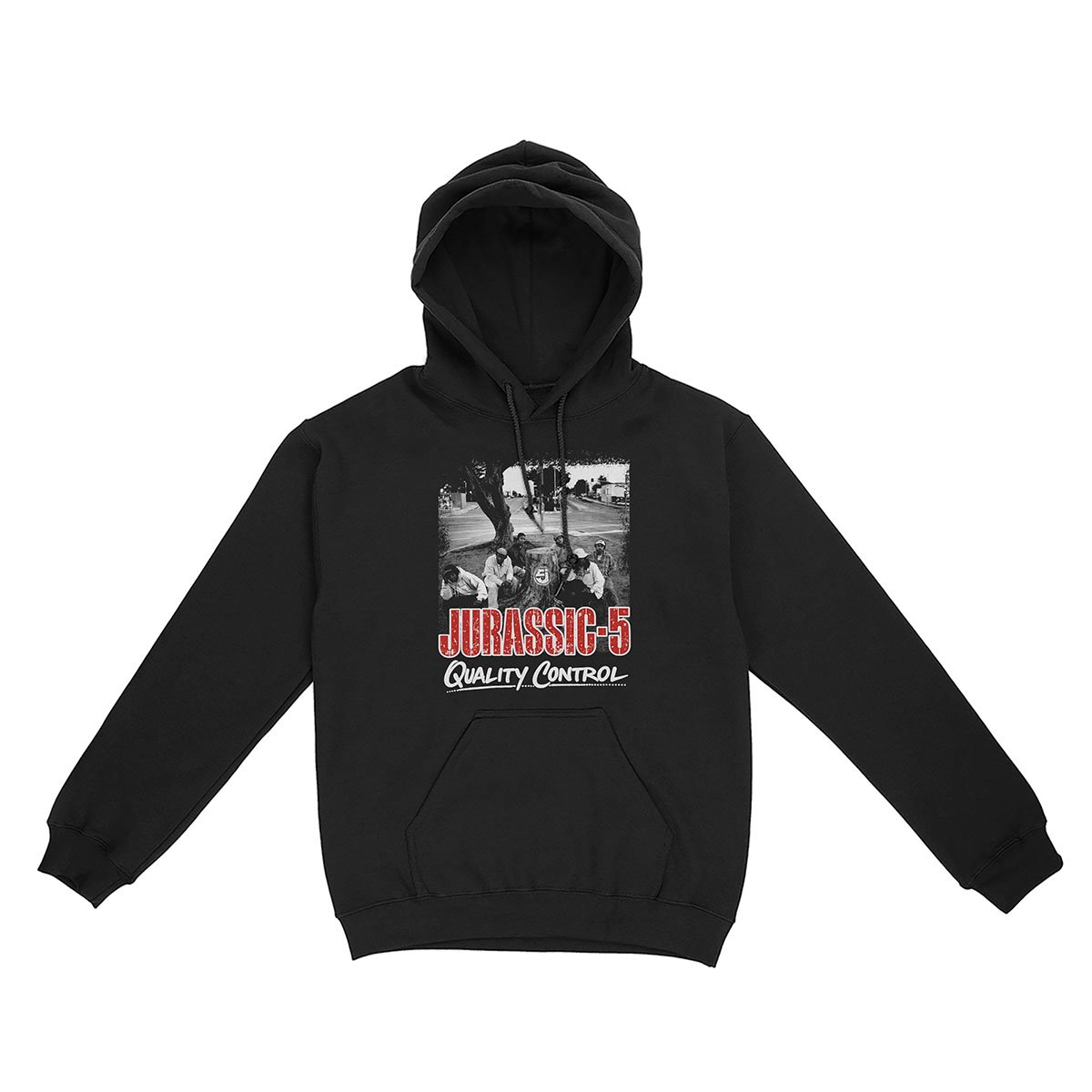
Rep the Album That Made Six Voices One
The Jurassic 5 Quality Control Hoodie is a straight-up tribute to the album where a Good Life open-mic crew turned six different origin stories into a Billboard breakthrough. Heavyweight cotton, built for real rotation.
Final Thoughts
What makes the Jurassic 5 members worth digging into isn’t just the music — it’s that the group is proof of what L.A.’s underground actually looked like before the internet flattened every scene into one timeline. Two crews from opposite sides of the city, formed independently by kids dealing with completely different circumstances, found each other through open mics and mutual friends and a shared refusal to sound like whatever was already popular. Add one drummer-turned-DJ with his own separate education, and you get six people who never had to fight for space in the mix because none of them arrived trying to be the loudest voice in the room. That’s the actual blueprint — not six egos sharing a stage, but three complete educations in hip-hop merging into one crew that never needed a frontman.
For more on the artists and crews that built this era, check out our breakdowns of Gang Starr’s real lineup history and every member of The Roots — plus the deeper story of the Bronx building where hip-hop itself was born, the same DIY spirit that shaped the Good Life scene on the other coast.
Get the Culture, Not the Noise
Deep dives on the artists, eras, and crews that built hip-hop — straight to your inbox, no fluff.

🎧 Never Miss a Drop
Exclusive product releases, hip-hop deep dives, and member-only discounts. Straight to your inbox.
Free forever. No spam. Unsubscribe anytime.
Get the Culture, Delivered
Deep dives into hip-hop history, exclusive product drops, and discounts sent straight to your inbox. No spam, just culture.
Join 2,000+ hip-hop heads already in the loop. Unsubscribe anytime.