Gang Starr Members: The Real Lineup History Before Guru Met DJ Premier
Ask a casual fan for the Gang Starr members and you’ll get one answer, fast: Guru and DJ Premier. Two names, one of the tightest MC-and-producer partnerships hip-hop ever produced. And for the classic run — Step in the Arena, Daily Operation, Hard to Earn, Moment of Truth — that answer is correct. But it’s incomplete, and the missing part of the story is more interesting than the part everybody knows.
Gang Starr didn’t start as a duo. It started at Morehouse College in the mid-’80s as a Boston crew with three friends and zero DJ Premier in sight. The lineup turned over twice — losing a founding MC to prison, losing a DJ to a career pivot — before Guru ever crossed paths with a Houston beatmaker calling himself Waxmaster C. Understanding the real Gang Starr members means understanding a group that nearly didn’t survive long enough to become “Gang Starr” as we know it.
So, Who Are the Actual Members of Gang Starr?
In its final and best-known form, Gang Starr was a two-person operation: Guru (born Keith Edward Elam, July 17, 1961, Roxbury, Boston) on the mic, and DJ Premier (born Christopher Edward Martin, March 21, 1966, Houston, Texas) behind the boards. That’s the lineup that made “Mass Appeal,” “Take It Personal,” “Full Clip,” and “Above the Clouds” into permanent fixtures of the golden age canon.
But “Gang Starr” as a name predates Premier’s involvement by several years. Before he ever touched a Gang Starr session, the group had already run through two full lineups, released three 12-inch singles on Wild Pitch Records, and broken up twice. Guru is the only member who was there for every version of the group — which makes him less a co-founder and more the sole constant through three completely different bands operating under one name.
The Original Gang Starr Members Before DJ Premier Ever Touched a Sampler
The first Gang Starr lineup formed at Morehouse College among three friends from Boston: Guru (then going by MC Keithy E, with plans to rap and sing), Big Shug as the group’s primary MC, and Shug’s younger brother Dana — DJ Suave D — handling the turntables. This is the version of Gang Starr nobody puts on a t-shirt, and it’s the one that best explains why the group’s later lineup changes read less like drama and more like survival.
That lineup didn’t last. Big Shug was incarcerated, and without its lead MC the group’s direction fell apart. Suave D quit shortly after. Guru — the one member with zero interest in letting the name die — was left holding a group with no MC and no DJ.
What’s easy to miss here: Big Shug wasn’t a footnote. He came back years later as a core member of the Gang Starr Foundation, Guru’s extended collective, and built a respected solo catalog of his own (Street Kingz, Never Backing Down). The guy who was Gang Starr’s original lead MC before Guru ever rapped a bar on record went on to have one of the longer careers to come out of the group’s orbit — just never under the Gang Starr name again.
Why Guru Was the One Who Kept the Name Alive
It’s worth sitting with why Guru — the least experienced MC in that original Morehouse trio, by his own account still figuring out whether he wanted to sing or rap — ended up the one member who refused to let “Gang Starr” die twice over. He wasn’t the star of the first lineup; Big Shug was. He wasn’t the only rapper in the second lineup either; Damo D-Ski shared the mic. But when both of those groups collapsed, Guru was the constant who kept rebuilding around the name rather than starting fresh under something new. That stubbornness is arguably the single most important trait in the entire Gang Starr story — without it, there’s no Wild Pitch deal, no Chrysalis signing, and no version of the group that ever meets DJ Premier at all.
The Lost Second Lineup: Damo D-Ski and DJ 1, 2 B-Down

Rather than fold the group, Guru rebuilt it. He brought in MC Damo D-Ski and DJ 1, 2 B-Down (also known as Mike Dee), working with a rotating cast of producers — Donald D, J.V. Johnson, and the 45 King all lent a hand — to cut demos starting in 1986. This is the lineup that actually got Gang Starr onto wax for the first time: three 12-inch singles released on Wild Pitch Records across 1987 and 1988.
Those singles matter historically even though almost nobody streams them today. They’re proof that “Gang Starr” existed, toured a demo tape, and had a working relationship with Wild Pitch — the same label that would eventually put out the Guru/Premier version of the group — well before the sound most fans associate with the name ever got made. If Damo D-Ski or Mike Dee had stuck around, “Gang Starr members” would be an entirely different trivia answer today.
That lineup dissolved too, in 1989 — the group’s second breakup in roughly three years. And once again, Guru was the only one who wanted to keep going.
What Happened to Damo D-Ski and Mike Dee?
Neither Damo D-Ski nor DJ 1, 2 B-Down went on to notable solo careers in hip-hop the way Big Shug eventually did — which is exactly why this lineup gets erased from most “Gang Starr members” write-ups entirely. But their three Wild Pitch singles are the direct reason Gang Starr had any industry footprint at all by the time Guru went looking for a new producer in 1989. Without that early paper trail — however commercially minor — there’s a real argument that Wild Pitch never bothers listening to Waxmaster C’s demo tape on Guru’s recommendation, because there’s no “Gang Starr” relationship with the label to leverage in the first place.
How DJ Premier (Then “Waxmaster C”) Became Gang Starr’s Other Half
Here’s the part of the story that turns Gang Starr from “a group that kept falling apart” into one of hip-hop’s most important pairings. Christopher Martin — a Houston native then recording under the name Waxmaster C, later Damion — had been mailing beat tapes to Wild Pitch Records hoping to get signed as a producer. Guru heard one, liked what he heard, and reached out.
Premier relocated from Texas to Brooklyn to join Gang Starr, and in 1989 the newly formed duo dropped their first single, “Words I Manifest,” followed by the album No More Mr. Nice Guy. A year later, Chrysalis Records — under A&R director and former rap critic Duff Marlowe — signed the group and gave them full creative control and major-label distribution. That deal is what let Premier’s boom-bap sample chopping and Guru’s deadpan, deliberate flow become the signature Gang Starr sound across four back-to-back classics.
Why the Chrysalis Deal Mattered More Than the Signing Itself
Full creative control sounds like a throwaway contract detail until you compare it to how most rap acts were signed in 1990. Labels were still figuring out hip-hop as a commercial category, and plenty of groups got A&R’d into chasing radio trends. Gang Starr got the opposite: a label executive who understood the genre from the critic’s chair, willing to let a jazz-sampling, unhurried, lyrically dense duo make exactly the record they wanted. That’s the direct reason Step in the Arena and Daily Operation sound like nobody else’s 1991 or 1992 — Premier wasn’t chasing a sound the label wanted, he was refining the one he and Guru already had.
If you want to rep the exact era where the “real” Gang Starr lineup locked in, the DJ Premier Cuts, Guru Bars Gangstarr Tribute Tee puts both names on one shirt — which, given everything that happened before they ever met, feels earned rather than obvious.
The Gang Starr Foundation: The Extended Family of Members
Once Gang Starr proper stabilized as a duo, Guru and Premier built something bigger around it: the Gang Starr Foundation, established in 1993 as a loose collective connected through Guru’s Ill Kid label, Premier’s production work, and their shared management company, Empire Management. This is where the “members” question gets genuinely broad, because the Foundation absorbed a serious roster of talent — some of it now more celebrated than Gang Starr’s own catalog among certain corners of the underground:
- Big Shug — the original Gang Starr MC, back in the fold as a Foundation artist
- Jeru the Damaja — The Sun Rises in the East is a straight-up boom-bap landmark, produced entirely by Premier
- Afu-Ra — dense, technical bars and a long-running Premier collaborator
- Group Home — Lil Fame’s cousin’s crew, best known for Livin’ Proof
- M.O.P. — the Mash Out Posse, later signed to Premier’s own imprint
- Bahamadia — the Philly MC Guru personally championed and executive-produced
- Freddie Foxxx (Bumpy Knuckles) — battle-tested veteran MC and longtime Premier collaborator
- True Master, Krumbsnatcha, Hannibal Stax, and NYG’z — deeper cuts, but all carried the Foundation name into the ’90s and 2000s
None of these artists are “Gang Starr members” in the literal, on-the-record sense — but leaving them out of the conversation misses why Gang Starr’s footprint is so much bigger than two guys and four classic albums. Jeru’s The Sun Rises in the East is arguably the purest distillation of “Premier sound, no Guru” that exists — Premier produced the entire album solo, and it’s regularly cited by boom-bap purists as one of the tightest full-length production jobs of the ’90s. M.O.P.’s relationship with Premier went furthest of all: he eventually signed the duo to his own label, Year Round Records, making them the rare Foundation act that graduated from “affiliated with Gang Starr” to “signed by Gang Starr’s producer directly.” If you want to trace the exact lineage from Guru’s Hard to Earn-era peak into the Foundation’s next generation of Brooklyn hardcore rap, the Jeru the Damaja “The Sun Rises in the East” Tee is basically wearing the family tree.
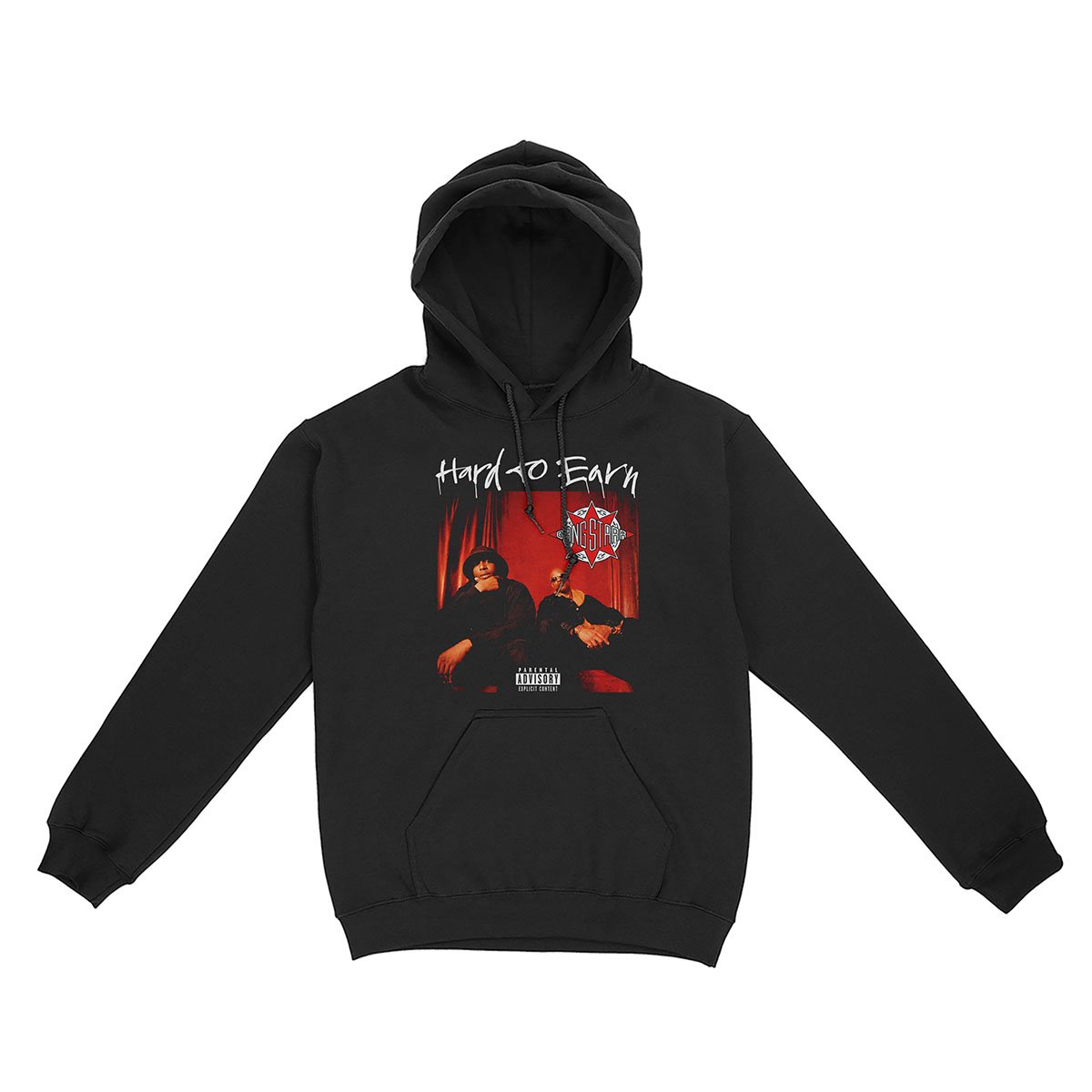
Rep the Album That Made the Duo
Hard to Earn dropped in 1994, right in the pocket of Gang Starr’s classic-lineup peak — Guru and Premier locked in, no lineup drama, just the sound that defined the era. This hoodie carries that album’s DNA.
Guru’s Death, the Estrangement, and What Happened After
Gang Starr’s classic lineup didn’t end cleanly. DJ Premier returned to the U.S. from touring in late 2002, and by 2006 Guru was telling interviewers the group had run its course. The two had quietly fallen out around 2003 — years before most fans knew anything was wrong.
In February 2010, Guru suffered a heart attack and went into a coma; he died on April 19, 2010, after a private, years-long battle with myeloma he’d chosen not to disclose. Days before his death, a statement attributed to Guru — but reportedly drafted by his collaborator DJ Solar — said he wanted “my ex-DJ to have nothing to do with my name, likeness, events, tributes, etc.” Guru’s family and longtime peers publicly questioned whether that statement reflected his actual wishes. It remains one of the more uncomfortable, unresolved footnotes in golden-age hip-hop history.
DJ Premier didn’t disappear from the Gang Starr name. He confirmed in 2015 he was working on a Gang Starr biopic with Guru’s sister, Patricia Elam. Then, in 2019, he released “Family and Loyalty” featuring J. Cole as a new Gang Starr single, followed that November by a full posthumous album, One of the Best Yet — built from verses Guru had recorded before his passing. Whatever the estrangement was about, Premier made clear he still considered the group’s catalog, and its legacy, worth protecting.
The timeline is worth sitting with: Guru’s myeloma diagnosis dates back to 2000, three years before the estrangement is generally placed, and he kept touring and recording without going public about it. What actually drove the rift between him and Premier has never been confirmed on the record by either man — only that it happened, and that it was still unresolved when Guru died in 2010. What’s not in dispute is the outcome: two men who built one of hip-hop’s most airtight creative partnerships spent their last several years as collaborators not speaking.
FAQ: Quick Answers About Gang Starr’s Lineup
How many members has Gang Starr had?
Counting every lineup, at least six people have carried an official Gang Starr membership: Guru, Big Shug, DJ Suave D, Damo D-Ski, DJ 1-2 B-Down (Mike Dee), and DJ Premier. Only Guru and Premier are on the classic-era catalog most fans know.
Was Gang Starr always just Guru and DJ Premier?
No. That lineup didn’t exist until 1989, roughly four years after the group formed at Morehouse College. Two earlier lineups came and went first.
What is the Gang Starr Foundation?
A separate but closely linked collective founded in 1993, connecting artists like Jeru the Damaja, Group Home, M.O.P., Bahamadia, Big Shug, and Afu-Ra through Guru’s label, Premier’s production, and their shared management. Foundation artists aren’t Gang Starr members, but the two are inseparable in hip-hop history.
Is DJ Premier still making music as Gang Starr?
He released a posthumous album, One of the Best Yet, in 2019 using previously recorded Guru vocals, and has spoken about a Gang Starr biopic in development with Guru’s family.
Did Guru and DJ Premier ever reconcile before Guru died?
Not publicly. The two had been estranged since around 2003, and a statement circulated around Guru’s 2010 death said he didn’t want Premier involved in his legacy — though Guru’s family and peers questioned whether the statement genuinely reflected his wishes or was written by someone else. There’s no on-record account of the two reconciling before his death.
Who produced Gang Starr’s albums besides DJ Premier?
Essentially no one. Once Premier joined in 1989, he produced the group’s catalog in full — a rarity for the era, when most rap acts pulled from a rotating pool of outside producers. That total creative lock is a big part of why the Gang Starr sound is so instantly identifiable from one album to the next.
Final Thoughts
The two-person answer to “who are the Gang Starr members” isn’t wrong — it’s just the ending of a story that started somewhere much rougher: a Morehouse dorm room, a locked-up MC, a DJ who bailed, and a run of demos nobody remembers. Guru rebuilt this group twice before Premier ever showed up, which is exactly why the version that finally stuck sounds as tight as it does. That’s not two guys who got lucky. That’s a group that survived long enough to get it right.
For more on the group’s classic-era catalog, check out our breakdowns of Gang Starr’s Moment of Truth and Guru’s complete story. And if “members” deep-dives are your thing, we did the same forensic breakdown for hip-hop’s only real band in The Roots Members Explained.
Deep Cuts, Delivered
Sign up and get the culture breakdowns, drop alerts, and golden-age deep dives before anyone else.

🎧 Never Miss a Drop
Exclusive product releases, hip-hop deep dives, and member-only discounts. Straight to your inbox.
Free forever. No spam. Unsubscribe anytime.
Get the Culture, Delivered
Deep dives into hip-hop history, exclusive product drops, and discounts sent straight to your inbox. No spam, just culture.
Join 2,000+ hip-hop heads already in the loop. Unsubscribe anytime.