Ultramagnetic MCs MC Ultra: The 1987 B-Side Before Critical Beatdown
Search “Ultramagnetic MCs MC Ultra” and you’ll hit a wall of confusion — Discogs listings, a YouTube hashtag, a Reddit thread asking what it even is. There’s no album called MC Ultra. What you’re actually looking for is “M.C.’s Ultra (Part Two),” a 1987 B-side the Bronx group cut a full year before Critical Beatdown made them legends. It’s the missing link between a crew that was still figuring itself out and the album that would get them canonized — and almost nobody’s written about it properly.
Ultramagnetic MCs: Kool Keith’s Group Before the Alter Egos

Before Dr. Octagon, before Dr. Dooom, before Kool Keith turned himself into a rotating cast of space-age personas, he was just one quarter of a Bronx group called Ultramagnetic MCs. And before any of them picked up a mic for real, Ced Gee, Kool Keith, Moe Love, and TR Love were breakdancers — members of the New York City Breakers and People’s Choice crews, moving through the same culture from the floor up before they ever touched a sampler. That’s not a footnote; it’s the reason their sense of rhythm and chopped-up timing sounds the way it does. They recorded a demo called “Space Groove” in 1984 before settling into the lineup that would become Ultramagnetic MCs — Kool Keith on the mic, Ced Gee handling MC duties and production, and DJ/producers TR Love and Moe Love rounding out the crew. Big D came in later as hype man — brought in by his cousin Kool Keith in 1988 — and beatboxer Rahzel worked as a roadie for the group early in his career, years before he’d redefine what a human mouth could do rhythmically.
The First Singles Nobody Remembers
The group’s debut single, “To Give You Love,” dropped in 1985 on the tiny Diamond International label — a release so under-the-radar most fans skip straight to the group’s actual breakout. That came in 1986 with “Ego Trippin’,” their first 12-inch on Next Plateau Records. It mattered for a reason beyond the song itself: it was the first hip-hop record to use the “Synthetic Substitution” drum break, composed by Melvin Bliss and now one of the most sampled pieces of music in hip-hop history. Before Mobb Deep, before a thousand other producers reached for that same break, Ultramagnetic MCs got there first.
It’s worth sitting with how fast the group’s palette was evolving in this window. “Ego Trippin'” leaned on a breakbeat nobody else had touched. Their next release would lean on something stranger — a sample most people associate with a garage-rock novelty song, not hip-hop.
The Rotating Cast Around the Core Four
The lineup was never as fixed as a “members” box implies. Tim Dog became an unofficial member in 1989, years before his own solo career took off. DJ Jaycee joined in 1990 as road manager and backup DJ. An earlier member, Rooney Roon, was let go after an assault arrest. And Rahzel — the man who’d later redefine beatboxing as a solo instrument — started out as a roadie for the group, hauling equipment years before anyone was calling him a legend in his own right. Groups this fluid rarely get remembered as fluid; they get flattened into a tidy four-person lineup. The reality was messier, and more Bronx, than that.
MC Ultra (Part Two): The 1987 B-Side That Hinted at What Was Coming
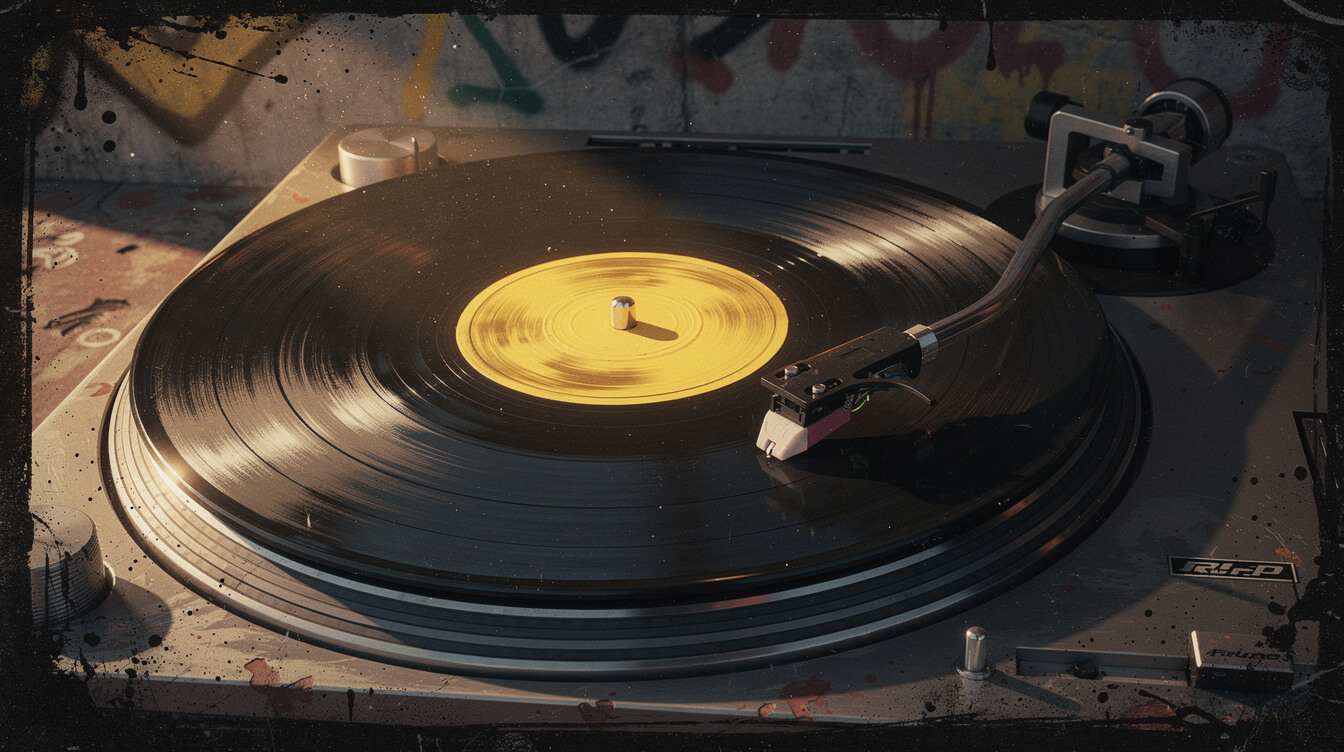
“M.C.’s Ultra (Part Two)” was the B-side to “Travelling at the Speed of Thought,” a single released ahead of the group’s debut album. The A-side built its groove around an extensive sample of “Louie Louie” by the Kingsmen — about as unlikely a hip-hop source as exists — while the single as a whole became a crate-digger’s reference point for the group’s pre-Critical Beatdown experimentation. It still turns up today in r/hiphopheads threads as a deep-cut flag for serious collectors, the kind of record people namecheck specifically to prove they’ve gone past the obvious singles.
What makes it worth a whole section instead of a footnote is timing. This wasn’t a victory lap after Critical Beatdown — it came before it, released alongside the “Funky”/”Mentally Mad” single in 1987, the same run of releases that directly led to the group landing its first album deal. “Funky” itself was built on a Joe Cocker piano sample that would resurface years later as the backbone of 2Pac’s “California Love.” That’s the era “M.C.’s Ultra” lives in: a group stockpiling techniques and sample sources a full year before anyone outside the Bronx knew their name, one of which would echo into a completely different decade of hip-hop.
If you’re building a collection around this exact era, the Ultramagnetic MCs T-Shirt keeps that pre-fame, crate-digger energy — no album title printed, just the group’s name, the way a real OG fan would want to rep it.
Ced Gee’s Sampling Technique — Parallel Innovation, Not a Straight Line to Marley Marl

Here’s where a lot of casual retellings get sloppy, so let’s be precise. Ced Gee (born Cedric Miller, also known by the production alias Delta Force One) is widely credited as the architect behind Ultramagnetic MCs’ sampling approach — specifically the technique of “chopping” samples, slicing a source recording into pieces and reassembling them out of their original context rather than looping a clean break. That’s a real, specific innovation, and it’s the backbone of everything Critical Beatdown would do a year later, built almost entirely on the E-mu SP-1200 sampler as the album’s main instrument — the same machine that, within a year or two, would become the defining tool of an entire generation of golden-age producers.
The Criminal Minded Connection
What’s less widely known: Ced Gee also produced the majority of Boogie Down Productions’ Criminal Minded (1987) — uncredited at the time, confirmed only by a “special thanks” line and later scholarship. That’s a genuinely wild footnote, because Boogie Down Productions and Marley Marl’s Juice Crew were on opposite sides of hip-hop’s first great beef, the Bridge Wars. So the honest version of this story isn’t “Ced Gee influenced Marley Marl.” It’s that two separate camps — Ced Gee’s Bronx sampling lab and Marley Marl’s Queensbridge studio — were independently cracking the same technical problem at almost the same moment, sometimes while actively feuding with each other. That’s a better story than a tidy influence chain, and it’s one almost nothing in the current search results actually tells.
KRS-One himself has said he came close to joining Ultramagnetic MCs before forming Boogie Down Productions instead — which makes the Criminal Minded connection even stranger. The group that could have had him produced the record of the crew he built without them.
Critical Beatdown (1988): The Album That Still Gets Cited by Producers
Released October 4, 1988, on Next Plateau Records, Critical Beatdown took everything “M.C.’s Ultra” and the group’s early singles had been testing and turned it into a full statement. Producer and engineer Paul C. — a criminally underused name in most hip-hop histories — produced “Give the Drummer Some” and engineered the bulk of the album, as well as producing the Hip-House remix of “Traveling at the Speed of Thought” that became the group’s first music video. The album leaned heavily on James Brown samples, a palette choice that would define golden-age production for years afterward, and its “chopped” sample editing is still referenced by producers decades later as a formative text. It charted modestly on release — peaking at just 57 on the US R&B/Hip-Hop albums chart — but has since been reassessed by critics as a cornerstone of golden-age and new-school hip-hop, with its abstract, syncopated rhyme style cited as an influence running from Public Enemy through gangsta rap to generations of underground MCs who came decades after. Roadrunner Records reissued it in 2004 with bonus tracks, including the original, pre-remix versions of the Next Plateau singles.
The Single That Sparked a Coastal Feud
The B-side “A Chorus Line” became one of the group’s most popular tracks and introduced Tim Dog, who’d go on to become an unofficial member. Its instrumental got recycled — with Ced Gee producing again — into Tim Dog’s “Fuck Compton,” a modest hit that’s credited with helping ignite the East Coast/West Coast feud that would define hip-hop’s most dangerous years in the mid-1990s. A single lineage, from a B-side nobody outside the Bronx noticed, running straight through to one of the genre’s defining conflicts.
For the crew ready to wear the album that started it, the Ultramagnetic MCs T-Shirt – Critical Beatdown is the direct hero piece — same era, same energy, no explanation needed to anyone who knows.
The Engineer Who Wouldn’t Live to See It Credited
Paul C. McKasty engineered most of Critical Beatdown and produced “Give the Drummer Some” outright — a track built on a James Brown “There Was a Time” chop so advanced that Pete Rock initially assumed Paul had somehow gotten his hands on an unreleased original recording rather than sampling the record everyone else owned. Questlove later called him “damn near the J Dilla of his day,” and Complex named him one of the most important figures in the development of sampling itself. He never got to see any of that praise. On July 17, 1989 — the same year Critical Beatdown came out — Paul C. was shot to death in Rosedale, Queens, at 24 years old. The case was cold until it was featured on America’s Most Wanted, which led to the arrest of Derrick “Little Shine” Blair months later.
Before his death, Paul C. had spent two weeks mentoring a teenage Large Professor on the SP-1200 sampler, lending him the machine and watching him turn out 30 to 40 beats in that span. Large Professor has said Paul “took me out of that tape deck era,” and later named his own publishing company Paul Sea Productions in tribute. That’s the uncredited production lineage sitting underneath Ultramagnetic MCs’ most important album — not a straight line to any one camp, but a direct line to one of the most mourned “what if” figures hip-hop production ever had.
Where This Fits in the Kool Keith Multiverse
The group broke up temporarily in 1990 and returned on Mercury Records in 1992 with Funk Your Head Up, an album hurt by outside producers remixing tracks into something more commercial-sounding at the label’s insistence. One song survived the gloss: “Poppa Large,” remixed by Da Beatminerz, which became a hit and is still a staple of Kool Keith’s live show — the video famously had him performing in a straitjacket with his head in a birdcage. 1993’s The Four Horsemen, featuring Godfather Don, was the group’s last official album until a real reunion LP, The Best Kept Secret, arrived in January 2007.
That’s the actual reunion record people are often hunting for when they type “MC Ultra” into a search bar — not a lost album, just a mislabeled memory of a deep-cut B-side. By the time The Best Kept Secret came out, Kool Keith had already spent most of the ’90s and 2000s splitting himself into aliases: Dr. Octagon in 1996 and Dr. Dooom not long after, both of which went on to influence Pharoahe Monch of Organized Konfusion and Ghostface Killah of Wu-Tang Clan. None of that happens without the sampling lab Ced Gee was running back in 1987, one B-side at a time.
The group has kept circling back to its own history since. They played a live set at the ATP “I’ll Be Your Mirror” festival in Asbury Park in September 2011, and in 2022, Ced Gee and Kool Keith released Ced Gee X Kool Keith on Ruffnation Records — the two founding members, the same chopped-sample instincts, four decades after a Bronx apartment turned into a sampling lab.
If you want the full arc — the alter egos, the Sony deal that fell apart, the 24-year sequel that finally closed the loop — our Black Elvis deep dive and Doctor Octagon: Earth People piece both pick up exactly where this one leaves off. And for the group’s complete origin-to-now story in one place, we’ve got a full Ultramagnetic MCs retrospective that covers ground this piece intentionally doesn’t.

Industry Is Wack — Still True
Ced Gee was calling it decades before it was a hashtag. The Ultramagnetic MCs “Industry Is Wack” Tee carries the same tell-it-straight energy that got this crew uncredited on two of the genre’s most important records.
Frequently Asked Questions
Is there an actual album called “MC Ultra” by Ultramagnetic MCs?
No. There’s no studio album with that title in the group’s discography. The closest real release is “M.C.’s Ultra (Part Two),” a 1987 B-side to “Travelling at the Speed of Thought,” released a year before their debut album Critical Beatdown.
What was Ultramagnetic MCs’ first album?
Critical Beatdown, released October 4, 1988, on Next Plateau Records.
Did Ced Gee really produce Boogie Down Productions’ Criminal Minded?
He’s credited with producing the majority of it, though uncredited on the original release — confirmed only through a “special thanks” line and later hip-hop scholarship.
What’s the group’s actual reunion album?
The Best Kept Secret, released January 9, 2007, the first official Ultramagnetic MCs album since 1993’s The Four Horsemen.
How does Kool Keith’s solo career connect back to this era?
Dr. Octagon (1996) and Dr. Dooom came directly out of the sampling and lyrical groundwork laid in the group’s 1980s run, and both went on to influence Pharoahe Monch and Ghostface Killah.
Who else did Ced Gee produce or work with?
Beyond Boogie Down Productions, Ced Gee worked with Antoinette, Doug E. Fresh, Treacherous Three, and Tim Dog, holding staff-producer roles at Next Plateau, Wild Pitch, Mercury, Ruffhouse, Roadrunner, and Uptown Records over the years.
Is Ultramagnetic MCs still active?
Yes, in a loose sense. The group’s core members have continued to perform and record periodically since the 2007 reunion, including a 2022 collaborative album between Ced Gee and Kool Keith.
Final Thoughts
“M.C.’s Ultra (Part Two)” isn’t a lost classic waiting to be rediscovered — it’s a B-side, and it shows. But it’s also the clearest evidence of a group mid-transformation, stacking up the sampling vocabulary that would make Critical Beatdown a landmark a year later. The real story was never a mislabeled reunion album. It’s a Bronx crew that started out breakdancing on cardboard before they ever touched a sampler, that was quietly rewriting hip-hop’s production rulebook a full year before anyone outside their neighborhood knew their name, and that kept circling back — through a coastal feud they accidentally helped spark, through a murdered engineer whose fingerprints are still on half the genre, through a dozen Kool Keith alter egos — to a sound that started with four kids and a demo called “Space Groove.”
Deep Cuts, Delivered Weekly
Get the hip-hop history nobody else is digging up — plus first access to new drops — straight to your inbox.

🎧 Never Miss a Drop
Exclusive product releases, hip-hop deep dives, and member-only discounts. Straight to your inbox.
Free forever. No spam. Unsubscribe anytime.

Get the Culture, Delivered
Deep dives into hip-hop history, exclusive product drops, and discounts sent straight to your inbox. No spam, just culture.
Join 2,000+ hip-hop heads already in the loop. Unsubscribe anytime.