Rawkus Records: The Full Story of the Indie Label Behind Black Star, Company Flow and Simon Says
Before “independent” was a marketing word, it was a slogan cut out with scissors and glue sticks on a kitchen table in New York. Rawkus Records is the label that took that slogan, put it on a razor-blade logo, and turned the late-’90s New York underground into records that charted. Mos Def, Talib Kweli, Company Flow, Pharoahe Monch, Hi-Tek and a posthumous Big L all ran through one indie imprint funded, of all people, by a Murdoch. Rawkus showed boom bap could sell without a shiny suit. Then it tried to become Def Jam, and it never released a record again after 2007.
This is the full story of Rawkus Records: who started it, the deals that made it different, the albums that defined it, how it fell, and where the catalog lives today. We’ve checked every release date, chart peak and certification below against Billboard data, Discogs liner credits and the people who were in the room. Where the sources disagree, we say so instead of picking a side.
How Rawkus Records Started: Horace Mann, a Murdoch and an Industrial Noise Catalog
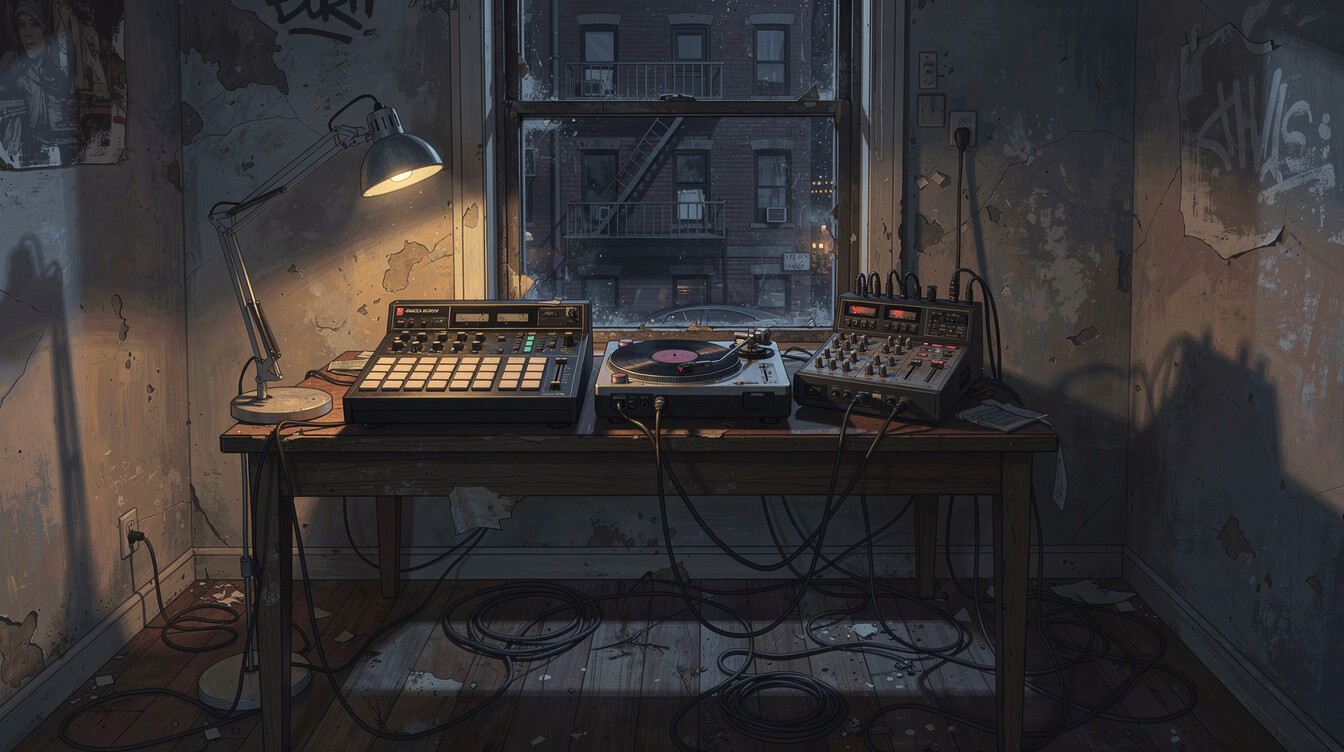
Rawkus Records was founded by Brian Brater and Jarret Myer, with money from their schoolmate James Murdoch, the son of Rupert Murdoch. The three knew each other from Horace Mann, the private prep school in the Bronx. Myer and Brater then went on to Brown University. Talib Kweli remembered them years later on his podcast as “these two white guys from Brown University” who “came to the hood” in Crown Heights looking for rappers.
1995 or 1996? The founding-year split
You’ll see both years. The label’s own earliest catalog numbers on Discogs (RWK 102, RWK 1101) are dated 1995, and Rawkus’s Wikipedia entry says 1995. Jarret Myer’s own bio and several later profiles say 1996. The safest call is that the first records came out in 1995. In 1996, per the Guardian and the New York Times, News Corp bought a majority stake. That date matters, because Rawkus was a Murdoch-family business years before anyone heard “Definition.”
The first Rawkus records weren’t rap
This is the jewel most heads don’t know. Pull the earliest Rawkus catalog and you get rap-rock (Plastique, Front Towards Enemy), industrial noise (Whorgasm, Final, Tactile), Dystopia One’s “fun-dustrial” record and the Future Shock electronic/industrial compilation. The hip-hop 12-inches came later, starting with small 1996 singles like Poppa Bear Kool Breez’s “Lighter.” On the name, Brater told FACT in a 2014 retrospective: “I just liked the word and I was really into Wu-Tang and what Loud Records was starting to do.” The first office was on Reade Street in Tribeca.
The Nervous Records blueprint
DJ Evil Dee of Black Moon and Da Beatminerz put it bluntly in a 2019 interview: “Rawkus Records was formed ’cause of Nervous Records.” Nervous, Mike Weiss’s label, had put out Black Moon’s Enta Da Stage and Smif-N-Wessun’s Dah Shinin’. Brater and Myer studied that model. They also studied Evil Dee, who says he sold “like 100,000” copies of Shadez of Brooklyn’s “Change” independently, out of his house. “They was like, ‘Whoa, well… wait a minute. How’s he doing this?'” Vibe’s 1998 feature on the label described a high-volume 12-inch strategy modeled on punk indies like SST and Victory.
Company Flow and “Independent as F***”: The Deal That Set the Tone

If Rawkus has an origin myth, it belongs to Company Flow: El-P, Bigg Jus and DJ Mr. Len. Before Rawkus, the trio were already doing it themselves. El-P and Bigg Jus worked at Tower Records on Lafayette Street, and El-P told Talib Kweli on The People’s Party that they used the store’s postage to mail demos to labels. “We’d take our money that we earned there, and we’d go record at night.” The Funcrusher EP came out on the group’s own Official Recordings imprint in the mid-’90s. El-P has dated it to both 1995 and 1996 in different interviews, so don’t let anyone tell you there’s one settled year.
The 50/50 deal
This is what made Rawkus different from a major. Company Flow walked into label offices with demands that, in El-P’s words, sounded “ludicrous” at the time. “We want to own the masters. We want a 50/50 deal. And we don’t want to promise more than one album.” Other labels passed. Rawkus said yes. El-P put it even more plainly to Red Bull Music Academy in 2012: “we’re gonna do a 50/50 split, we gonna own the masters, or f*** off.” By El-P’s account, that kind of leverage simply didn’t exist for rap acts in 1997.
Funcrusher Plus (July 22, 1997)
Funcrusher Plus, the expanded full-length, landed on Rawkus on July 22, 1997. El-P produced most of it, Bigg Jus produced “Lune TNS,” and Mr. Len handled the cuts. The sound was dense, abrasive and sci-fi paranoid, closer to Public Enemy’s Bomb Squad than to the jazz loops that were then everywhere. “Independent as f***” became the rallying cry of the late-’90s underground. El-P says Company Flow came up with it while hand-assembling artwork at a kitchen table with glue sticks. Talib later joked that “Rawkus co-opted this whole ‘independent as f***’ thing.” El-P’s answer was fair: “Rawkus certainly recognized it, and I think they had the ability to do something about it.”
If Funcrusher Plus rewired your idea of what rap could sound like, our Company Flow Funcrusher Plus T-Shirt is built for you. It also comes as a Funcrusher Plus hoodie for the cold crate-digging months.
Where El-P went next
Company Flow and Rawkus eventually split. El-P launched Definitive Jux, which became the defining indie rap label of the early 2000s (the label that dropped Cannibal Ox’s The Cold Vein), and later formed Run the Jewels. In a real sense Def Jux was Rawkus’s first spinoff. It took the masters-and-control lesson and built a whole label around it.
Soundbombing, Lyricist Lounge and Black Star: The 1997–1998 Run
Company Flow gave Rawkus credibility. The next 18 months turned it into a movement, through 12-inch singles, two compilations and one album that still sits on every “conscious rap starter pack” list.
The 12-inches that built the roster
In 1997 Rawkus pressed the singles that introduced its two future stars. Reflection Eternal (Talib Kweli and Cincinnati producer Hi-Tek) put out “Fortified Live” b/w “2000 Seasons,” and Mos Def put out “The Universal Magnetic.” The sleeves were part of the pitch: custom designed, hand-made looking, nothing like the glossy major-label product of the time. Talib remembers what convinced him. He was skeptical of indie labels (“I’m trying to get to a major”) until Mos told him the Rawkus guys had paid him for a single. “They gave you some money? How much money they give you?” Talib laughed. “My whole thought pattern changed.”
Soundbombing: the tape that paid for itself
Evil Dee tells the origin of Soundbombing (released October 14, 1997) like this. He offered to make the young label a tape. He had studio time at D&D Studios in Midtown, told them to send their artists over, and recorded freestyles in one night: Black Star, R.A. The Rugged Man and more. Then he blended it all off acetates. A week later Rawkus wanted it as a real, distributed album. He says he got a $10,000 advance. “They put Soundbombing out, right? And it explodes.” Evil Dee also says it was the first Rawkus album that earned its money back. “Their other albums, they over-spent, over-spent, over-spent.” That’s his account, not an audited number, but it’s the earliest warning sign in the story.
Lyricist Lounge, Volume One (May 5, 1998)
The Lyricist Lounge started in the winter of 1991 as an open mic run by Danny Castro and Anthony Marshall in a studio apartment at 45 Orchard Street on the Lower East Side. Rawkus sponsored shows and then packaged the energy into Lyricist Lounge, Volume One, a double-disc compilation released May 5, 1998. It only peaked at No. 167 on the Billboard 200, but Brater later told Red Bull Music Academy it sold around 100,000 copies. It also set up the MTV Lyricist Lounge Show, which premiered in February 2000.
Mos Def & Talib Kweli Are Black Star (September 29, 1998)
Then came the record. Mos Def & Talib Kweli Are Black Star dropped September 29, 1998. Hi-Tek produced six of the 13 tracks: the intro, “Definition,” “Re: Definition,” “K.O.S. (Determination),” “Respiration” and “Twice Inna Lifetime.” Da Beatminerz did “Astronomy (8th Light),” Shawn J. Period did “Children’s Story” and “Hater Players,” J. Rawls did “Brown Skin Lady” and “Yo Yeah,” Ge-ology did “B Boys Will B Boys” and 88-Keys did “Thieves in the Night.” Billboard has it peaking at No. 53 on the Billboard 200 and No. 13 on R&B/Hip-Hop, with “Definition” reaching No. 60 on the Hot 100. One receipt worth knowing: the album has no RIAA certification. If anyone tells you Black Star went gold, they’re guessing. Its weight is cultural, not commercial. For the full track-by-track story, read our Mos Def Black Star deep dive.
El-P, half-joking, says the only time he felt competition with Black Star was when Hi-Tek “got to the B.D.P beat before me.” “Definition” is built on Boogie Down Productions. He and Talib agreed the two camps were opposite sides of the same brain: Co Flow’s big, stabbing, Bomb Squad-rooted noise next to Black Star’s “warm, fuzzier thing,” as Talib called it.

The Rawkus Record Everybody Owns
We made the Mos Def & Talib Kweli Are Black Star tee for heads who learned what “Definition” meant in 1998 and never forgot it. Brooklyn, Hi-Tek, the razor-blade era.
1999–2000: The Rawkus Records Peak
In 1999 Rawkus signed a distribution deal with Priority Records, and for about 18 months nothing in independent rap could touch it.
Soundbombing II (May 18, 1999)
Evil Dee passed on doing a sequel. DJ Babu and J Rocc mixed Soundbombing II instead. It came out May 18, 1999 and went to No. 30 on the Billboard 200 and No. 6 on R&B/Hip-Hop, which is wild for a mixtape-style comp of underground artists. It opens with Eminem’s “Any Man.” Common myth: that made Eminem a Rawkus artist. He wasn’t. The liner credit reads “courtesy of Web Records.” And the famous “Stan” line about “the underground shit that you did” mentions Skam, not Rawkus. Plenty of sites get that wrong.
Black on Both Sides (October 12, 1999)
Mos Def’s solo debut was released October 12, 1999 on Rawkus/Priority. It peaked at No. 25 on the Billboard 200, No. 3 on R&B/Hip-Hop and No. 1 on Top Rap Albums, and was certified Gold on February 2, 2000. That makes it the clearest commercial proof the Rawkus model worked. Producers include Mos himself, DJ Premier, Diamond D, Ayatollah, 88-Keys, Ge-ology, Ali Shaheed Muhammad and Psycho Les. Our Today in Hip-Hop entry for October 12 has more of the story.
Internal Affairs and the Godzilla problem (October 19, 1999)
Seven days later Rawkus dropped Pharoahe Monch’s Internal Affairs, his first solo album after Organized Konfusion. It peaked at No. 41 on the Billboard 200. The lead single, “Simon Says,” was released August 17, 1999 and is built on Akira Ifukube’s Godzilla theme. Its Hot 100 peak was only No. 97, but it reached No. 3 on Hot Rap Singles and has never left stadium PA systems since.
The sample is also why Internal Affairs disappeared for almost 20 years. There are two versions of the story. Most coverage, including a 2014 Claims Journal report, points to a sample suit from Toho, which owns Godzilla; Monch himself later put the figure at $420,000 and said “the label, the distributer and myself” were sued. Another account, reported by the Independent, says Monch refused to record for Geffen after Universal absorbed Rawkus, which left the album stranded. Either way, the record first came to streaming and new vinyl on October 19, 2019, its 20th anniversary. Read our October 19 Today in Hip-Hop for the day it shared with DOOM’s Operation: Doomsday. If Pharoahe’s pen is your thing, our Pharoahe Monch Desire T-Shirt carries the later chapter of that catalog.
Big L’s The Big Picture (August 1, 2000)
Big L was killed in Harlem in February 1999, and Rawkus had released nothing of his while he was alive. “Ebonics” came out in 1998 on his own Flamboyant Entertainment label, and Jay-Z later told MTV that Roc-A-Fella had been “about to sign him.” Rawkus partnered with Flamboyant on the posthumous release. The “Flamboyant” single came out in May 2000, and The Big Picture followed on August 1, 2000. It debuted at No. 13 on the Billboard 200 with 72,549 copies sold in its first week and was certified Gold that October. It’s still Big L’s best-selling album. The full discography is in our Big L albums guide.
Train of Thought, Lyricist Lounge 2 and Hip Hop for Respect
Reflection Eternal’s Train of Thought (October 17, 2000) peaked at No. 17 on the Billboard 200 and No. 5 R&B/Hip-Hop. Lyricist Lounge 2 (November 28, 2000) hit No. 33. And in 2000 Rawkus released the Hip Hop for Respect EP, organized by Mos Def and Talib after the NYPD killed Amadou Diallo, a 23-year-old Guinean immigrant, in a hail of 41 shots in 1999. The EP’s posse cut brought Talib, Mos, El-P, Common, Posdnuos, Kool G Rap, Rah Digga and Shabaam Sahdeeq together on one record. It’s the clearest single snapshot of what the label stood for. Our Soulquarians piece covers the parallel Electric Lady scene that Mos Def and Common were part of.
“Trying to Be Def Jam”: How Rawkus Records Fell (2001–2005)

Ask people who were there why Rawkus collapsed and you get the same answer in different words: it stopped acting like Rawkus. Evil Dee’s version is the sharpest. “At the time, Rawkus was about the music. Then, when they started the whole trying to be Def Jam [concept], that’s what killed them.” He adds a detail that says it all: “All the big [music executives] had houses in the Hamptons, so Rawkus went and got a house in the Hamptons.” That’s one insider’s opinion, but it lines up with what the release schedule shows next. (For contrast, see how the actual Def Jam scaled from a dorm room.)
The 2001–2002 releases
The music didn’t drop off right away. Hi-Tek’s Hi-Teknology came out May 8, 2001 on Rawkus/Priority. In 2002 Rawkus moved into a joint venture with MCA. Soundbombing III (June 4, 2002) peaked at No. 23, and Talib Kweli’s solo debut Quality (November 19, 2002) reached No. 21. Its single “Get By,” built on Nina Simone’s “Sinnerman,” peaked at No. 77 on the Hot 100 in 2003 and is still one of the biggest records with a Rawkus logo on it.
The albums that got stuck
The label’s problems show up in its delays. Kool G Rap’s The Giancana Story was signed to Rawkus and first scheduled for October 2000. It finally came out on November 26, 2002, licensed to Koch Records. Discogs lists it as a Koch release with a Rawkus credit, so “a Rawkus album” is only half true. Mad Skillz’s I Ain’t Mad No More was planned for 2002 and never came out on Rawkus. El-P was gone. Company Flow had dissolved. Hi-Tek has told Okayplayer the label pushed him to rush out an instrumental album.
MCA folds, Geffen inherits, the lights go out
Then the corporate floor moved. In 2003 Universal folded MCA into Geffen, and Rawkus’s joint venture went with it. At the end of January 2004, Geffen/Universal didn’t renew the deal. Rawkus laid off staff, left its Broadway offices, and some of its artists moved to Geffen. Mos Def’s The New Danger (October 12, 2004) and Talib’s The Beautiful Struggle (September 28, 2004) both came out through Geffen. In June 2005 Brater told Billboard that the catalog had been sold to Universal Music Group “earlier this year.” Some sources date the sale to 2004; Billboard’s contemporary report says 2005. That sale is why Universal, not Rawkus, controls Black on Both Sides, Black Star and Train of Thought today.
The Afterlife of Rawkus Records: RED, Rawkus 50 and the Streetwear Echo
Rawkus didn’t die in 2004. It just got quieter.
The RED relaunch and Rawkus 50
In 2005 Rawkus signed a three-year distribution deal with RED, Sony BMG’s indie arm, and put out a new generation in 2006–2007: Kidz in the Hall’s School Was My Hustle, The Procussions, Panacea and Marco Polo’s Port Authority. Universal’s Geffen issued Best of Decade I: 1995–2005 on December 13, 2005. The strangest experiment came in 2007. Rawkus 50 was an open call where artists submitted albums, and the 50 picks got a digital distribution deal through IODA, all released on the same day in late 2007. It was a crowdsourced label years before streaming made that normal. According to the label’s public discography, Rawkus has released no new project since.
The catalog’s second life
The music kept moving even with the label dormant. Universal’s catalog division pressed Rawkus classics on vinyl in 2014. Interscope gave Black on Both Sides a 25th-anniversary vinyl reissue in 2024, limited to 3,000 copies. And streetwear noticed: in 2018 Bobby Hundreds’ The Hundreds dropped a Rawkus Records collab, with Jarret Myer on camera explaining the label’s history. Bobby’s pitch was that streetwear “wouldn’t be as popular today if it wasn’t for” rap’s rise, and Rawkus was where a lot of that independence started.
Where the founders landed
Myer and Brater co-founded Uproxx in 2008. Warner Music Group bought it in 2018, and in April 2024 Myer, Rich Antoniello and will.i.am bought Uproxx, HipHopDX and Dime back from Warner as Uproxx Studios, with Myer as CEO. So one of the men who ran Rawkus now owns HipHopDX, a site that reviewed Rawkus records. James Murdoch went on to run 21st Century Fox and resigned from the News Corp board in July 2020 over disagreements about editorial content.
Black Star’s second album is not a Rawkus record
One more myth to clear up. Black Star’s long-awaited sequel, No Fear of Time, came out May 3, 2022, entirely produced by Madlib. It launched as a Luminary podcast exclusive and got a physical release through Rhymesayers in 2023. The duo was reunited, but the label was not. For a modern label built on the same independence ethos, compare Stones Throw at 30 or the Griselda blueprint.
Essential Rawkus Records Albums: A Starter Crate
If you’re building the shelf from zero, these are the records that carry the label’s DNA, in release order:
- Company Flow, Funcrusher Plus (1997). The manifesto. Noisy, paranoid, owned by the artists. Start here to understand why Rawkus mattered.
- Soundbombing (1997). Evil Dee’s blend of the early roster. Rawkus’s sound in mixtape form.
- Lyricist Lounge, Volume One (1998). The open-mic scene on wax, two discs deep.
- Mos Def & Talib Kweli Are Black Star (1998). The one everyone knows. Hi-Tek’s best work, two MCs at full power.
- Mos Def, Black on Both Sides (1999). The label’s commercial proof: Gold, No. 1 on Top Rap Albums, still essential.
- Pharoahe Monch, Internal Affairs (1999). A lyrical clinic, and the album a Godzilla sample stole for two decades.
- Big L, The Big Picture (2000). A posthumous Gold record and the best-selling album of Big L’s career.
- Reflection Eternal, Train of Thought (2000). Talib and Hi-Tek’s full-length statement and arguably the label’s deepest album.
- Talib Kweli, Quality (2002). The bridge from underground to radio, anchored by “Get By.”
Want the album art on your back instead of on the shelf? We made the Black Star hoodie for exactly that.
Rawkus Records FAQ
Who founded Rawkus Records?
Brian Brater and Jarret Myer, with funding from their Horace Mann schoolmate James Murdoch. News Corp later bought a majority stake. Rupert Murdoch didn’t found it. His son James co-founded and bankrolled it.
When was Rawkus Records founded?
The first catalog releases date to 1995, though some profiles of the founders say 1996. Both years show up in reputable sources.
Was Eminem signed to Rawkus Records?
No. Eminem’s “Any Man” opens Soundbombing II (1999), but he’s credited “courtesy of Web Records.” He was never a Rawkus artist, and the “Stan” lyric often quoted as proof actually references Skam.
Why did Rawkus Records shut down?
The short version: overspending, a shift toward major-label ambitions, and corporate consolidation. When Universal folded MCA into Geffen, Rawkus lost its joint venture. The deal wasn’t renewed in early 2004, and the catalog was sold to Universal Music Group in 2005.
Who owns the Rawkus catalog now?
Universal Music Group. That’s why reissues like the 2024 Black on Both Sides 25th-anniversary vinyl come through Interscope.
Is Rawkus Records still active?
Not as a releasing label. Its last new projects came out around the 2007 Rawkus 50 campaign. Black Star’s 2022 album No Fear of Time was released through Luminary and Rhymesayers, not Rawkus.
Why was Pharoahe Monch’s Internal Affairs off streaming for so long?
Mostly the uncleared Godzilla sample on “Simon Says,” which brought a Toho lawsuit. Some accounts also point to Monch refusing to continue under Geffen. The album finally hit streaming on October 19, 2019.
Final Thoughts: Why Rawkus Records Still Matters
Strip away the Murdoch money and the Hamptons house, and Rawkus Records comes down to one idea: give artists a fair deal, put their records in stores and let the music carry it. For about five years it worked better than anyone expected. Company Flow owned its masters. A double-disc open-mic compilation moved six figures, by its founder’s count. Mos Def went Gold without trying to sound like the radio. Big L got the posthumous album he deserved.
Then the label chased scale and lost what made it special. That’s a lesson every independent label since, from Def Jux to Stones Throw to Griselda, has had to learn for itself. Pull out Funcrusher Plus, then Black Star, then Internal Affairs, and listen to what independent sounded like before it was a marketing term.
Stay creative — The Custom Creative Team
Get the Culture in Your Inbox
Liner-note receipts, studio stories, anniversaries and first dibs on new drops. No spam, just hip-hop.

🎧 Never Miss a Drop
Exclusive product releases, hip-hop deep dives, and member-only discounts. Straight to your inbox.
Free forever. No spam. Unsubscribe anytime.
Get the Culture, Delivered
Deep dives into hip-hop history, exclusive product drops, and discounts sent straight to your inbox. No spam, just culture.
Join 2,000+ hip-hop heads already in the loop. Unsubscribe anytime.