Gang Starr ‘Mass Appeal’ (1994): DJ Premier’s Vic Juris Chop, the Sellout Paradox, and Boom-Bap’s Perfect Contradiction
On February 8, 1994, Gang Starr released “Mass Appeal” — a single explicitly built to critique rap acts chasing radio play. Twelve weeks later it peaked at #67 on the Billboard Hot 100, making it the highest-charting single in the duo’s entire catalog. That contradiction is the whole story. This deep-read decodes DJ Premier’s Vic Juris sample chop, the sellout paradox coded into every bar Guru wrote, the Times Square-shot music video that framed east-coast underground identity, and the reason the Vic Juris loop under this record is arguably the boom-bap blueprint that J Dilla, Madlib, and Alchemist all built on. The gang starr mass appeal record isn’t a hit song with a good sample. It’s a self-aware manifesto that accidentally proved its own thesis — and every producer since has been chasing the tension it captured.
The Premier Chop: Vic Juris’s “Horizon Drive” (1980) → Boom-Bap’s Perfect Loop

The source record: guitarist Vic Juris’s Horizon Drive, released in 1980 on Muse Records. Juris was a New Jersey jazz-fusion player known for his work with Dave Liebman’s Quintet — not a household name, not a crate-digger legend, just a working session guitarist whose album ended up in a Brooklyn thrift shop bin decades later. DJ Premier heard four bars of it and heard the future of hip-hop.
What Premier chopped was not the song’s melodic hook. He grabbed a short interior loop — a warm, slightly detuned electric-piano figure sitting under Juris’s guitar solo — filtered it hard to strip the top end, and looped it at 88 BPM. He then re-triggered the loop from the SP-1200 with a slight swing, so every downbeat lands just a hair behind the metronome. That behind-the-beat feel is what turns a jazz-guitar interlude into a boom-bap anthem. The sound isn’t “sampled.” It’s translated.
Premier layered a razor-thin snare that cuts through the mid-range and a soft, almost gentle kick that never crowds the loop. There are no drum fills. No key changes. No bridge. The entire beat is that one four-bar cycle for four minutes and twenty-two seconds. In a Rolling Stone interview years later, Premier admitted the “background melody” was made real simplistic on purpose — as a joke about how mainstream radio was watering down hip-hop into elevator music. That decision is the fingerprint on the whole record. Premier didn’t accidentally make something radio-friendly. He weaponized simplicity.
Beat historians point to three specific Premier choices on this record that later producers copied wholesale: the filtered mid-frequency loop with the highs surgically removed, the swung-eighth kick pattern that leaves silent air on the downbeat, and the willingness to let the loop sit unchanged for the entire song rather than switching up the beat under different verses. That template — one loop, one drum pattern, four minutes — is exactly how J Dilla built Donuts. It’s how Madlib built Madvillainy. It’s how Alchemist still constructs beats in 2026. Premier didn’t invent the loop-based approach in 1994, but “Mass Appeal” is the record where the aesthetic locked in.
The Sellout Paradox: A Song Critiquing Mass Appeal That Became Gang Starr’s Biggest Chart Hit
Guru wrote the record as an indictment. Read the lyrics with a highlighter and every couplet is aimed at someone — the rapper who softened his sound to get on radio, the label executive greenlighting watered-down beats, the audience conditioned to expect a hook every eight bars. The chorus is not a celebration of mass appeal. It’s a diagnosis of it.
Then the record hit the Hot 100.
#67 on Billboard‘s pop chart. #35 on Hot R&B/Hip-Hop Songs. A gold plaque nowhere in sight, but for Gang Starr — a duo who had built their reputation on being the underground’s underground — this was the closest they ever came to mainstream success. Their previous singles peaked much deeper. “Take It Personal,” from 1992’s Daily Operation, never touched the Hot 100. “Dwyck” with Nice & Smooth was a college-radio favorite that stayed in the crates. “Mass Appeal” was the anomaly. A song written specifically to reject radio logic ended up performing better on radio than anything they’d made before.
The paradox has a clean explanation once you strip the irony. The record is legitimately radio-perfect. That “simplistic” loop Premier built to mock radio? It’s melodic, it sits nicely in a car stereo, it doesn’t clash with the DJ transition into the next track. Guru’s flow is measured and pocket-locked — no complex internal rhymes to lose a casual listener, no aggressive delivery to scare off crossover programmers. The song is about selling out while being the most sellout-shaped song Gang Starr ever recorded. Program directors either didn’t get the joke or didn’t care. Either way, they added it to rotation.
What makes the record complicated in retrospect is that Gang Starr never chased that success again. There was no follow-up crossover single. Guru and Premier watched their most commercial moment happen almost by accident, then went back to making records that were harder, denser, less radio-legible. If “Mass Appeal” was a test, they refused to take the exam a second time.
The Times Square Music Video: NYC Underground Framing in the Middle of Mainstream Chaos

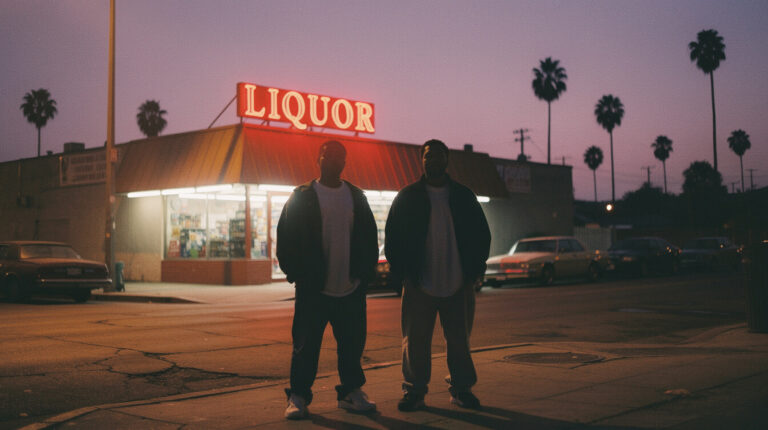
The music video dropped in March 1994, roughly two weeks after Hard to Earn. Director Elliot Lewis Rosenblatt shot the primary sequences in three locations that carry cultural weight for anyone who read the geographical subtext: Times Square before Giuliani’s cleanup, a Brooklyn brownstone stoop, and an interior shot in what appears to be an old radio-station lobby. Guru raps his first verse framed inside the doorway of a peep-show storefront on 42nd Street. The shot is deliberate. This is what Times Square looked like in 1994 — before the Disney Store, before M&M’s World, before Marriott Marquis lit up half the block. Peep shows, XXX theaters, three-card monte hustlers, tourists getting fleeced, cops posted every corner.
The choice to plant the video in that specific geography is the entire visual argument of the record. Gang Starr are not commenting on hip-hop’s sellout problem from the sidelines. They’re standing in the middle of America’s most commercialized square mile — Times Square, the literal center of the entertainment industry — and calling out the people who chase mass appeal while positioning themselves as the alternative. The peep-show storefront is not decoration. It’s the thesis.
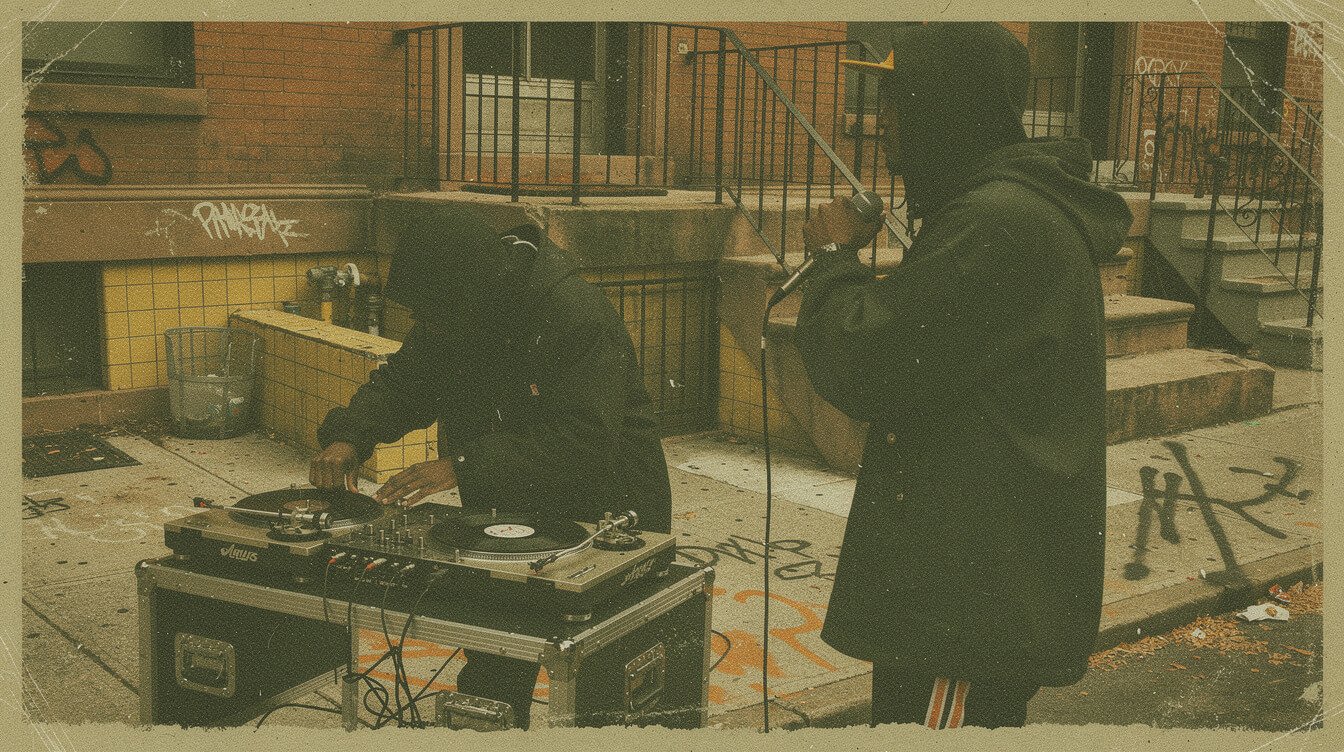
The Brooklyn stoop sequences add the counterweight. Guru raps the second verse on what looks like a Bedford-Stuyvesant brownstone block — the exact geography where Gang Starr’s core audience lived. Cutting between those two locations sets up a clean binary: this (Times Square, Midtown, the mainstream machine) versus this (Brooklyn, the block, the community). The record’s argument is that authentic hip-hop lives on that block and gets exported to Times Square only in watered-down form. The video makes the geographic argument physical.
A minor detail most decoders miss: DJ Premier appears in the video not behind decks but standing beside Guru, holding a portable boombox on his shoulder. Premier the producer becomes Premier the fan — a deliberate framing that positions boom-bap production as an act of community consumption rather than industry manufacture. It’s a subtle piece of imagery but it lands. Everything about the video argues that Gang Starr are on one side of a cultural line, and pop-radio hip-hop is on the other.
Where “Mass Appeal” Sits on Hard to Earn (1994) — the Gang Starr Catalog Arc
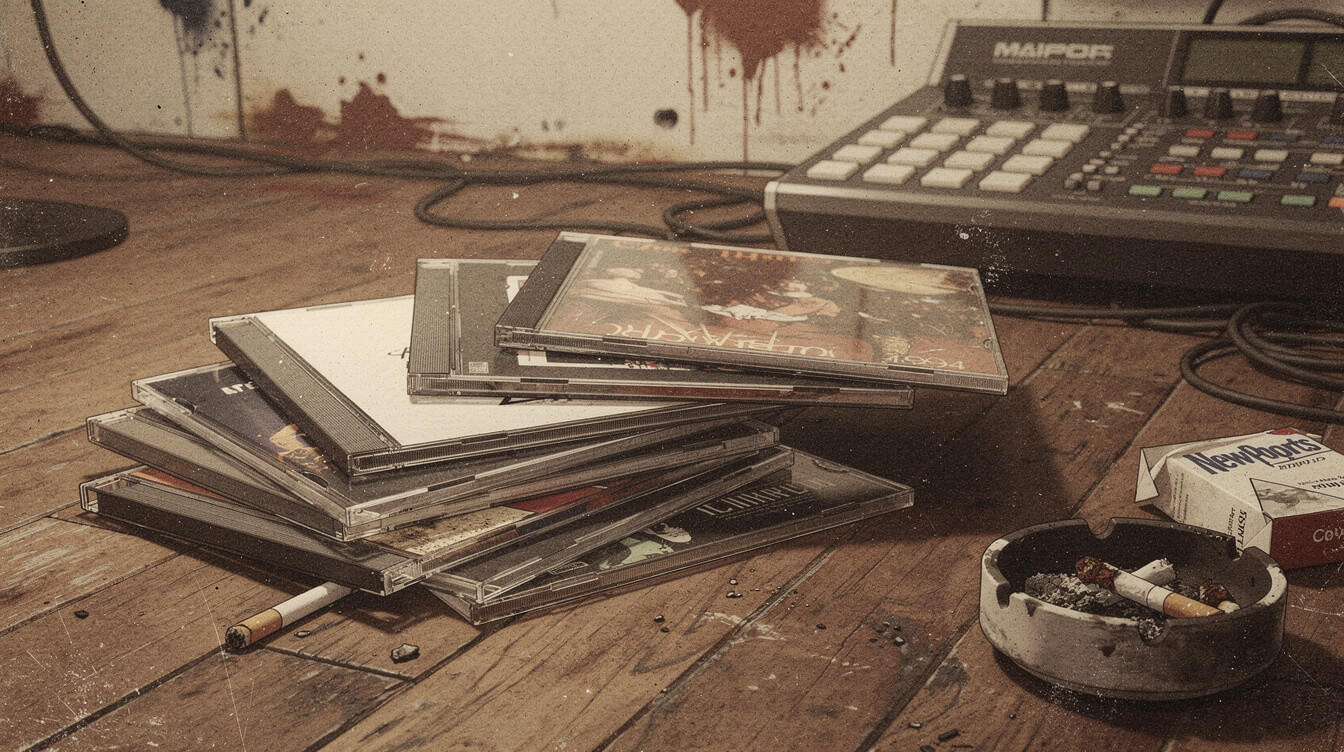
“Mass Appeal” sits at track 11 on Hard to Earn, Gang Starr’s fourth studio album. To understand the record you have to understand where it fell in the duo’s catalog arc. This was not an early-career grab for attention. Gang Starr had already released three albums — No More Mr. Nice Guy (1989), Step in the Arena (1991), and Daily Operation (1992) — each denser, more sample-forward, more critically respected than the last. Hard to Earn was the record where they had earned enough credibility to say anything they wanted, to anyone.
The album is 17 tracks and clocks 61 minutes. It’s darker than Daily Operation — the sample palette leans harder into minor-key jazz and horror-soundtrack samples, and the drums hit louder. Rolling Stone gave it three stars at release and later revised the assessment. The Source gave it four mics, one short of the coveted five, which was the standard sub-classic-tier grade in 1994. Culturally, though, the album’s staying power is elsewhere: it’s the record that includes both “Mass Appeal” (the highest-charting Gang Starr single) and “Code of the Streets” (their most critically praised track). Two hits, both in the top half of the tracklist, both produced by Premier at the peak of his single-loop craft.
The album’s positioning matters because it decides what “Mass Appeal” means in context. If Gang Starr had released this song as their debut single, it would read as ambition. Coming as track 11 on their fourth album — with their credibility bank already fully stocked — the record reads as commentary. They could afford to make a “radio joke” because they had already proven, three albums deep, that they were incapable of actually making a sellout record. The critique lands because the source is unimpeachable.
Beyond Hard to Earn, the catalog continued in the direction the album pointed: Moment of Truth (1998), the four-year-later follow-up, is arguably Gang Starr’s most cohesive full-length. The Ownerz (2003) closed out the original run before Guru’s death in 2010. Each record continued the aesthetic that “Mass Appeal” both mocked and mastered — one filtered loop, one hard drum pattern, no crossover concessions.
The Sample’s Second Life: How Premier’s Chop Influenced J Dilla, Madlib, and Alchemist
The influence of the “Mass Appeal” production technique is unmissable in the work of the next generation of loop-based producers. J Dilla built his entire late-period catalog — Donuts, the unreleased MPC volumes, the Ruff Draft material — on the exact same aesthetic principle Premier codified here: pick one filtered sample loop, program a swung drum pattern, and let it ride. The three-year overlap between Hard to Earn and Dilla’s earliest Slum Village recordings is not coincidence. Dilla was a Detroit producer who apprenticed at the feet of the New York boom-bap tradition, and Premier was the door he walked through.
For readers tracking the sample sources on J Dilla’s Donuts, the through-line to Premier’s Vic Juris chop is immediate. Dilla used the same filter-and-loop discipline. He just applied it to soul records instead of jazz-fusion ones. The compositional logic is identical.
Madlib picked up the same DNA and pushed it further underground. Madvillainy (2004), his collaborative album with MF DOOM, is essentially the “Mass Appeal” template stretched across 22 tracks — filtered loops from obscure sources, minimal drum programming, no radio concessions. When Madlib talks about his influences in interviews, DJ Premier’s name comes up before nearly anyone else’s. The Vic Juris chop is a direct lineage ancestor to Madlib’s work with Freddie Gibbs on Piñata and Bandana.
Alchemist represents the third generation of the template. His 2020s catalog with Roc Marciano, Boldy James, and Curren$y is Premier’s aesthetic strategy applied to soul and psych-rock samples. The one-loop rule holds. The behind-the-beat drum swing holds. The refusal to add radio-friendly hooks holds. The “Mass Appeal” DNA is loud in the Alchemist and Roc Marciano collaboration The Elephant Man’s Bones.
The genealogy matters because it explains why “Mass Appeal” is not merely a hit song from 1994. It’s the technical blueprint that an entire wing of hip-hop — the underground, sample-based, loop-driven wing — has been building on for thirty-two straight years.
Guru’s Lyric Read: Line-by-Line on the Sellout Manifesto
Guru’s writing on “Mass Appeal” is deceptively simple. Every line is a plain-spoken statement — no metaphor stack, no punchline structure, no internal rhyme showcase. This is intentional. The record is a manifesto, and manifestos work in clear declarative sentences. Guru wanted the argument to land on the first listen, not the fifth.
The opening verse targets the specific demographic of rappers who softened their sound to court radio: “Even though they know the beats and rhymes are strong / Radio and video stations just play along.” The couplet is precise. It’s not the rappers who are the primary villains — it’s the gatekeepers, the program directors, the video-show producers who reward compromise. Guru is not just naming the sellout. He’s naming the incentive structure that produces them.
The second verse pivots to the audience. “Some brothers will do anything to have that mass appeal” indicts artists. But the follow-up line — that the audience is complicit for demanding surface-level entertainment over substance — is where the record does its harder work. Guru’s read is that the mainstream/underground split isn’t just about producers and MCs. It’s about listeners who choose. The record refuses to let anyone in the value chain off the hook.
The bridge lines about “juggling contracts and having no time to relax” are the most quietly bitter section on the whole record. Guru is not commenting from a mountain top. He and Premier were signed to Chrysalis Records at the time — a major-label subsidiary that owned their masters and dictated their release schedule. The critique is coming from inside the machine. There’s no clean position from which to reject mass appeal, because the industry structure has already claimed everyone. That interior tension is what makes the record more than a screed. It’s a self-portrait.
What Guru never does is offer a solution. There’s no “and here’s how to fix it” verse. The record is diagnostic, not prescriptive. That refusal to offer answers is part of what has kept the song culturally alive for three decades. Every generation of hip-hop finds a version of the mass-appeal problem alive in its own moment — Auto-Tune debates in the 2010s, streaming-algorithm gaming in the 2020s — and Guru’s diagnostic frame keeps applying. The record isn’t dated because the problem isn’t dated.
If you’re building a hip-hop catalog wardrobe around the era that produced this record, the Gang Starr Hard to Earn t-shirt is the natural anchor piece — the album that carried “Mass Appeal” and cemented the duo’s underground blueprint.
32 Years On: Why This Is Still the Blueprint for East-Coast Underground
Three decades after release, “Mass Appeal” reads not as a critique of a 1990s problem but as a durable framework for understanding hip-hop’s structural tensions. The record’s ideas keep applying because the underlying dynamic — an industry that rewards flattening, an audience that responds to what’s familiar, artists caught between craft and career — has not resolved. It never will. The mass-appeal problem is a permanent feature of any art form connected to commerce.
What Gang Starr did on this record is provide a permanent point of reference. Every subsequent conversation about “keeping it real,” “selling out,” “conscious rap versus commercial rap,” “authenticity” — none of those conversations begin without acknowledging that Guru and Premier laid the terminology down on track 11 of an album released in February 1994. That’s a structural contribution beyond the aesthetic one. The record didn’t just build a template producers copied. It built a vocabulary critics still use.
The record’s placement in the broader east-coast underground canon sits alongside DJ Premier’s later work with Nas, the Wu-Tang catalog’s early years, and the run of Boot Camp Clik releases that defined the mid-90s Brooklyn sound. But “Mass Appeal” occupies a specific slot in that canon: the record that named the problem the entire underground was trying to solve. Others made the boom-bap sound. Gang Starr made the boom-bap sound and then wrote its charter.
For contemporary producers — anyone building beats in a bedroom in 2026 with Ableton and a stack of dusty jazz samples — the lesson is unchanged. Filter the loop. Swing the drums. Let the four-bar cycle carry the entire song. Don’t add a hook because the algorithm wants one. That’s the Gang Starr method. That’s what Premier proved on this record. Three decades of underground rap have not found a better foundation to build on.
The Vic Juris record still sits in the Muse Records catalog. Vic Juris himself passed away in 2019, and the sample became one of his most-known contributions to popular culture — a jazz guitarist whose four-bar loop, filtered and looped by a Brooklyn producer, ended up soundtracking three decades of a genre he probably never listened to. The chain of custody from Juris’s guitar solo to Roc Marciano’s 2024 output runs directly through track 11 of Hard to Earn. That’s the actual legacy. Not the chart position. Not the video. The four bars.
Stay creative — The Custom Creative Team

Rep the Album That Named the Blueprint
Track 11 was “Mass Appeal.” The whole record was Gang Starr’s fourth-album statement piece. Our Hard to Earn hoodie carries the artwork of the album that changed how east-coast boom-bap was written.
Get the Deep-Read Weekly
Sample chops, catalog arcs, cultural receipts. One post a week on the records and artists that built hip-hop. Straight to your inbox, no filler.

🎧 Never Miss a Drop
Exclusive product releases, hip-hop deep dives, and member-only discounts. Straight to your inbox.
Free forever. No spam. Unsubscribe anytime.
Get the Culture, Delivered
Deep dives into hip-hop history, exclusive product drops, and discounts sent straight to your inbox. No spam, just culture.
Join 2,000+ hip-hop heads already in the loop. Unsubscribe anytime.