Mos Def Black Star: Inside the Album That Invented Conscious Rap’s Blueprint
Twenty-eight years on, nobody talks about Mos Def & Talib Kweli Are Black Star like a debut album. They talk about it like a founding document. Two Brooklyn MCs, barely in their twenties, walked away from their own solo deals to make one record together — and that record became the blueprint every “conscious rap” or “backpack” act since has either chased or reacted against. Most people just call it Mos Def Black Star, which tells you everything about how completely the duo’s name swallowed the album’s actual title.
This is the full story: how the record got made, why it’s called what it’s called, what’s actually happening in the production and the lyrics, how critics and charts received it in real time, and the strange 24-year wait for a proper sequel that followed.
Two Solo Careers That Almost Happened Instead
Talib Kweli and Yasiin Bey — then performing as Mos Def — had both built reputations on the Brooklyn open-mic circuit by 1996, each with a solo deal lined up. Instead of releasing competing debuts, they postponed both projects and put the chemistry on record first. That decision is the entire reason the album exists: neither man needed Black Star to break through, which is part of why it reads as a creative choice rather than an industry-engineered pairing.
The Rawkus Machine Behind Them
The album landed inside Rawkus Records’ brief but enormous run as the center of New York’s underground rap resurgence — the same label ecosystem that gave Hi-Tek his breakout production credits and connected the duo to the Native Tongues lineage that De La Soul had carried since the late ’80s. Recorded between September 1997 and May 1998 at Unique Recording Studios in New York and released September 29, 1998, Black Star didn’t even have the loudest release day it was part of — it shared that Tuesday with Jay-Z’s Vol. 2… Hard Knock Life, OutKast’s Aquemini, and A Tribe Called Quest’s The Love Movement, a stacked slate we’ve already broken down in full as hip-hop’s single greatest release Tuesday. Of those four albums, Black Star debuted the smallest and aged into arguably the most influential.
Why They Called Themselves Black Star (And Why Everyone Just Says Mos Def Black Star)

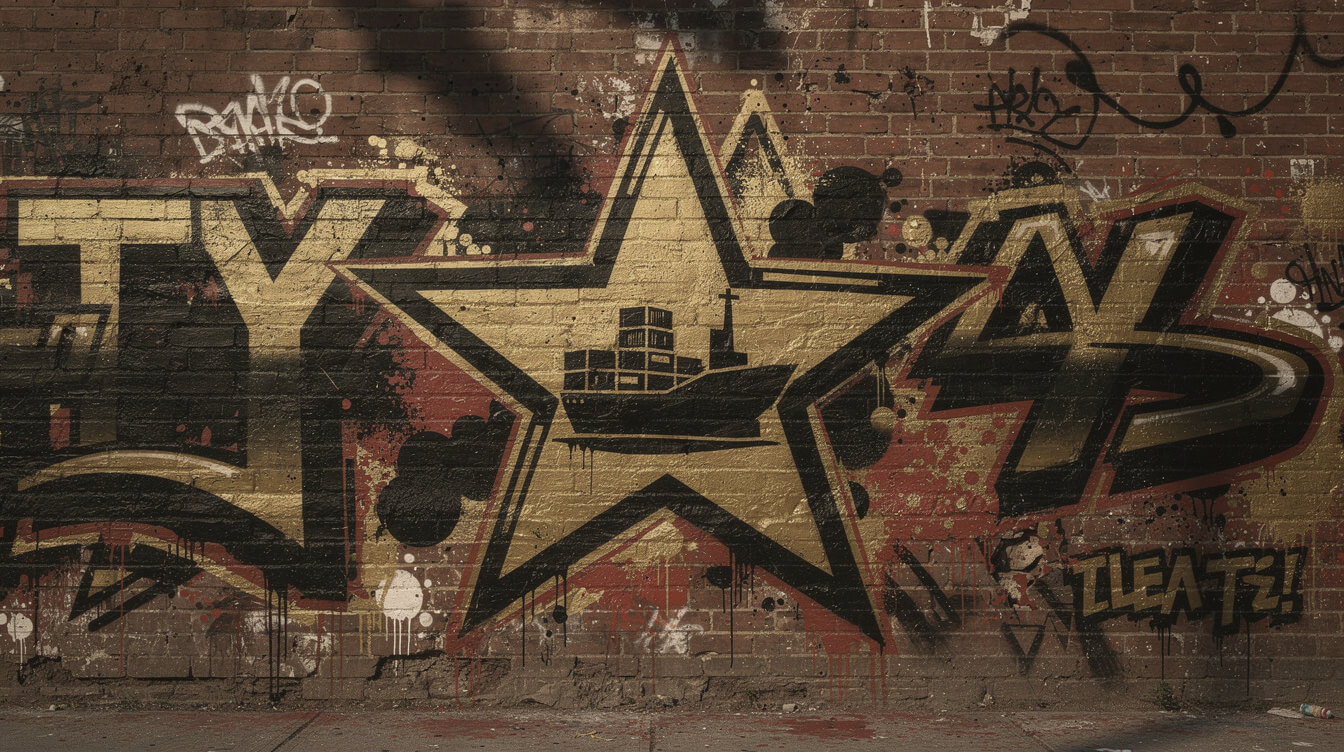
The name isn’t abstract branding — it’s a direct reference to the Black Star Line, the shipping company Pan-Africanist Marcus Garvey founded in 1919 to physically connect Black communities across the diaspora and build independent Black economic infrastructure. Garvey’s venture collapsed within a few years under fraud charges and financial mismanagement, but the symbolism — self-determination, independent movement, a flag you plant yourself rather than one handed to you — is exactly the frame Kweli and Bey wanted over their own debut.
The Cover That Matched the Concept
Designer Brent Rollins, who’d go on to shape album art for Freeway and Spank Rock, built the cover and packaging around that same severity — stark, high-contrast, text-forward, nothing decorative. It’s a look that reads less like a major-label rap release and more like a political pamphlet, which was the point. The album art choices here weren’t incidental; they’re part of why the record still reads as a statement piece instead of a product.
Inside the Sound: Rawkus, Hi-Tek, and a Jazz Legend on the Keys

The production team reads like a who’s-who of late-’90s underground boom bap: Hi-Tek, Shawn J. Period, Ge-ology, 88-Keys, J. Rawls, and Da Beatminerz all contributed beats, giving the album a patchwork of regional and label-crew styles — Hi-Tek’s Cincinnati sound sitting next to Brooklyn’s own Beatminerz — the same loose, crew-based production model that powered Gang Starr’s Rawkus-adjacent circle and the broader boom-bap ecosystem we’ve covered in depth looking at Guru’s career. Opener “Astronomy (8th Light)” features the late jazz keyboardist Weldon Irvine — a Nina Simone collaborator who’d go on to co-write “Mathematics” for Mos Def’s solo debut the following year — playing live keys over a track that reframes the word “black” as pure affirmation rather than threat, with Mos Def dropping similes like “Black, like my baby girl’s hair” before the beat has even fully formed.
“Definition” Was a Eulogy Disguised as a Single
The album’s first single and most enduring song, “Definition,” is built on a hook that plays triple duty: a direct response to hip-hop’s then-fresh wounds from the murders of Tupac Shakur and the Notorious B.I.G. (“they shot 2Pac and Biggie, too much violence in hip-hop, y’o”), a callback to Boogie Down Productions’ anti-gun anthem “Stop the Violence,” and a near-lift of the hook structure from BDP’s own “Remix for P Is Free.” It’s a dense piece of lineage-tracing disguised as a radio single — the kind of layered reference that rewards someone who already knows the catalog instead of alienating someone who doesn’t.
The Toni Morrison Line Nobody Else Was Quoting in ’98
“Thieves in the Night,” the album’s closing statement, interpolates a passage from Toni Morrison’s The Bluest Eye almost word for word. Kweli has said he first read the passage at fifteen and considered it one of the truest critiques of society he’d encountered — rewritten into the verse as “not strong, only aggressive / not free, we only licensed / not compassionate, only polite… chasin’ after death so we could call ourselves brave.” Pulling a literary novel into a rap verse wasn’t a common move in mainstream hip-hop in 1998; it’s one of the clearest markers of the “conscious rap” label the album is still filed under today.
The Soulquarians Thread Running Through It
Wikipedia’s own infobox lists Black Star as a “spinoff” of the Soulquarians — the loose, D’Angelo/Questlove/J Dilla/Common-adjacent collective that reshaped late-’90s and early-2000s R&B and hip-hop production around live instrumentation and jazz chord voicings. Weldon Irvine’s live Fender Rhodes work on “Astronomy (8th Light)” is the clearest audible link, and it’s not a one-off connection: Irvine went on to co-write “Mathematics” for Black on Both Sides the following year, and Mos Def himself is credited playing Fender Rhodes on Black Star‘s own personnel sheet. The album arrived right as that whole Soulquarians-adjacent, live-band-over-sampler aesthetic was starting to take over New York’s underground — the same shift that would eventually carry The Roots from sampler-era group to the live-instrument act behind 1999’s Things Fall Apart.
Track by Track: Who Actually Produced This Thing
The production credits are scattered enough across all thirteen tracks that it’s worth laying out in full, because no single beatmaker owns the album’s sound:
- “Intro” — Hi-Tek, with Talib Kweli co-producing
- “Astronomy (8th Light)” (feat. Weldon Irvine) — Da Beatminerz
- “Definition” — Hi-Tek
- “Re: Definition” — Hi-Tek
- “Children’s Story” — Shawn J. Period
- “Brown Skin Lady” — J. Rawls
- “B Boys Will B Boys” — Ge-ology
- “K.O.S. (Determination)” (feat. Vinia Mojica) — Hi-Tek
- “Hater Players” — Shawn J. Period
- “Yo Yeah” — J. Rawls, with Talib Kweli co-producing
- “Respiration” (feat. Common) — Hi-Tek
- “Thieves in the Night” — 88-Keys
- “Twice Inna Lifetime” (feat. Jane Doe, Wordsworth, and Punchline) — Hi-Tek
Hi-Tek alone touched six of the thirteen tracks, which is the real reason the album still sounds unified despite six different named producers passing through it — he’s effectively the record’s sonic anchor, with everyone else filling in texture around him. DJ Evil Dee of Da Beatminerz handled cuts on top of his production credit, and Mr. Walt — the other half of the Beatminerz — is credited as producer, engineer, and mixer, meaning the Beatminerz’ fingerprints run deeper into the album’s final sound than their single production credit on “Astronomy” suggests.
“Brown Skin Lady,” “Children’s Story,” and the Album’s Moral Center
“Brown-Skin Lady” is a direct rebuttal to Eurocentric beauty standards, built around Kweli’s line “we’re not dealing with the European standard of beauty tonight / turn off the TV and put the magazine away.” It’s a theme the duo returns to constantly across the record — self-worth as a political position, not a personal-growth platitude. “Children’s Story” takes the opposite route into the same territory, flipping Slick Rick’s narrative original into a warning against materialism rather than a cautionary crime tale, with Mos Def narrating consequences instead of chasing them.
If you want that moral seriousness on something you can actually wear, we made the Mos Def & Talib Kweli Are Black Star T-Shirt for exactly this — the same stark, text-forward energy as Brent Rollins’ original cover, on cotton.
Five Stars, 10 out of 10, and a No. 53 on the Billboard 200
Critics were nearly unanimous even while the record undersold commercially. Spin gave it a perfect 10/10. Entertainment Weekly and The Village Voice both landed on A-minus. NME scored it 8/10, AllMusic gave it four stars, and The Source landed at three-and-a-half. Robert Christgau — the Village Voice critic who created the Pazz & Jop poll — wrote that Kweli and Bey “devise a hip hop imaginary where hater players lose their girls-not-bitches to MCs so disinterested they give ’em right back,” and the album finished 24th in that year’s Pazz & Jop critics’ poll. Colin Larkin’s Encyclopedia of Popular Music went further, crediting the record with abandoning “the negativity of gangsta rap” in favor of an intelligent examination of Black culture that intentionally contrasted with the “overblown productions of Puff Daddy” then dominating the format — a direct shot at the Bad Boy maximalism that ruled commercial rap radio at the time.
The Chart Numbers Undersell It
Commercially, the album peaked modestly: No. 53 on the Billboard 200 and No. 13 on Top R&B/Hip-Hop Albums. “Definition” cracked the Hot 100 at No. 60 but hit No. 3 on Hot Rap Songs; the Common-featuring “Respiration” peaked lower, at No. 77 Hot 100. Those numbers put it well behind the commercial blockbusters it shared a release date with — but a quarter-century of critical consensus has inverted that hierarchy almost completely. It’s the rare case where the sales chart and the legacy ranking tell two different stories, and the legacy ranking won.
Rep the Record That Started Conscious Rap
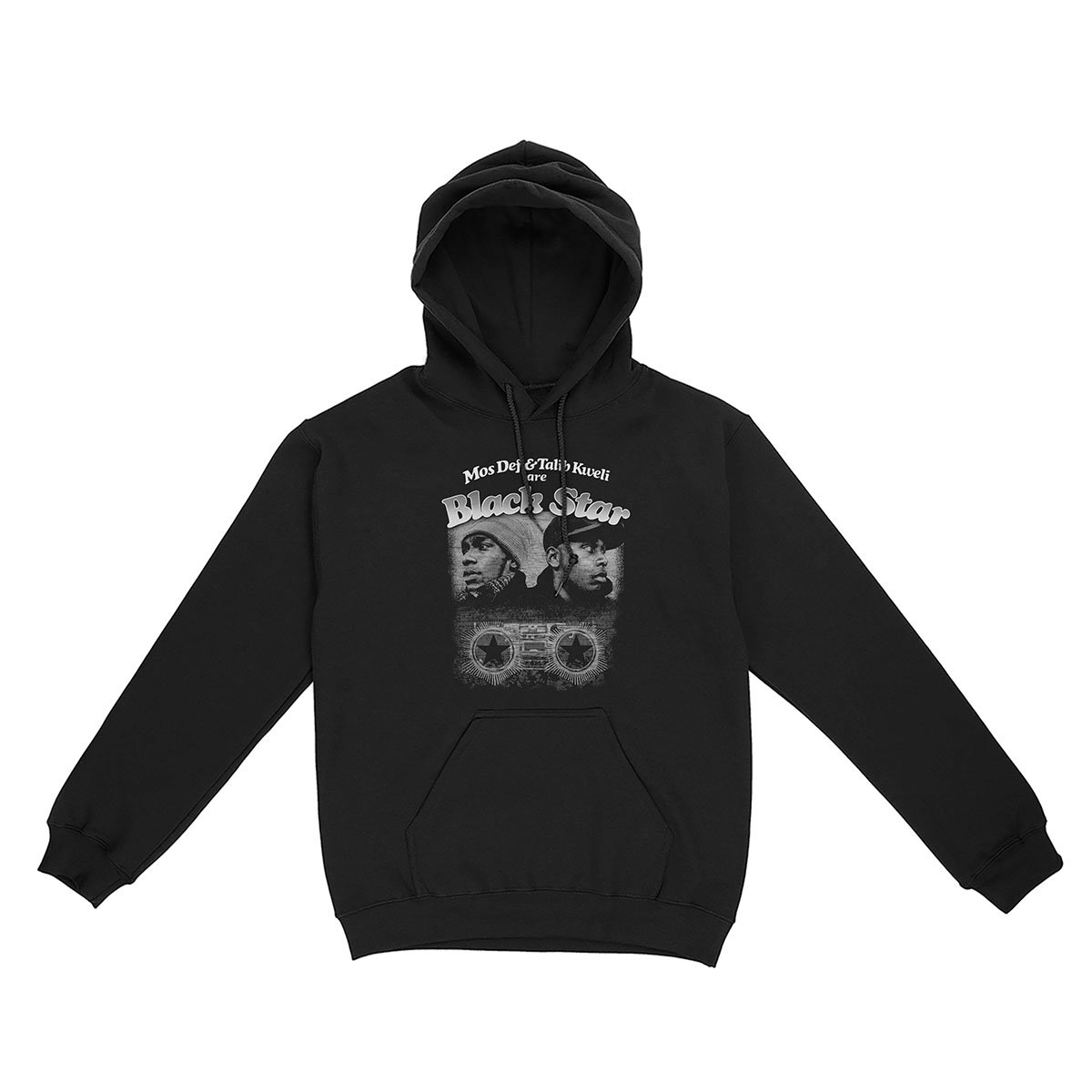
The Black Star Hoodie takes the same stark, Pan-African energy Brent Rollins put on the original cover and puts it on heavyweight cotton. Built for the heads who know the Pazz & Jop placement mattered more than the chart position.
From One Flag to a 24-Year Wait: What Happened After Black Star
Both MCs went on to bigger solo careers almost immediately — Mos Def’s Black on Both Sides landed in 1999, Kweli’s Reflection Eternal project Train of Thought in 2000 — but Black Star as a unit didn’t disappear entirely.
A Posse Cut Born From Outrage
In February 1999, NYPD officers fired 41 shots at unarmed West African immigrant Amadou Diallo, killing him. Mos Def and Talib Kweli responded by executive-producing Hip Hop for Respect, a benefit EP released through Rawkus on April 25, 2000, built around the title posse cut and recorded with production from Organized Noize, Mr. Khaliyl, and 88-Keys. The guest list is almost absurd in scale for a protest record: Common, Kool G Rap, Pharoahe Monch, Posdnuos, Jean Grae, Cappadonna, dead prez, Rah Digga, and roughly two dozen more MCs all showed up for a cause, not a check. It’s one of the clearest real-world extensions of the album’s “Thieves in the Night” politics — Black Star didn’t just rap about injustice, they organized a release around one.
In 2001 the duo also recorded “Money Jungle” with jazz bassist Ron Carter and organist John Patton for Red Hot + Indigo, a Duke Ellington tribute benefiting AIDS charities. A year later, “Hater Players” soundtracked an episode of The Wire — a show that, like Black Star itself, got far more critical love than commercial reach during its original run.
The Madlib Album Nobody Expected to Actually Arrive
Talk of a second Black Star album circulated as early as 2005, but it took until November 2019 for Kweli to confirm a Madlib-produced follow-up was actually finished. No Fear of Time didn’t surface until May 3, 2022, and even then only as an exclusive on the Luminary podcast platform — an unusual, almost defiantly anti-commercial release strategy for a 24-years-later reunion album — before a wider Bandcamp release followed in June 2023. The duo marked the moment properly, performing twice on Saturday Night Live‘s Dave Chappelle-hosted episode in November 2022. The same year, Black Star appeared on “Peppas,” from Westside Gunn’s mixtape 10 — a genuinely odd-couple pairing of Rawkus-era conscious rap and Griselda’s grimy maximalism that somehow worked.
Frequently Asked Questions About Mos Def Black Star

When did Mos Def & Talib Kweli Are Black Star come out?
September 29, 1998, on Rawkus and Priority Records — the same day as Jay-Z’s Vol. 2… Hard Knock Life, OutKast’s Aquemini, and A Tribe Called Quest’s The Love Movement.
Why is it called “Black Star”?
It’s named for the Black Star Line, the shipping company Marcus Garvey founded to build independent Black economic infrastructure in the early 20th century. The duo also performs under the name Black Star.
Is Mos Def still called Mos Def on this album?
Yes — Yasiin Bey performed and is credited as Mos Def on the 1998 release. He legally changed his stage name to Yasiin Bey in 2012, well after the album’s release.
Did Black Star ever make a second album?
No Fear of Time, produced entirely by Madlib, arrived May 3, 2022 — nearly 24 years after the debut — first as a Luminary podcast exclusive, then on Bandcamp in June 2023.
What’s the most sampled or referenced song on the album?
“Definition” and “Respiration” (featuring Common) remain the most widely cited tracks, with “Thieves in the Night” the most frequently discussed for its direct Toni Morrison interpolation.
Did Black Star ever perform together again before the reunion album?
Yes. The duo never fully stopped performing as a unit — they played international festival dates in the years between albums, including a widely photographed set at Finland’s Ilosaarirock festival in 2012 — a full decade before No Fear of Time and the Saturday Night Live reunion performance made it official again.
Where can you actually hear the album today?
The original 1998 pressing is on Spotify, Apple Music, and Discogs under the Rawkus/Priority/EMI release, and the full catalog — including the later Madlib-produced follow-up — is also available through Bandcamp, which is where the group has pushed its more recent, less commercially-filtered releases.
Final Thoughts
What makes Mos Def & Talib Kweli Are Black Star hold up isn’t nostalgia — it’s that the record never tried to out-shout its moment. Dropped the same Tuesday as three bigger, louder albums, it won on specificity: a Toni Morrison passage nobody else was quoting, a jazz legend playing live keys on a rap record, a cover built like a pamphlet instead of a poster. Twenty-eight years and one 24-years-later sequel later, it’s still the record people point to when they want to explain what “conscious rap” actually means instead of just naming the subgenre.
Deep Cuts, Delivered Weekly
Get the stories behind the albums, the artists, and the merch — straight to your inbox, no fluff.

🎧 Never Miss a Drop
Exclusive product releases, hip-hop deep dives, and member-only discounts. Straight to your inbox.
Free forever. No spam. Unsubscribe anytime.
Get the Culture, Delivered
Deep dives into hip-hop history, exclusive product drops, and discounts sent straight to your inbox. No spam, just culture.
Join 2,000+ hip-hop heads already in the loop. Unsubscribe anytime.