Kurtis Blow Christmas Rappin’: Two Billboard Writers, a Chic Bassline, 20-Plus Rejections and the Holiday Record That Got Rap Signed
Every December, somebody’s uncle puts on Kurtis Blow’s “Christmas Rappin'” and the whole room knows the hook before Santa even gets to Harlem. Most people treat it as a novelty. It’s actually one of the most important business deals in rap history. Two Billboard writers made a holiday record as a royalty play. More than 20 labels turned it down. A British A&R man in Los Angeles said yes, and that made Kurtis Blow the first rapper signed to a major label. The B-side handed MCs a do-it-yourself instrumental. Nineteen years later its bassline sat at No. 1 on the Hot 100.
We already ran the rest of the Christmas rap canon, from Blondie to Tyler. This piece stays on one record and reads it off the label: who wrote it and why, who played on it, how it got signed, where it really sits in the 1979 timeline, and how it kept paying long after the tinsel came down. Where the sources disagree (and on this record they disagree a lot), we tell you.
Kurtis Blow Christmas Rappin’ Started as Two Billboard Writers’ Royalty Play

The record starts in an office, not a park jam. Robert “Rocky” Ford Jr. was born in Harlem on June 30, 1949, and in the late ’70s he was a Billboard staffer who mostly covered disco. In 1978 he went up to the Bronx to figure out why obscure R&B records kept selling out in certain shops. The answer was DJs like Kool Herc, cutting up the breaks on those records for crowds that wanted nothing else. Ford was one of the first music journalists to take that scene seriously.
His partner was J.B. Moore, a former Billboard co-worker. The two came from different worlds and still bought the same records. Moore described it years later in a 2001 oral history for Seattle’s Museum of Pop Culture: Ford was “a black guy from the middle of Hollis, Queens and I was a white guy from the North Shore of Long Island, and our record collections were virtually identical.” (Several write-ups call Moore the Hollis native. By his own account that was Ford.)
The Mickey Addy Math
Here’s the jewel most retellings skip. The Christmas angle wasn’t sentiment. It was arithmetic. Ford had a Billboard mentor named Mickey Addy, an old Tin Pan Alley songwriter who co-wrote “There Is No Christmas Like a Home Christmas” with Carl Sigman. Perry Como released it in 1950, and it paid Addy every holiday season after that. A Christmas record doesn’t die in January. It comes back every December like a check in the mail. Wax Poetics, Rock the Bells and the Smithsonian’s account all tell that same story of where the idea came from.
Ford also had personal reasons. By the Smithsonian’s and Billboard’s accounts, his girlfriend was pregnant in the spring of 1979 and he was making about $300 a week at the magazine. His son, Robert Ford III, was born that year. A holiday record that paid out every December was a real plan for a young family, not a gimmick.
Why Kurtis Blow
In May 1979 Ford published a Billboard piece on New York’s “jive talking” DJs rapping in Black discos, and the reporting put him in the orbit of Kurtis Walker, a Harlem kid studying at City College who rocked crowds as Kurtis Blow. He wasn’t Ford’s first choice. By the Smithsonian’s and Cuepoint’s accounts, Ford looked first at DJ Hollywood and then Eddie Cheeba, the two biggest names on the disco-rap circuit. The connection to Blow ran through Hollis: Ford met young Joseph Simmons, who was handing out party flyers, and Joey introduced him to his older brother Russell, who was managing Blow. A showcase at the Hotel Diplomat on August 31, 1979 settled it. Ford later put it plainly to Cuepoint: he picked Blow partly because Russell was his “ambassador to rap.”
Ford left Billboard in 1979 to make the record. Moore put up the money, by his own account savings he’d set aside to write a novel about his time in Vietnam. That’s how hip-hop’s first Christmas record got funded: with a war veteran’s book money and a Billboard writer’s baby on the way.
Inside the Christmas Rappin’ Groove: A Good Times Twist and an 8-Minute 12-Inch

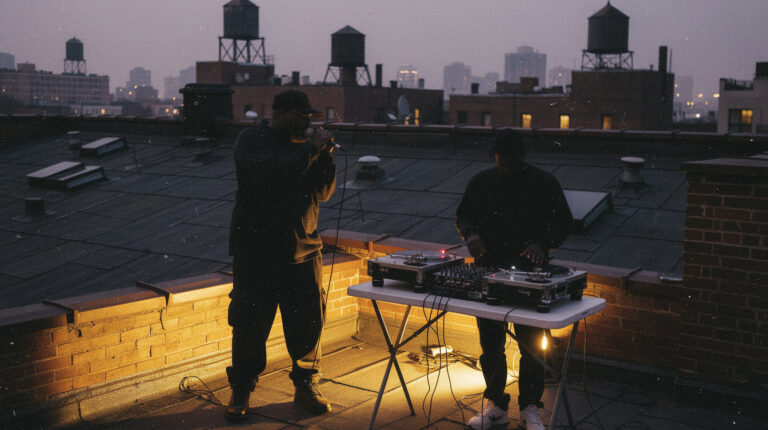
Smithsonian Magazine and Cuepoint both place the session at Greene Street Recording in SoHo. (Wax Poetics names a different studio. With two sources against one, we go with Greene Street.) By the Smithsonian’s account the record was cut in a single night, essentially live, with Jimmy Bralower on drums.
Larry Smith’s Good Times Flip
The groove came from Larry Smith on bass and Denzil Miller on keys. Smith was Ford’s old high-school friend, and he brought Miller in. Everybody in 1979 was riding Chic’s “Good Times.” It was the same bassline under “Rapper’s Delight,” and every DJ in New York had a copy. Smith didn’t copy it. He bent it. In Robbie Ettelson’s 2014 Cuepoint profile, Smith put it in his own words: “We changed the cadence up and just lay in the cut.” Same feel, different phrasing, a new part with its own writing credit. That decision matters later in this story, because a re-played part is what Next would interpolate in 1998.
Larry Smith went on to co-produce Run-DMC’s first two albums and Whodini’s early hits, which makes this session the first page of his résumé as a hip-hop architect. He died on December 18, 2014, a week before Christmas.
Two Halves, Two Writers
The A-side is really two records. The first half belongs to J.B. Moore: a send-up of “‘Twas the Night Before Christmas” in which Santa drops in on a Harlem party. The prim, very British voice reading the opening line of the poem before Blow cuts in is Adam White, a young English colleague at Billboard. The Smithsonian names him, and White later confirmed it himself in a 2020 comment on Cuepoint’s oral history, writing that he was “Santa Claus.” (And no, Moore is no relation to Clement Clarke Moore, who wrote the original poem.)
Blow liked the conceit even though the meter was nothing like how uptown MCs rhymed. “That’s a totally different meter from the way we rapped then,” he told the Smithsonian. “But it was so witty, and I welcomed the opportunity to do it.” The second half is Blow’s own: crowd-moving party routines in the style of Hollywood and Cheeba, the kind of call-and-response he ran every weekend.
There’s one more claimed writer. In a December 2025 Rock the Bells interview, Blow said his “Disco Son” D.J. Run, the teenage Joseph Simmons who was billed on flyers as the “Son of Kurtis Blow,” “also wrote some parts, though he wasn’t credited,” pointing to the “not a preacher or a teacher” run of bars. Treat that as Blow’s account. The Discogs writing credits list five names, and Run isn’t one of them.
The “Do It Yourself” B-Side
The US 12-inch, Mercury MDS-4009, runs “Christmas Rappin'” at 8:11 on side A. Side B is “Christmas Rappin’ (Do It Yourself Version – Instrumental)” at 7:58. That B-side was practical: Blow could perform live over the track without rapping on top of his own vocal. But it was a gift to every MC with a notebook, too. A full-length instrumental on the flip became standard practice on rap 12-inches. Both the Smithsonian and Rock the Bells trace the habit back to this record.
The Credits, Straight Off the Label
- Produced by: J.B. Moore and Robert Ford Jr.
- Written by: Kurtis Walker, J.B. Moore, Robert Ford Jr., Denzil Miller and Larry Smith
- Production company: “Produced For Prep/Street Productions”
- Label: Mercury, marketed by Phonogram, Inc., distributed by PolyGram Distribution, ℗ 1979
- Format: “Disco Single / Special 33-1/3 Disco Version,” catalog MDS-4009
- Runout etching: “PSP-12-1A-AA mDS 4009 A”
Source for all of the above: the Discogs entry for the original US 12-inch (release 360403), cross-checked against MusicBrainz, which clocks the A-side at about 8:16.

From Christmas Rappin’ to Christmas in Hollis
Blow says Run wrote bars on rap’s first Christmas record. Eight years later, Run-DMC made their own. Our Christmas in Hollis tribute hoodie is heavyweight, holiday-ready, and pure Queens.
More Than 20 No’s, One Yes: How Mercury Made Kurtis Blow Rap’s First Major-Label Signing

Nobody wanted it. The exact count changes with each telling: “over twenty” (Wax Poetics), “nearly two dozen” (Smithsonian), 21 (Blow to Rock the Bells), 22 (Blow in Netflix’s Hip-Hop Evolution). The safe version is more than 20 labels. Moore had a theory about how to get past them: “We didn’t think a major label would understand a rap record,” he said in the MoPOP oral history. “But they would understand a parody.”
The No That Came Back Around
One of those rejections is pure hip-hop irony. According to Blow, the 21st label to pass was Panorama, where the man saying no was Cory Robbins. Robbins’ own Wikipedia entry notes he tried and failed to sign Blow. In 1981 Robbins co-founded Profile Records with Steve Plotnicki, building it on the little-used Panorama imprint they’d bought from MCA. Profile then signed Run-DMC, the group led by the same kid who’d been billed as the “Son of Kurtis Blow.” If you rock our Run DMC “Rock Box” tee or the Raising Hell tee, you’re repping the label that grew out of the imprint that passed on Christmas Rappin’.
John Stainze Says Yes
The yes came from an Englishman. John Stainze was an A&R man at Phonogram who had signed Dire Straits in London before moving to the company’s Los Angeles office. Moore mailed him a cassette. In Moore’s telling to Billboard, Stainze sold Mercury on the idea that the UK alone could cover the cost of the record. Mercury signed Blow, and he became the first rapper signed to a major label. Wikipedia, Wax Poetics, the New York Times and the New Yorker all credit him with that first.
The deal was tight. Blow has told it the same way more than once, to Rock the Bells and to the New Yorker in 2025: the single had to sell 30,000 copies before Mercury would release a second one. Per Blow’s Rock the Bells telling, 50,000 would earn an album.
From Leviticus to WBLS
Getting it played was its own hustle. In Hip-Hop Evolution, Blow and his manager tell how they paid the DJ at the club Leviticus to drop the record while WBLS’s Frankie Crocker was in the room. Crocker, who was back at WBLS as DJ and program director that year, watched the floor go up. Then he put it on the air at WBLS. Most tellings, including the New York Times and Cuepoint, put the first spin on Christmas Eve 1979. The documentary says Christmas morning.
Either way, it cleared the 30,000 bar easily. Sales figures vary by source: more than 350,000 (Smithsonian), 370,000 in the first year (Blow to Rock the Bells), and over 400,000 (Nelson George, cited on Wikipedia). Whichever number you take, that’s hundreds of thousands of 12-inches for a holiday novelty that 20-plus labels thought had no market. (One note for the record nerds: some articles say it went gold. The RIAA database shows no certification for it, so we don’t say that.)
The two-single ladder worked exactly as designed. That’s where The Breaks came from, and the Kurtis Blow LP after it. For the full career arc, see our Kurtis Blow’s birthday profile. The Simmons side of the story kept growing into Def Jam and Rush Management, which is another story.
Not Quite First: Where Christmas Rappin’ Really Sits in the 1979 Timeline

This is the section a real head will check, so let’s be exact. Christmas Rappin’ was not the first rap record. In 1979, rap hit wax in this order:
- Fatback, “King Tim III (Personality Jock)”: released around July 25, 1979 on Spring Records, per a US Copyright Office record cited on Wikipedia. It peaked at No. 26 on the R&B chart.
- The Sugarhill Gang, “Rapper’s Delight”: released September 16, 1979 on Sugar Hill. It reached No. 36 on the Hot 100 in January 1980. Our Rapper’s Delight anniversary piece has the full story.
- Kurtis Blow, “Christmas Rappin'”: late 1979, on Mercury. Sources disagree on the exact day (December 7 on one chart-history blog, November 30 on a Dutch chart database), so we’re not printing one. Wax Poetics’ header says “Released 1978.” That’s a typo, and Discogs, MusicBrainz and every other source say 1979.
So What Was First?
Three claims hold up. It’s arguably the first Christmas rap record. Kurtis Blow was the first rapper signed to a major label. And it was one of the first rap singles to sell big. What we won’t say flatly is “the first major-label rap single.” Spring Records, home of King Tim III, had a distribution relationship with Polydor, which muddies that line. (Yes, our own Christmas rap songs table uses the shorthand. This is the longer version.)
Why the US Charts Don’t Show It
Look for Christmas Rappin’ on the 1979 Hot 100 or R&B chart and you won’t find it. The Smithsonian, chart historian DJRob and Wikipedia’s discography all show no US entry for the original run, and there was no rap chart yet. It sold anyway, on 12-inch, through clubs and specialty shops, exactly the market the Billboard charts of the day were worst at measuring. The chart footprint came later, and it came from overseas.
After the Holidays: Rappin’ Blow, the UK Single and the Reissues

A Christmas record has a shelf life of about five weeks. Mercury found a way around that, and you can see it in the Discogs listings.
The Same Record, Retitled “Rappin’ Blow”
After the holidays, Mercury reissued the same 12-inch, still catalog MDS-4009, as “Rappin’ Blow.” It kept the 8:11 and 7:58 timings, and the label carried a note: “Previously released as ‘Christmas Rappin” December 1979.” Same groove, holiday lyrics gone, sellable in March. When the Kurtis Blow LP came out in 1980, it opened with “Rappin’ Blow (Part 2).” Christmas Rappin’ itself showed up only as a later CD bonus. In Europe, Mercury put out 7-inch singles simply titled “Rappin'” in the Netherlands, Germany and France, backed with a “Do It Yourself Rappin'” instrumental. Brazil got a 1980 pressing retitled “Christmas Rappin’ = Melô Do Mão Branca.” That’s a deep-cut find for any collector.
The UK Proved Stainze Right
Remember Stainze’s pitch that the UK alone would cover the cost? Mercury released it in Britain as BLOW 7 (7-inch) and BLOW 12 (12-inch). Per the Official Charts Company, it entered the UK singles chart on December 15, 1979, spent six weeks on the chart and peaked at No. 30 on January 5, 1980. A rap record charted in Britain before it ever charted in America.
Every Few Years, It Comes Back
- 1982: a Mercury 7-inch pairing Christmas Rappin’ with “Daydreamin'” (Mercury 76194).
- Mid-’90s: it finally showed up on a US chart, peaking at No. 52 on Billboard’s R&B/Hip-Hop Airplay chart in January 1995. A French “Christmas Rappin’ 95” remix came out on Mascotte around the same time.
- 1999: Mercury’s 20th-anniversary reissue, as a CD single (314 562 559-2) and a 12-inch (314 562 560-1) labeled “Celebrating the 20th Anniversary of Hip-Hop’s First Christmas Song.” It made Billboard’s Hot Rap Singles chart going into 2000.
That’s Mickey Addy’s math, working decades later.
Kurtis Blow’s Biggest Hit Came Next
The second single Mercury had promised was “The Breaks,” released in mid-1980. It peaked at No. 87 on the Hot 100 and No. 4 on the R&B chart. On August 19, 1980, the RIAA certified the 12-inch gold, making it the first certified-gold rap single. Christmas Rappin’ opened the door. The Breaks walked through it.
The Bassline That Went to No. 1: Next, Too Close and the Liner Credit

Fast forward to 1998. Next’s “Too Close” debuted on the Hot 100 in February, hit No. 1 on the chart dated April 25, 1998, spent five weeks on top, and finished as Billboard’s No. 1 song of the year. The RIAA certified it platinum on April 14, 1998.
Replayed, Not Sampled
Here’s the detail that most “sampled by” lists get wrong. The US CD single’s credits, transcribed on Discogs, say “Too Close” “contains replayed elements from ‘X-Mas Rappin”” and list the writers R.A. Ford, D. Miller, J.B. Moore, K. Walker and L. Smith. Replayed means interpolated: the producers re-recorded the bassline rather than lifting it off the vinyl. Remember Larry Smith changing the “Good Times” cadence back in 1979? That’s exactly why it was a new, copyrightable part, and why all five Christmas Rappin’ writers ended up on a No. 1 song nineteen years later. In February 1998, reviewer Ralph Tee named the Christmas Rappin’ bassline in his five-star review in Music Week’s Record Mirror dance section.
It paid off for the families, too. Nelson George, quoted in the New York Times’ obituary of Ford, said Ford told him that record put his son through college. Billboard also reported that “Too Close” won Top R&B Song at the 1999 ASCAP Rhythm & Soul Awards.
Its Fingerprints in Golden-Age Rap
The record’s DNA got into the golden age, too. The Beastie Boys took the phrase “hold it now, hit it” from Blow’s intro for the title of their 1986 Def Jam single, a lift cited by Cuepoint and Songfacts. Public Enemy sampled it on “Night of the Living Baseheads” from It Takes a Nation of Millions to Hold Us Back. You’ll see bigger “sampled 200 times” claims online. Rock the Bells repeats that number, but we can’t double-source a figure like that, so we’re sticking to the receipts.
Don’t Confuse It With “Christmas Wrapping”
One search-engine trap: The Waitresses’ “Christmas Wrapping” (1981, ZE Records) is a different song by a different band. It’s a new-wave tune with a talky vocal, which is why people mix them up. Even Wikipedia puts a disambiguation note on Kurtis Blow’s page.
Kurtis Blow Christmas Rappin’ FAQ
When did Kurtis Blow release Christmas Rappin’?
Late 1979, on Mercury (12-inch catalog MDS-4009). It reached the UK chart on December 15, 1979 and WBLS radio around Christmas Eve that year. It wasn’t 1978, whatever one magazine header says.
Who wrote and produced Christmas Rappin’?
J.B. Moore and Robert “Rocky” Ford Jr. produced it. The credited writers are Kurtis Walker (Kurtis Blow), Moore, Ford, Denzil Miller and Larry Smith. Blow has said Run wrote some uncredited lines.
Was Christmas Rappin’ the first rap song?
No. Fatback’s “King Tim III” (July 1979) and “Rapper’s Delight” (September 1979) came out first. Christmas Rappin’ is arguably the first Christmas rap record, and it made Kurtis Blow the first rapper signed to a major label.
What was Kurtis Blow’s biggest hit?
“The Breaks” (1980). It reached No. 4 R&B and No. 87 on the Hot 100, and it was the first rap single certified gold by the RIAA.
What song samples Christmas Rappin’?
The biggest is Next’s 1998 No. 1 “Too Close,” which interpolates the bassline (credited as “replayed elements”). Public Enemy sampled it, and the Beastie Boys took “Hold It Now, Hit It” from its intro.
Are there other Christmas rap songs?
Plenty. Start with Christmas in Hollis, then work through our full Christmas rap songs guide.
Rocky, J.B. and the Record That Pays Every December
Both architects are gone now. Rocky Ford died in Brooklyn on May 19, 2020. Blow’s tribute was short: “He taught me how to be a man.” J.B. Moore died in Manhattan on March 13, 2025, at 81. Two Billboard writers who were early to cover the culture, and then helped put it on a major label, are now part of its history themselves.
Kurtis Blow is still hip-hop’s holiday MC. He was the guest MC at the 2014 world premiere of The Hip Hop Nutcracker at NJPAC and he’s on the 2026 tour, opening shows with a short set. You can guess which record people wait for.
Mickey Addy’s royalty math held up. The record still comes back every December, and it carried rap through the door at a major label, a gold follow-up and a No. 1 hit nineteen years later. The next chapter of hip-hop Christmas came eight years later out of Hollis, from the same kid Blow said helped write these bars: read the story of Christmas in Hollis, then grab the Christmas in Hollis RUN-DMC Tribute Hoodie for the season. Got a crate-digger to shop for? A Personalized AeroCase Wallet printed with your own design is a gift that keeps paying out, like a holiday royalty. And if you want the backstory on the shirts themselves, here’s the history of rap tees.
Stay creative — The Custom Creative Team

Get the Liner-Note Receipts First
One email a week: record histories, producer credits and new drops from the Custom Creative team. No spam, just culture.

🎧 Never Miss a Drop
Exclusive product releases, hip-hop deep dives, and member-only discounts. Straight to your inbox.
Free forever. No spam. Unsubscribe anytime.

Get the Culture, Delivered
Deep dives into hip-hop history, exclusive product drops, and discounts sent straight to your inbox. No spam, just culture.
Join 2,000+ hip-hop heads already in the loop. Unsubscribe anytime.