Ready to Die Biggie: The Complete Guide to Notorious B.I.G.’s Debut Album, Every Track and Producer Decoded
Ready to Die by The Notorious B.I.G. dropped on September 13, 1994, and did the impossible: it dragged East Coast hip-hop out of a two-year commercial coma, reintroduced New York to the top of the charts, and rewrote the blueprint for what a hip-hop debut album could be. Recorded across seven months at The Hit Factory and D&D Studios in Manhattan, sequenced like a Scorsese street epic, and executive-produced by a 24-year-old Sean Combs fresh off getting fired from Uptown Records, Ready to Die Biggie was less an album than a mission statement. Twenty years before streaming turned rap into a singles game, Christopher Wallace built a 69-minute film about a Brooklyn kid living, hustling, and dying in real time.
This guide covers everything: how the record almost never happened, who actually made the beats, the samples that stitched it together, the tracklist decoded top to bottom, the chart runs and platinum certifications, and why — three decades later — Ready to Die still shows up on nearly every “greatest hip-hop albums of all time” list ever published.
The Album That Saved East Coast Hip-Hop
In 1994, the West Coast owned rap. Dr. Dre’s The Chronic (1992) had gone triple platinum. Snoop Doggy Dogg’s Doggystyle (1993) debuted at number one on the Billboard 200 with 806,000 copies sold in a week. G-funk was the sound. Long Beach and Compton were the geography. New York — the birthplace of the whole genre — had gone quiet on the mainstream charts, and hip-hop’s center of gravity had slid three thousand miles west.
Then Ready to Die Biggie hit. The album peaked at number 15 on the Billboard 200 in its first week, but the story is in the tail: it kept selling. And selling. By April 2018, the RIAA had certified it six times platinum — six million copies sold in the United States alone, a number almost no debut hip-hop album in history has ever matched. In 2020, the Library of Congress selected Ready to Die for inclusion in the National Recording Registry, marking it as “culturally, historically, and aesthetically significant.” That’s the same registry that houses Louis Armstrong’s West End Blues and Aretha Franklin’s Respect.
What makes the East Coast rescue mission specific to this record isn’t just the sales. It’s that Biggie’s arrival forced the industry to remember that New York rap could sound urgent, radio-ready, and street-authentic at the same time. Before Ready to Die, the East Coast’s flagship acts were purists — Wu-Tang, Nas, Gang Starr, Mobb Deep — who made incredible records with limited commercial reach. Puff wanted the streets and the Billboard Hot 100, and Ready to Die proved you could have both. The ripple hit everywhere. Jay-Z’s Reasonable Doubt (1996), Nas’s It Was Written (1996), and the entire Bad Boy roster that followed all descended from the template Ready to Die set.
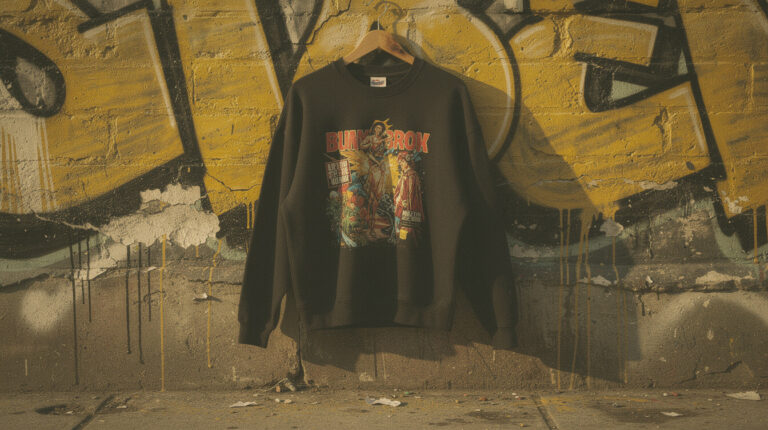
For the deeper Brooklyn context around the era, see our hip-hop fashion lineage guide, which traces how Biggie’s Coogi sweaters and Versace shades quietly rewrote menswear alongside the music.
How the Record Almost Never Happened: Uptown to Bad Boy
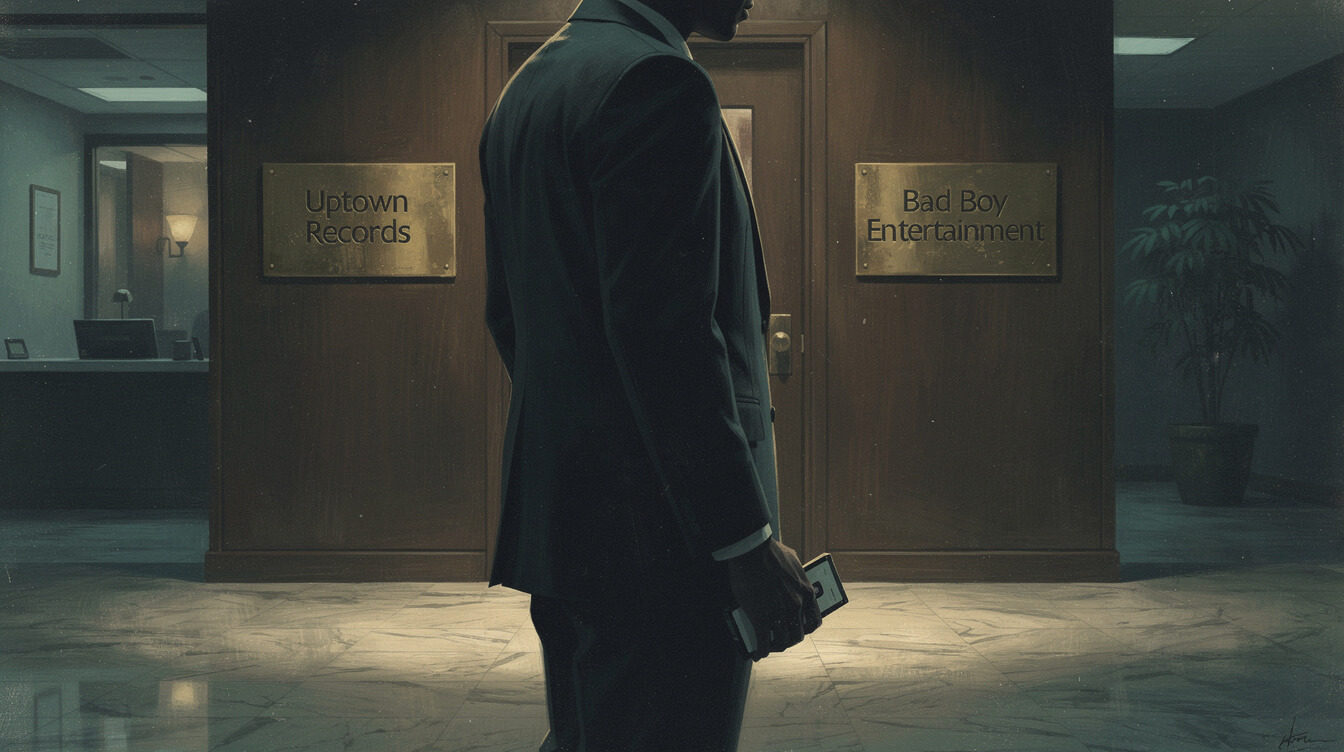
The Ready to Die story starts not in a studio but in a boardroom. In 1992, Sean “Puffy” Combs — then a 22-year-old A&R at Uptown Records — signed Christopher Wallace off the strength of an unsolicited demo tape. Combs had heard Wallace on Mister Cee’s mixtape and on the pages of The Source’s Unsigned Hype column, where a young journalist named Matty C had run a rave notice in March 1992. The demo made it to Puff. The signing happened almost immediately.
Recording began at Uptown in December 1993. It was going nowhere fast. Wallace was writing, Puff was pushing sonic direction, but the label was a Mary J. Blige / Jodeci R&B house — the machine wasn’t built for a street-rap debut. Then everything imploded. In July 1993, Uptown founder Andre Harrell fired Combs, reportedly for insubordination and a clash over Puff’s aggressive management style. Combs walked out with a Bad Boy Entertainment imprint deal at Arista Records and a handful of loyal artists in his orbit. Wallace — still technically an Uptown signing — was left in limbo.
Puff bought Biggie out of his Uptown contract and rebooted the sessions at Bad Boy. Recording resumed in early 1994 at The Hit Factory in Times Square and D&D Studios (of Gang Starr / DJ Premier fame) on West 37th Street, wrapping in June 1994. What could have been a shelved development deal became the founding release for a new empire. Bad Boy Records — which would over the next decade break Faith Evans, 112, Total, Ma$e, and The Lox — was essentially built on the back of Ready to Die‘s first-year sales. Puff was not exaggerating when he later called Biggie “the reason Bad Boy exists.”
The Producers Who Built Ready to Die
The received wisdom that Ready to Die Biggie is a “Puff Daddy production” is a marketing legend, not a credit sheet. Combs executive-produced and co-produced several tracks, but the sonic architecture belongs to a small crew of NYC beat-makers, each with a distinct signature.
Easy Mo Bee — The Boom Bap Backbone
Osten Harvey, aka Easy Mo Bee, produced five tracks: Gimme the Loot, Machine Gun Funk, Warning, Ready to Die, and The What featuring Method Man. He also co-produced Friend of Mine. Mo Bee was already a proven boom-bap architect — he had produced Miles Davis’s posthumous Doo-Bop in 1992 and multiple cuts on the Wu-Tang and GZA orbits. His sound on Ready to Die is dry, punchy, and cinematic: thick 808 kicks, jazz-inflected chops, minimal decoration. Everything he touched on the record hits like a short film scene.
DJ Premier — The One-Track Masterpiece
Christopher Martin (Preemo) produced exactly one song on Ready to Die — Unbelievable, track 16 — and it became one of the most respected beats on the album. Premier chopped R. Kelly’s Your Body’s Callin’ hook, layered it with a signature scratch chorus, and gave Biggie the kind of minimalist ledge that let him rap harder than anywhere else on the record. For a producer who was simultaneously building Gang Starr’s Hard to Earn and Jeru the Damaja’s The Sun Rises in the East, this one placement was a gift to the culture. If Preemo’s palette speaks to you, our Boogie Down Productions Criminal Minded Hoodie pays tribute to the KRS-One era that seeded the entire NYC boom-bap tradition Premier came up in.
Chucky Thompson & Bluez Brothers — The Radio Hooks
Carl “Chucky” Thompson (later of Mary J. Blige’s My Life fame) and the Bluez Brothers production duo handled the tracks Puff needed for radio: One More Chance, Everyday Struggle, and Me & My Bitch. Thompson specifically co-produced Big Poppa, the Isley Brothers-sampling smash that became the album’s biggest crossover moment. These weren’t pandering pop moves — Thompson’s ear for warmth and groove is what let Biggie’s storytelling breathe on the mid-album run.
Lord Finesse — The Closer
Robert Hall Jr. — Lord Finesse of D.I.T.C. — produced the album’s devastating closer, Suicidal Thoughts. A minimal loop, a phone call, and 2:50 of Biggie confessing his own despair to Puff. Finesse’s production is barely there, which is the point. He gave Wallace a stage empty enough to whisper on.
Trackmasters (Poke & Combs)
Jean-Claude “Poke” Olivier of Trackmasters co-produced Juicy and Respect with Puff. Juicy famously flips Mtume’s 1983 Juicy Fruit — a sample choice Poke pushed against Biggie’s initial resistance. That single decision changed everything: Juicy peaked at number 27 on the Billboard Hot 100, became Biggie’s first pop breakthrough, and is now regularly cited as one of the greatest opening-track statements in rap history.
Track-by-Track: Every Song on Ready to Die Decoded
Seventeen tracks, 69 minutes, sequenced like a life span from birth to death. Here’s the full run-down of the standard 1994 LP.
- Intro (3:24, produced by Combs) — A radio-play birth-to-arrest montage tracking Biggie’s life via era-defining hits: Curtis Mayfield’s Superfly, Sugarhill Gang’s Rapper’s Delight, Audio Two’s Top Billin’, Snoop’s Tha Shiznit. Fifteen writers credited because Puff cleared every sample.
- Things Done Changed (3:58, prod. Darnell Scott) — The state-of-Brooklyn address. Dr. Dre’s Chronic energy filtered through a nihilist Bed-Stuy lens. The line “back in the day our parents used to take care of us / look at ’em now, they even fuckin’ scared of us” is the album’s thesis in two bars.
- Gimme the Loot (5:04, prod. Easy Mo Bee) — Biggie duets with himself, pitched up as the young stick-up kid. A 5:04 heist film. One of the greatest solo-artist performance pieces in rap.
- Machine Gun Funk (4:17, prod. Easy Mo Bee) — Interpolates Marley Marl / K-Def-era loops. Biggie flexes rapid-fire flow to prove he’s not just a slow storyteller.
- Warning (3:40, prod. Easy Mo Bee) — Samples Isaac Hayes’s cover of Burt Bacharach’s Walk On By. Third single. A cinematic phone call — “who the fuck is this?” — that became one of the most-quoted openings in East Coast rap.
- Ready to Die (4:24, prod. Easy Mo Bee) — The title track. Interpolates the Ohio Players and Barbara Mason. Biggie stares down mortality with a bass line that feels like it’s already digging the grave.
- One More Chance (4:43, prod. Bluez Brothers, Chucky Thompson & Combs) — Remix would go on to peak at number two on the Hot 100 (blocked from number one only by Michael and Janet Jackson’s Scream). Sampled DeBarge’s Stay With Me.
- Fuck Me (Interlude) (1:31) — A skit. Airing on the album because Puff insisted it belonged in the sequence.
- The What (3:57, prod. Easy Mo Bee, feat. Method Man) — The only guest verse on the entire album. Meth was fresh off Enter the Wu-Tang. Two of the biggest voices in New York on one track. Every Wu-Tang and Biggie fan you’ve ever met owns this song.
- Juicy (5:02, prod. Poke & Combs) — The single that broke him. Samples Mtume’s Juicy Fruit. The autobiography verse — “birthdays was the worst days / now we sip champagne when we thirsty” — is arguably the most-quoted stretch of the whole album.
- Everyday Struggle (5:19, prod. Bluez Brothers) — Samples Dave Grusin’s Either Way. Biggie’s most naked hustler’s-remorse track. “I don’t want to live no more / sometimes I hear death knockin’ at my front door.”
- Me & My Bitch (4:00, prod. Bluez Brothers, Thompson & Combs) — Samples Zapp / Roger Troutman. A ride-or-die love story that ends in a hit. Foreshadowed Biggie’s own 1997 murder in ways that still haunt.
- Big Poppa (4:13, prod. Chucky Thompson & Combs) — Isley Brothers Between the Sheets flip. Grammy nomination for Best Rap Solo Performance. Peak charm-mode Biggie. Number six on the Hot 100.
- Respect (5:21, prod. Poke & Combs) — KC and the Sunshine Band’s I Get Lifted sample. Features Diana King on vocals. Biggie’s origin story in autobiography form — birth, teenage years, the game.
- Friend of Mine (3:28, prod. Easy Mo Bee) — Kool & The Gang sample. A misogynist trip-hop rant that even the Wallace family later distanced from, but historically significant as an artifact of the sound-and-values of the era.
- Unbelievable (3:43, prod. DJ Premier) — The Preemo cut. B-side of the Juicy single. R. Kelly hook chop. Consistently ranks in fan polls as the album’s best pure-rap moment.
- Suicidal Thoughts (2:50, prod. Lord Finesse) — The closing phone call to Puff. Biggie ends the record confessing suicidal despair, then a gunshot, then nothing. One of the most devastating album closers in any genre.
The Charts, the Certifications, and the Legacy
Ready to Die entered the Billboard 200 at number 15 the week it dropped. It never climbed to number one — it didn’t need to. Instead it did something rarer: it charted for 96 weeks straight and became one of the longest-running rap catalog albums of the 1990s. It was RIAA-certified gold in November 1994, platinum by February 1995, four times platinum by August 1999, and — after two decades of continuous vinyl and CD reissues, plus the streaming era — six times platinum on April 24, 2018.
The singles: Juicy (number 27 Hot 100), Big Poppa (number six Hot 100, Grammy-nominated), and One More Chance remix (number two Hot 100, held off number one by Michael and Janet Jackson’s Scream). Three top-30 singles from a debut hip-hop album in 1994–1995 was almost unprecedented for the format.
Critical reception was rapturous. The Source gave the record its rare five-mic rating. Rolling Stone included it in the 500 Greatest Albums of All Time (currently ranked number 22 in the 2020 update). NPR, Pitchfork, Complex, and every serious hip-hop critical publication in the 30 years since has slotted Ready to Die in their top-15 hip-hop albums list. The 2020 National Recording Registry induction sealed it as a cultural artifact permanently preserved by the U.S. government.
For a parallel East Coast lyrical peak from the exact same era, our Eric B. and Rakim songs guide covers the Long Island lineage that trained Biggie’s ear. And for the 1996–1997 Bad Boy-vs-Death Row war that Ready to Die unwittingly kicked off, our Tupac albums covers deep-dive maps the other side of the coin.
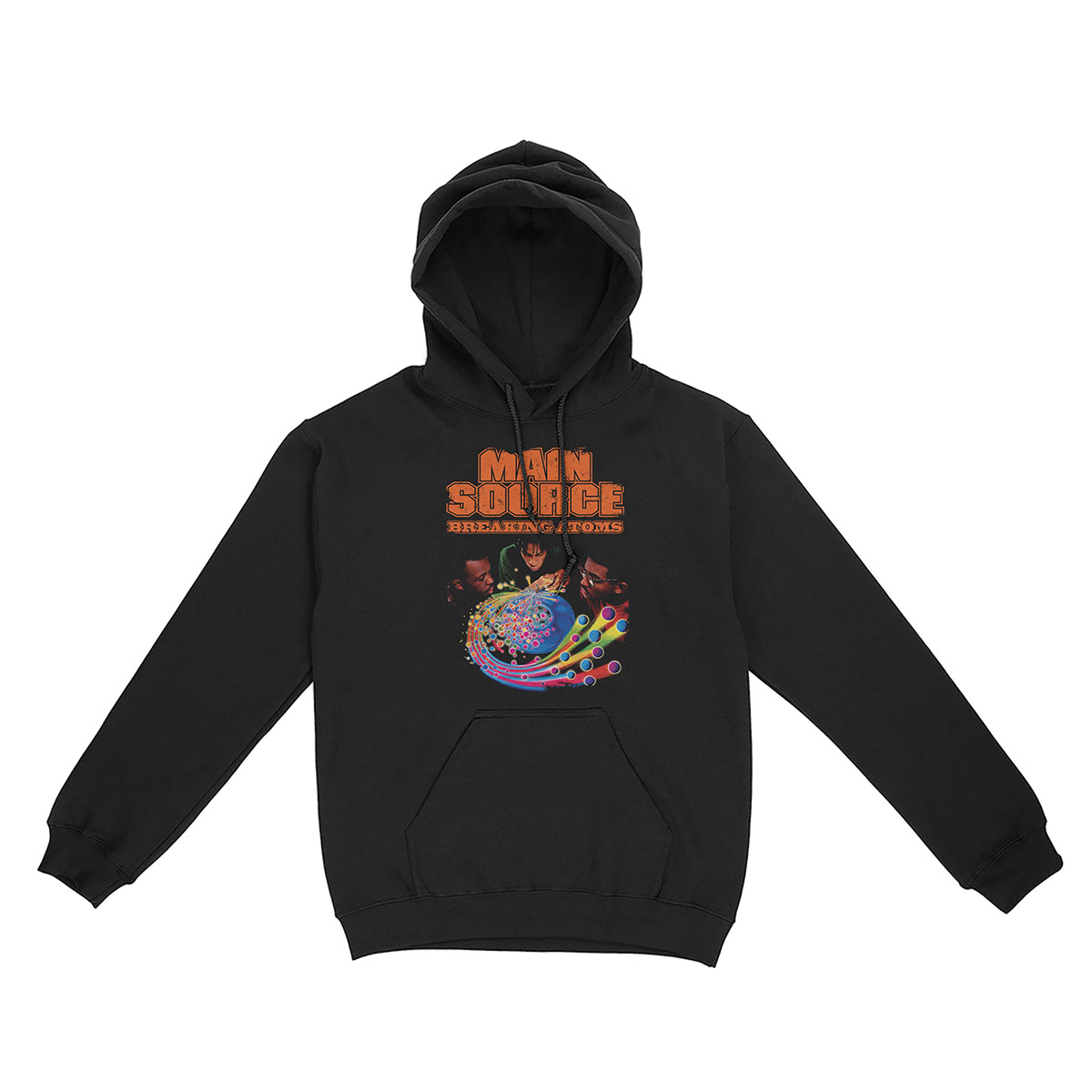
Rep the Era That Set the Stage
Before Ready to Die there was Main Source’s Breaking Atoms — the 1991 NYC classic where Large Professor cut the template Biggie’s producers built on three years later. Wear the album cover that started the East Coast lineage.
The Cultural Impact: Coogi, Versace, and the New York Comeback
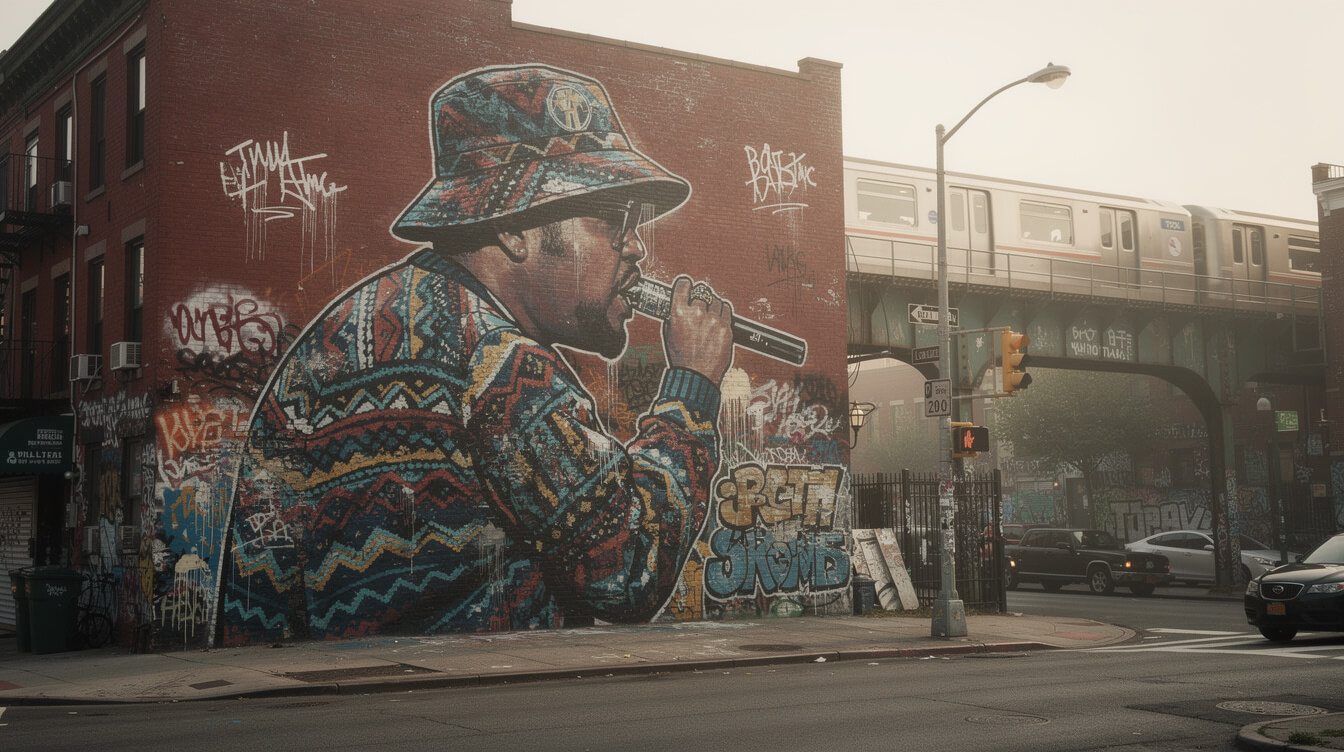
Music-wise, Ready to Die Biggie retooled what an East Coast debut could sound like. Culturally, it did more than that. Biggie’s Coogi sweaters — the wildly patterned Australian knitwear he wore in the One More Chance and Big Poppa videos — went from an obscure luxury import to a mainstream hip-hop signifier overnight. His Versace shades, his Rolex, his fondness for tailored black button-downs: it was the first time a Brooklyn street rapper had made luxury-brand consumption central to the image, and it was the direct forerunner of everything that came after — Jay-Z’s champagne runs, Cam’ron’s pink Range Rovers, Kanye’s fashion week seats.
Biggie also permanently rehabilitated the concept of the “unattractive rapper as sex symbol.” Before Wallace, mainstream rap acts sold on either lyrical ferocity (Chuck D, Rakim, KRS-One) or good looks (LL Cool J, Q-Tip, Puff himself). Biggie was 6’3″ and 300+ pounds and turned that into a marketing engine. The Big Poppa video is a slow-motion flex about being wanted because of who he was, not despite it. That single move — the confidence to make the album’s biggest single a love-and-women record from a heavyset Brooklyn kid — recalibrated hip-hop masculinity for the next decade.
And then there was the East-West rivalry. Ready to Die‘s success helped ignite what became the Bad Boy vs. Death Row war of 1995–1997. Tupac Shakur, once Biggie’s friend, publicly accused Wallace of involvement in the November 1994 Quad Studios shooting. The feud escalated, and both artists were murdered within six months of each other — Tupac in September 1996, Biggie in March 1997, six months before his second album Life After Death was released. Ready to Die is now the only solo studio album Biggie ever finished during his life. That reality colors every listen.
Frequently Asked Questions About Ready to Die
When was Ready to Die released?
September 13, 1994, on Bad Boy Records / Arista. Recording ran from December 1993 through June 1994, mainly at The Hit Factory in Times Square, with additional sessions at D&D Studios on West 37th Street.
Who produced Ready to Die?
Executive-produced by Sean “Puffy” Combs. The main producers on the tracklist are Easy Mo Bee (five tracks), Chucky Thompson and the Bluez Brothers (four tracks together), Puff Daddy (co-produced multiple tracks), DJ Premier (one track — Unbelievable), Lord Finesse (one track — Suicidal Thoughts), Poke of Trackmasters (co-produced Juicy and Respect), and Darnell Scott (Things Done Changed).
What’s the only guest verse on Ready to Die?
Method Man on The What (track 9). It’s the sole featured artist verse on the entire album. Lil’ Kim and members of Total appear as additional/backup vocalists on other tracks but aren’t rapping.
How many copies has Ready to Die sold?
Six-times platinum in the United States per RIAA certification (April 24, 2018), which represents six million copies sold domestically. Worldwide sales estimates hover around 10 million. It was one of the top-selling hip-hop debuts of the 1990s.
Is Ready to Die considered the greatest hip-hop album ever?
It’s regularly ranked in the top five debut albums in hip-hop history, and inside the top 25 albums of the genre period. Rolling Stone’s 2020 500 Greatest Albums list placed it at number 22 across all genres. The National Recording Registry entry in 2020 gave it permanent institutional recognition. Different fans debate its position versus Nas’s Illmatic, Wu-Tang’s Enter the 36 Chambers, and OutKast’s Aquemini — but nobody serious leaves it off the list.
What sample is used on Big Poppa?
The Isley Brothers’ Between the Sheets (1983). Chucky Thompson chopped it. The Isleys were compensated in full, and Between the Sheets‘s Billboard catalog performance spiked after Biggie’s single broke — a common pattern for well-cleared samples in the mid-1990s.
Why does Ready to Die have such a dark album cover?
The cover is a baby with an Afro sitting in a blank white background — the same baby (a young Keithroy Yearwood, not Biggie’s own son) shown at birth, echoing the album’s biographical arc from cradle to death threat. Puff Daddy commissioned the cover to make the album feel like a life story from track one. The child on the cover has since done multiple interviews about the modest one-time payment he received and the enormous cultural weight of the image.
Final Thoughts on Ready to Die’s Enduring Power
Some albums age. Ready to Die Biggie has done the opposite: every year that goes by, its influence gets more visible. Every Bad Boy signee, every Roc-A-Fella release, every mainstream New York rapper of the last three decades is downstream of what Christopher Wallace and Sean Combs assembled at The Hit Factory in the spring of 1994. Every “street rap that goes pop” formula — from 50 Cent’s Get Rich or Die Tryin’ to Meek Mill’s Dreams and Nightmares to Pop Smoke’s posthumous Shoot for the Stars, Aim for the Moon — traces its DNA to what this record proved was possible.
The tragedy that closes the Biggie story — his murder on March 9, 1997, at 24 years old, six months after Tupac’s — turned Ready to Die‘s title from a swaggering hustler’s boast into an eerily accurate epitaph. Listening to it in 2026 is listening to a young man who somehow knew, and made his masterpiece anyway. Play Suicidal Thoughts once and you’ll never forget the sound of the gunshot that closes the record.
Thirty-one years after release, Ready to Die is still where the East Coast tradition starts for anyone new to the culture, still the album that non-hip-hop heads accidentally love the first time they hear Juicy at a wedding reception, and still the single most-cited debut in every “best rap album” argument that has ever happened. If you want to understand hip-hop, you play this record from track one to track seventeen, in order, with the lights off, and let it work. That’s how it was built.
Stay creative — The Custom Creative Team.
Deep-Dive Hip-Hop, Delivered
Album breakdowns, producer histories, and receipts most sites won’t dig for. Straight to your inbox from the Custom Creative crew.

🎧 Never Miss a Drop
Exclusive product releases, hip-hop deep dives, and member-only discounts. Straight to your inbox.
Free forever. No spam. Unsubscribe anytime.
Get the Culture, Delivered
Deep dives into hip-hop history, exclusive product drops, and discounts sent straight to your inbox. No spam, just culture.
Join 2,000+ hip-hop heads already in the loop. Unsubscribe anytime.