Mobb Deep’s Hell on Earth at 30: The Sequel That Got Overshadowed by The Infamous
Every era of hip-hop has a sequel nobody wanted to have to make. Hell on Earth is Mobb Deep’s. Released November 19, 1996 on Loud/RCA, it’s the record that had to follow The Infamous — one of the most airtight, universally canonized rap albums of the decade — and it did the job so well that most people forgot it happened. Thirty years later, on the anniversary of its release, Hell on Earth deserves a real look, not a footnote.
This isn’t a nostalgia lap. It’s a case for why the “difficult second act” narrative around this album has always been backwards — and why, if you actually sit with the record instead of the reputation, it might be the colder, more disciplined listen of the two. Anniversaries are a good excuse to relitigate consensus, and this one’s overdue: Hell on Earth has spent three decades getting talked about as the album Mobb Deep made after the classic, instead of the classic it actually is.
Hell on Earth: The Impossible Job of Following The Infamous
Put yourself in Havoc and Prodigy’s position in early 1996. The Infamous had just redefined what East Coast rap could sound like — claustrophobic, paranoid, cold as a fire escape in January — and critics were already calling it a classic before the ink dried. Queens duos don’t usually get a second chance to define an era. Mobb Deep had one album to prove The Infamous wasn’t a fluke, and they had less than eighteen months to do it.

Most groups in that position play it safe. Mobb Deep did the opposite. Havoc took full production control — no outside beats, no committee — and pushed the sound somewhere darker and less forgiving than the record everyone was still trying to catch up to. That’s not the move of a group protecting a formula. That’s the move of a group that knew the only way to survive a classic was to refuse to repeat it.
The album’s title alone tells you the intent. The Infamous was a reputation. Hell on Earth is a location — a place you don’t leave. Mobb Deep weren’t chasing the same trophy twice. They were building the world the first album only sketched, one block at a time, and betting that a fully-realized environment would land harder than a repeat performance.
The Weight of a Classic
Hip-hop has a handful of these forced-second-act moments — records that had to follow something the culture had already decided was untouchable. What separates the ones that survive from the ones that don’t isn’t polish. It’s whether the artist treats the follow-up as an obligation or an opportunity to go further into the same idea. Hell on Earth is firmly the latter, and that distinction is exactly why it holds up.
November 19, 1996: What Hip-Hop Looked Like That Week
Context matters here, and it’s brutal context. Hell on Earth dropped in the thick of the East Coast–West Coast rivalry, seven months after Tupac Shakur’s “Hit ‘Em Up” had turned coastal tension into open warfare on wax, and less than a year before hip-hop would lose two of its biggest voices to that same conflict. Every “authentic,” gun-talk-heavy record released that fall got read through that lens whether the artist wanted it or not — and a Queensbridge duo known for cold, unflinching street narratives was never going to get a neutral read in that climate.

Mobb Deep’s response track, “Drop a Gem on ‘Em,” is usually filed as a direct Tupac diss because of its timing and tone. The fuller picture is more interesting: in the same album’s liner notes, Prodigy shouts out Snoop Dogg, Tha Dogg Pound, and Xzibit by name. That’s not the move of a group drawing a coastal line in the sand. It’s a group from Queensbridge making a record about violence and survival in their own neighborhood, released into a moment that made every dark bar sound like it was aimed at somebody specific — because the industry around them needed it to be.
Understanding that tension is essential to hearing Hell on Earth correctly. It’s not a beef record dressed up as an album. It’s an album that got read as a beef record because of when it landed, and that mislabeling has followed it for thirty years.
Havoc’s Sound Gets Colder
If The Infamous sounded like a haunted apartment, Hell on Earth sounds like the building it’s in. Havoc took the sample palette that made the first album work — pianos, string sections, film-score textures — and stripped out anything that resembled warmth. AllMusic’s retrospective review put it plainly: the record “refines the Mobb Deep formula, amplifying much of what made The Infamous a success,” with street narratives that got “even more violent and extreme” over production that got “even grittier and creepier.”

That’s the key production idea most casual listens miss: this isn’t The Infamous Part 2. It’s The Infamous with the mercy removed. Where the first album occasionally let a sample breathe into something close to melody, Hell on Earth holds the tension down for the entire runtime. Every loop feels like it’s bracing for something. Havoc wasn’t just producing an album here — he was building a mood board for East Coast hardcore rap that Griselda, Roc Marciano, and a generation of Queens-adjacent producers would still be studying decades later.
Spin‘s Sacha Jenkins caught the tone at the time, writing that the record “pursues retribution like Charles Bronson in the Death Wish flicks” — cold, procedural, unglamorous violence, delivered without a wink to the camera. That’s a different register than most of the coastal-rivalry records dropping that same year, which were loud and combative by design. Hell on Earth is quiet menace. It doesn’t posture. It just describes the room, and lets the room do the intimidating.
A Sound Ahead of Its Own Genre
Listen to this record next to anything currently coming out of the Griselda camp, or a Mach-Hommy tape, and the lineage is obvious — minimal drums, dust-caked samples, verses that read like case files rather than boasts. Havoc was building that template in a home studio in 1996, years before “atmospheric” became a critical shorthand for East Coast rap production.
The Tracks That Still Hit
Strip away the context and the record still works purely as a collection of songs, which is the part that gets lost when an album is discussed only as “the one after the classic.” “Extortion,” featuring Method Man, is one of the most underrated posse-cut pairings of 1996 — Meth’s cadence stretching over Havoc’s stripped-down loop like he’s working a different tempo than the beat and still landing every bar on time. “Man Down” and “Give It Up Fast,” both featuring Queensbridge affiliate Big Noyd (the latter also pulling in Nas), function as a Queensbridge family reunion disguised as album tracks.
Then there’s “G.O.D. Pt. III” and “Front Lines (Hell on Earth)” — the two singles that carry the album’s thesis most directly, both built on the kind of minor-key dread that makes the hook feel like a warning rather than a chorus. “Nighttime Vultures,” with Raekwon dropping in from the Wu-Tang camp, is proof that 1996 New York rap was still, at its core, a small circle of people trading verses over each other’s beats. “Bloodsport” and “More Trife Life” round out the tracklist as pure mood pieces — the kind of songs that don’t need a guest verse or a single release to justify their place, because the atmosphere alone is doing the work.
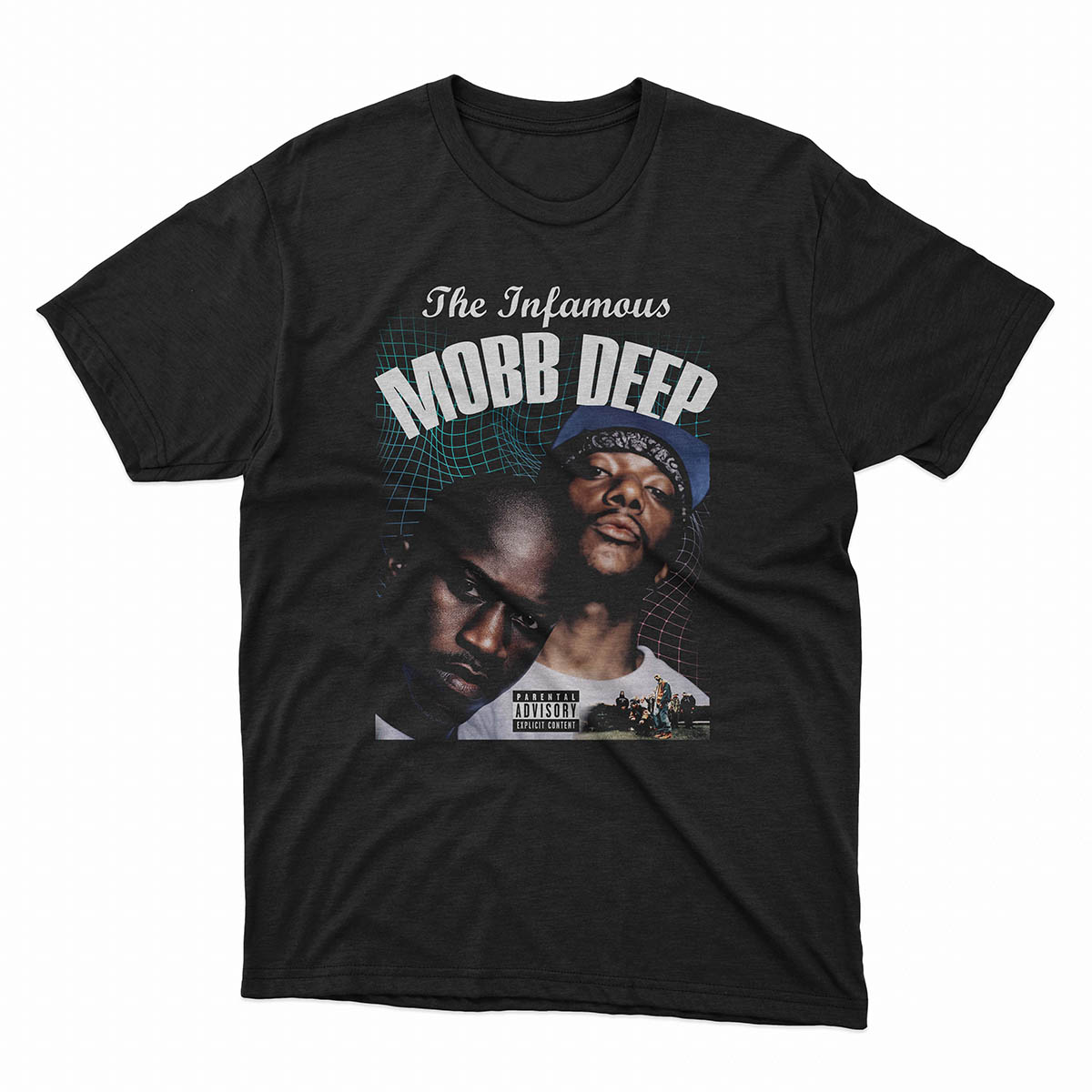
If you want the era on your back the way Mobb Deep put it on wax, our Mobb Deep The Infamous T-Shirt carries the same Queensbridge lineage this album was built to extend — a direct nod to the record Hell on Earth had to live up to.
Rep the Album That Set the Bar
The Mobb Deep The Infamous Tee carries the same Queensbridge lineage Hell on Earth was built to extend — cold, authentic, straight from the source.
Nas, Raekwon, Method Man, and the Queensbridge Bench
The guest list on Hell on Earth reads like a roll call of who mattered in New York rap in 1996, and none of it feels like industry politics. Nas, fresh off It Was Written, and Raekwon, riding Only Built 4 Cuban Linx…, weren’t just marquee names bolted on for chart appeal — they were neighbors and collaborators trading favors across a scene that was still small enough to actually be a scene. Big Noyd, the Queensbridge affiliate who’d go on to release his own Mobb Deep-produced records, appears twice, cementing his role as the group’s most trusted extended-family voice.

This is the part of the album that gets undersold in the “difficult sequel” framing: Hell on Earth isn’t a two-man show padded with guests. It’s a document of exactly how connected the Queensbridge-and-friends network was at its commercial and creative peak — before Death Row, before Bad Boy’s ascension fully rewired the industry’s center of gravity, before half these relationships got complicated by things that had nothing to do with the music. Method Man’s appearance on “Extortion” alone is worth the price of admission — a Staten Island voice dropping into a Queensbridge production without either side sanding down what makes them distinct.
What’s easy to miss now, thirty years removed, is how unusual that kind of cross-borough collaboration actually was outside of the Wu-Tang collective’s own orbit. Raekwon showing up on a Mobb Deep record wasn’t a label-mandated feature swap — it was two camps that respected each other’s work ethic enough to trade time for free. That’s a different economy than the one guest verses operate in now, and it’s part of why the record still sounds like a document instead of a marketing exercise.
Why The Infamous Ate Its Sequel’s Shine — and Why That’s Backwards
Here’s the uncomfortable truth about “second album syndrome”: it’s almost never actually about the quality of the second album. Hell on Earth debuted at No. 6 on the Billboard 200 and hit No. 1 on the Top R&B/Hip-Hop Albums chart — a better chart performance than The Infamous managed on release. It went RIAA Gold within five months, certified April 9, 1997. Critics across the board — The Source, Entertainment Weekly, the LA Times, Spin, Rolling Stone — gave it strong-to-glowing reviews, and it later made Q‘s list of the 50 Heaviest Albums of All Time. This was not a commercial or critical stumble by any reasonable measure.

What actually happened is simpler and less flattering to how hip-hop history gets written: The Infamous got there first, and “first” calcifies into “definitive” faster than quality alone can compete with. The LA Times‘ Cheo Hodari Coker called Hell on Earth “just as alluring, pessimistic and downright scary” as its predecessor — not lesser, just as. Rolling Stone’s Chris Ryan went further, framing the sequel’s ambition directly: “If Infamous was a chilling documentary, Hell on Earth is a crime saga of mythical proportions. The stickup kids of the last album become hitmen and corner drug pushers become crime kingpins.” That’s not a band coasting. That’s a band escalating a story on purpose — and getting punished in the historical record for the sin of not being the first chapter.
The Source’s Selwyn Seyfu Hinds put it best at the time, praising Prodigy for “painting an endless series of chilling, near-surreal cinemascapes” and Havoc for “a surprisingly high octane performance,” before calling Mobb Deep “the most intense, most authentic, most powerful practitioners” of East Coast hardcore hip-hop working that decade. That’s not a review of a group in decline. That’s a review of a group at the top of its game, writing a chapter that just happened to come second.
Hell on Earth at 30: The Case for Reassessment
Thirty years on, Hell on Earth is one of the more quietly influential records in the hardcore rap catalog — you can trace its DNA straight through to the current run of Griselda, Roc Marciano, and Mach-Hommy records that treat menace as a production choice rather than a lyrical flex. It’s also, genuinely, one of the earliest enhanced CDs in hip-hop, shipping with a hidden bonus track (“In the Long Run”) that required a home computer to unlock — a small, easily forgotten detail that says a lot about how much Loud Records was willing to experiment with the format around this release. The UK pressing swapped that hidden cut for “Shook Ones Pt. I,” a bonus track choice that quietly acknowledges the album it was following even while trying to step out of its shadow.

The commercial numbers back up the reassessment case too. UK certification landed BPI Silver at 60,000 units — respectable for a hardcore New York rap import in that market — while the US Gold certification and the No. 1 R&B/Hip-Hop Albums peak confirm this was never a niche release. It was a mainstream hit that the culture’s memory simply filed under “the other one.”
Quick answers, for the record:
Is Hell on Earth as good as The Infamous? Different, not lesser — colder, more escalated, and arguably more purely a Havoc production showcase from front to back.
What’s the best way into the album for a first-time listener? Start with “Extortion,” “G.O.D. Pt. III,” and “Front Lines (Hell on Earth),” then go back for the deep cuts like “Bloodsport” and “More Trife Life.”
Why doesn’t it get talked about as much as The Infamous? Timing, not merit — it arrived second, into a coastal-rivalry news cycle that made every dark bar read as a headline instead of art.
Who produced Hell on Earth? Havoc handled the entire album himself, with no outside production credits — a rarity for a major-label rap release even in 1996.
What’s the significance of the November 19, 1996 release date? It landed squarely in the East Coast–West Coast rivalry’s most volatile stretch, which shaped how critics and fans initially read the album’s tone.
Final Thoughts
The best sequels in hip-hop rarely get remembered as sequels — they get remembered as the moment an artist proved the first record wasn’t an accident. Hell on Earth did exactly that in 1996, and thirty years of it sitting in The Infamous‘s shadow hasn’t made the record any less airtight. If anything, the distance makes the case cleaner: strip away the release-order bias, and what’s left is a Havoc solo production run, a stacked Queensbridge-and-friends guest list, and some of the coldest East Coast hardcore rap ever committed to tape.
Put it next to The Infamous today, back to back, and the sequel doesn’t flinch. It escalates, it commits, and it closes out one of the most consistent two-album runs East Coast hip-hop ever produced. Thirty years is exactly the right distance to stop grading it on a curve.
For more on the album it had to answer to, and the duo behind both, check out our deep dives on The Infamous at 30, our complete guide to Mobb Deep, and our profile on Havoc’s production career.
Stay creative — The Custom Creative Team
Culture Delivered Weekly
Get the deep-catalog hip-hop breakdowns, anniversary reads, and drops straight to your inbox — no filler.

🎧 Never Miss a Drop
Exclusive product releases, hip-hop deep dives, and member-only discounts. Straight to your inbox.
Free forever. No spam. Unsubscribe anytime.
Get the Culture, Delivered
Deep dives into hip-hop history, exclusive product drops, and discounts sent straight to your inbox. No spam, just culture.
Join 2,000+ hip-hop heads already in the loop. Unsubscribe anytime.