4 Elements of Hip Hop: DJing, MCing, Breaking and Graffiti, With the Receipts
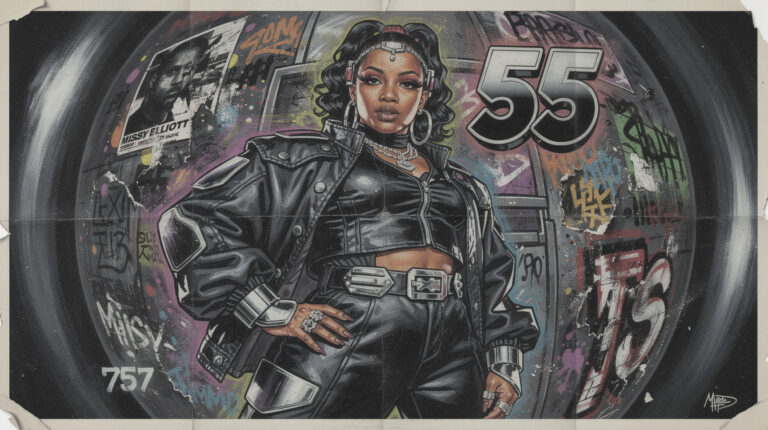
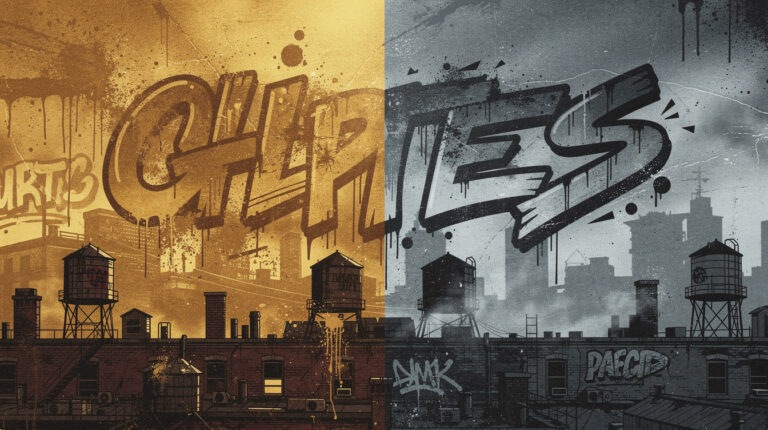
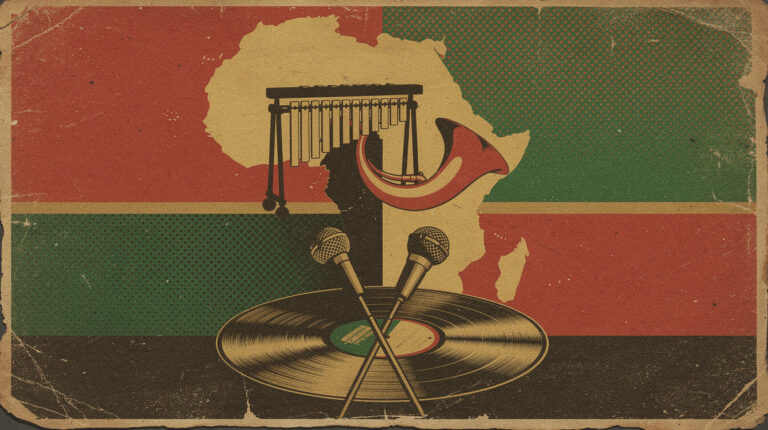
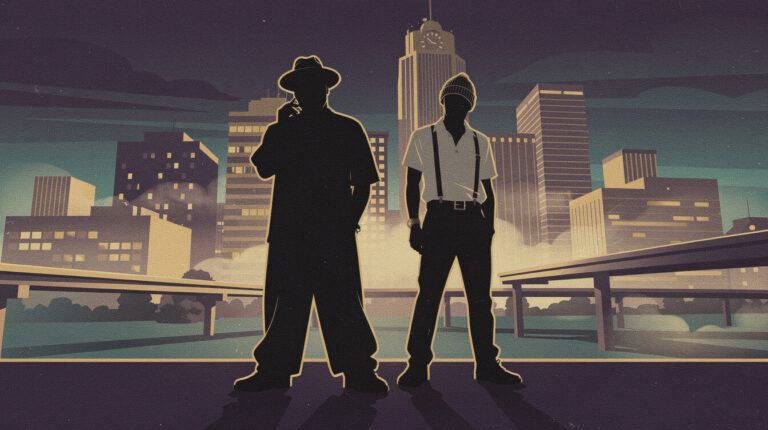
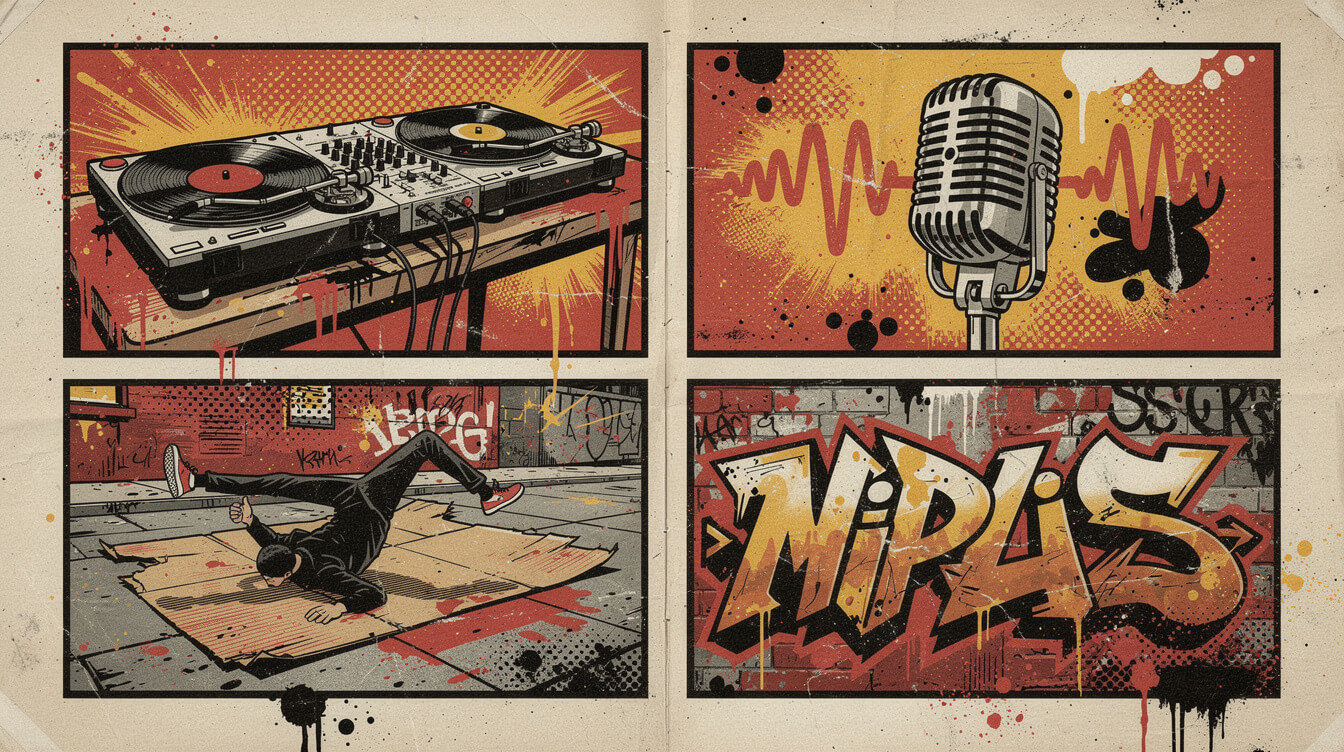
Ask ten heads what hip-hop is and you’ll get ten answers, but the old ones all start in the same place: the 4 elements of hip hop. DJing, MCing, breaking and graffiti writing. Four disciplines that grew out of the same Bronx blocks in the early 1970s, fed off each other at the same parties, and only later got a name for the whole thing. Most explainers hand you the list and stop. We’re going to give you the receipts: who built each element, the exact records and dates that mark its birth, who decided there were four in the first place, and why some of the culture’s own architects say four was never the full count.
If you only know hip-hop as music, the 4 elements of hip hop are the map of everything that came with it. If you’ve been in it for decades, stick around anyway, because the lineage gets more interesting the closer you look.
What Are the 4 Elements of Hip Hop?
The short answer, the one you’d give on a test:
- DJing (deejaying or turntablism): manipulating records on two turntables to build and extend the beat.
- MCing (emceeing or rapping): rhyming and talking on the mic, rocking the crowd over the DJ’s beat.
- Breaking (b-boying, b-girling, or “breakdancing”): the dance built on the drum breaks the DJ extends.
- Graffiti writing (writing, bombing, or “aerosol art”): the visual art, from a quick tag to a whole-car burner.
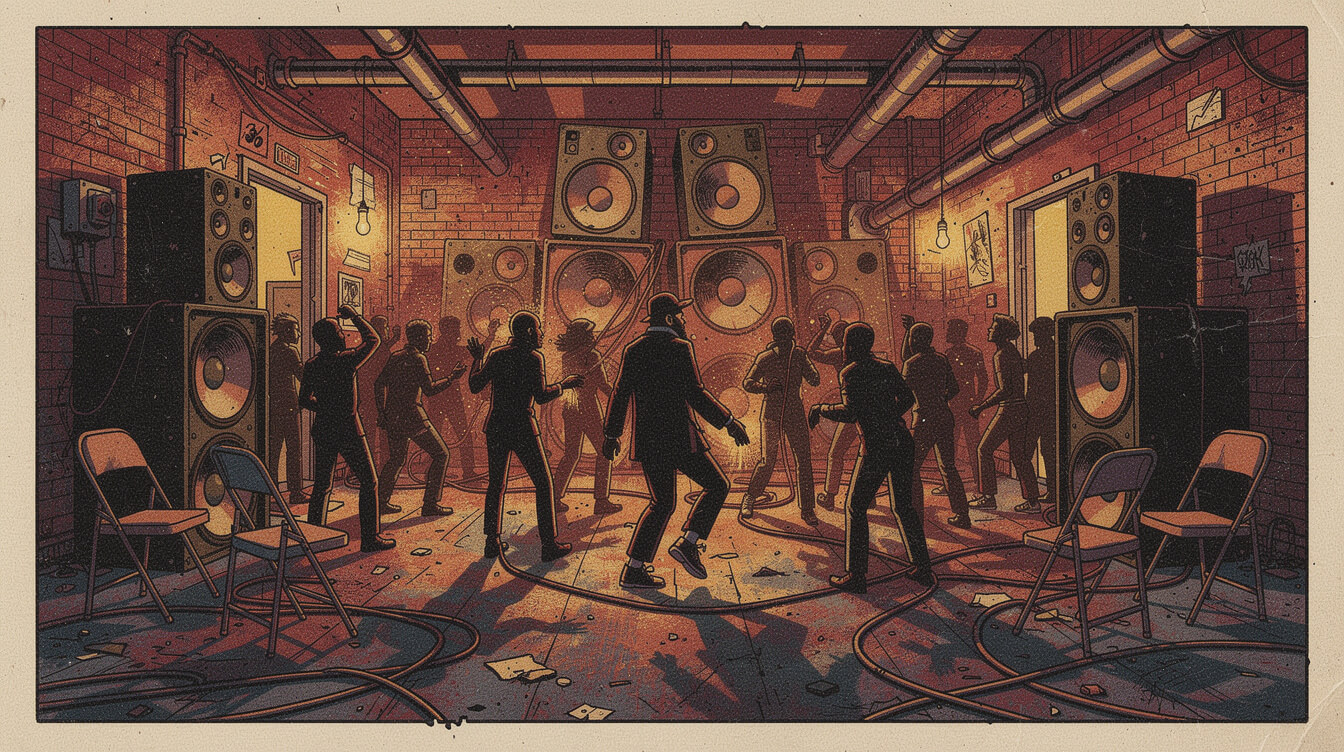
The longer answer is that these four didn’t start out as one package. Graffiti writing was already moving through Philadelphia and New York before anyone called a party “hip-hop.” Dancers were going off at Bronx clubs before the DJs figured out how to give them more of what they wanted. What tied it together was a place and a moment: the Bronx in the 1970s, with the borough burning, the gangs ruling, and teenagers inventing their own entertainment out of whatever they had. The four elements are what grew in that soil.
Who Decided There Were Four?
The framework is usually credited to Afrika Bambaataa and the Universal Zulu Nation. Bambaataa came up in the Black Spades, one of the Bronx’s biggest gangs, then turned his crowd toward parties and culture instead. The Zulu Nation’s official birth date is November 12, 1977, and it’s widely described as the first hip-hop organization. Its pitch to Bronx kids was simple: put your energy into DJing, rhyming, dancing and writing instead of fighting. Defining the culture as a set of disciplines you could actually practice was how a party scene became a movement.
That history comes with a hard asterisk. Bambaataa stepped down as head of the Zulu Nation in May 2016 after allegations that he had sexually abused several young people in the organization, some of them children. In May 2025 he lost a civil case brought under New York’s Child Victims Act, and he died on April 9, 2026. You can’t tell the story of the four elements honestly without his name in it, and you can’t tell his story honestly without that part either. Both things are on the record.
Why “Elements” and Not Just “Genres”?
The word matters. A genre is something you listen to. An element is something you do. Calling them elements framed hip-hop as a living culture with skills you earn, not a product you consume. It’s the same idea KRS-One would later boil down to a line every head knows: rap is something you do, hip-hop is something you live. Hold onto that, because it’s the key to the whole “how many elements are there really” debate at the end of this piece.
Element One: DJing, the Engine Room
Every account of hip-hop’s birth starts with a DJ, and every DJ story starts with Clive Campbell, aka DJ Kool Herc. Born in Kingston, Jamaica in 1955, he grew up around the island’s sound systems, where the selector played the records and a deejay “toasted” over them. His family moved to the Bronx in 1967 and settled at 1520 Sedgwick Avenue.
August 11, 1973: The Rec Room Party
The date the culture treats as its birthday is August 11, 1973, when Herc DJed a party his sister Cindy Campbell organized in the building’s recreation room. Cindy rented the room for $25 and charged 25 cents for girls and 50 cents for guys at the door. That’s the receipt for the birth of a billion-dollar culture: a borrowed room, a family sound system, and a teenager taking admission. We marked it for the 53rd anniversary in our Today in Hip-Hop piece on Kool Herc and 1520 Sedgwick.
The Merry-Go-Round
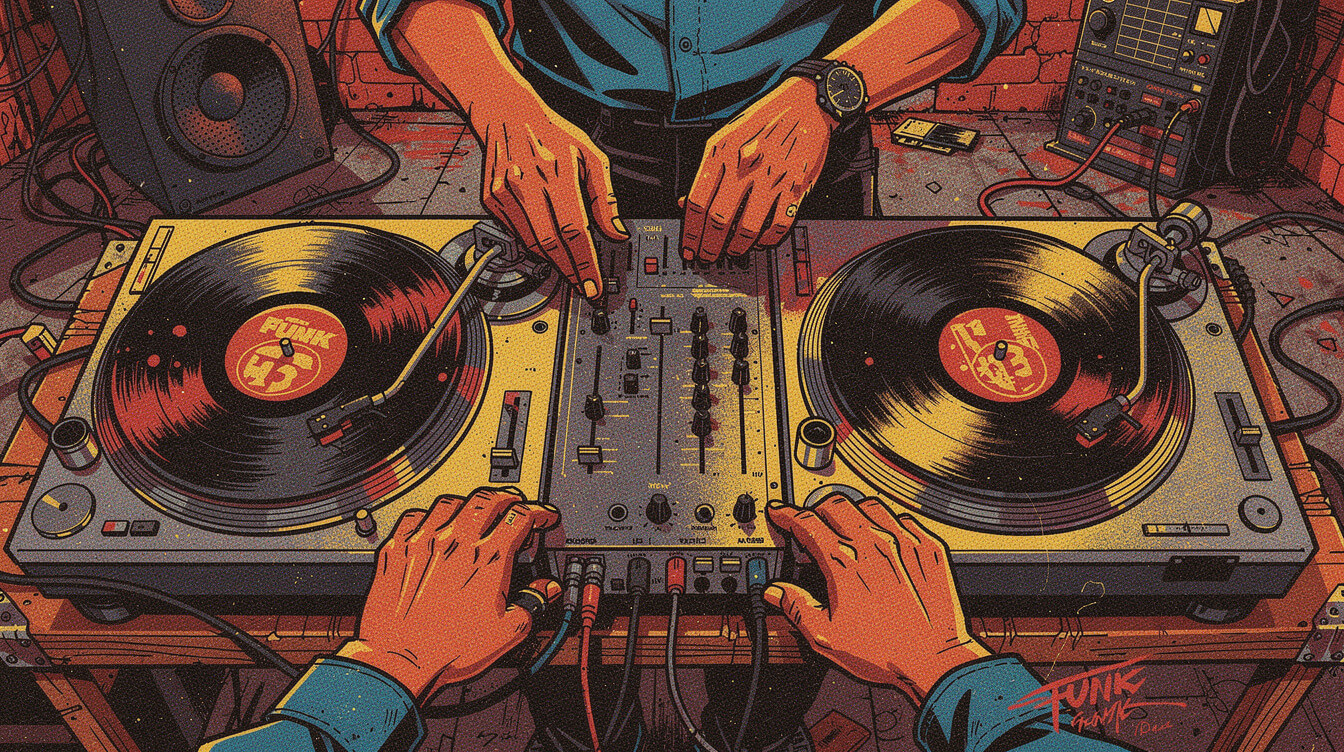
Herc’s breakthrough was noticing what the dancers actually wanted. They didn’t care about the whole song; they waited for the break, the short stretch where the vocals drop out and the drums take over. So Herc stopped playing whole songs. Using two turntables and two copies of the same record, he would play the break on one, cue the other back to the top of the break, and switch, stretching a few seconds of drums into what he called a “five-minute loop of fury.”
He called his break-to-break routine “The Merry-Go-Round” and said he started using it in 1973. The earliest known version ran from James Brown’s “Give It Up or Turnit a Loose” into the Incredible Bongo Band’s “Bongo Rock,” then into Babe Ruth’s “The Mexican.” Two years later, in 1975, he started rocking the Incredible Bongo Band’s “Apache,” which went on to become one of the most important breakbeats in the culture’s history. Every sample-based beat you’ve ever nodded to descends from this idea: the best part of the record, isolated and looped.
Grandmaster Flash and the Science of the Mix
Herc found the breaks. Grandmaster Flash (Joseph Saddler) made them precise. Watching how smooth disco DJs blended records, compared with the rough, unmatched transitions of early Bronx DJing, Flash developed what he called the Quick Mix Theory: fingertip control of the vinyl plus the crossfader, so the same break could loop cleanly without a hiccup. He finished working it out at 927 Fox Street in the Hunts Point section of the Bronx. His toolkit included the backspin, where he spun the record backwards by hand to land on the top of the break, and punch phrasing, where he cut short stabs like horn hits over a running beat.
Flash’s methods led to the techniques that turned the turntable into an instrument: cutting, scratching and transforming. Scratching itself is generally credited to Grand Wizzard Theodore, with Flash perfecting it and taking it to bigger crowds. The DJ line runs straight from these Bronx parties to Jam Master Jay cutting up for Run-DMC. We made a Jam Master Jay T-Shirt for the heads who know the man on the decks was the third member of the group, not the backup.
Element Two: MCing, From Hype Man to Poet
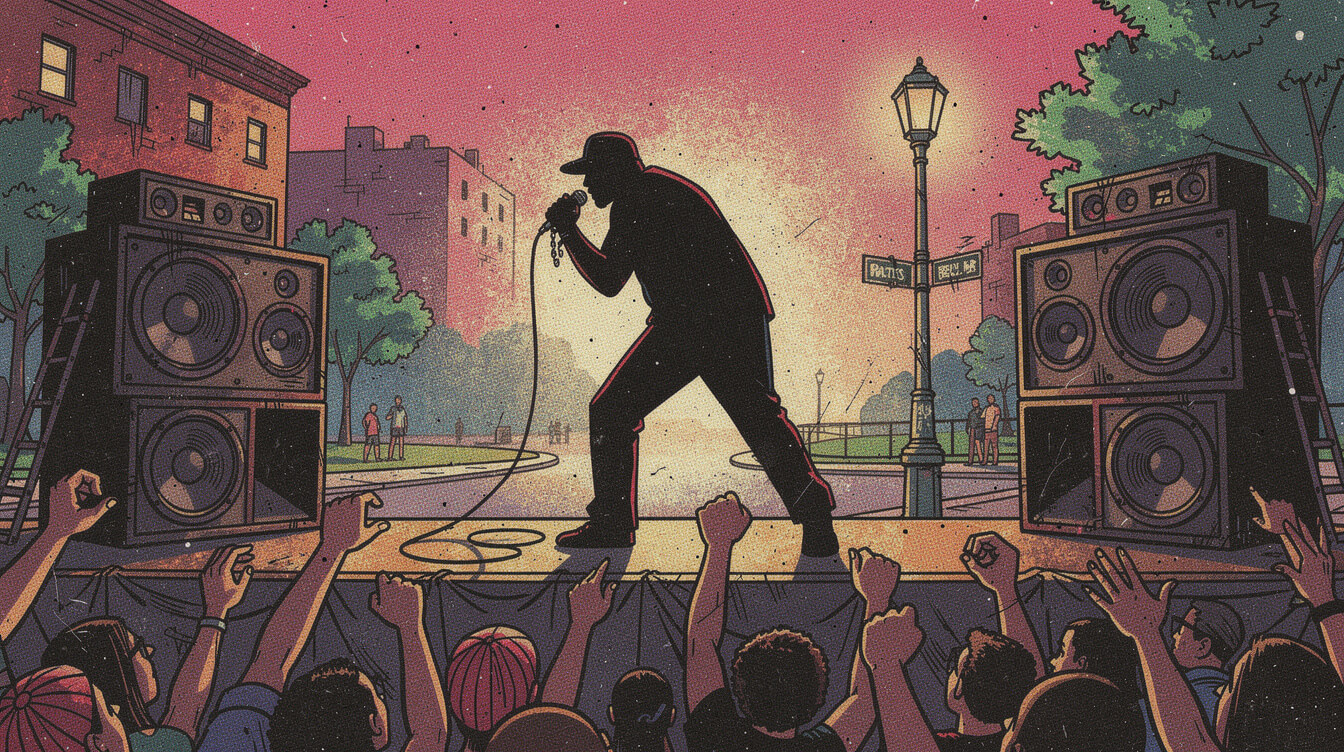
Today MCing is the element that gets the money, the magazine covers and the Grammys. At the start it was the support act. The MC, short for master of ceremonies, was the person on the mic keeping the party moving: shouting out names, calling for the dancers, and hyping the DJ. The rhymes grew out of that job.
Coke La Rock and the First Rhymes
Herc himself talked over his sets with crowd calls like “Rock on, my mellow!” and “B-boys, b-girls, are you ready?” That’s the Jamaican toasting tradition he grew up with, transplanted to the Bronx. But the name the history credits with taking the mic further is his friend Coke La Rock, who was rhyming at Herc’s parties from the 1520 Sedgwick era on. He’s often credited as hip-hop’s first MC. The first MCs had no plan to be recording artists. They were there to rock the crowd.
The Furious Five and the Birth of the Crew
When Grandmaster Flash built a crew of MCs around his DJing, the mic stopped being a sideline. Grandmaster Flash and the Furious Five are credited with pioneering group MCing and freestyle battles, with five rhymers trading lines in routines as tight as Flash’s mixes. One of them, Keith “Cowboy” Wiggins, is credited with naming the whole culture. His “hip/hop/hip/hop” scat became a crowd chant and then the name of everything. MCing literally named hip-hop.
When the MC Took Over
Once the records started selling in the early 1980s, the balance flipped. The DJ had been the star and the MC the hype man; on wax, the voice became the selling point. By the late ’80s, MCs like Rakim, Big Daddy Kane and KRS-One had turned rhyming into a literary craft with its own technical standards. Through the 1990s hip-hop became one of the best-selling genres in music, and by 1999 it was the top-selling genre outright, with 81 million CDs sold. That commercial weight is a big part of why so many people now think “hip-hop” just means rap. The other three elements were never smaller, just harder to sell on a CD.
Element Three: Breaking, the Dance That Went Olympic
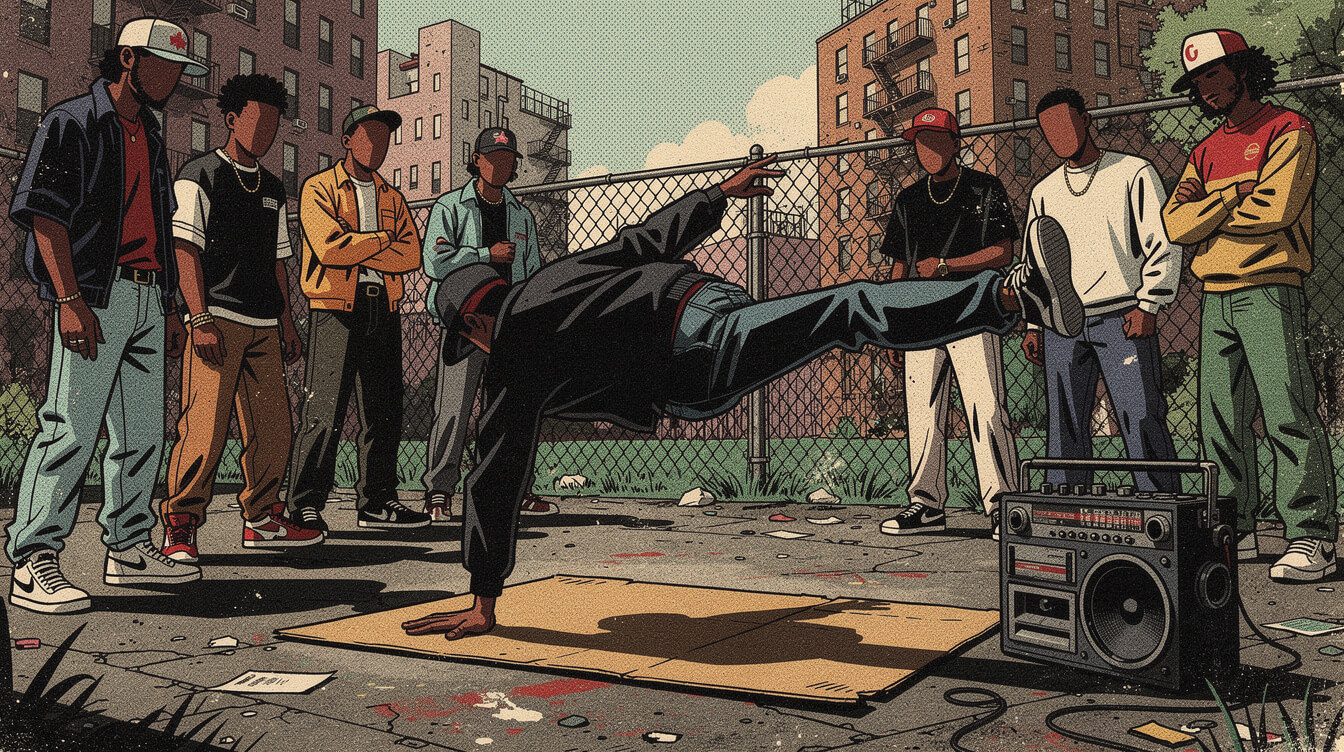
Call it breakdancing if you have to, but the people who built it call it breaking, and the dancers are b-boys and b-girls. Both terms come from Kool Herc, who named the dancers at his parties “break-boys” and “break-girls.” Herc has also pointed out that “breaking” was already street slang for getting hyped or causing a commotion, so the name fit the energy as much as the drum breaks.
Built for the Break
Breaking and DJing grew up together. Herc noticed the dancers saved their best moves for the drum breaks, so he started stringing breaks together just for them: “Apache,” “The Mexican,” Yellow Sunshine’s “Yellow Sunshine.” People started showing up just to watch. Core parts of the dance took shape in that feedback loop. Toprock, the upright footwork that opens a set, developed at Herc’s parties as a way for dancers to claim space before they went down to the floor. Early breakers like Richard “Crazy Legs” Colón and Kenneth “Ken Swift” Gabbert have named James Brown and Bruce Lee kung fu films as influences, which is why so much classic breaking looks like a fight scene set to funk.
Rock Steady Crew Takes It Worldwide
The crew most responsible for taking breaking out of the Bronx was Rock Steady Crew, started by Jimmy Dee and Jimmy Lee to keep “the rock” (the dance) steady and alive, and later led by Crazy Legs. In 1981, photographer Henry Chalfant, who came to breaking through his work documenting graffiti, set up a battle between Rock Steady and the Dynamic Rockers at Lincoln Center that got coverage from ABC News and the New York Times. Then came the movies: Rock Steady landed a part in Flashdance, and breaking was in Wild Style and later Beat Street. When Wild Style opened in Japan, Rock Steady toured with it and started a breaking scene there. We broke down both films in our pieces on the Wild Style movie and the Beat Street movie.
From Cardboard to the Olympics, and Back
About fifty years after Herc’s rec room, breaking became an Olympic sport. It debuted at the 2018 Youth Olympic Games in Buenos Aires, then at the 2024 Summer Olympics in Paris, where Canada’s Philip “Phil Wizard” Kim took men’s gold, sweeping France’s Danis “Danny Dan” Civil. It was a one-Games run: the LA28 organizers left breaking off the 2028 program and picked baseball-softball, cricket, flag football, lacrosse and squash instead. Nobody in the culture is waiting on the IOC, though. The cyphers were there before the medals and they’ll be there after.
Element Four: Graffiti Writing, the Culture You Can See
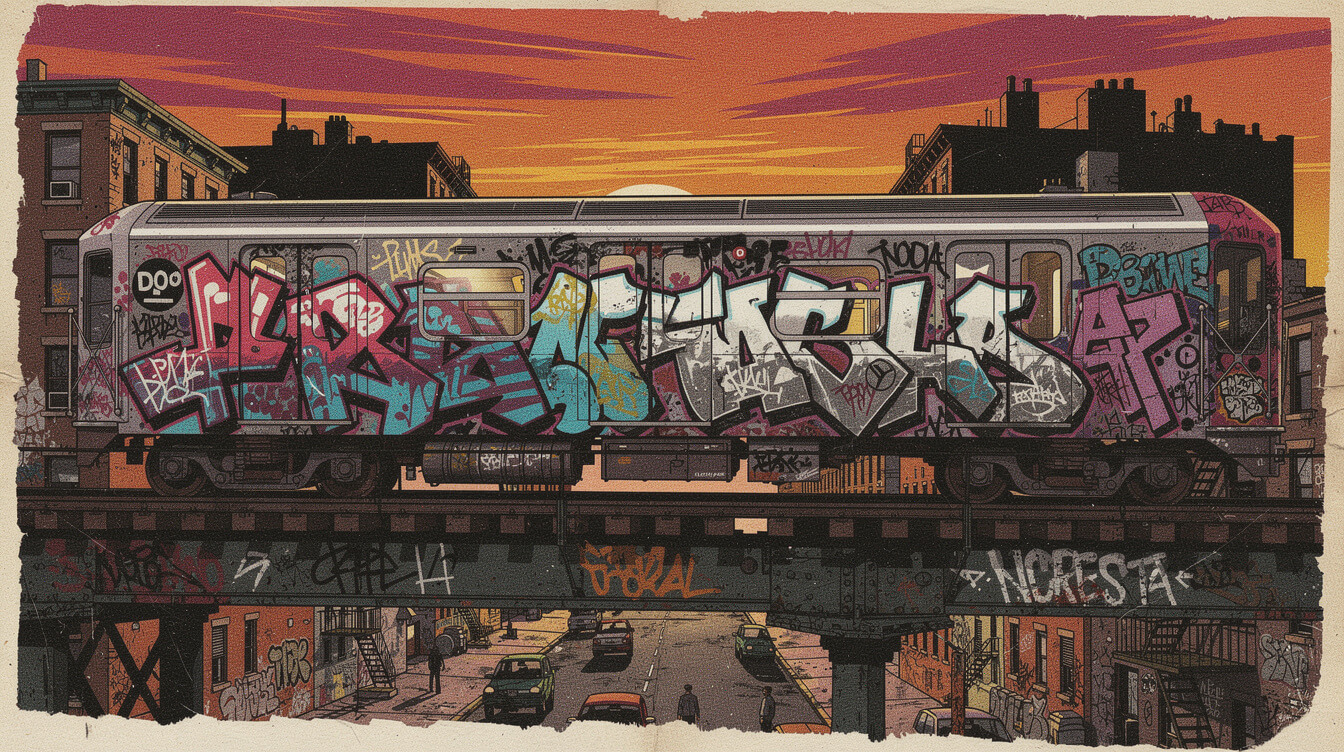
Graffiti is the element with the longest prehistory and the strangest relationship to the rest. Writers were bombing before Herc ever cued a break. What made it part of hip-hop was the shared scene: the same neighborhoods, the same kids, the same “make your name known” attitude in a city that ignored them.
TAKI 183 and the Name Game
Modern name-based writing got rolling in Philadelphia in the mid-1960s, where writers like Cornbread and Cool Earl started putting up oversized signatures. In New York the breakout name was TAKI 183, a bicycle messenger whose tag spread across the city as he made deliveries. A 1971 New York Times article on him turned a neighborhood habit into a citywide competition. Writers like Tracy 168 kept pushing in the same early-’70s wave. The basic logic of the element was set: get your name up, get it up everywhere, and get it up with more style than anyone else.
From Tags to Wildstyle
Tags became throw-ups, throw-ups became pieces (short for masterpieces), and pieces turned into whole cars. Fab 5 Freddy has described how lettering styles from Upper Manhattan and Brooklyn started merging in the late 1970s, and “out of that came ‘Wild Style'”: interlocking, arrowed, nearly unreadable letters that became the visual signature of the culture. Freddy is also the figure most often credited with connecting graffiti and rap uptown to the downtown art and music world, which led to gallery shows for writers like Dondi and Futura 2000 and to documentaries like Style Wars (1983). That visual language never left. It runs through every album cover, flyer and graphic tee covered in our complete visual history of hip-hop artwork.
May 12, 1989: The Day the Trains Went Clean
The subway was graffiti’s gallery, and the city went after it hard. In April 1984 the new president of the New York City Transit Authority, David Gunn, launched the Clean Car Program: once a car went into the program, it was pulled from service if it got bombed. On May 12, 1989, the MTA declared victory when the last graffiti-covered car was taken out of service. That date ended the era of whole-car burners running through every borough, but it didn’t end the element. Writers moved to walls, freight trains, canvases, and eventually brand collabs and museum shows. It’s the same arc as breaking: pushed off the street, back with more reach than before.
The 5th Element and Beyond: Why the 4 Elements of Hip Hop Kept Growing
Ask an old-school head to name the elements and there’s a good chance you’ll hear five, not four. The list was never sealed, and the people who added to it were the same pioneers who drew it up in the first place.
Knowledge: The One That Holds It Together
Bambaataa himself said the Zulu Nation had four elements (the DJs, the rappers, the dancers and the artists) and added a fifth: knowledge, the thing that “holds it all together.” In the Zulu Nation sense, knowledge means knowing the culture’s history and its pioneers, and also knowledge of self: using the culture to build understanding instead of just entertainment. It’s the most debated element because you can’t battle with it, but it’s also why so many hip-hop heads are part-time historians. Knowing the lineage is part of the culture.
Some lists offer beatboxing as the fifth element instead. Beatboxing, making drum machine and turntable sounds with your mouth, comes out of the same block parties, and that’s why it shows up in so many school assignments and playlists. In the culture’s own institutions, though, knowledge is the canonical fifth.
KRS-One’s Nine Elements
Nobody pushed the list further than KRS-One. Lawrence Parker came up with Boogie Down Productions alongside DJ Scott La Rock. Their debut, Criminal Minded, dropped in May 1987, and La Rock was shot and killed later that year while trying to defuse a dispute. KRS answered by founding the Stop the Violence Movement, which produced the 1989 posse cut “Self Destruction,” and then spent decades as the culture’s self-appointed teacher. He founded the Temple of Hip Hop to preserve and teach what he calls “Hiphop Kulture,” and it asks fans to mark Hip Hop Appreciation Week every third week of May.
In a 1999 lecture at Harvard, and later on a track literally titled “9 Elements,” KRS laid out nine:
- Breaking
- Emceeing
- Graffiti art
- Deejaying
- Beatboxing
- Street fashion
- Street language
- Street knowledge
- Street entrepreneurialism
The point of the longer list is the same point as the original four: hip-hop is not a music genre, it’s “an attitude, an awareness, a way to view the world,” as KRS puts it. Street fashion being on that list is why the tee on your back counts. Our KRS-One Return of the Boom Bap T-Shirt is a nod to the Teacha who put fashion on the syllabus. For the deeper fashion lineage, our guide to hip-hop fashion traces how that element built an industry, and our KRS-One birthday piece covers more of his catalog.
So, Four, Five or Nine?
All of them, depending on what you’re asking. The 4 elements of hip hop are the foundation, not the ceiling. If you mean the core art forms that developed side by side at Bronx parties in the 1970s, it’s four. If you’re asking what the Zulu Nation tradition teaches, it’s five, with knowledge holding it together. If you’re asking KRS-One, it’s nine, because to him hip-hop is a whole way of life. None of these lists cancels the others. They’re the same culture counted at different zoom levels.

Wear the Teacha’s First Lesson
Before the Temple of Hip Hop and the nine elements, there was a 1987 Bronx record from KRS-One and Scott La Rock. We made a Boogie Down Productions Criminal Minded T-Shirt for the heads who started their syllabus there.
4 Elements of Hip Hop: Frequently Asked Questions
What are the 4 elements of hip hop?
DJing (turntablism), MCing (rapping), breaking (b-boying and b-girling) and graffiti writing. They developed side by side in the Bronx in the 1970s and were grouped as hip-hop’s core disciplines by Afrika Bambaataa’s Universal Zulu Nation.
Who created the four elements of hip hop?
No single person invented all four. Kool Herc is credited with the breakbeat DJing that set it off in 1973, Coke La Rock and the early crews built MCing, Bronx dancers and crews like Rock Steady built breaking, and writers from TAKI 183 onward built graffiti. The Zulu Nation is credited with packaging them as “elements” of one culture.
What is the fifth element of hip hop?
In the Zulu Nation tradition, the fifth element is knowledge: knowing the culture’s history and knowledge of self. Some sources name beatboxing as the fifth element instead.
What are KRS-One’s 9 elements of hip hop?
Breaking, emceeing, graffiti art, deejaying, beatboxing, street fashion, street language, street knowledge and street entrepreneurialism.
Which element came first?
Graffiti writing predates the others as a scene, with name-based writing in Philadelphia in the mid-1960s and New York by the early ’70s. As a culture organized around parties, hip-hop’s starting point is usually given as DJ Kool Herc’s August 11, 1973 party at 1520 Sedgwick Avenue, where DJing, MCing and dancing were all happening in one room.
Is breaking still an Olympic sport?
Breaking debuted at the Paris 2024 Olympics, but LA28 organizers did not include it on the 2028 program.
Is “breakdancing” the right word?
Practitioners generally prefer “breaking,” and the dancers are b-boys and b-girls, terms that go back to Kool Herc’s parties. “Breakdancing” is the term the media popularized.
Final Thoughts: Four Ways In, One Culture
The best thing about the 4 elements of hip hop is that they’re an invitation. Not everybody can rap. Somebody who couldn’t rhyme could still cut a break, hold a freeze or burn a wall, and in 1970s Bronx terms they were just as much a part of it as the voice on the mic. That’s still true. Spinning records in your bedroom, practicing toprock in the kitchen, filling sketchbooks with letters, or just knowing the history cold: each one is a legit way in.
So next time someone says hip-hop is “just music,” you’ve got fifty-plus years of receipts. A rec room at 1520 Sedgwick. A Merry-Go-Round of breaks. A bicycle messenger’s tag in the New York Times. A Lincoln Center battle. A clean train on May 12, 1989. And a Teacha with a list of nine. Pick your element and put in the work.
Stay creative — The Custom Creative Team
Get the Knowledge, Weekly
Culture history, sample receipts, and new drops from the Custom Creative crew, straight to your inbox. Call it the fifth element.

🎧 Never Miss a Drop
Exclusive product releases, hip-hop deep dives, and member-only discounts. Straight to your inbox.
Free forever. No spam. Unsubscribe anytime.
Get the Culture, Delivered
Deep dives into hip-hop history, exclusive product drops, and discounts sent straight to your inbox. No spam, just culture.
Join 2,000+ hip-hop heads already in the loop. Unsubscribe anytime.