Def Jam Records: From Rick Rubin’s NYU Dorm to the Label That Ran Hip-Hop for Four Decades
Def Jam Records started with a punk band, a dorm room and a kid who credited himself as “reducer” instead of producer. Forty-plus years later it’s the most famous logo in rap. It put out LL Cool J’s first single, the first rap album to top the Billboard 200, Public Enemy’s two most political records, DMX’s two No. 1 albums in one year, and a stretch where Jay-Z ran the front office. Most label histories flatten all of that into one highlight reel. This one goes era by era, with the catalog numbers, the deal sizes and the founders’ stories that don’t match.
Quick map before we dig in. The history of Def Jam Records breaks into four eras: the dorm-room independent (1984–1988), the near-death and rebuild under Lyor Cohen (1988–1997), the DMX/Roc-A-Fella money years (1997–2004), and the corporate era that runs from Jay-Z’s presidency to today’s Universal-owned label. Each one has its own sound, its own boss and its own artists. If you’ve already seen the movie version, our piece on Krush Groove, the 1985 Def Jam origin film, covers how Hollywood told it first.
How Def Jam Records Started: A Dorm Room at Weinstein Hall
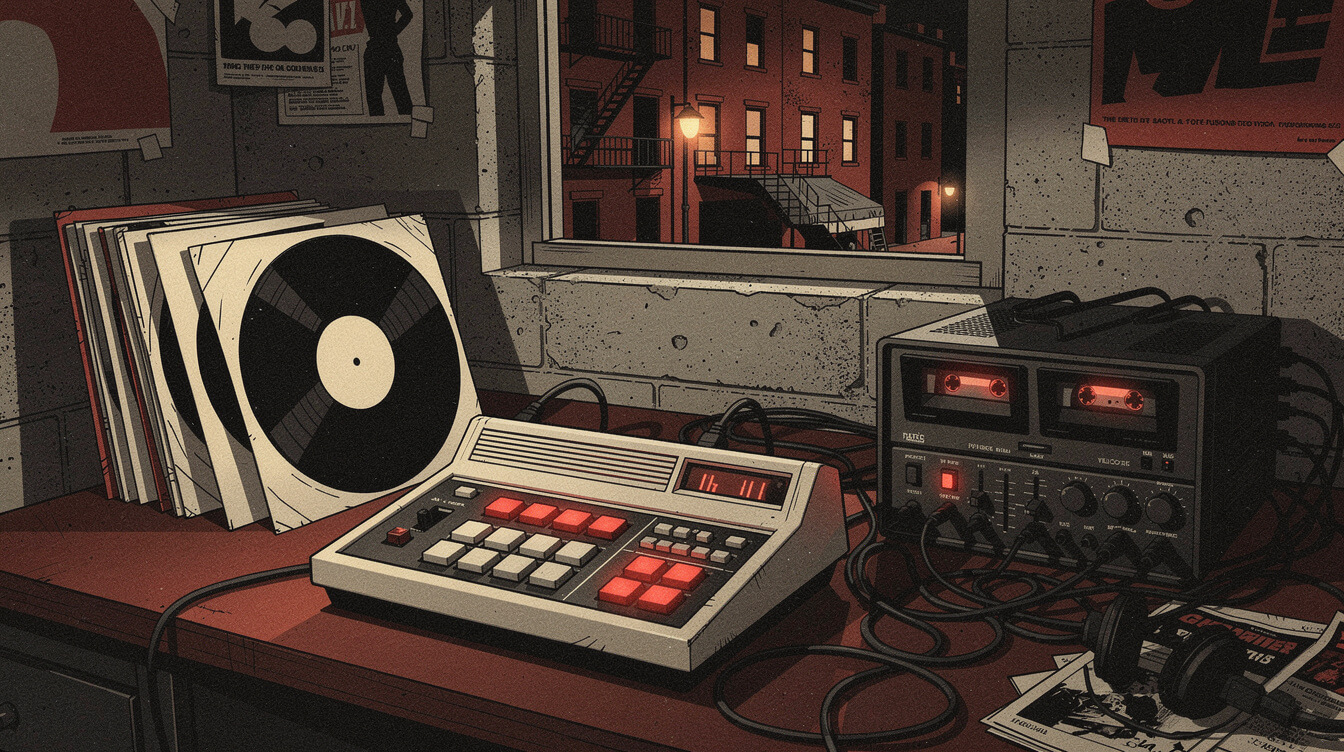
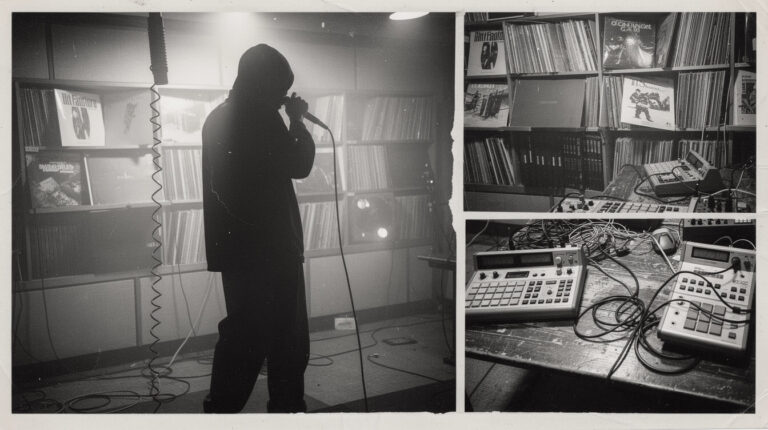
The label began in room 712 of Weinstein Hall, an NYU dormitory, where a Long Island student named Rick Rubin was making noise with a punk band called Hose. The first record to carry the Def Jam name wasn’t rap at all: it was a Hose release that Discogs dates to 1982. That’s why you’ll see founding years from 1982 to 1984 depending on who you read. The safest way to put it: Rubin was using the Def Jam name by 1982–83, and the label as a real business, with Russell Simmons as an equal partner, launched in 1984.
“It’s Yours”: The Record That Brought Simmons In
Rubin’s first rap production was T La Rock & Jazzy Jay’s “It’s Yours” (1984). It has the Def Jam logo on the label, but look at the catalog number: PT 104. It came out on Partytime, a sub-label of Arthur Baker’s Streetwise Records, not on Def Jam proper. That detail matters later. When Def Jam signed its distribution deal with CBS, “It’s Yours” and the Hose records weren’t part of it, and they’re still controlled by other companies today.
Every version of the founding story agrees on one thing: Russell Simmons heard “It’s Yours” and wanted to know who made it. Simmons was already established. He ran Rush Artist Management, which handled Run-DMC, Kurtis Blow and Whodini. Rubin later said Simmons was five years older, already in the business, and “the face of hip hop,” while he himself had no experience at all.
The Founders Can’t Agree on How They Met
Here’s a jewel most histories skip: the two founders tell different stories about the meeting. In the label’s 25th-anniversary book, Simmons traces it through Red Alert and Jazzy Jay to an introduction at Danceteria. Rubin places it at the party for Michael Holman’s TV show Graffiti Rock. Wikipedia adds a third version, Jazzy Jay making the connection at the club Negril. We’re not going to pick a winner. The fact that the most documented label in rap can’t settle its own origin story says everything about how fast it moved.
DJ001 and DJ002: The Catalog Starts
The first records with real Def Jam catalog numbers came out in 1984. DJ001 was LL Cool J’s “I Need a Beat,” a demo-tape kid from Queens over a bare drum machine. DJ002 was the Beastie Boys’ “Rock Hard.” The credit on DJ001 reads “Reduced by Rick Rubin,” and the same joke shows up on LL’s debut album. It’s Rubin telling you his whole philosophy in three words: strip the record down until only the hardest parts are left.
The singles sold well enough that in 1985 Def Jam signed a distribution deal with CBS through Columbia Records, reported at $600,000. LL’s Radio (November 18, 1985, Columbia catalog FC 40239) became the label’s first album and went platinum in 1988. Same year, Hollywood fictionalized the whole operation as “Krush Groove Records,” with Rubin playing himself.
The Logo
The Def Jam logo, the one with the fat, offset “D” and “J,” is usually credited to Rubin himself, assembled from press-on lettering. Treat the details as label lore; the primary sourcing is thin. What isn’t lore is how far it travelled. It’s the rare record-label mark that people wear without being fans of any single artist on it.
The Golden Age Def Jam Roster: LL, the Beasties, Public Enemy and Slick Rick
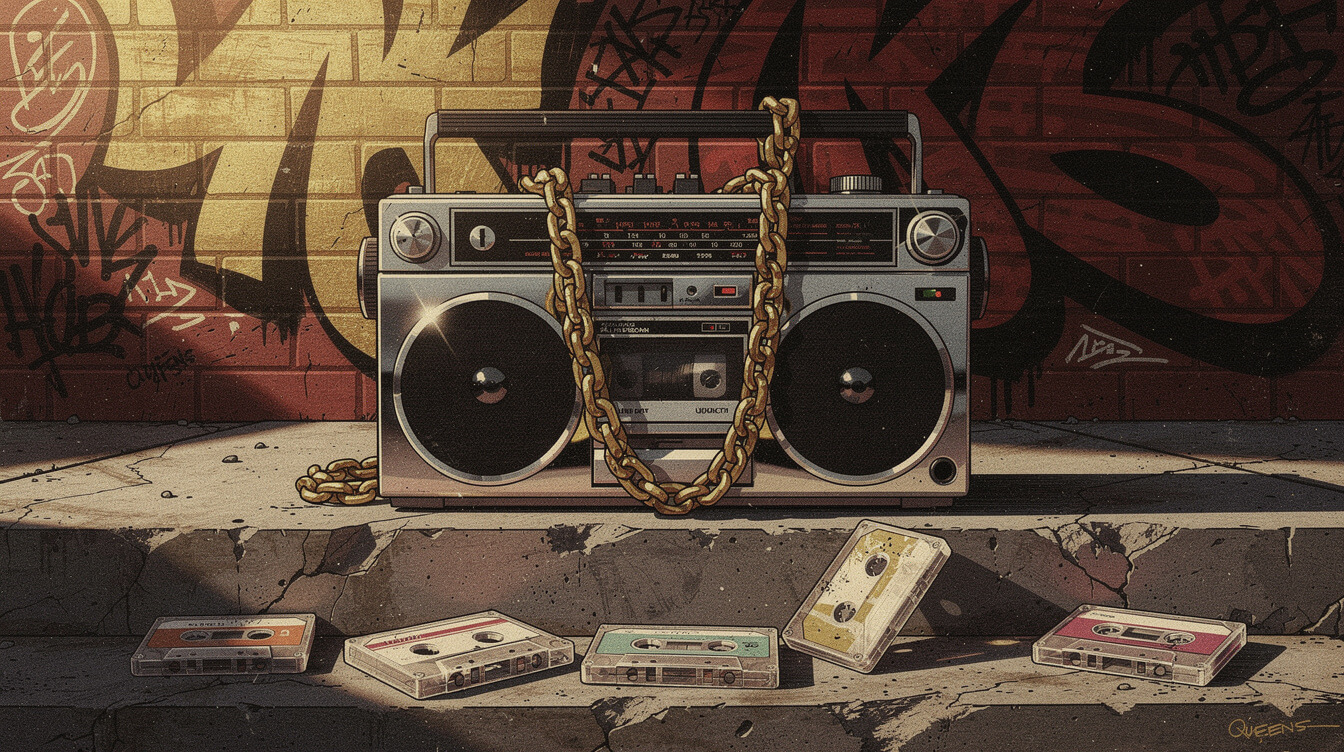
Between 1985 and 1990, Def Jam’s run of releases was strong enough to define what “golden age” means. Four acts carried it.
LL Cool J
LL was the label’s first signing and its first star. After Radio came 1987’s Bigger and Deffer and the run that made him rap’s first real heartthrob without going soft on the bars. We’ve broken down his whole wardrobe history in our LL Cool J t-shirt guide, and the LL Cool J Bigger and Deffer T-Shirt is our nod to the BAD era.
Beastie Boys: First Rap Album to Hit No. 1
Licensed to Ill came out on November 15, 1986, and reached No. 1 on the Billboard 200 on March 7, 1987, the first rap album ever to top that chart. The RIAA certified it Diamond (10 million) on March 4, 2015. Then the Beasties walked. They signed with Capitol in 1988, and Paul’s Boutique (July 25, 1989) is a Capitol record, not Def Jam, even though plenty of fans assume otherwise. The split came with lawsuits running in both directions over royalties and contract claims. If you rep the Def Jam years, the Beastie Boys Licensed To Ill Hoodie is the one.
Public Enemy
The Public Enemy signing ran through college radio. In the usual telling, Rubin heard Chuck D’s work from WBAU, the Adelphi University station, and courted him hard, and Bill Stephney, another WBAU alum, came aboard partly to help close the deal. What followed: Yo! Bum Rush the Show (1987), It Takes a Nation of Millions to Hold Us Back (June 28, 1988, platinum in 1989) and Fear of a Black Planet (April 10, 1990, platinum within two months). All of them were Def Jam/Columbia releases. Our Public Enemy members guide covers who did what, including the Bomb Squad. The Public Enemy Fear of a Black Planet Hoodie carries that era.
Slick Rick
The Great Adventures of Slick Rick dropped on November 1, 1988, and went platinum in October 1989. It’s the label’s storytelling masterpiece, and it peaked at only No. 31 on the Billboard 200, which tells you how far ahead of the charts Def Jam was running. We ranked his essentials in Slick Rick songs, decoded, and the Great Adventures of Slick Rick T-Shirt is in the shop.
The Deep Cuts: OBR, Slayer and 3rd Bass
Def Jam was never only rap. Its R&B imprint, OBR (Original Black Recordings), launched with Oran “Juice” Jones, whose “The Rain” reached No. 9 on the Hot 100 in 1986. Rubin also signed thrash band Slayer, the label’s only metal act. Then there’s 3rd Bass: The Cactus Album (November 1989, gold in 1990) includes “The Gas Face,” the first appearance on record of a young Zev Love X, who later became MF DOOM.
Broke at Sony: Lyor Cohen, RAL and the Mid-’90s Def Jam Rebuild
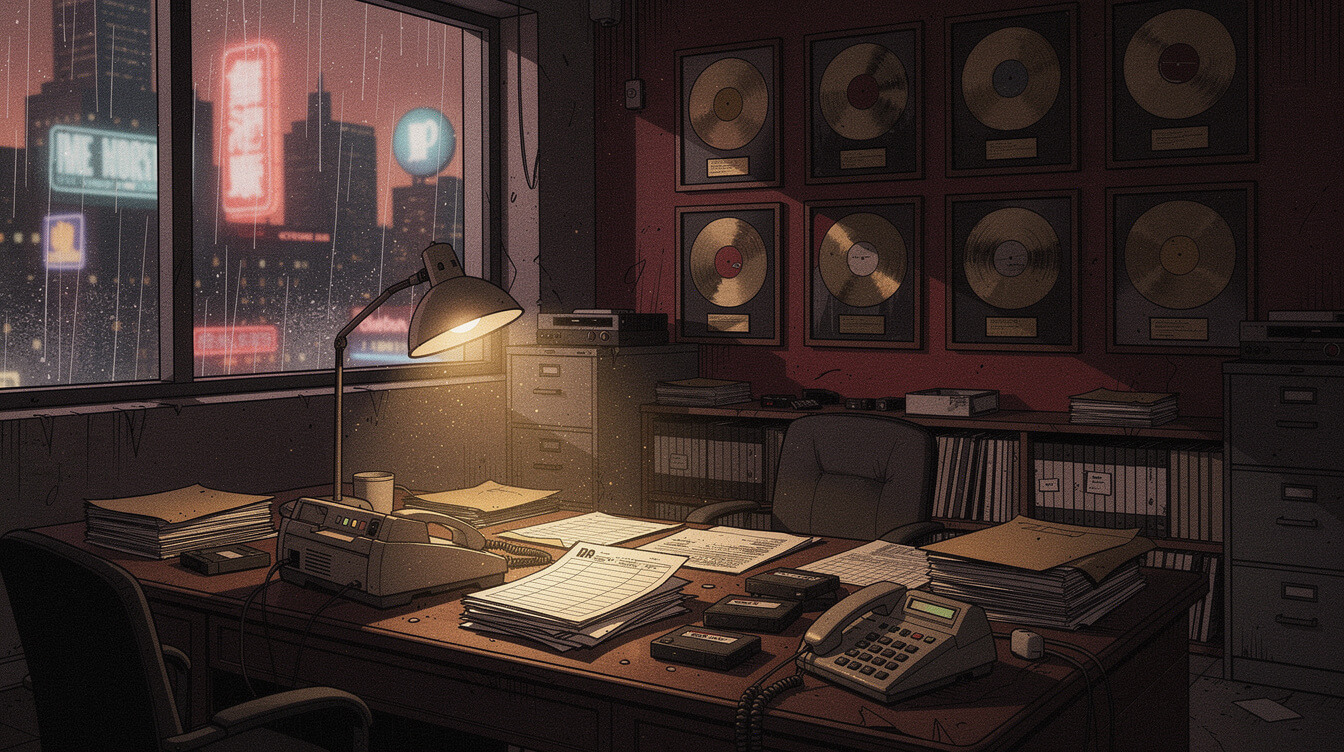
Def Jam’s founders were always pulling in different directions. Simmons loved R&B like Oran “Juice” Jones; Rubin was making Slayer records. In a VladTV interview later quoted by Trapital, Simmons put it plainly: he was making “Walking in the Rain” while Rubin was making thrash metal, and Rubin and Lyor Cohen didn’t get along. In 1988 Cohen, who had come up as Run-DMC’s road manager at Rush, won the power struggle and became president of Def Jam/RAL. Rubin left to start Def American, distributed through Geffen, and took Slayer with him.
What RAL Was For
RAL, short for Rush Associated Labels, was the umbrella Simmons and Cohen set up for Def Jam’s spin-offs. When Sleeping Bag Records and its sister label Fresh folded, RAL picked up two of their acts: Nice & Smooth and EPMD. A detail fans often get wrong: EPMD’s Strictly Business (1988) was a Fresh Records album. Their Def Jam story begins with Business as Usual (December 18, 1990), the first RAL release, gold by May 1991, and the first time Redman appeared on record.
The Sony Years and the Near-Collapse
In 1991, CBS Records became part of Sony, and Def Jam moved with it. By 1992, despite multi-platinum Public Enemy and EPMD records, the label was in serious financial trouble and was close to folding. The same year, a young intern named Kevin Liles walked in the door. Six years later, at 30, he was the president of Def Jam.
The Rebuild Ran on Hardcore New York Rap
The comeback started with Redman’s Whut? Thee Album (September 22, 1992), gold by mid-1993. Onyx’s Bacdafucup (1993, via Jam Master Jay’s JMJ imprint under RAL) went platinum within seven months. In 1994, PolyGram bought Sony’s 50% stake, which moved Def Jam into the Island family, and later took another 10%. Then the hits stacked:
- Warren G, Regulate… G Funk Era (June 1994, Violator/RAL): triple platinum, and much-needed revenue from the West Coast.
- Method Man, Tical (November 15, 1994): platinum by July 1995. Full story in our Method Man Tical breakdown, and the Method Man Tical Tribute Tee lives in the shop.
- Montell Jordan, “This Is How We Do It”: a No. 1 Hot 100 single, with a platinum album in 1995.
- Foxy Brown, Ill Na Na (November 1996): platinum by February 1997.
LL Cool J’s Mr. Smith (1995) brought the label’s first star back to form. A couple of years after nearly folding, Def Jam was making money again.
1998: DMX, the Roc and the Sale of Def Jam Records
Def Jam Records’ most important year was a business story as much as a music story. Two moves set it up.
The Roc-A-Fella Deal
In June 1997, Def Jam bought 50% of Jay-Z, Damon Dash and Kareem “Biggs” Burke’s Roc-A-Fella Records. The reported price was about $1.4–1.5 million, depending on the source. Reasonable Doubt had been a Priority-distributed release; In My Lifetime, Vol. 1 (November 1997) was Jay’s first album under the Def Jam deal. In 2004, Island Def Jam bought the other half of the Roc for $10 million. We told the whole Roc story in Roc-A-Fella Records, fully decoded.
DMX: Two No. 1 Albums in One Calendar Year
Also in 1997, Def Jam A&R Irv Gotti brought DMX to the label after a showcase for Lyor Cohen. It’s Dark and Hell Is Hot arrived in May 1998 (sources split between the 12th and the 19th), debuted at No. 1 with about 251,000 first-week copies, and was certified 4x platinum by the end of 2000. Then Cohen challenged X to deliver another album before the year was out. Flesh of My Flesh, Blood of My Blood came out on December 22, 1998 and debuted at No. 1 with roughly 670,000 copies. The calendar detail: its No. 1 run actually landed on January 1999 charts, three weeks at the top. We go album by album in DMX albums in order.
Why the Rush? The Sale
Here’s the jewel. In 1998 Seagram bought PolyGram, which by then owned 60% of Def Jam, and wanted the rest. On the Trapital podcast, Forbes writer Zack O’Malley Greenburg explained that the buyer valued Def Jam on a multiple of revenue. So Def Jam set out to maximize revenue, and two albums from its biggest star in one year did exactly that. Trapital, citing a 1999 Los Angeles Times report, puts the label’s 1998 sales at an estimated $176 million. In 1999 Universal bought Simmons’ remaining stake, at a reported $100–120 million (sources disagree on the figure). DMX later said Def Jam made $144 million off his first two albums. That’s his claim, not an audited number, but you can see why he made it.
The Universal deal folded Def Jam, Island and Mercury into the Island Def Jam Music Group at the turn of 1999. Cohen became co-president of the group, and Liles moved up to run Def Jam. The money years kept coming: Irv Gotti’s Murder Inc. (Ja Rule’s Venni Vetti Vecci, June 1, 1999), DMX’s third straight No. 1 with …And Then There Was X, and a Def Jam South office in Atlanta headed by Scarface, which signed Ludacris and his Disturbing tha Peace crew.

The Album That Started Def Jam’s Biggest Year
A No. 1 debut, 4x platinum, and the first half of the double that defined Def Jam’s biggest year. We made the DMX It’s Dark and Hell Is Hot T-Shirt for the ones who were there in ’98.
Jay-Z, President: Running Def Jam From the Corner Office (2005–2007)

In 2004 the old guard left. Lyor Cohen went to Warner Music Group, and Kevin Liles and Julie Greenwald followed him. Antonio “L.A.” Reid took over Island Def Jam. On December 8, 2004, Reid named Jay-Z president of Def Jam, effective at the start of 2005. Jay went from being the label’s best-selling rapper to signing its checks.
What Happened Under Jay
- Rihanna auditioned for Jay-Z and Reid in early 2005. “Pon de Replay” came out that May, and Music of the Sun followed in August.
- Ne-Yo‘s solo career also took off on Jay’s watch.
- Young Jeezy‘s Let’s Get It: Thug Motivation 101 (July 2005) debuted at No. 2. Give the credit to A&R Shakir Stewart, who signed and co-executive-produced it, not to Jay-Z.
- Jay-Z’s own Kingdom Come (November 21, 2006) sold about 680,000 in its first week, the biggest opening of his career, released while he was running the label.
A Common Misconception: Kanye
Kanye West is often listed as a “Jay-Z presidency” success. He wasn’t. The College Dropout came out in 2004 on Roc-A-Fella/Def Jam, before Jay took the job. The Blueprint connection goes back further; see our Blueprint at 25 piece.
The Friction and the Exit
Not everyone liked the new boss. Label veterans LL Cool J and DMX, plus new signee Joe Budden, were uneasy with Jay-Z running the label, and all three eventually left. Jay announced on December 24, 2007 that he wouldn’t renew. His contract ran out at the end of that month, and he moved on to Roc Nation, his venture with Live Nation. Reid ran Def Jam directly after that rather than hiring a replacement.
Is Def Jam Records Still Active? The Label in 2026
Yes. Def Jam Records is still active in 2026, owned by Universal Music Group. It isn’t the swaggering independent it once was, though. Here’s the short version of the last 15 years.
The Leadership Carousel
L.A. Reid left in March 2011 for The X Factor. Barry Weiss ran Universal’s East Coast labels until Island Def Jam Music Group was dissolved on April 1, 2014, when Def Jam, Island and Motown became separate labels again. Steve Bartels was CEO by 2014. Paul Rosenberg, Eminem’s longtime manager, ran the label from January 2018 until he stepped down on February 21, 2020, with Jeffrey Harleston as interim chief. Tunji Balogun became chairman and CEO on January 1, 2022.
Latest: in October 2026, Black Enterprise and other outlets citing Music Business Worldwide reported that Balogun will leave by the end of the year as part of a UMG cost-cutting program. He’s staying through the transition, and no successor had been named when this piece went live.
The Roster Story
Def Jam’s partnership with Kanye West’s GOOD Music became public news in October 2022, but UMG said the artist deal, the GOOD partnership and the merch arrangement had all ended in 2021. Pusha T’s It’s Almost Dry (April 22, 2022) debuted at No. 1 and finished his Def Jam contract. In 2025, Clipse left Def Jam before Let God Sort Em Out, which came out that July through Roc Nation. Accounts differ on whether they were dropped or paid their way out, and Def Jam kept a share of the album.
The legacy side is alive too. In September 2019 the label re-signed LL Cool J and DMX. DMX passed in April 2021, and Def Jam released his posthumous album Exodus a month later. LL’s The FORCE (2024) was his first album for the label since 2008. For the label’s 40th birthday in 2024, New York City Council named January “Def Jam Month,” and LL led a Def Jam tribute at the 2024 VMAs with Chuck D and Flavor Flav. Under UMG’s 2024 reorganization, Def Jam now sits inside the Republic Corps unit alongside Republic, Island, Motown and Mercury.
The Global Def Jams
The name now spans continents: 0207 Def Jam in London (Stormzy’s home), Def Jam Japan, Def Jam South East Asia (launched 2019), Def Jam India (2022) and Def Jam Africa. Whatever happens in the CEO’s office, the logo is now an international franchise.
Def Jam Vendetta, Fight for NY and Why the Def Jam Brand Still Hits
“Def Jam game” is one of the top related searches for this label, and with reason. Def Jam may be the only record label that also ran a hit fighting-game series.
Def Jam Vendetta (2003)
EA’s Def Jam Vendetta was developed by AKI with EA Canada. It shipped on April 1, 2003 for PlayStation 2 and GameCube. The cast included DMX, Method Man, Redman, Ludacris, Scarface and Ghostface. Method Man’s performance as himself, and Christina Milian’s as Angel, both earned Interactive Achievement Award nominations for voice acting.
Def Jam: Fight for NY (2004)
The sequel landed in September 2004 on PS2, GameCube and Xbox, and it’s the one most fans remember. Snoop Dogg played Crow. Busta Rhymes, Lil’ Kim, Ice-T, Method Man & Redman, Ludacris, Ghostface and more appeared alongside actors like Danny Trejo and Henry Rollins. For a generation of kids, that game was their first introduction to half the Def Jam roster.
Why the Logo Still Means Something
Most record labels are invisible to fans. Def Jam turned itself into a brand you could wear, play and watch. After the sub-label era, Def Jam also became infrastructure: Roc-A-Fella, Murder Inc. and Disturbing tha Peace each ran their own scene under one umbrella. Trapital’s Dan Runcie compared that model to an institutional VC backing emerging fund managers. It’s the same lesson running through our label series, from Rap-A-Lot Records to Stones Throw at 30: the label that lets its people build their own lanes lasts longest.
Def Jam Records FAQ
Who founded Def Jam Records?
Rick Rubin and Russell Simmons. Rubin started using the Def Jam name from his NYU dorm room around 1982–83, and the label launched as a Rubin–Simmons partnership in 1984. Rubin left in 1988; Simmons sold his remaining stake to Universal in 1999.
What was the first Def Jam release?
It depends on what you count. The first record with the Def Jam name was by Rubin’s punk band Hose. The first rap record with the logo was T La Rock & Jazzy Jay’s “It’s Yours” (on Partytime). The first official catalog number, DJ001, was LL Cool J’s “I Need a Beat” in 1984.
When did Jay-Z become president of Def Jam?
He was named president on December 8, 2004, took the job at the start of 2005, and left when his contract ended in December 2007.
Who owns Def Jam today?
Universal Music Group, which bought out Russell Simmons in 1999. Since UMG’s 2024 reorganization, the label sits inside the Republic Corps unit.
Who is the CEO of Def Jam?
Tunji Balogun has been chairman and CEO since January 2022. In October 2026 he was reported to be leaving by year’s end, with no successor named yet.
Were the Beastie Boys’ Paul’s Boutique and EPMD’s Strictly Business on Def Jam?
No to both. Paul’s Boutique was the Beasties’ first Capitol album after they left Def Jam. EPMD’s Strictly Business came out on Fresh Records. Their Def Jam debut was 1990’s Business as Usual, through RAL.
What was the first rap album to hit No. 1 on the Billboard 200?
The Beastie Boys’ Licensed to Ill, a Def Jam release, on March 7, 1987.
Final Thoughts: Four Eras, One Logo
Def Jam Records has outlived its founders, the label it was sold to, and a dozen bosses. In every era it’s been a little different: Rubin’s stripped-down dorm-room records, Cohen’s hardcore New York rebuild, the DMX and Roc-A-Fella money years, and the corporate global brand of today. What stayed constant is that fat-lettered logo and a catalog that maps most of rap’s first 40 years.
If you want one piece of the original run, start with the radio era. The LL Cool J I Can’t Live Without My Radio Hoodie is a tribute to the album that started the catalog: Def Jam’s first LP, “reduced by Rick Rubin.” Then play Radio start to finish and hear how little it took to build an empire.
Stay creative.
Get the Culture in Your Inbox
Label histories, catalog receipts, anniversaries and first dibs on new drops. No spam, just hip-hop.

🎧 Never Miss a Drop
Exclusive product releases, hip-hop deep dives, and member-only discounts. Straight to your inbox.
Free forever. No spam. Unsubscribe anytime.
Get the Culture, Delivered
Deep dives into hip-hop history, exclusive product drops, and discounts sent straight to your inbox. No spam, just culture.
Join 2,000+ hip-hop heads already in the loop. Unsubscribe anytime.