Goodie Mob Members: CeeLo, Khujo, T-Mo and Big Gipp, the Full Story From the Dungeon to the Farewell
Before trap had a name, before Atlanta ran the charts, there were four young men in a red-clay basement turning street sermons into records. The Goodie Mob members are CeeLo Green, Khujo, T-Mo and Big Gipp, and between 1991 and 2025 they gave the South its conscience, gave rap the phrase “Dirty South” its first big stage, and showed the whole region it could make music as heavy as anything out of New York or LA. Most people know CeeLo. Fewer could tell you who rapped the only Goodie Mob verse on “Dirty South,” which member lost a leg in a 2002 crash and kept recording, or why the group’s 30th-anniversary show never happened.
This is the full story of the Goodie Mob members: who each man is, how the Dungeon built them, the albums and splits and reunions, and where all four stand in late 2026. Every chart number and certification below has been checked against Billboard’s chart history and the RIAA database, because Goodie Mob heads will catch a wrong year in a heartbeat.
Who Are the Goodie Mob Members? The Lineup at a Glance

Goodie Mob is a four-man rap group from Atlanta, Georgia, formed in 1991 and raised inside the Dungeon Family collective alongside OutKast and the production team Organized Noize. The lineup never changed. It just took a few detours. Here are the four Goodie Mob members, by their government names:
- CeeLo Green (Thomas DeCarlo Callaway, born May 30, 1975, Atlanta): the singer, the preacher, the wild card. Later half of Gnarls Barkley and a five-time Grammy winner.
- Khujo (Willie “Khujo” Knighton Jr.): the gruff voice. Pronounced “Coo-Joe.” Street-level storyteller with a deep spiritual streak.
- T-Mo (Robert “T-Mo” Barnett): the energy. Khujo’s original partner in the duo the Lumberjacks.
- Big Gipp (Cameron Gipp, born in East Point, Georgia): the slow, low, drawn-out baritone. Later one half of Ali & Gipp.
What does “Goodie Mob” stand for?
It’s a backronym. On “Fighting,” the deep cut on their 1995 debut Soul Food, CeeLo closes with a near minute-and-a-half sermon that spells it out: “The Good Die Mostly Over Bullsh*t.” In the same breath he flips it a second way: “God Is Every Man of Blackness.” That double meaning tells you everything about the group. Street survival on one side, spiritual uplift on the other, and no contradiction between them.
Were there ever other Goodie Mob members?
No. This trips people up because the Dungeon Family was crowded and the credits overlap. Cool Breeze, Big Rube, Witchdoctor and Sleepy Brown all appear on Goodie Mob records, but none of them were ever in the group. Cool Breeze in particular gets mistaken for a fifth member because he has two verses on “Dirty South.” The Quietus put it plainly in its 20th-anniversary piece: Breeze was “a Dungeon Family member who wasn’t even a part of the group.” Four men, from day one to the farewell.
How Goodie Mob fits into the Dungeon Family
Think of the Dungeon Family as a solar system. Organized Noize (Rico Wade, Ray Murray and Sleepy Brown) is the sun. OutKast and Goodie Mob are the two biggest planets, with Cool Breeze, Witchdoctor, Backbone, Killer Mike and later Future in orbit. If OutKast were the collective’s oddball futurists (the ones who went to space on ATLiens), Goodie Mob were its ground crew and its pulpit. Albumism put it best: Goodie Mob “had the soil from the Dungeon coursing through their veins.”
How the Goodie Mob Members Came Together in the Dungeon

The Dungeon was not a metaphor. It was the unfinished basement of Rico Wade’s mother’s house in southwest Atlanta, with a dirt floor and a studio pieced together by Organized Noize. That’s where the Goodie Mob members, still teenagers and barely twenty, wrote and rehearsed through the early ’90s, in the same basement where OutKast were coming up.
The Lumberjacks came first
Before there was a Goodie Mob, Khujo and T-Mo were already rhyming together as a duo called the Lumberjacks. Big Gipp came out of East Point and Benjamin E. Mays High School in southwest Atlanta. CeeLo, born in 1975, was the youngest of the four. Exactly who put them in one room depends on who’s telling it. Some retrospectives credit Rico Wade, others credit Atlanta music figure Ian Burke. What every source agrees on is that the group was official by 1991 and that the Dungeon was home base.
Their first verses were on an OutKast album
Here’s the jewel most fans miss. The Goodie Mob members made their recorded debut on OutKast’s 1994 debut Southernplayalisticadillacmuzik, and the liner notes prove it. The Discogs transcription of the album credits shows “Call of da Wild” written by Barnett, Burton and Knighton (T-Mo, CeeLo and Khujo), and “Git Up, Git Out” written by Gipp and Burton (Big Gipp and CeeLo). So all four were on wax before Soul Food existed.
CeeLo’s verse on “Git Up, Git Out” is autobiography. Years later he told Thrasher that the line “My auntie had enough / Times was rough” came straight from moving in with his aunt as a teenager: “I wrote that rhyme in a notebook and I said to myself that if I ever get the opportunity, this will affirm to her that I got my head on straight.” The song became a Southern rap touchstone, and its “don’t spend all your time trying to get high” message still gets quoted three decades later. If you want the full OutKast side of that era, our OutKast albums ranked guide goes deep.
Rico Wade, the Dungeon’s architect
None of this happens without Rico Wade. He opened his mother’s basement to a crew of teenagers, co-founded Organized Noize and produced the records that defined Atlanta’s first golden era. He was also Future’s older cousin, which is why T-Mo told Thrasher that “every star that has been formulated in Atlanta comes from the Dungeon Family.” Wade died on April 13, 2024, at 52. Every story about the Goodie Mob members runs through his basement.
Member by Member: CeeLo Green, Khujo, T-Mo and Big Gipp
The magic of Goodie Mob was four distinct voices that never sounded alike. Albumism described it well: CeeLo’s “high-pitched rasp and powerful singing voice,” the “gruff-voiced Khujo, deep-bass tones of Gipp, and boundless energy of T-Mo.” Here’s each member up close.
CeeLo Green: the preacher who became a pop star
Thomas Callaway grew up in Atlanta as the son of two firefighters. When he was 16, his mother, Sheila, was paralyzed in a car crash. She died when he was 18, and Soul Food is dedicated to her. On “Guess Who” he raps to her directly: “The doctor said that you’ll never talk again / But you’re talking so I know that you’re going to walk again.” He told Thrasher he wrote it “very hopeful,” convinced her strength would carry her through.
After leaving the group in the early 2000s, CeeLo launched a solo career on Arista with Cee-Lo Green and His Perfect Imperfections (2002), then teamed with Danger Mouse as Gnarls Barkley. Their 2006 single “Crazy” peaked at No. 2 on the Billboard Hot 100 and became the first song to top the UK chart on download sales alone. His 2010 solo single “Forget You” also hit No. 2. He’s won five Grammys from 18 nominations and was a coach on NBC’s The Voice for seasons 1–3 and 5. In March 2026, Gnarls Barkley released Atlanta, billed as their final album and titled, fittingly, after the city that raised him.
Khujo: the voice of the streets, and the man who kept going
Willie Knighton Jr. was the group’s grit. On Soul Food‘s “Fighting” he sounds exhausted by the struggle (“The way things going today I might as well be dead”), and that honesty is why people trusted Goodie Mob. Khujo also explained the group’s mission better than any critic, telling Thrasher in 2021: “All we was really trying to do was to just get Georgia on the map because Uncle Luke of 2 Live Crew was doing it in Miami, UGK and Underground Kings was doing it in Houston and Three 6 Mafia was doing it in Memphis.” (We’ve covered both of those other Southern capitals, Memphis rap and Houston’s Rap-A-Lot.)
In June 2002, Khujo fell asleep driving home from the studio on I-75 and crashed. His right leg was amputated below the knee. Big Boi broke the news backstage at the BET Awards. A widely shared 2010 listicle dates the amputation to 2007, but Pollstar’s 2002 report and the group’s own history put it in June 2002. Khujo kept recording through it: solo albums like The Man Not the Dawg (2002) and Mercury (2007), the Willie Isz project Georgiavania (2009), and as recently as August 21, 2026, a new single, “Whole Room Lit.”
T-Mo: the energy and the conscience
Robert Barnett brought the motor. His Soul Food verse on “I Didn’t Ask to Come” is one of the album’s rawest moments: “The system ain’t given T-Mo a chance / Twenty-two on the loose and Black.” He released his solo album 2 the Fullest in 2000 and later reunited with Khujo as the Lumberjacks. T-Mo is also the member who sums up the group’s legacy most simply. Asked by Thrasher what he wants Goodie Mob remembered for, he said: “That we just told the truth.”
He also told one of the great coincidence stories in rap. Goodie Mob’s “Guess Who,” a song for their mothers, landed in 1995, the same year as 2Pac’s “Dear Mama.” “We were not inspired by him. He wasn’t inspired by us,” T-Mo told Thrasher. “It was just ironic that we both came out at the same time.”
Big Gipp: the baritone with the slow drawl
Cameron Gipp has the most recognizable delivery in the group: slow, heavy and unhurried, like he’s got all day and you’d better listen. He’s the only Goodie Mob member with a verse on “Dirty South” (more on that below), and he’s on “Git Up, Git Out” too. After the split he went solo with Mutant Mindframe (2003), then formed Ali & Gipp with Ali of the St. Lunatics. The pair first appeared together on Nelly’s 2005 No. 1 hit “Grillz” and released the album Kinfolk in 2007. Gipp is also the group’s loudest defender. In 2020 he told REVOLT that Goodie Mob was “the only group of men from our era that all of us are still alive.”
Soul Food, “Dirty South” and the Albums That Made the Goodie Mob Members Legends
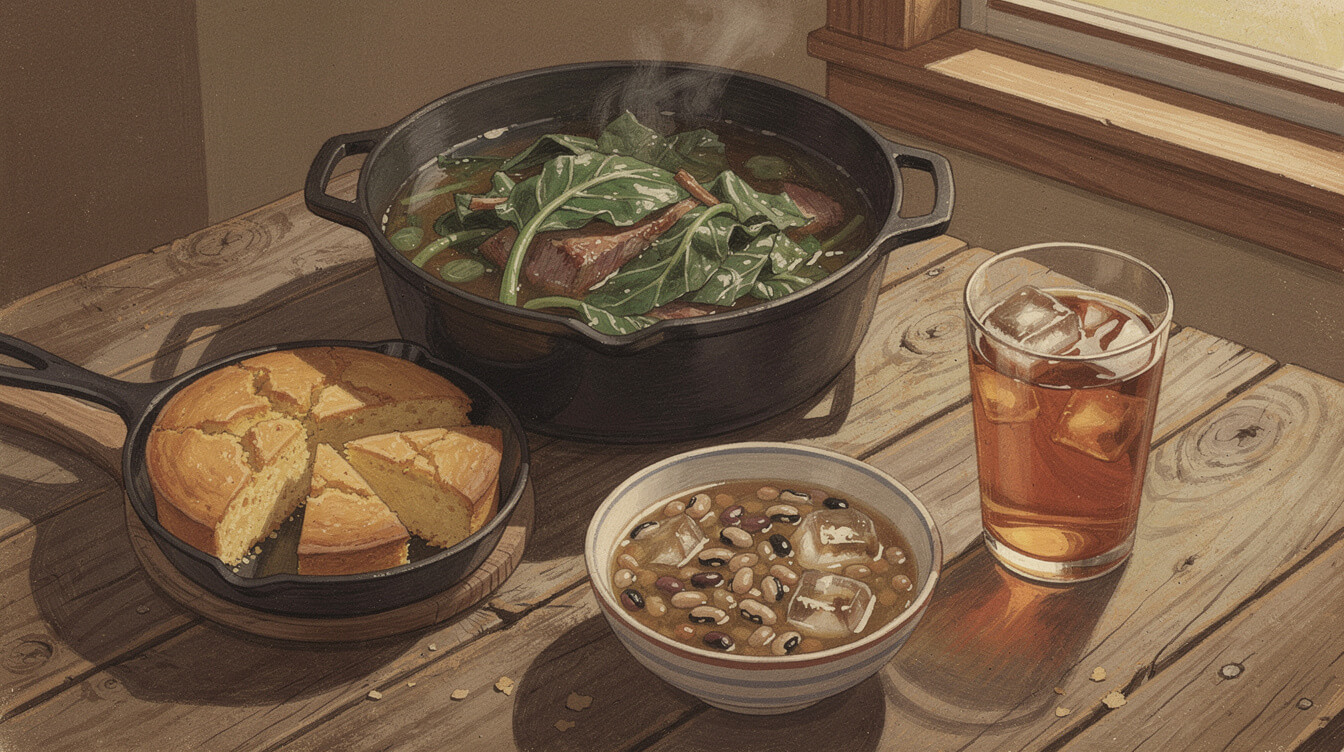
Three albums in four years: two gold, one top-10, all three eventually certified. Here’s the run that made the Goodie Mob members permanent.
Soul Food (1995): the debut that put Georgia on the map
Soul Food dropped on November 7, 1995, on LaFace Records (distributed by Arista), produced by Organized Noize, with L.A. Reid and Organized Noize credited as executive producers. It peaked at No. 45 on the Billboard 200 and was certified gold by the RIAA on June 26, 1996. Those numbers undersell it badly. This album taught the industry that the South could make conscious, dense, spiritual rap that stood next to anything from the East Coast.
The lead single, “Cell Therapy,” is the group’s signature. It reached No. 39 on the Hot 100, the group’s only Top 40 hit, and went all the way to No. 1 on Billboard’s Hot Rap Songs chart. It’s a paranoid, brilliant song about surveillance, gated communities and government control. Albumism reports the song was sparked by a copy of William Cooper’s conspiracy book Behold a Pale Horse, and The Quietus draws the same line from the book to the lyrics. Organized Noize’s beat is just a few spare piano notes, odd animal croaks and a drone you can’t quite place, and it still sounds like nothing else. “Thought Process” brought in André 3000, and “Soul Food” (No. 64 on the Hot 100) is the album’s warmest moment, a love letter to music as nourishment.
The album turned 30 in November 2025 and 31 this month, which we marked in our Today in Hip-Hop for November 7. We also made a tee for it: our Goodie Mob Soul Food T-Shirt puts that debut on cotton for the heads who still keep it in rotation.
“Dirty South”: the song that named a region
“Dirty South” (No. 92 on the Hot 100, No. 8 Rap) is the song that took the phrase national, and it’s full of surprises. The term wasn’t CeeLo’s, and it wasn’t Organized Noize’s. Rico Wade was blunt about it in Complex’s 2012 Organized Noize oral history: “‘Dirty South’ was Cool Breeze’s sh*t. He came up with that sh*t and he didn’t make nothing from it.” And on the song itself, Big Gipp is the only Goodie Mob member who raps. Cool Breeze has two verses, Big Boi has one, and Gipp closes it out. CeeLo is there only on ad-libs. So one of the most important songs in Southern rap is a Goodie Mob single with three-quarters of the Goodie Mob members barely on it.
Still Standing (1998): the commercial peak
Still Standing arrived April 7, 1998, and became the group’s biggest chart hit, peaking at No. 6 on the Billboard 200. The RIAA certified it gold on May 7, 1998, just one month after release. The standout is “Black Ice (Sky High)” with OutKast, which reached No. 50 on the Hot 100. It wasn’t an Organized Noize beat. Producer Mr. DJ had built it as a remix of the group Mista’s “Blackberry Molasses.” Gipp heard it in the Dungeon and started writing. That same year OutKast released Aquemini, the album our OutKast Aquemini T-Shirt celebrates. The Dungeon had two classics in one year.
World Party (1999): the album CeeLo disowned
World Party came out on December 21, 1999, peaked at No. 48 and went gold on January 24, 2000. That’s three gold albums in a row. But it was a deliberate pivot to party records (the title track samples Lionel Richie’s “All Night Long”), and the group’s own singer hated it. CeeLo told Phoenix New Times in 2002: “I believe we failed morally with that album. I was ashamed of that album… This is not signature Goodie Mob. It’s definitely not progression — it’s regression. I opted not to argue, because I was more or less the odd man out.” That same year the group showed up in the superhero comedy Mystery Men (1999), cameoing as the “Not So Goodie Mob.”
Splits, Side Projects and Reunions: The Goodie Mob Members After 2000

After World Party, the four Goodie Mob members went separate ways, then found their way back more than once. Here’s the timeline in order.
CeeLo steps away (early 2000s)
The exact date of CeeLo’s exit is genuinely disputed. Some accounts say he left during the World Party sessions in 1999. But in May 2002 he told Phoenix New Times the group was “still intact,” and he plainly worked on World Party. The safe answer is that he stepped away after that album, in the early 2000s, to go solo. Anyone giving you a precise year is guessing.
One Monkey Don’t Stop No Show (2004): the trio album
Khujo, T-Mo and Big Gipp kept going as a trio. One Monkey Don’t Stop No Show came out June 29, 2004, on Koch Records and reached No. 85 on the Billboard 200. The title is the old Southern saying: losing one person doesn’t stop the show. The group claimed it wasn’t a shot at CeeLo. As Shea Serrano wrote in a 2010 Dallas Observer piece, “everyone knew better.”
The side-project years
- The Lumberjacks (Khujo and T-Mo): The Goodie Mob Presents: Livin’ Life as Lumberjacks, January 25, 2005, on Koch, with Big Gipp on two tracks.
- Ali & Gipp: Kinfolk (2007) on Derrty Entertainment/Universal, after their “Grillz” breakout.
- Gnarls Barkley: CeeLo and Danger Mouse’s St. Elsewhere (2006) and “Crazy.” The duo won two Grammys in 2007, one for the album and one for the song.
- Khujo solo and Willie Isz: Mercury (2007) and Georgiavania (2009).
The reunions: 2009, 2013 and 2020
The four Goodie Mob members first shared a stage again in October 2006, after a Gnarls Barkley show. A reunion was announced on Atlanta’s V-103 in November 2007, and the first official reunion concert came September 19, 2009, at the Masquerade in Atlanta. A new album followed: Age Against the Machine (August 27, 2013) debuted at No. 30 on the Billboard 200.
Then came the best late-career record they made. Survival Kit arrived in November 2020, executive-produced by Organized Noize. CeeLo told REVOLT the four hadn’t worked together like that “since we’re kids. Twenty years in the making almost.” It featured André 3000, Big Boi, Big Rube and Chuck D on “Are You Ready.” He called having Organized Noize oversee it “not only a pleasure, but a privilege,” and recalled that Vibe once framed Public Enemy as “passing the torch” to Goodie Mob. The Chuck D feature closed that loop 25 years later.
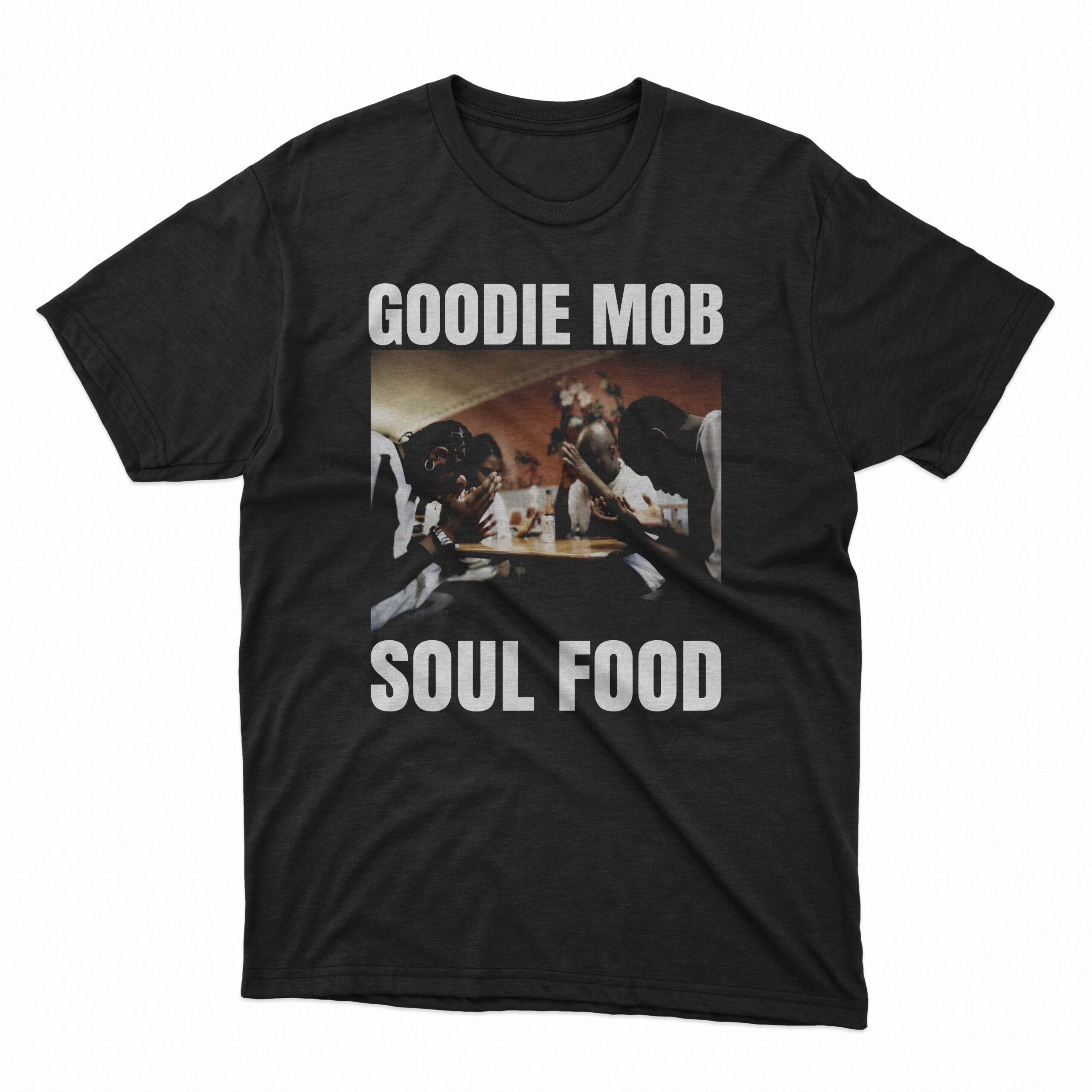
Four Voices. One Debut. Still Fed.
We made the Goodie Mob Soul Food tee for the heads who learned the Dirty South from Cell Therapy, not a hashtag. Dungeon-raised, 1995-certified.
The Farewell: Where the Goodie Mob Members Are Now (2025–2026)

The last two years have been the most uncertain in the group’s history. Here’s what’s verified.
May 2025: CeeLo announces the end
On May 4, 2025, CeeLo posted on Instagram that Goodie Mob would officially disband after more than three decades. “This will be our #farewell,” he wrote. “The fans know that we’ve gone through a great deal together so, for no reasons in particular let’s just call it ‘natural causes’ and we all agree that it’s #time.” He said a farewell album and tour were planned around Soul Food‘s 30th anniversary that November, adding: “we did it for #atlanta.”
The farewell that didn’t happen
The 30th-anniversary celebration was scheduled for Atlanta’s Tabernacle on November 2, 2025. Ticketing listings show it as cancelled, and no public reason was given. As of November 2026, no farewell album has been released and no tour dates are listed.
2026: friction, film and new music
In July 2026, Big Gipp publicly pushed back on the idea that the group was finished. On an Atlanta morning show he said “Goodie Mob ain’t your problem, and ain’t never been your problem,” and added, “don’t turn around and turn on your family.” So the honest answer to “Is Goodie Mob still together?” is that it’s contested. CeeLo has called it done, and Gipp clearly doesn’t see it that way. We’re not going to pretend to know how it ends.
Meanwhile, all four members are working:
- CeeLo closed out Gnarls Barkley with Atlanta (March 2026).
- Khujo dropped the single “Whole Room Lit” (August 21, 2026).
- All four are credited as executive producers on Thomasville, an award-winning short film by Atlanta director Alex Woodruff about the demolished Thomasville Heights projects. It won Best Drama at the San Jose International Short Film Festival. The members produced it but don’t act in it.
Whatever happens next, all four Goodie Mob members are alive, still in Atlanta’s orbit, and still connected to the same project. That’s more than most groups from their era can say.
Goodie Mob Members FAQ
Who are the 4 members of Goodie Mob?
CeeLo Green (Thomas Callaway), Khujo (Willie Knighton Jr.), T-Mo (Robert Barnett) and Big Gipp (Cameron Gipp). The lineup has never changed since the group formed in Atlanta in 1991.
Is CeeLo Green still in Goodie Mob?
CeeLo left in the early 2000s, rejoined for the 2009 reunion, and recorded Age Against the Machine (2013) and Survival Kit (2020) with the group. In May 2025 he announced the group’s farewell. As of late 2026 the group’s status is disputed among the members themselves.
Did Goodie Mob create the term “Dirty South”?
Goodie Mob’s 1995 single “Dirty South” took the phrase national, but Rico Wade credited the term to Cool Breeze, a Dungeon Family member who has two verses on the song. Big Gipp is the only Goodie Mob member who raps on it.
What happened to Khujo’s leg?
In June 2002, Khujo fell asleep at the wheel on I-75 driving home from the studio. His right leg was amputated below the knee. Some articles date this to 2007. That’s wrong.
What is Goodie Mob’s best-selling album?
All three of their ’90s albums (Soul Food, Still Standing and World Party) are RIAA-certified gold. Still Standing charted highest, at No. 6 on the Billboard 200 in 1998.
Are Goodie Mob and OutKast related?
Not by blood, but by the Dungeon. Both groups came up in Rico Wade’s basement with Organized Noize producing. Goodie Mob members appear on OutKast’s debut, and OutKast members appear on Soul Food, Still Standing and Survival Kit. For the OutKast side of the family, see our OutKast album-by-album guide.
Did Goodie Mob break up?
CeeLo announced a farewell on May 4, 2025, but the planned farewell album and anniversary show never happened, and Big Gipp disputed the breakup in 2026. Officially announced, practically unresolved.
Final Thoughts: Why the Goodie Mob Members Still Matter
Strip away the Grammys, the TV chair and the breakup headlines, and you’re left with four Atlanta kids in a dirt-floor basement deciding that Southern rap could preach. Goodie Mob proved Southern rap could preach as hard as it partied, and they handed the region a conscience, a vocabulary and a blueprint. Every Atlanta artist who raps about God, the system and the block in the same verse is working in the lane CeeLo, Khujo, T-Mo and Big Gipp cut with Soul Food.
T-Mo said it best: “That we just told the truth.” Thirty years later, that’s still the whole legacy. Put Soul Food on, front to back, and listen for the four voices.
Stay creative — The Custom Creative Team
Get the Culture in Your Inbox
Liner-note receipts, studio stories, anniversaries and first dibs on new drops. No spam, just hip-hop.

🎧 Never Miss a Drop
Exclusive product releases, hip-hop deep dives, and member-only discounts. Straight to your inbox.
Free forever. No spam. Unsubscribe anytime.
Get the Culture, Delivered
Deep dives into hip-hop history, exclusive product drops, and discounts sent straight to your inbox. No spam, just culture.
Join 2,000+ hip-hop heads already in the loop. Unsubscribe anytime.