Pete Rock & CL Smooth’s Mecca and the Soul Brother at 34: The Mt. Vernon Diary That Defined Jazz-Rap
Thirty-four summers on from the day it dropped, Mecca and the Soul Brother still plays like the moment jazz-rap stopped being a subgenre and became a whole tradition. Pete Rock and CL Smooth weren’t rappers who dabbled in jazz samples; they were two kids from Mt. Vernon, New York, who chopped horns like sculptors and wrote block-party diaries like short-story authors. If you want to understand why every chillhop producer with an MPC is still trying to reverse-engineer their sound — and why CL Smooth is the most underappreciated emcee in the jazz-rap canon — you have to go back to a suburban Bronx suburb, a beat-up SP-1200, and one grief-stricken elegy that changed how the culture mourns.
This is the story of the two-album run that quietly rewired the DNA of a genre: how Pete Rock’s chopping technique invented a texture nobody else was making, why CL Smooth’s conversational, neighborhood-narrative style descended straight into Common, Mos Def, and Black Star, and what makes “They Reminisce Over You” the most-sampled grief ode in hip-hop history. It’s also a listening guide — because if you know CL Smooth only as a Wikipedia footnote, you’ve been robbed of one of the richest catalogs of the golden age.
Why Mt. Vernon at 34 Still Sounds Like the Genre’s Soul
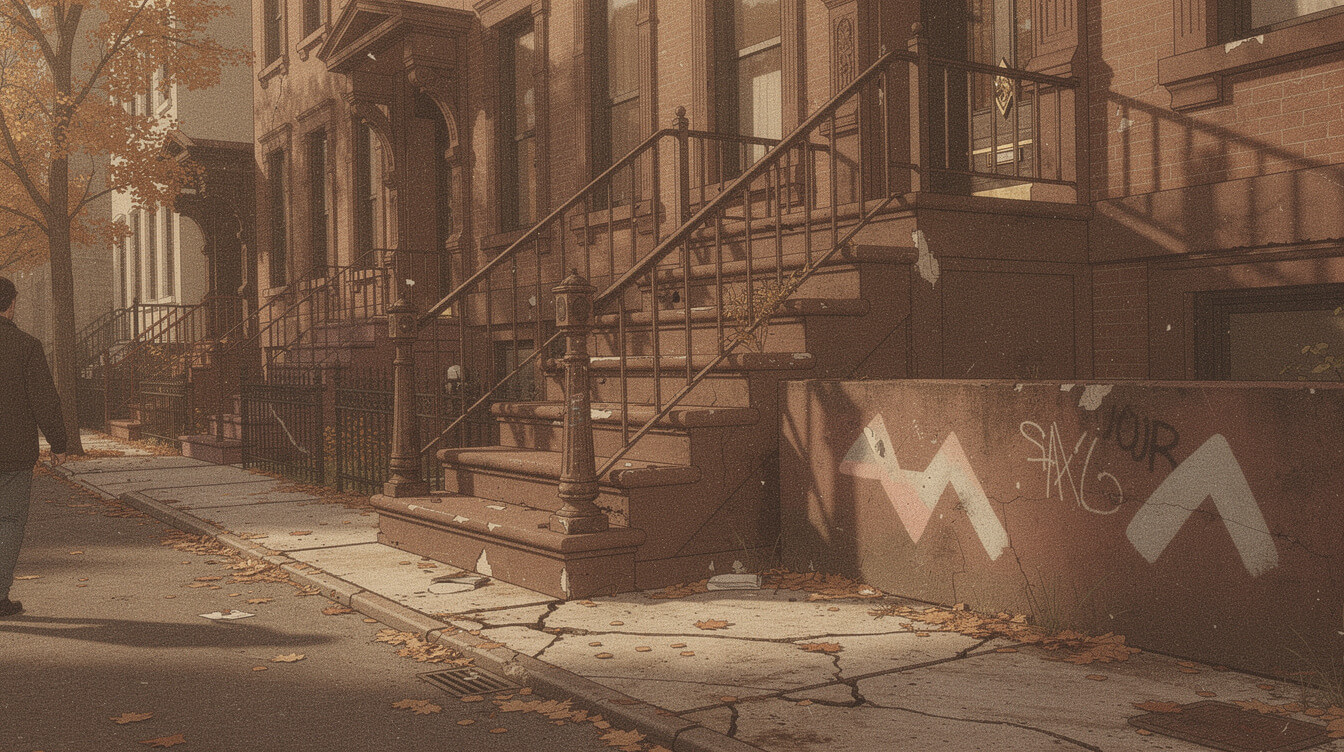
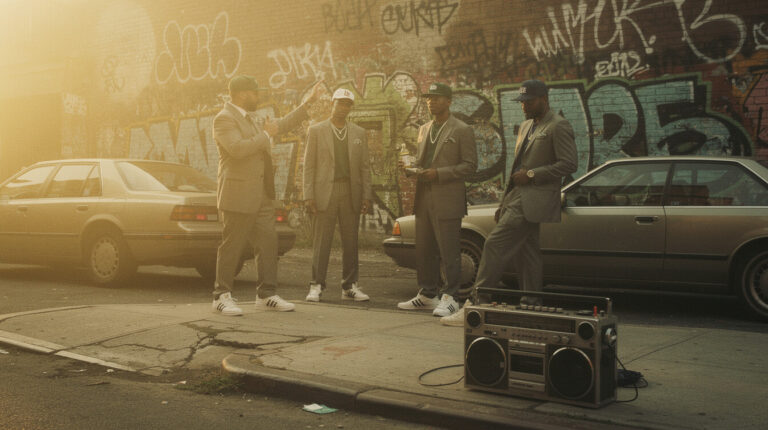
Mt. Vernon is a small suburb of New York City that sits directly north of the Bronx line, a half-hour subway ride from Yankee Stadium. In the late 1980s and early 1990s, it produced a bench-depth of jazz-literate hip-hop that punched wildly above its weight: Heavy D, DJ Eddie F, Grand Puba, Al B. Sure!, and — the two we’re here for — Peter Phillips (Pete Rock) and Corey Penn (CL Smooth). Where Long Island’s Eric B. & Rakim gave hip-hop its minimalism and Queensbridge gave it its knife-edge realism, Mt. Vernon gave it something rarer: warmth. Living-room warmth. The sound of a soul record playing while your uncle tells stories about the block.
That warmth is what makes Mecca and the Soul Brother still hit in 2026. Pete Rock chopped horns off jazz records his father owned and looped them into beds that felt lived-in rather than programmed. CL Smooth wrote verses that sounded like a diary — not a manifesto, not a boast, not a threat, but a Sunday-afternoon breakdown of what was happening on the corner. When you play the album today, you’re not hearing a nostalgia object; you’re hearing the last moment before hip-hop turned inward on itself, before it split into shiny-suit crossover on one side and jaw-clenched hardcore on the other. Mecca is the pivot record — the place where the genre still sounded like it was in conversation with the rest of Black music history rather than in a rap-specific silo.
That’s why every producer from J Dilla to Alchemist to Nicholas Craven has a Pete Rock quote in their DNA, whether they name-check it or not. And that’s why the album deserves to be talked about the same way we talk about Nas’ Illmatic or Wu-Tang’s debut — not as a curio, but as one of the load-bearing walls of the whole house.
The SP-1200 Thesis: How Pete Rock Chopped Horns Like Nobody Before Him

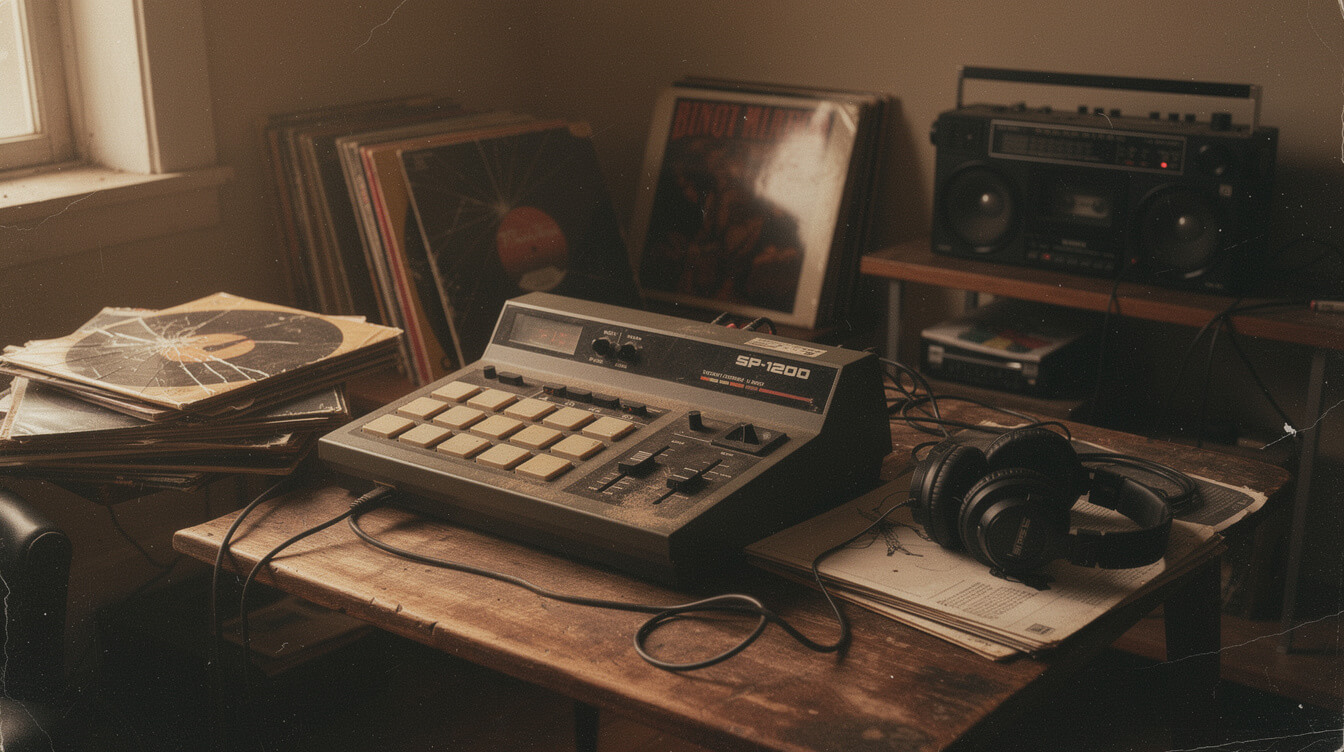
To hear why Pete Rock is the producer he is, you have to hear him at the sampler. His weapon of choice on Mecca and the Soul Brother was the E-mu SP-1200: a 12-bit drum machine with a criminally short 10-second sample time that forced producers to develop technique instead of piling on layers. Most 1990s beatmakers used the SP for its drums, then flew in melodic samples from a keyboard or a second machine. Pete Rock did the opposite. He treated the SP as a horn instrument.
Listen to “Straighten It Out” or “The Basement” and you can hear it: he isolates a horn stab from a jazz record — a single note, maybe two — and chops it into a tuned melodic phrase by triggering the pads in sequence. Not a loop, not a straight lift. A chop. He then dust-textures it with the SP’s 12-bit downsampling, which is why every Pete Rock beat sounds like it was mixed inside a wool blanket. Nobody chopped horns that way before him at scale. RZA came at it from a kung-fu/soul-loop angle; DJ Premier came at it from a jazz-piano scratch angle; Pete came at it from a bandleader’s angle, arranging chopped brass into new harmonic phrases.
The dust texture is not incidental — it’s ideological. Pete Rock’s records feel warm because the SP-1200 rolls off high frequencies in a way modern samplers don’t. That rounded, mid-forward EQ is what critics call “boom bap,” but on Mecca it’s more specific than that: it’s boom bap wrapped around a horn chart. Every producer from Roc Marciano to Griselda’s Daringer has spent the last decade trying to rebuild that exact texture. This is why the album still sounds fresh — because most modern reissues of this sound are chasing a moving target that Pete Rock already caught in 1992.
Pair his SP-1200 approach with what DJ Premier was doing for Nas in the same era and you get the two poles of 90s East Coast production: Premo working in scratch-hook staccato, Pete Rock working in horn-chart legato. Both essential, neither replaceable.
CL Smooth, the Most Underappreciated Narrator in Jazz-Rap

Here is where the SERP does CL Smooth dirty. Type his name into Google and you’ll get a Wikipedia bio, a Spotify page, an Instagram handle. What you will not get is any acknowledgment that CL Smooth is the missing link between the New York battle-rap tradition of the mid-80s and the conversational, observational, first-person storytelling that would define the following decade. He is the lineage nobody traces because he never made a headline album under his own name.
Play “The Creator” or “For Pete’s Sake” and you can hear the DNA of everything that comes after: Common on Resurrection (1994), Mos Def on Black on Both Sides (1999), Black Star’s whole self-titled album, De La Soul’s late-career grown-man mode, Little Brother’s Phonte at his most reflective. CL wasn’t yelling. He wasn’t threatening. He was just talking — but talking the way a diarist talks, laying out the block, the argument, the memory, the joke, the pain, all in the same low-and-warm register. Where Rakim brought precision, CL brought presence. Where Chuck D brought volume, CL brought volume of detail.
That style became the default emotional register of jazz-rap and its Native Tongues-adjacent cousins. When De La Soul made Stakes Is High, when Stetsasonic were building the whole hip-hop-band template, when Digable Planets and A Tribe Called Quest were writing verses about jazz clubs and everyday Brooklyn, they were all borrowing from the register CL Smooth was standardizing on Pete Rock’s beats. The one difference: CL got there earliest, and least loudly.
That’s why the SERP keeps missing him. He never wrote a song designed to be a hip-hop meme. He wrote songs designed to be re-listened to five years later, alone, at 2 a.m. That doesn’t move quarterly on Wikipedia, but it moves generations on Bandcamp.
“They Reminisce Over You”: The Elegy That Became Hip-Hop’s Grief Language

“They Reminisce Over You (T.R.O.Y.)” was written for Troy Dixon — Trouble T-Roy — the Heavy D & the Boyz dancer who died in 1990 after falling from a stage riser during a tour date in Indianapolis. He was 22. Pete Rock produced the record; CL wrote the verses. The sample is a flute-and-strings figure from Tom Scott’s 1974 cover of Jefferson Airplane’s “Today,” which Pete looped and dust-textured until it sounded like memory itself.
The verses do not eulogize Trouble T-Roy the way a modern rap song eulogizes a fallen friend, which is with hashtag-anchored specificity. CL wrote wider than that. Verse one is a family memory — his own uncle Doc, his cousin, his childhood. Verse two is his mother. Verse three is Trouble T-Roy. The elegy is nested inside a portrait of every person in CL’s life he loves, so that the specific grief becomes a universal one. That is why the record has been sampled, quoted, and covered more than any other rap elegy in the genre’s history — because it functions as a template every listener can pour their own dead into.
Every hip-hop obituary that has followed — Puff Daddy’s “I’ll Be Missing You,” Gang Starr’s “In Memory Of,” Common’s “A Song for Assata,” the entire subgenre of tribute records that flowered after Tupac and Biggie — is standing on T.R.O.Y.’s shoulders. Not just because of the sample, but because of the structural discovery: grief in hip-hop works best when it’s laid over jazz and framed as testimony. Pete Rock and CL Smooth wrote that grammar. Everyone since has been conjugating it.
If you’re going to own one artifact from the album, this is the song the wardrobe should be built around. Speaking of which — we made a Pete Rock & CL Smooth Main Ingredient hoodie for the exact type of head who quotes the T.R.O.Y. verses from memory.
Mecca and the Soul Brother → The Main Ingredient: The Two-Album Masterclass
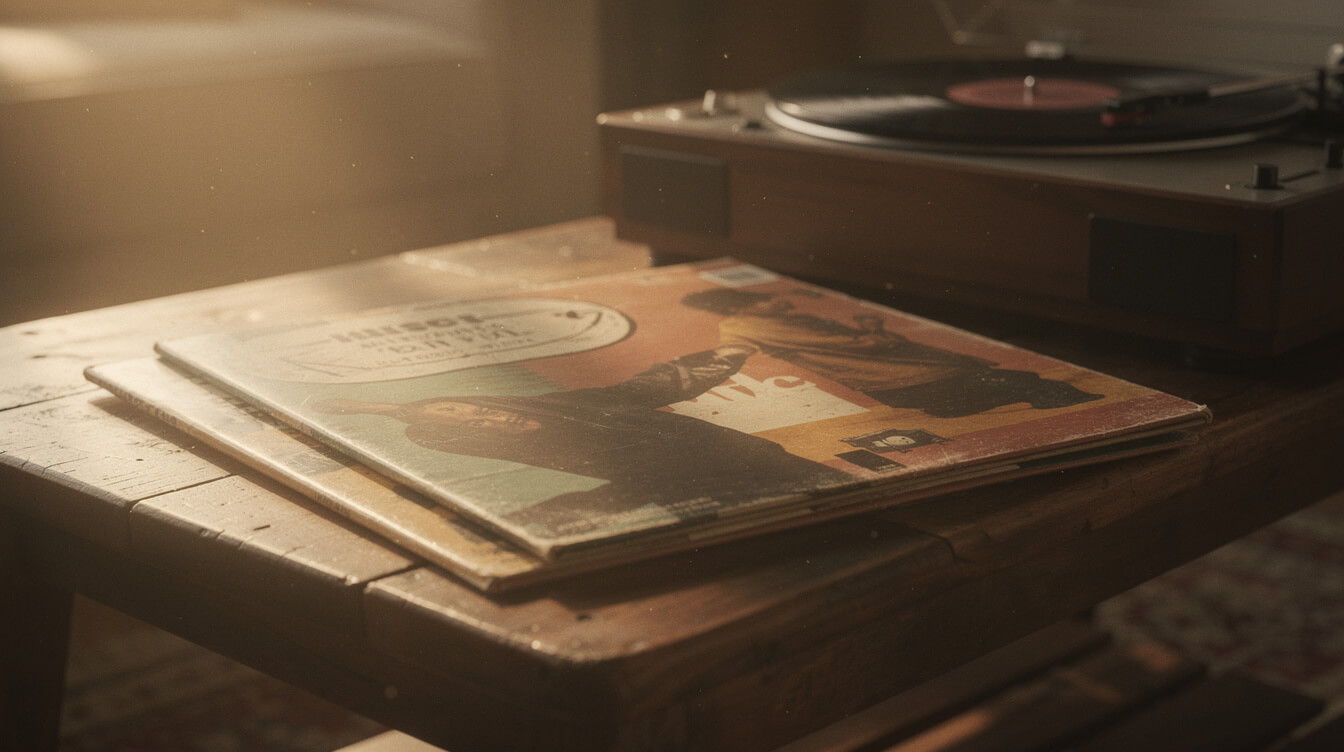
Mecca and the Soul Brother dropped June 9, 1992. If it were the only record Pete Rock & CL Smooth ever released, it would still put them on this list. But it wasn’t. Two years later, they came back with The Main Ingredient — and if the SERP keeps skipping this album, that’s another indictment of how underexamined this duo is.
Where Mecca is expansive — nineteen tracks, skits, interludes, the full 74-minute CD-era sprawl — The Main Ingredient is tightened, drier, and in some ways more consequential. Pete Rock’s production got harder and more minimal: “I Got a Love,” “In the House,” and “Take You There” trade the wall-of-horns lushness for a leaner boom-bap punch. CL Smooth’s writing got sharper too — less impressionistic, more cinematic. “Searching” is arguably the best pure vocal performance he ever recorded, a track that hangs on a Vince Guaraldi-esque piano figure and dares CL to fill the space. He fills it.
The two-album run is a masterclass in artistic pacing. Mecca is the introduction: here is our aesthetic, here is our palette, here is what jazz-rap can sound like when you commit fully. The Main Ingredient is the refinement: now that you know the palette, here is what happens when we edit ourselves. Very few duos in hip-hop history have executed that arc — introduction, refinement — as cleanly. Gang Starr did it. Mobb Deep did it. Nas did it against himself. Pete Rock & CL Smooth did it in two records and then broke up, which is what makes their catalog feel like a perfect closed system rather than a career in progress.
Wear the Album That Redefined Jazz-Rap
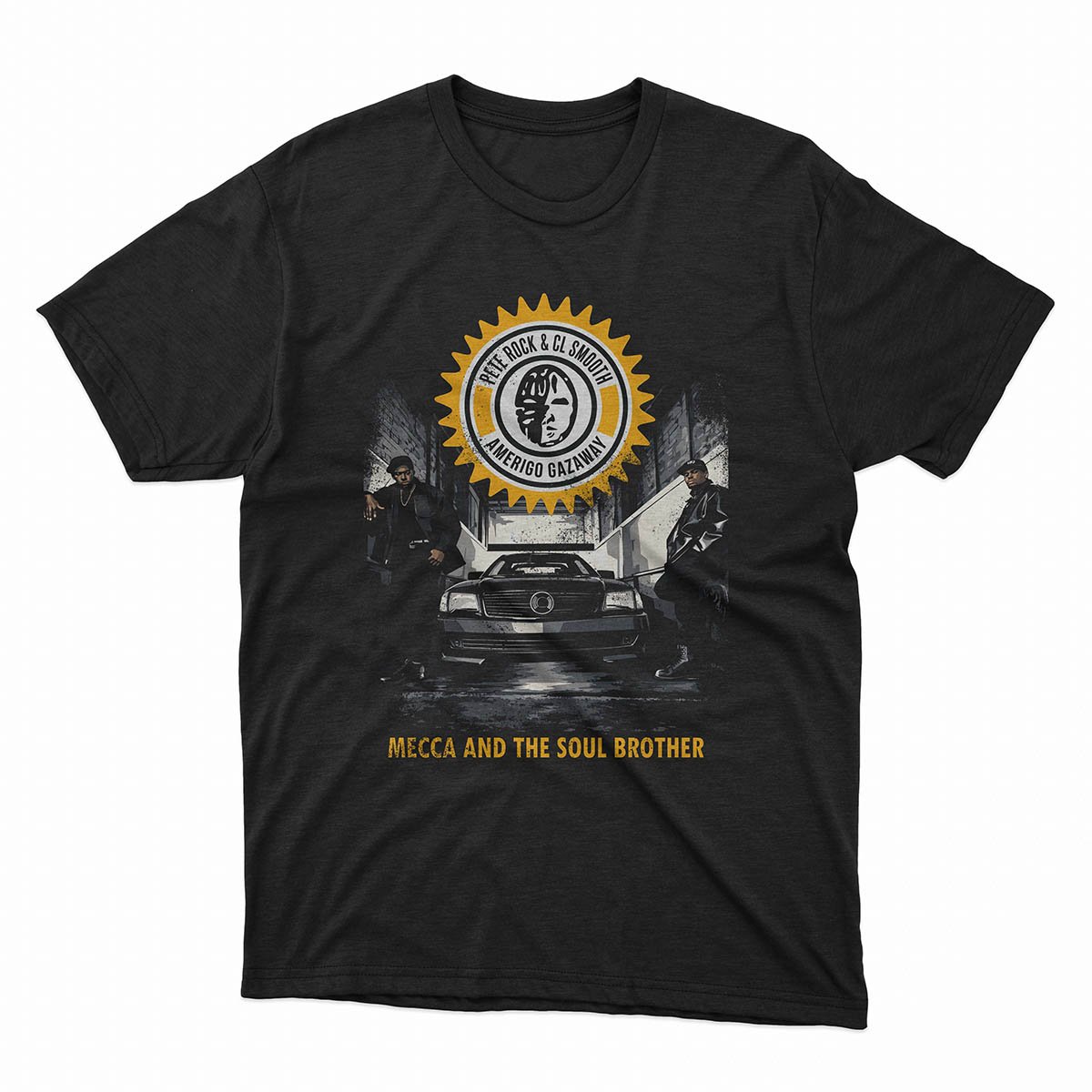
Our Pete Rock & CL Smooth Mecca and the Soul Brother tee is built for the heads who know why 1992 still matters. Cotton weight, Mt. Vernon energy, 34-year receipts.
Pete Rock’s Post-CL Discography and CL Smooth’s Quiet Indie Arc

Pete Rock & CL Smooth broke up around 1995 in a split that industry lore attributes to a mix of creative and personal friction — the specifics are murky and the two have since publicly reconciled. The split is the reason the catalog is only two albums deep. It is also the reason the two of them have such wildly different narratives afterward.
Pete Rock became one of the most in-demand producers in rap for the second half of the 1990s. He remixed Nas’s “The World Is Yours” into what many fans consider a superior version of the original. He produced deep cuts for the entire Wu-Tang family, including Inspectah Deck’s Uncontrolled Substance, a solo record that carries his stamp all over its production. He made beats for Mobb Deep, Method Man, Ghostface, Common, and later a full generation of underground names from Skyzoo to Camp Lo. His 1998 solo album Soul Survivor is one of the great producer albums of the era. He has never really stopped working. If you follow his Instagram he is still cutting up records at his kitchen table.
CL Smooth’s post-split arc is quieter, but arguably richer for the head who does the digging. He released his own solo record, American Me, in 2006, then spent the next two decades building one of the best-kept indie catalogs in golden-age hip-hop — collaborations with underground producers, features on beats-and-rhymes projects that never made it to major-label rotation, and a Bandcamp discography that rewards the crate-digger. He is still writing in that low-and-warm register. If anything, age has made the voice better. The SERP won’t tell you this; the underground has been telling you for twenty years.
If you liked what Jay-Z did in his post-Roc-A-Fella indie phase — see our long piece on Reasonable Doubt at 30 — you already understand the appeal of an artist who stops chasing the spotlight and starts building for the readers. CL is that in emcee form.
What to Play After You’ve Finally Heard T.R.O.Y.

If you have just come to this album for the first time, do not stop at “They Reminisce Over You.” The rest of the record is not backing material for the single. It is the argument. Here is a listening path that will let you hear how Mecca and the Soul Brother works as a whole record, plus where to go next.
- “Straighten It Out” — the horn-chop thesis in its purest form. Play this if you want to hear the SP-1200 technique the whole essay is about.
- “The Basement” — six emcees, one loop, a summer-block-party vibe. This is CL as MC ceremony master, not lead voice, and it works.
- “For Pete’s Sake” — CL’s writing at its most confident. Study the pacing.
- “They Reminisce Over You (T.R.O.Y.)” — the grief template. Come back to it three times, at three different times of your life.
- Then queue up The Main Ingredient. Start with “In the House,” ride through “I Got a Love,” land on “Searching.” Notice how the palette narrows and the writing sharpens.
- Then Pete Rock’s Soul Survivor (1998). This is where he shows what happens when the producer is running the room without a fixed emcee partner. It’s one of the great deep listens of the era.
- Finally, dig for CL Smooth’s American Me (2006) and his Bandcamp catalog. This is the reward for putting in the work.
Play the record for someone who has never heard Pete Rock & CL Smooth and watch what happens. They will not tell you it’s dated. They will not tell you it’s boring. They will tell you it sounds like the last honest thing hip-hop made before the industry ate itself. Thirty-four years later, that is a hell of a testimony for two kids from a small town north of the Bronx line, one drum machine, and one elegy for a friend.
Stay creative — The Custom Creative Team
Get the Culture in Your Inbox
Long reads on the albums that built the genre, first looks at drops from our catalog, and no filler. Join the Custom Creative newsletter.

🎧 Never Miss a Drop
Exclusive product releases, hip-hop deep dives, and member-only discounts. Straight to your inbox.
Free forever. No spam. Unsubscribe anytime.

Get the Culture, Delivered
Deep dives into hip-hop history, exclusive product drops, and discounts sent straight to your inbox. No spam, just culture.
Join 2,000+ hip-hop heads already in the loop. Unsubscribe anytime.