Madlib: The Loop Digga’s Method, From an SP-303 in a Brazil Hotel Room to Bandana on an iPad
Madlib is Otis Lee Jackson Jr., born October 24, 1973, in Oxnard, California. Search his name and Google also tries to sell you the fill-in-the-blank word game. This is about the man. Madlib may be the most sampled-from crate in underground rap, and he’s also the most disguised person in it. He’s recorded as a squeaky cartoon MC, as a five-piece jazz band that never existed, as a house DJ, and as an instrumental “Beat Konducta.” He made the beats for a canonical rap album in a hotel room in Brazil, and he made the beats for another one on an iPad.
Most of what ranks for his name is a discography table, a streaming page or a label store. None of it explains how he works. So this is the producer profile: the gear, the aliases, the beat CDs that fed Kanye West and Freddie Gibbs, the rappers he keeps choosing, and the January 2025 fire that took his home. We checked the dates against liner notes and the databases. Where the sources disagree, we say so.
Madlib’s Oxnard Inheritance: A Musician’s Kid With His Dad’s Records

Oxnard is a farm town on the beach, about 40 miles up the coast from Los Angeles. It’s nobody’s idea of a rap capital. What it gave Madlib was a house full of records and a crew of friends who dug through them with him.
Musician parents and a famous uncle
Madlib grew up in a working musician’s house. His parents, Otis Jackson Sr. and Dora Sinesca Jackson, were both musicians. The New Yorker’s 2021 profile describes his father as a soul singer and his mother as a pianist. On his mother’s side the family tree reaches jazz royalty: his uncle is the trumpeter Jon Faddis, the Dizzy Gillespie protégé famous for playing in the stratosphere. His younger brother, Michael Jackson, raps and produces as Oh No.
That inheritance is the first key to the catalog. Madlib wasn’t raised on rap records alone. He was raised on whatever his parents had on the shelf, and he’s been mining it ever since. Spin’s 2014 feature puts it around 1985, when an 11-year-old Otis Jackson Jr. sampled his first song from his father’s records. In his 2016 Red Bull Music Academy lecture he tells it slightly differently, starting out in junior high on a Casio keyboard that his friend DJ Romes gave him. Either way, he was sampling before he was a teenager.
Lootpack, CDP and the first credit
Madlib’s first crew was Lootpack, with his childhood friends Wildchild and DJ Romes. Around them grew a wider Oxnard circle called the Crate Diggas Palace, or CDP, which included Oh No and other local rappers and producers.
The first commercial receipt is on Tha Alkaholiks’ 21 & Over (Loud/RCA, August 1993). The credit there goes to Lootpack, not to Madlib by name. Lootpack produced “Mary Jane,” one of the album’s singles, and “Turn Tha Party Out,” which they also rap on. That was three years before Lootpack’s own debut: the Psyche Move EP came out in 1996 on Crate Diggas Palace, the family imprint. “My pops put out my first single on Crate Diggaz Palace Records in ’96,” he told the Red Bull Music Academy in 2002. Wikipedia’s main Madlib page dates it to 1995, but the Discogs pressings and his own account both say 1996.
From there the story belongs to a label. A Lootpack 12-inch reached Peanut Butter Wolf, and the Oxnard crew ended up at the center of Stones Throw. We told that part in full in Stones Throw Records at 30, so we won’t repeat it here. This piece is about what Madlib did once he had a room to work in.
The Madlib Toolkit: An SP-303, a Tape Deck, Then an iPad
Producer forums love gear lists. Madlib’s career is the strongest argument against them. Whatever the room and whatever the machine, the ear stays the same.
The Brazil hotel room
In November 2002, Madlib flew to São Paulo for the Red Bull Music Academy. The trip was organized by the photographer B+ and Eric Coleman of Mochilla, who were shooting what became the documentary Brasilintime. The crew included Cut Chemist, DJ Babu, J.Rocc and Stones Throw’s Egon, who hosted Madlib’s lecture there. They dug for records all over the city.
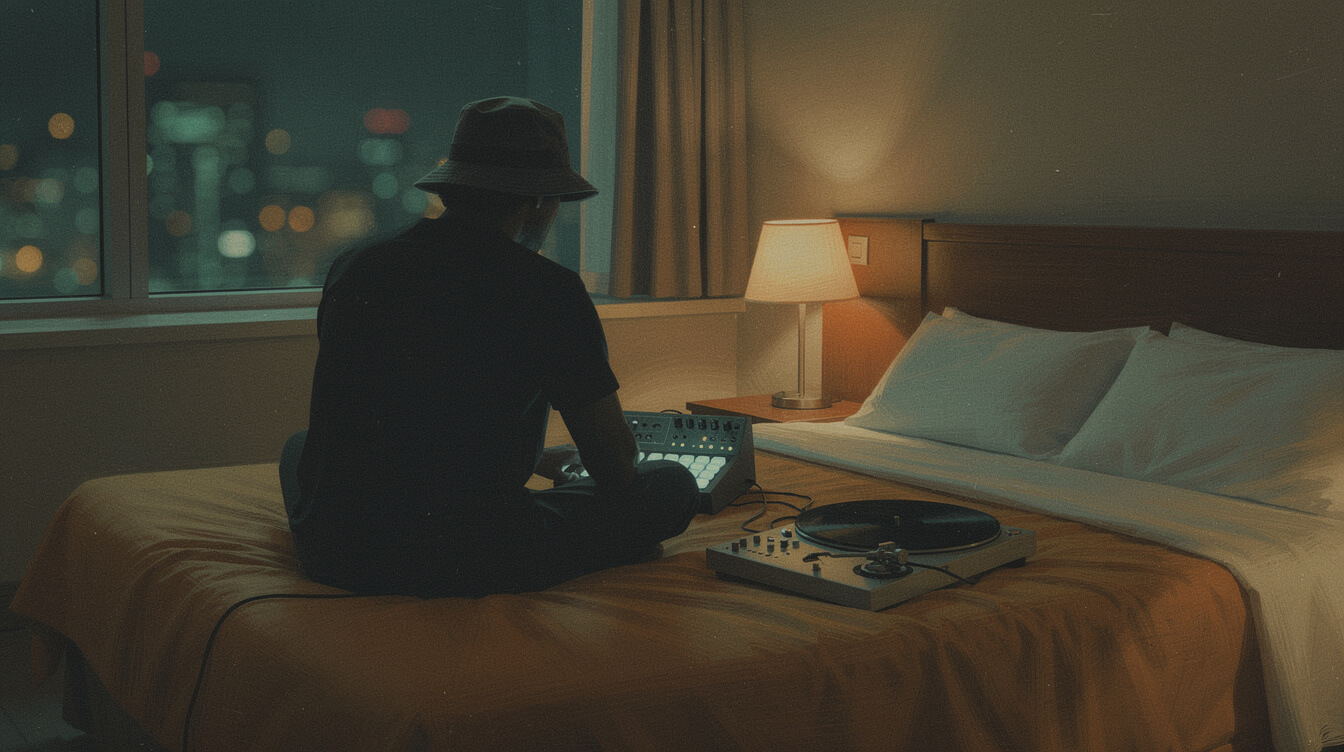
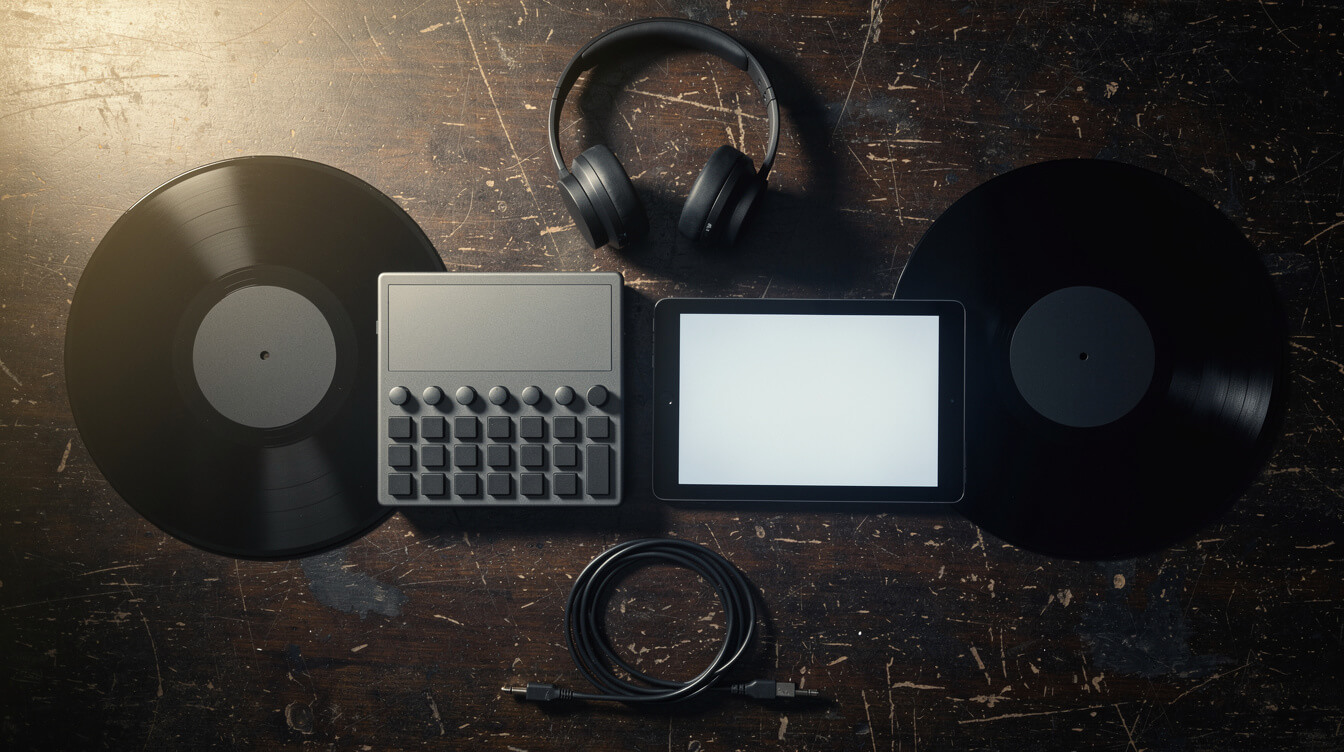
Madlib also worked in his room. “I did most of the Madvillain album in Brazil,” he told Scratch magazine in a 2005 interview that Stones Throw reposted. “Cuts like ‘Raid’ I did in my hotel room in Brazil on a portable turntable, my 303, and a little tape deck.” The 303 is the Boss SP-303 Dr. Sample, a compact tabletop sampler that was never meant to be anybody’s main studio. Per The Ringer’s 2023 excerpt from Will Hagle’s 33⅓ book on Madvillainy, the tape deck was one the hotel provided. Madlib recorded the beats to tape, brought them home, put them on CD, and DOOM wrote to them.
That’s the setup behind one of the most acclaimed underground rap records ever made: a small sampler, a turntable that fits in a suitcase, and the hotel’s tape deck. The Madvillainy liner notes add the rest: “Recorded at Bionic, the Bomb Shelter in Los Angeles and DOOM’s crib in Atlanta,” then mixed and mastered by Dave Cooley at Bionic. Different sources put the Bomb Shelter in Mount Washington or in Glendale. The liners just say Los Angeles, and so will we.
Bandana on an iPad
By the 2010s the tablet had taken over. Madlib said in 2016 that the beat for Kanye West’s “No More Parties in LA” was “made off an iPad,” and on June 28, 2019, Freddie Gibbs and Madlib released Bandana. The next day Madlib tweeted: “I made all of the beats for Bandana on my iPad.” HotNewHipHop and Okayplayer both ran it. People have been asking which app ever since. He has never said publicly, so we won’t guess.
The point was never the tablet. The man who built Madvillainy on a portable sampler built its spiritual sequel on a consumer device, and both sound unmistakably like him.
Sound Ancestors: handing someone else the edit
The third chapter of the toolkit story is about trust. Sound Ancestors (Madlib Invazion, January 29, 2021) is credited to Madlib, but the Discogs credits list Kieran Hebden, better known as Four Tet, for “Arranged By, Edited By, Mastered By.” Madlib supplied the raw beats, and Hebden shaped them into an album. For a producer who usually works alone and often in disguise, handing someone else the arrangement was a real change in method.
If you want to wear the record that came out of that Brazil hotel room, we made the MF DOOM Madvillain T-Shirt for exactly that.

The Album Built in a Brazil Hotel Room
We made the MF DOOM Madvillain Tee for the record that came out of an SP-303, a portable turntable and a hotel tape deck. A tribute to Madlib’s loops and DOOM’s rhymes, made for heads who read the liner notes.
The Alias Machine: Quasimoto, Yesterdays New Quintet, DJ Rels and Beat Konducta
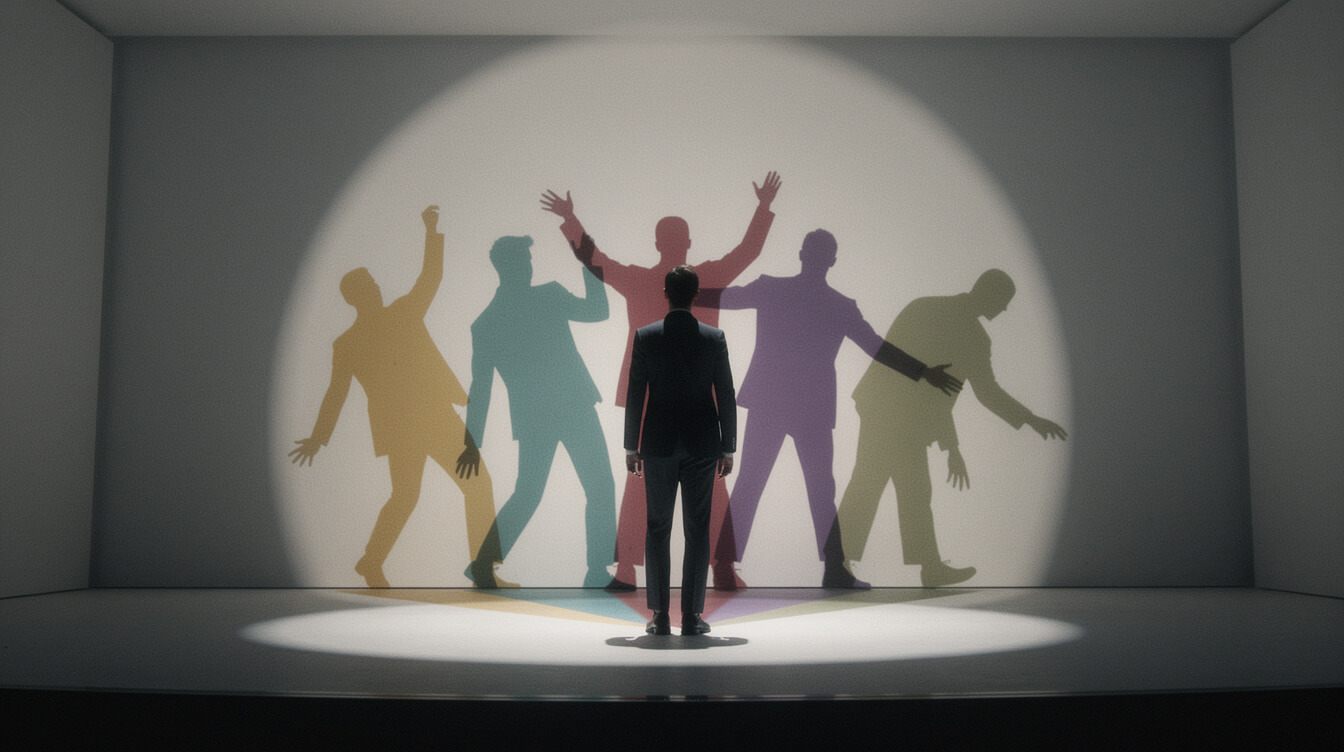
Most producers use one name. Madlib’s discography reads like the roster of a small label. Resident Advisor’s profile alone lists Ahmad Miller, Beat Konducta, DJ Lord Such, DJ Rels, Duma Peterson, the Jahari Massamba Unit and the Joe McDuphrey Experience. These aren’t throwaway gags. Each alias is a way of working, and each one lets him make a kind of record that “a Madlib album” couldn’t hold.
Even his official bio is in costume. The Madlib page on Stones Throw’s website introduces “Madlib, aka Beat Konducta” as an American comedian who starred in a sitcom called Quasimoto and Son, ran with Malcolm X as “Oxnard Green,” and had his house seized by the IRS in 1989. All of it is Redd Foxx’s life story with the names swapped: Sanford and Son, “Chicago Red,” the Malcolm X dishwasher days and the 1989 IRS raid all come straight from Foxx’s biography. The label has left that joke up for years.
Quasimoto: the voice he didn’t like
Quasimoto is the alias that made him famous, and it started with self-consciousness. “When I rap I don’t like my voice anyways, so I wanted to try something different,” he told RBMA in 2002. In a 2013 Wax Poetics interview he called his natural voice “low” and “all tired-sounding.” (The often-repeated story that his friends called him “Barry White” traces back to a single source, so treat it as lore.) The fix was mechanical. He slowed the beat down, rapped slowly in his normal voice, and then sped the tape back up, so the voice comes out high and nasal over a beat at normal speed.
The character got a body before he got an album. The furry yellow creature on the 1999 “Microphone Mathematics” 12-inch was drawn by Keith “DJ Design” Griego, credited on the Discogs release as “Furry Monster Created By.” Stones Throw’s art director Jeff Jank later redrew Lord Quas and designed the cover of The Unseen, released June 13, 2000. Spin ranked it No. 17 on its albums of 2000 list. The album is stitched together with Melvin Van Peebles vocal samples from Ain’t Supposed to Die a Natural Death (1971), and the 1973 animated film Fantastic Planet and its Alain Goraguer score run through tracks like “Come On Feet.”
Yesterdays New Quintet: a band of one
Around 2000 and 2001, Madlib invented a jazz group. Yesterdays New Quintet had five members, Joe McDuphrey, Ahmad Miller, Monk Hughes, Malik Flavors and Otis Jackson Jr., and every one of them was Madlib. He played the instruments himself, then credited the parts to imaginary sidemen. Later “groups” like the Joe McDuphrey Experience and Sound Directions kept the fiction going. The result sounds like a lost 1970s record you’d dig for, which is the joke and the point.
DJ Rels and Beat Konducta
DJ Rels is where he goes for house and broken-beat music: Theme for a Broken Soul came out on Stones Throw in 2004. Beat Konducta is the instrumental series, and it’s the best way to hear his raw method. Vol. 1-2: Movie Scenes (2006) arrived in the same year as J Dilla’s Donuts, and the two make a natural pair. If you’ve read our Donuts track-by-track, play Movie Scenes next. Vol. 3-4: Beat Konducta in India (2007) is built from Indian film and pop records. Mos Def later rapped over some of those beats on The Ecstatic. Vol. 5-6 (2009) is Madlib’s tribute to Dilla, who had died in 2006.
The newest alias is a partnership. The Jahari Massamba Unit is Madlib with the drummer and producer Karriem Riggins. Pardon My French came out on November 27, 2020, as a Record Store Day Black Friday vinyl limited to 2,000 copies, and YHWH Is LOVE followed in March 2024.
Shades of Blue and the Jazz Brain
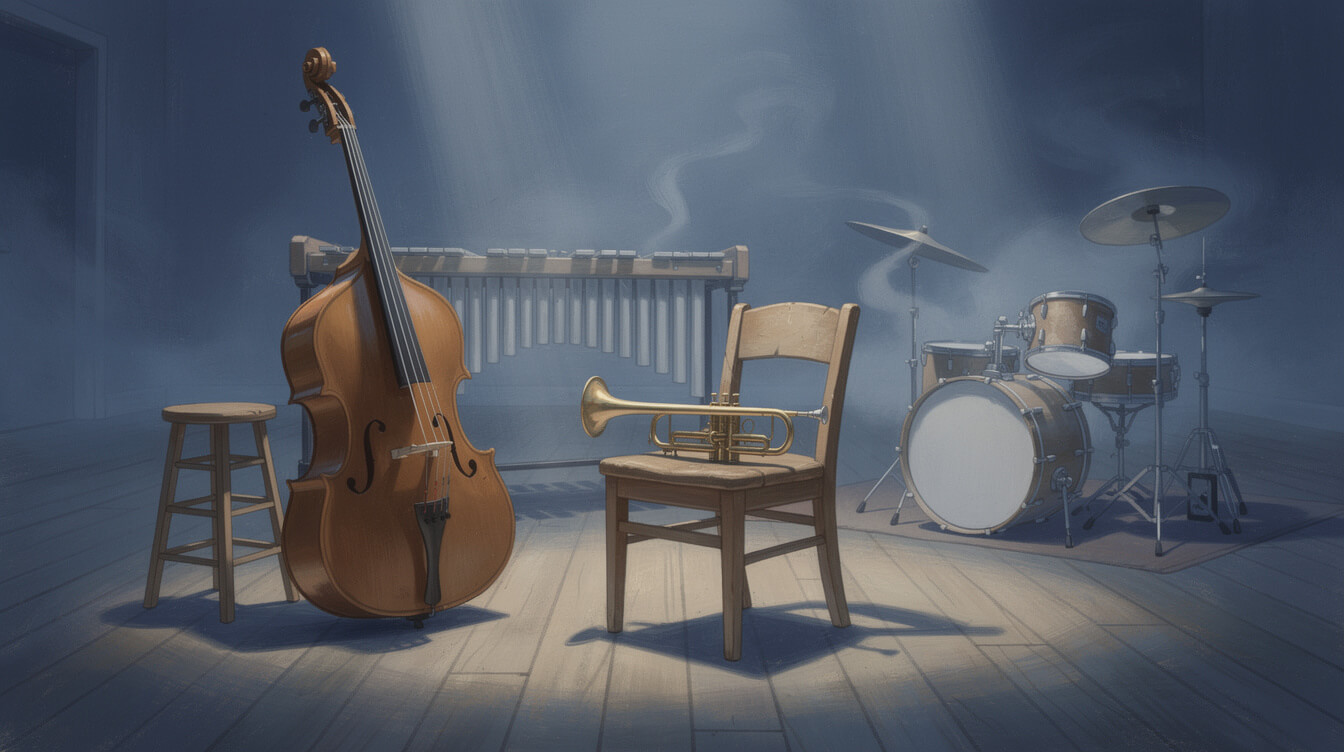
The alias machine reached its peak on a real jazz label. Blue Note gave Madlib the keys to its vault, and on June 24, 2003, it released Shades of Blue. It’s part remix album and part tribute. He sampled and rebuilt Blue Note records from the 1960s and ’70s, and then he had his fake bands “cover” others.
The tracklist gives the trick away. “Footprints,” the Wayne Shorter standard, is credited to Yesterdays New Quintet. “Peace/Dolphin Dance” is credited to the Joe McDuphrey Experience. So fictional bands, all of them Madlib, are covering real Blue Note records on Blue Note. The liner credits for “Footprints” even list Joe Chambers, the drummer on the original Blue Note session, alongside “Otis Jackson Jr.” on drums. The album was mastered by Dave Cooley at Bionic and recorded at the Bomb Shelter, the same rooms as Madvillainy. Pitchfork gave it an 8.6.
Where did the jazz come from? Partly from his family, with a trumpet-playing uncle. And partly from the records he loves, and he has told you exactly which ones. “Jazz Cats, Pt. 1,” near the end of The Unseen, is Madlib’s spoken roll call of the jazz musicians he loves. If you want the 2003 story day by day, our Today in Hip-Hop piece on Madlib invading Blue Note covers the release. The lesson here is about method. To Madlib, sampling a jazz record and playing one are the same act, done with different tools.
The Beat-CD Economy: How Madlib Feeds Rappers
Madlib’s business model doesn’t look like a typical hitmaker’s. He’s known for making beats in volume, burning them to CD and letting rappers pick. Several of his best-known collaborations started with a disc.
A hundred beats in a few weeks
Around 2002, during the Madvillainy era, he made roughly a hundred beats in a matter of weeks. They didn’t all go to DOOM. That same burst fed Jaylib’s Champion Sound and albums by his Oxnard associates M.E.D. and Dudley Perkins. That’s the method in short. He doesn’t produce an album, he produces a stockpile, and albums get built out of it.
The Kanye discs
The volume approach reached the biggest rap star in the world. In 2010, during the sessions for My Beautiful Dark Twisted Fantasy, Kanye West put five Madlib beats on hold, per LA Weekly’s reporting at the time. None of them made that album. Kanye later tweeted thanks to Madlib “for these 6 beat CDs he sent over.”
One beat from that era finally surfaced on January 18, 2016: “No More Parties in LA,” with Kendrick Lamar. It came out as a free SoundCloud track and then landed on The Life of Pablo in February 2016. Madlib is the producer, with West credited as co-producer on the intro. Kanye’s slow decisions turned out to be Freddie Gibbs’ gain. Talking to the Fader and Vice in May 2016, Madlib said Gibbs took the beats Kanye had been sitting on: “[He] rapped over everything. Kanye waited too long.”
The flip side is the one that got away. Kendrick Lamar called him around the To Pimp a Butterfly sessions, and Madlib didn’t pick up. “Back then I was more elusive than I am now. I was busy on my own thing. Missed opportunities, man,” he told the Guardian in January 2021. Then he shrugged it off: it “probably wouldn’t have worked out anyway… cos I’m like a sore thumb.”
Freddie Gibbs and the Gibbs-Madlib run
The Gibbs partnership is the beat-CD economy at full strength. It started with a run of EPs: Thuggin’ (2011), Shame (June 2012) and Deeper (September 2013). Then came Piñata on March 18, 2014, on Madlib Invazion, which debuted at No. 39 on the Billboard 200 with about 9,000 copies. Bandana followed on June 28, 2019. It debuted at No. 21 with about 18,000 units, and it has Pusha T and Killer Mike on “Palmolive” and Anderson .Paak on “Giannis.”
Google’s most-asked question about him is “Is Freddie Gibbs Madlib?” No. Freddie Gibbs is the rapper from Gary, Indiana. Madlib produced every track. The releases are credited to “Freddie Gibbs & Madlib,” and fans and some outlets shorten the duo to “MadGibbs.” For the full Gibbs catalog, see our Freddie Gibbs songs guide. For the wardrobe each album era inspired, see Freddie Gibbs merch, from Piñata to Alfredo.
The Madlib Pairings: DOOM, Dilla, Kweli, Percee P, Black Star and Rapsody
Madlib’s rapper choices over 20 years follow a pattern. He goes for writers with an unusual voice or a dense style who can carry a beat without a hook, and then he gets out of the way.
MF DOOM: Madvillainy, from the producer’s side
We covered how Madvillainy came together in our Stones Throw history, including the beat CD sent to DOOM in Georgia and the leak that forced the re-cut. Here’s the production view. The album has 22 tracks, most of them under three minutes, and hardly any hooks. Beats end when the idea ends. That economy is a big part of the answer to “Why is Madvillainy so highly regarded?” Nothing on it wastes your time. And the slower, more relaxed flow DOOM recorded after the leak sits deep inside Madlib’s loops instead of on top of them.
The samples tell their own story. “Accordion” is built on “Experience” by the LA producer Daedelus, from his 2002 album Invention, and the liner notes credit Alfred Darlington (Daedelus) as a writer. It isn’t even an accordion. Rolling Stone’s 2023 excerpt from Will Hagle’s book reports that Daedelus played the melody on a Magnus electric chord organ. “Meat Grinder” opens with a pitched sample of the Mothers of Invention’s “Sleeping in a Jar” and loops “Hula Rock” by Lew Howard & the All-Stars.
The chart history shows how slowly the world caught up. Madvillainy came out on March 23, 2004, and peaked at No. 179 on the Billboard 200. A 10th-anniversary reissue took it to No. 117 in 2014. Its highest peak came in January 2021, after DOOM’s death was announced: No. 73. The RIAA certified it Gold on March 25, 2024. Peanut Butter Wolf called it “the first (and only) album on my 28-year-old label to go gold.” If you know, you know: the MF DOOM Madvillain Hoodie carries the same art as our tee. For the rest of the villain’s catalog, start with our MF DOOM albums guide.
J Dilla: Champion Sound
Jaylib’s Champion Sound came out in October 2003, and it was made long-distance. Madlib and J Dilla traded instrumentals between California and Detroit, and each rapped over the other’s beats. Two of the most-imitated producers in rap made an album together mostly without sharing a room. The Dilla side of that story is in our J Dilla production discography.
Percee P, Talib Kweli and Mos Def
Percee P’s Perseverance (Stones Throw, September 18, 2007) is all Madlib, a long-awaited full-length debut for one of the Bronx’s most respected battle rappers. We made the Percee P Perseverance T-Shirt for the heads who know the Rhyme Inspector by name.
Talib Kweli and Madlib’s Liberation went up as a free download on December 31, 2006, and came down about a week later. Liberation 2 followed in March 2023 as a Luminary exclusive before a vinyl release that fall.
On Mos Def’s The Ecstatic (2009), Madlib produced “Wahid,” “Pretty Dancer” and “Revelations,” and co-produced “Auditorium” with Mos. That last beat comes from his own Beat Konducta in India, where it was called “Movie Finale.” One common mistake: “Supermagic” on the same album is Oh No’s beat, not Madlib’s. Read the full story in our Ecstatic anniversary piece, or wear it with the Mos Def The Ecstatic T-Shirt.
Black Star, Rapsody and Droogie Otis
The biggest pairing of the 2020s reunited Mos and Kweli. Black Star’s No Fear of Time came out on May 3, 2022, as a Luminary podcast-app exclusive, and Madlib produced all of it. It was recorded over about four years, in hotel rooms and backstage at Dave Chappelle shows, which fits a producer who once made a classic in a São Paulo hotel. The Mos Def & Talib Kweli Are Black Star T-Shirt honors the 1998 debut that started it all. Our Mos Def Black Star deep dive has the full history.
The pairings keep coming. Rapsody and Madlib’s two-track MadRaps EP (“Daddy’s Girl” and “Avon Thru The Wire”) sold on Rapsody’s site in June 2025 and reached streaming that September. Droogie Otis, Madlib’s duo with Your Old Droog, released singles through 2025 with Boldy James, Killer Mike, Wiz Khalifa and Jay Electronica, and made its TV debut on The Tonight Show in January 2026.
2025 and After: The Fire, the Demos, and Where to Start With Madlib

The fire
In January 2025, the Los Angeles wildfires destroyed Madlib’s home. The Guardian, Uproxx and DJ Mag all reported the loss of “decades of music and equipment,” including a record collection the Guardian said he had built over 30 years. Friends shared a Donorbox fundraiser to help him rebuild. For a producer whose whole method is the crate, it’s hard to think of a worse loss. The released catalog is safe. The decades of music and equipment in those reports are not.
The demos and the vault
Just before the fire, Stones Throw released Madvillainy Demos, a vinyl set of the album’s early demo versions. It shipped from Stones Throw’s own store on Black Friday, November 29, 2024, with a wide release on January 31, 2025. The label is also taking pre-orders for new editions of the Beat Konducta volumes and a box set. One project fans keep asking about is still unreleased: MacLib, his collaboration with the late Mac Miller. Madlib said in March 2023 that he was “finishing up” with the estate’s blessing. No release date has been announced.
Where to start: a Madlib listening order
If you’re new, don’t start with the discography table. Go in this order, one alias at a time:
- Quasimoto, The Unseen (2000). Listen for the pitched voice sitting a step above the beat, and for the Melvin Van Peebles snippets stitching it together.
- Madlib, Shades of Blue (2003). Listen for where the sampling stops and the fake bands start playing. It’s harder to hear than you’d think.
- Madvillain, Madvillainy (2004). Listen for how short everything is. Beats end mid-thought on purpose.
- Jaylib, Champion Sound (2003). Listen for the two producers’ drums. Dilla swings, Madlib staggers.
- Beat Konducta, Vol. 5-6 (2009). Listen to one producer mourning another with nothing but loops.
- Freddie Gibbs & Madlib, Piñata (2014). Listen for how a street rapper rides beats that were never built for him.
- Madlib, Sound Ancestors (2021). Listen for Four Tet’s edits, which give the loops a shape they never had on the beat CDs.
Madlib FAQ
Is Freddie Gibbs Madlib?
No. Freddie Gibbs is a rapper from Gary, Indiana. Madlib is the producer who made every beat on their joint albums, Piñata (2014) and Bandana (2019). The releases are credited to “Freddie Gibbs & Madlib,” which fans shorten to “MadGibbs.”
What is Madlib’s real name?
Otis Lee Jackson Jr. He was born October 24, 1973, in Oxnard, California.
What equipment did Madlib use for Madvillainy?
By his own account, he made much of it in a hotel room in Brazil on a Boss SP-303 sampler, a portable turntable and a small tape deck. The album was then recorded at Bionic, the Bomb Shelter in Los Angeles and DOOM’s place in Atlanta, and mixed and mastered by Dave Cooley.
Did Madlib make Bandana on an iPad?
Yes. The day after Bandana came out in June 2019, he tweeted, “I made all of the beats for Bandana on my iPad.” He has never publicly named the apps he uses.
Is Madlib related to Oh No?
Yes. Oh No (Michael Jackson) is his younger brother, also a rapper and producer. Their uncle is the jazz trumpeter Jon Faddis.
Who is Quasimoto?
Quasimoto, or Lord Quas, is Madlib’s rapping alter ego. He made the voice by rapping slowly over a slowed-down beat and then speeding the tape back up. The furry yellow character was first drawn by Keith “DJ Design” Griego and later redrawn by Jeff Jank. The debut album The Unseen came out in 2000.
Why is Madvillainy so highly regarded?
It’s 22 short tracks with almost no hooks, so every bar counts, and DOOM’s re-recorded vocals sit inside Madlib’s loops instead of on top of them. It sold slowly at first, peaking at No. 179 in 2004, then kept growing. It reached a new high of No. 73 in 2021 and went Gold in 2024, the first Stones Throw album to get there.
Final Thoughts: The Ear Is the Instrument
Look at Madlib’s career as a whole and the gear keeps changing: an SP-303 in a São Paulo hotel, beat CDs sent to Kanye, an iPad in 2019, Four Tet’s edits in 2021, and a fire in 2025 that took the crates themselves. What stays the same is the ear. He hears a record and knows what’s buried inside it, and then he finds whatever name, band or rapper fits the result.
That’s why new heads should go one alias at a time, and why producers still argue over his loops. The tools were always secondary. Dig into the records, then dig into the records he dug through. That’s the Madlib lesson.
For more from the crew around him, read our Stones Throw Records at 30 history next.
Stay creative — The Custom Creative Team
Get the Culture in Your Inbox
Liner-note receipts, producer stories, anniversaries and first dibs on new drops. No spam, just hip-hop.

🎧 Never Miss a Drop
Exclusive product releases, hip-hop deep dives, and member-only discounts. Straight to your inbox.
Free forever. No spam. Unsubscribe anytime.
Get the Culture, Delivered
Deep dives into hip-hop history, exclusive product drops, and discounts sent straight to your inbox. No spam, just culture.
Join 2,000+ hip-hop heads already in the loop. Unsubscribe anytime.