Kool G Rap and DJ Polo: Three Albums, the Cover Warner Refused, and the Queens Blueprint
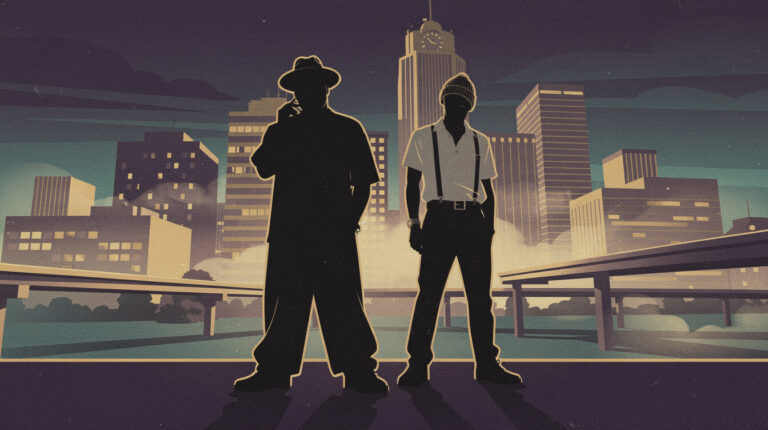
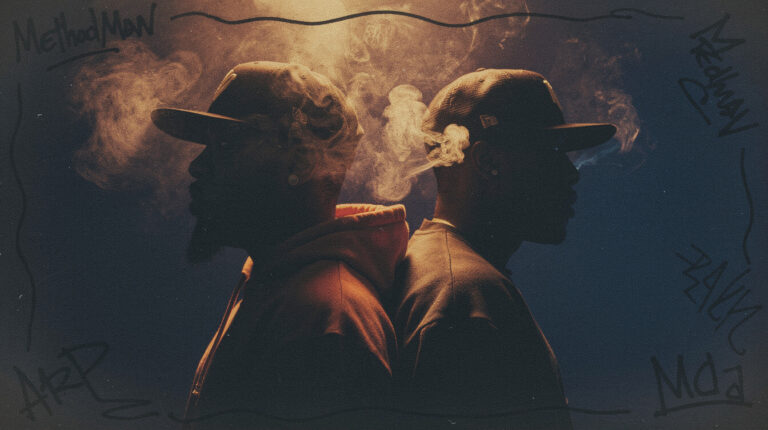
Kool G Rap and DJ Polo made three albums between 1989 and 1992, and those three records quietly wrote the rulebook for New York street rap. Nathaniel Wilson, the “G Rap,” was the rapper. Thomas Pough, DJ Polo, was the DJ who brought him into the game. Together they came out of Corona, Queens, joined Marley Marl’s Juice Crew, put a Billy Joel snippet under a crime story before anyone called it mafioso rap, and made an album cover Warner Bros. refused to ship.
Search their name today and you get streaming pages, a full-album upload and used-CD listings. Nobody tells the duo story in order, with the credits. So that’s what this is: the demo, the posse cut, all three albums with who produced what, the cover fight, why they split, and what Polo’s passing in July 2024 closed out. We checked dates and credits against the record labels, Discogs liner transcriptions, MusicBrainz and the artists’ own interviews. Where the sources disagree, we tell you.
Corona to the Juice Crew: Where Kool G Rap and DJ Polo Started

G Rap was born July 20, 1968, and grew up in Corona, Queens, the same neighborhood that produced Eric B. In his telling Corona was “like a little Harlem,” a place where street life pulled at every teenager on the block. He was looking for a DJ. Polo was looking for an MC. The reissue liner notes credit Eric B. with putting them together. When G Rap told the story to Complex in 2014, he skipped that step and kept it simple: he and Polo were from the same hood, and Polo linked him with Marley Marl.
That detail matters, because it explains the line G Rap would use years later about the breakup. Polo had the connection. G Rap had the pen. For seven years that was the deal.
“It’s a Demo”: the tape that became a single
Marley Marl and Mr. Magic, the Juice Crew’s architects, let the pair cut a demo at Marley’s place. The result was literally called “It’s a Demo.” G Rap told Complex: “when I laid it down at Marley Marl’s house… it ended up being my first single.” The reissue liner notes add that it was written and recorded in a single night. Mr. Magic played it on his Rap Attack show, and in 1986 it came out as a 12-inch on Cold Chillin’, catalog number CC 101, with Marley credited as producer and mixer. That was the label’s first run of independent pressings, before the Warner Bros. distribution deal.
“Rikers Island” followed in 1987 (Cold Chillin’ CC 106), another Marley production. It’s a warning song, not a boast: a vivid picture of what the jail does to people who thought they were hard. Keep that one in your pocket. It comes back three years later.
“The Symphony” and the verse that ran out of tape
In 1988 Marley released In Control, Volume 1, and on it sat “The Symphony”: Masta Ace, Kool G Rap, Craig G and Big Daddy Kane trading verses over a ferocious drum break and an Otis Redding “Hard to Handle” piano loop that Marley pulled from a WBLS station copy. Rolling Stone later ranked it No. 48 on its list of the 50 greatest hip-hop songs and called it “the first truly great posse cut.” The magazine also singled out G Rap’s line as the record’s sharpest couplet: “Making veterans run for medicine / ‘Cause I put out more lights in a fight than Con Edison.”
Two jewels hide in that session. Per Masta Ace, MC Shan was supposed to be on it and passed, and Ace only went first because nobody else wanted to open. And G Rap told Complex that his verse was cut short when “the tape ran off the rail.” The lines that got clipped became the first verse of “Men at Work.” Marley, for his part, told NPR’s Microphone Check in 2013 that the Lear jet photo shoot for the album was pure theater: “I was still living in the projects. I was paying like $110 a month for my rent, free electricity. So New York City Housing Authority kind of co-produced some of my earlier hits.”
If you want more from the crew around them, our breakdown of Big Daddy Kane’s essential cuts covers the Kane side of the posse cut, and our piece on Masta Ace and the Juice Crew legacy picks up the man who opened it.
Road to the Riches (1989): Marley Marl’s Hardest Board Work
Road to the Riches came out on Cold Chillin’/Warner Bros. on March 14, 1989. Marley Marl produced every track, and the original LP and 12-inch credits list the writers as Wilson and Williams (Marley’s government name is Marlon Williams). It’s a harder record than most of what Marley was making at the time: rougher drums, darker loops, and a rapper who stuffed four and five rhyming syllables into every bar.
Be honest about what it is, though. Most of Road to the Riches is battle rap, in the same lane as Big Daddy Kane and Rakim. The crime narratives that made G Rap’s name are concentrated in the title track. That one song, though, did a lot of work. It has G Rap calling himself “the town’s Al Pacino” in 1989, six years before Raekwon’s Only Built 4 Cuban Linx and seven before Jay-Z’s Reasonable Doubt made Pacino references standard issue.
The Billy Joel flip nobody got sued over
The title track’s piano comes from Billy Joel’s “Stiletto,” off 52nd Street (1978). Amir Said’s sampling research pins it to two short snippets, one around 14 to 30 seconds into the original and one at 31 to 34 seconds. Here’s the jewel: some online sources list Joel as a writer, but the 1989 LP and 12-inch credits list only Wilson and Williams, and per Said, they were never sued over it. A Long Island piano man ended up under the first great Queens crime story, uncredited.
“Poison” had a different beat first
“Poison” was the album’s first single, released in 1988. G Rap told Complex the original beat was built on King Curtis’ “Memphis Soul Stew,” the same sample the Geto Boys used. Then Marley changed it, “and it ended up being the single.” Discogs also shows something most fans miss: the first “Poison” 12-inch came out on Prism Records, not Cold Chillin’.
CD-only bonuses and Polo’s showcase
Format nerds, this one’s for you. “Butcher Shop” is on the CD but not on the vinyl LP. It also turned up as the B-side of the “Road to the Riches” 12-inch. “Cold Cuts” is Polo’s showcase, the track where the DJ gets the spotlight, and it’s a reminder that this was billed as a duo for a reason. In 1989, the DJ’s name on the cover still meant something.
The afterlife of a 1989 record
Road to the Riches made The Source’s “100 Best Rap Albums” list in January 1998 (the list is alphabetical, so there’s no rank to quote). The title track got a second life in 2004 on Playback FM, the old-school station in Grand Theft Auto: San Andreas, which put it in front of a generation born after it came out. And the Roots’ Black Thought paid tribute to “Men at Work” with “Thought @ Work” on Phrenology (2002).
Both Names on the Cover
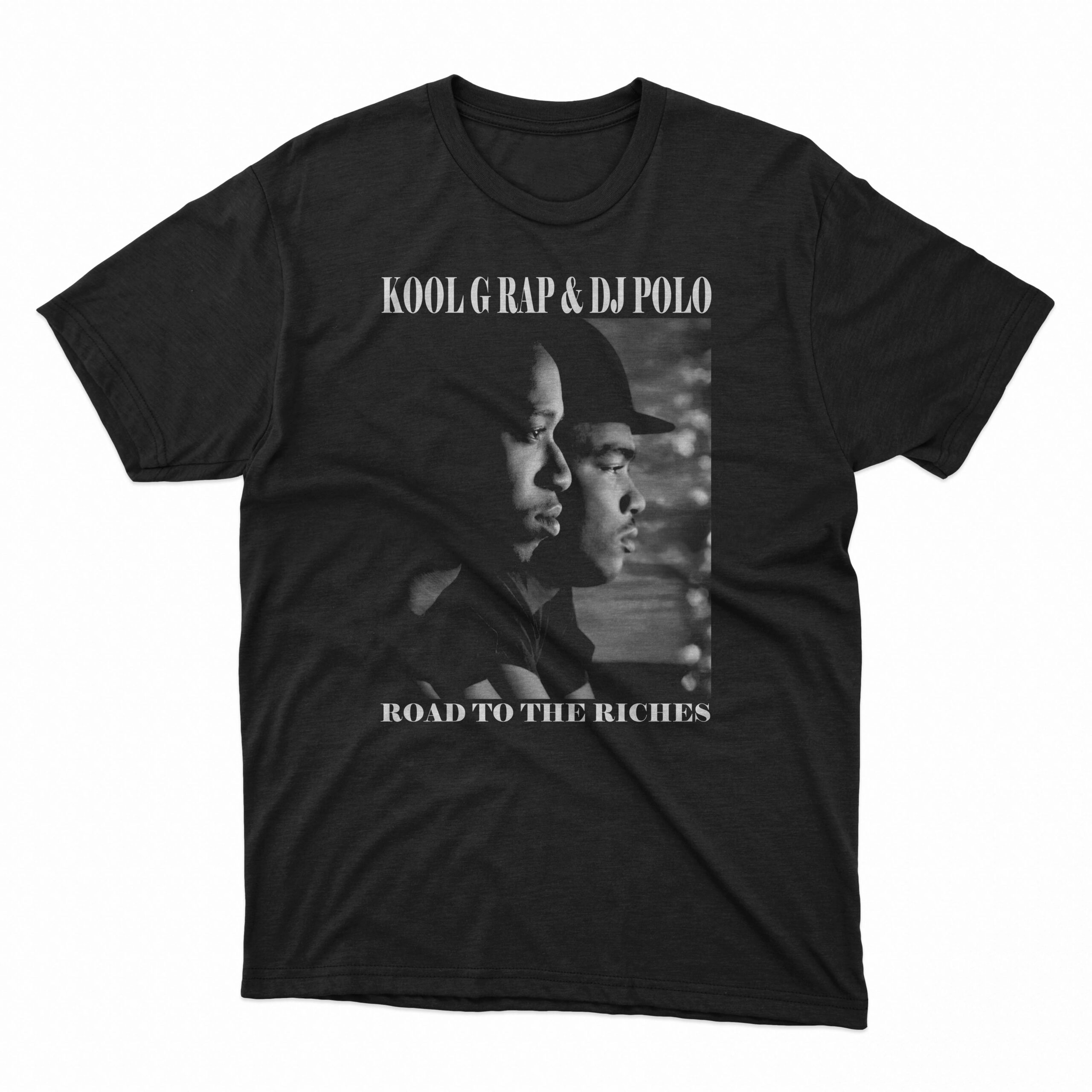
We made the Road To The Riches Tee for the 1989 debut Marley Marl produced front to back, with the rapper and the DJ side by side the way the record billed them. For heads who still know what “Cold Cuts” is.
Wanted: Dead or Alive (1990): The Street Narrator Arrives
Wanted: Dead or Alive landed in August 1990 on Cold Chillin’/Warner. Wikipedia and MusicBrainz both date it August 14. It’s the record where G Rap stops just proving he can rap and starts telling you what the block looks like. Critics liked it more than the debut, and it’s the one that usually leads the duo’s album carousel on Google today.
Eric B. and a pre-Illmatic Large Professor
The big change is behind the boards. Marley Marl is down to one song. The CD credits (Discogs) give Eric B. six tracks: the title track, “Bad to the Bone,” “Play It Again, Polo,” “Kool Is Back,” “Play It Kool” and “Death Wish.” Large Professor and G Rap are credited as co-producers on all six. Large Professor also produced “Money in the Bank,” where he, Freddie Foxxx and Ant Live appear uncredited on the LP.
That’s the jewel: a teenage Large Professor all over a Juice Crew record, years before he produced for Nas on Illmatic. G Rap told Complex that Large Pro came to him through Eric B., and he still sounds amazed: “That dude on the SP1200s was like a one man band.” Polo got his production credits too. He and Anton Pukshansky made “Jive Talk” and “The Polo Club.”
“Streets of New York”
The lead single is the one people mean when they say G Rap invented the New York street narrative. It’s credited to Kool G Rap, Large Professor and Anton Pukshansky, and it reads like a tour of the city’s worst corners with none of a tour guide’s optimism. Rolling Stone called it “a vivid look inside the misery of the hood.” Wikipedia says Nas credited it as an influence on “N.Y. State of Mind,” but we couldn’t find Nas saying that anywhere on the record, so treat it as critics’ framing. What Nas did say on record, in Complex’s 2012 list of his 25 favorite albums, was this: “Kool G Rap is a major influence… Rakim was scientific, Big Daddy Kane was acrobatic, but Kool G Rap was bloody chainsaws fighting each other lyric style.”
“Erase Racism” and the CD-only “Rikers Island”
“Erase Racism” (spelled “Erace Racism” on the CD) is the wildcard: Biz Markie produced it with Cool V, and Biz and Big Daddy Kane both rap on it. G Rap told Complex the song came out of the 1989 killing of Yusef Hawkins in Bensonhurst, and that they shot the video in that neighborhood. It’s a reminder that the “mafioso” label never covered everything this duo did. For more on Biz, read our tribute to the clown prince of hip-hop.
And remember “Rikers Island” from 1987? It’s back as a bonus track, but only on the CD. The vinyl LP runs 12 tracks without it. It’s the second time in two albums that the LP and CD versions of a G Rap & Polo record don’t match, so check which pressing you own.
Live and Let Die (1992): The Cover Warner Wouldn’t Ship

Live and Let Die came out on November 24, 1992. That date is on MusicBrainz and Wikipedia, and both Mass Appeal and Ambrosia for Heads marked the 25th anniversary on November 24, 2017. One Discogs CD listing says November 17. Treat that as an outlier. AllMusic’s Andy Kellman wrote that “a strong case could be made for Live and Let Die as Kool G Rap & DJ Polo’s crowning achievement.” Robert Christgau gave it his “dud” icon. Both are still right, depending on what you want from rap.
A Queens rapper with a West Coast producer
This time the main producer was Sir Jinx, the Los Angeles beatmaker from Ice Cube’s camp, working with G Rap himself. The Discogs LP notes list sessions at Cherokee, Westlake and Paramount studios in LA. The Trackmasters produced three tracks, including “Straight Jacket” and the single “Ill Street Blues,” which was cut back in New York at Powerplay and Chung King. G Rap told Mass Appeal it was made “in the studio in Queens,” with a third verse added later in Manhattan.
The guest list is a coast-to-coast map. Big Daddy Kane shows up on “#1 with a Bullet.” The closing posse cut brings in Ice Cube, Scarface and Bushwick Bill. Think of it as a mirror of AmeriKKKa’s Most Wanted: Cube went east to make his debut with the Bomb Squad, and G Rap went west to make his darkest album with Cube’s guy. (Our Ice Cube era guide and our Scarface profile cover the guests’ side.)
The samples in the liner notes
The liners are full of film-buff choices. The “Intro” uses “The Godfather Waltz,” the Nino Rota theme, in the Enoch Light & The Light Brigade version. “On the Run” “contains excerpts from” a Joe Farrell record (the notes misspell him “Ferrell”), which Discogs links to his 1975 album Canned Funk. And the 12-inch for “Ill Street Blues” says it “embodies portions of” “Get Out of My Life, Woman,” written by Allen Toussaint. Even the original LP sides have names: “Horror Side” and “Terror Side.”
The cover, told straight
The cover is why this album gets talked about, so here are the facts without the hype. George DuBose shot it. By the reissue liner notes’ account, earlier ideas were scrapped: G Rap told Mass Appeal one concept had the duo “caught on the surveillance camera” robbing a bank. The final image shows the duo feeding raw steaks to two rottweilers in front of two men standing in nooses. G Rap said the photographer came up with the idea of two cops about to be hanged, and Wikipedia, citing the liners, identifies them as undercover narcotics agents. Death is implied, not shown.
Timing did the rest. This was 1992, months after Ice-T’s “Cop Killer” fight engulfed Time Warner. In G Rap’s words to Mass Appeal, “Warner Bros. got cold feet due to the whole Ice-T [Cop Killer] controversy… Cold Chillin’ Records just released it on their own.” So it wasn’t banned by any law. The distributor refused it. Wikipedia, citing The Source in January 1993, says G Rap spent almost a year rewriting and re-recording while the album sat. That’s the only source we found for that detail. He has also said he “could have caught a Gold album off just the singles” with full Warner support.
Sources disagree on what happened to the Warner deal. Some say Warner’s refusal ended it on the spot. Wikipedia’s Cold Chillin’ page says the five-year distribution deal signed in 1988 ran its full course. Either way, the Warner era was over by 1993. The album peaked at No. 185 on the Billboard 200. A Japanese CD reissue arrived on P-Vine in 2006, and Traffic Entertainment reissued it in the US in 2008.
We made a Kool G Rap & DJ Polo Live and Let Die T-Shirt that reproduces the original album art. It’s for collectors who know that cover as a piece of label history and a censorship story, not as a joke.
The Split, the Solo Run, and Saying Goodbye to DJ Polo
“Three albums and seven years”
By 1993 the duo was done. G Rap explained it best himself, in Ben Merlis’ 2019 book Goin’ Off: The Story of the Juice Crew & Cold Chillin’ Records: “Me and Polo parted ways because I felt it was my time to separate. Polo had brought me in the game, so I gave Polo three albums and seven years of my life. For it to not be a group where we’re contributing to the group evenly – 50%/50%, then I felt like it was time for us to eat off our own plates.”
He told Rolling Stone the same thing in 2024, almost word for word: “Three albums and seven years. I felt I paid him back at that point.” That isn’t bitterness. It’s a debt paid off, and he’s been consistent about it for decades.
G Rap goes solo
The solo debut, 4,5,6, arrived on September 26, 1995, on Cold Chillin’/Epic Street. Dr. Butcher, Buckwild, Naughty Shorts and T-Ray handled production, and Buckwild produced “Fast Life” with Nas. The album hit No. 24 on the Billboard 200 and remains his most commercially successful record. Watch for one common error online: some shops list 4,5,6 as a G Rap & Polo album. It isn’t. It’s solo.
Roots of Evil followed on October 20, 1998, through Illstreet/Downlow, with a cover built from Godfather and Scarface poster elements. The Giancana Story was planned for Rawkus around 2000, got stuck in delays, and finally came out on Koch in November 2002. Our Rawkus Records history covers that era of the label. Cold Chillin’ also kept the duo’s catalog moving with the compilations Killer Kuts (March 1994) and Rated XXX (1996).
DJ Polo, 1986 to 2024
Polo released Polo’s Playhouse in 1998. According to RapReviews, it reached stores only in Germany. Thomas Pough died on July 27, 2024. MusicBrainz, RapReviews and Billboard’s July 29 report all confirm the date (a couple of outlets printed “June 27,” which is wrong). No cause of death was announced. G Rap posted: “R.I.P. to a dear friend and a Brother from another Household. He is a Legend to Hip Hop and Juice Crew history.”
The fair way to remember Polo is the way G Rap does. He was the DJ who brought the rapper in, cut the first demo with him, and shared billing with him on three albums. Without the DJ, there’s no Kool G Rap story to tell.
The Kool G Rap and DJ Polo Blueprint: Who Actually Says So

“G Rap influenced everybody” gets thrown around so loosely that it stops meaning anything. So here’s what’s actually on record, and what isn’t.
What’s on the record
- Nas called G Rap “a major influence” in Complex’s 2012 list of his favorite albums (“bloody chainsaws fighting each other lyric style”). He also rapped next to him on “Fast Life” in 1995. Start with our Illmatic retrospective and the track-by-track credits. Our Nas Illmatic T-Shirt is for the album that took the Queens street narrative global.
- Jay-Z made the comparison himself on “Encore” (2003): “hearin’ me rap is like hearin’ G Rap in his prime.” The Jay-Z Reasonable Doubt T-Shirt belongs to the debut where Jay ran the mafioso playbook.
- The Pacino timeline. G Rap’s “the town’s Al Pacino” line is on a 1989 record. Raekwon’s Only Built 4 Cuban Linx came in 1995 and Reasonable Doubt in 1996. That’s not opinion, it’s release dates. If the Wu side of that lineage is your lane, grab the Raekwon Only Built 4 Cuban Linx T-Shirt and read our 36 Chambers breakdown.
- Rolling Stone put “The Symphony” on its all-time list and named G Rap’s couplet the sharpest on it.
What we left out, and why
Plenty of pages repeat that Biggie, RZA and Raekwon each named G Rap as a top influence in specific magazine issues. Those claims trace back to a single encyclopedia list, and we couldn’t find the original interviews, so we’re not printing them as quotes. The same goes for the oft-repeated idea that “Streets of New York” directly inspired “N.Y. State of Mind.” It’s a reasonable critic’s read, but we couldn’t find Nas saying it. The influence is real. The receipts above are the ones that hold up.
The technique that got copied
The style is the easiest part to verify, because you can hear it. G Rap stacked multisyllabic rhymes long before that was the norm, rapped with a breath control that sounded like he never needed air, and told crime stories with specific, filmic detail rather than slogans. He also wrote the foreword to Paul Edwards’ 2009 book How to Rap, which is about as close as an MC gets to being formally credited with writing the manual.
Where to Start: A Kool G Rap and DJ Polo Listening Order

New to the duo? Here’s the run in the order that makes the story make sense, with one thing to listen for on each.
- “It’s a Demo” (1986): the tape cut at Marley’s house that became a single. Listen for how fully formed the multisyllabic style already is.
- “Rikers Island” (1987): the warning song. It’s grim, specific and not glamorous at all.
- “The Symphony” (1988): G Rap’s verse is the Con Edison couplet. Remember that the tape ran out on him.
- “Road to the Riches” (1989): listen for the Billy Joel “Stiletto” snippets and the Pacino line.
- “Poison” (1988 single, on the 1989 album): imagine it on the King Curtis loop it almost had.
- “Men at Work” (1989): the verse that got cut from “The Symphony,” and the song Black Thought later paid tribute to.
- “Streets of New York” (1990): Large Professor’s fingerprints, and the blueprint for every bleak Queens tour that followed.
- “Erase Racism” (1990): Biz on the boards, Kane on a verse, and a reminder that this duo had range.
- “Ill Street Blues” (1992): the Trackmasters flip of a Toussaint composition, recorded back home in New York.
- Killer Kuts (1994): the compilation shortcut if you want the hits in one place.
Want to wear the wider Juice Crew? We’ve got the Big Daddy Kane Long Live The Kane T-Shirt, the Masta Ace A Long Hot Summer T-Shirt and the Biz Markie Goin’ Off T-Shirt, covering the other three names behind “The Symphony” and “Erase Racism.” For the Corona connection, see our history of Eric B. & Rakim.
Kool G Rap and DJ Polo FAQ
Is DJ Polo still alive?
No. DJ Polo, born Thomas Pough, died on July 27, 2024. No cause of death was announced. Some outlets misreported the date as June 27.
Why did Kool G Rap and DJ Polo split?
G Rap went solo in 1993. In his words, Polo “had brought me in the game, so I gave Polo three albums and seven years of my life,” and since the group wasn’t a 50/50 contribution, “it was time for us to eat off our own plates.”
Why was Live and Let Die banned?
It wasn’t banned by law. Warner Bros., the distributor, refused to release it in late 1992 because of the cover and the Time Warner fallout over Ice-T’s “Cop Killer.” Cold Chillin’ put it out independently.
Who produced Road to the Riches?
Marley Marl produced every track on the 1989 debut.
How many albums did Kool G Rap and DJ Polo make?
Three studio albums: Road to the Riches (1989), Wanted: Dead or Alive (1990) and Live and Let Die (1992). Compilations like Killer Kuts and Rated XXX came later. 4,5,6 (1995) is a G Rap solo album.
What does the G in Kool G Rap stand for?
He’s given two answers. On The Giancana Story he ties it to “Giancana,” after mobster Sam Giancana. Elsewhere he’s said it stands for “Genius.”
What did Billy Joel have to do with Road to the Riches?
Marley Marl sampled two short snippets of Billy Joel’s “Stiletto” (1978) for the title track. Joel isn’t credited on the original 1989 releases, and per sampling researcher Amir Said, it never led to a lawsuit.
Was Kool G Rap the first mafioso rapper?
He’s the one most often credited. His mob-film references were on record in 1989, years before Only Built 4 Cuban Linx and Reasonable Doubt. Most of Road to the Riches is still battle rap, though. The full crime-narrative style arrives on Wanted: Dead or Alive and Live and Let Die.
Final Thoughts: A Debt Paid in Three Albums
The Kool G Rap and DJ Polo story is short: one demo, one posse cut, three albums, and a cover a corporation wouldn’t touch. It also explains a whole lineage. The Queens street narrator, the mob-movie cadence and the multisyllabic density came off those three records and into the rappers who followed.
Credit the DJ too. Polo opened the door at Marley’s, and G Rap has said so every time he’s been asked. Start with “It’s a Demo,” end with “Ill Street Blues,” and listen to how fast two kids from Corona grew up on tape.
For the next chapter of the Queens and Brooklyn story, read our deep dive on Black Moon’s Enta Da Stage.
Stay creative — The Custom Creative Team
Get the Culture in Your Inbox
Liner-note receipts, producer stories, anniversaries and first dibs on new drops. No spam, just hip-hop.

🎧 Never Miss a Drop
Exclusive product releases, hip-hop deep dives, and member-only discounts. Straight to your inbox.
Free forever. No spam. Unsubscribe anytime.
Get the Culture, Delivered
Deep dives into hip-hop history, exclusive product drops, and discounts sent straight to your inbox. No spam, just culture.
Join 2,000+ hip-hop heads already in the loop. Unsubscribe anytime.